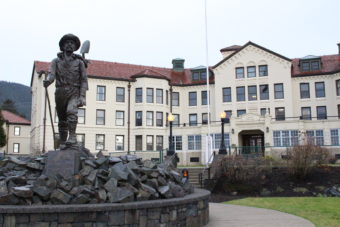
“The Prospector” statue stands in front of the Sitka Pioneers Home entrance, which was under repair Sept. 20, 2016. The homes reduced admissions as budgets were cut. (Photo by Ed Schoenfeld/CoastAlaska News)
When the Alaska Legislature convenes later this month, it will consider a budget that makes no further cuts to Alaska’s Pioneer Homes. Final decisions are months away.
But Gov. Bill Walker’s spending plan would help level the senior-care program’s funding after several years of reductions.
Juneau Sen. Dennis Egan’s heard a lot from his constituents about cutbacks at Alaska Pioneer Homes. And he understands their importance, from personal experience.
“My mother was a tenant for over five years. And I know the good that Pioneer Homes do,” he said.
His mom, former Alaska First Lady Neva Egan, was a lot like many in the six homes, in Southeast and the Railbelt.
“She had dementia and she was always very confused. And the folks here at the Juneau Pioneer Home facility were just incredible folks,” he said.
Juneau Sen. Dennis Egan addresses a conference in 2014 in Juneau. (Photo by Ed Schoenfeld/CoastAlaska News)
Egan, a Democrat representing about half of Southeast, is happy to see the governor plans no more cuts.
Walker’s operating plan calls for spending about $51 million in state money during the fiscal year beginning in July. That’s a slight increase over the current budget year, which itself was a small boost from the previous one.
Pioneer Homes Division Director Vickie Wilson said they lost capacity because of budget reductions.
“No program wanted to be cut, but we all felt that we were doing our share. But it did result in having a lower number of beds available that we could provide care in,” she said.
One way to look at it is the total number of residents. That dropped close to 10 percent over most of the past three years, ending in the fall.
Another way is how quickly beds are filled when residents die or move.
In the 2015 fiscal year, about 97 percent had new occupants. But the following year, it was only about 83 percent.
Wilson said that’s because Pioneer Homes spend about 80 percent of their budget on staff who tend to residents’ medical needs and provide them with meals and other essentials.
“Many positions, we had no funding for. So we’ve lost many of our staff through the cuts that we had,” she said.
Staff losses, many through attrition, have slowed admissions at the homes, in Ketchikan, Sitka, Juneau, Anchorage, Palmer and Fairbanks.
The active waiting list, for those ready to enter any of the facilities, is more than 650. An inactive, placeholder list is eight times as long. Wilson estimates about three-quarters of those on the active list need the highest level of care, which requires more staff.
She said open positions are being filled, just not as fast as they used to.
“They are being held longer. But that could be a month to six weeks,” she said. “Not turning around and hiring tomorrow. And it allows us to be able to manage.”
There’s no guarantee the governor’s Pioneer Homes budget will remain untouched as it works its way through the Legislature.
Sen. Egan said he’ll be among those pushing for the funding.
“I hope the heck it does. I hope it makes it,” he said.
And has Egan signed up and added his name to the waiting list?
“Oh, absolutely. I signed up on my 65th birthday,” he said, admitting his wife, Linda, took care of the paperwork. He added he hopes he doesn’t need go to into a home.
The Sitka Pioneer Home was the first such facility. It and others in Ketchikan, Juneau, Anchorage, Palmer and Fairbanks have lost staff due to budget cuts. (Photo by Emily Kwong/KCAW)
Alaska’s Pioneer Homes have stopped accepting new residents, at least for a while. It’s one more impact of state budget cuts.
The state’s six homes usually serve about 440-450 Alaskans at any given time.
State Pioneer Homes Division Director Vickie Wilson said reduced funding is dropping that number by about 30, or 7 percent.
“They are beds that we are not filling because we don’t have adequate staff to be able to ensure good, safe care,” she said.
Wilson’s agency has lost 30 positions, mostly because of attrition. And since senior care is labor-intensive, fewer people can be housed.
Jacque Farnsworth and Jack Brandt play for Juneau Pioneer Home residents earlier this year. (Photo by Lisa Phu/KTOO)
That means the homes, three in Southeast and three in the Railbelt, can no longer accept new residents in the highest category of care. It’s called Level 3, and it’s pretty much like a nursing home, with 24-hour, hands-on assistance.
“Right at the moment, it’s all six of them. No one’s taking any of the level 3s right at this point,” she said.
More than half of all residents, and a large number of applicants, are in that category. Two lower levels, different types of assisted-living care, require less staffing.
Wilson said seniors seeking such care might have a chance to get a bed. But, probably not right away.
“We would look carefully at their level of care and see if we could manage them with the staff that we have,” she said.
“This is devastating,” said Ann Secrest, communications director for the Alaska branch of AARP, a nationwide senior advocacy group.
She said Alaskans are living longer and staying at home as late as they can. But there comes a time when more care is required. So pioneer home cuts remove a much-needed option.
“The majority of individuals are cared for at home. There are approximately 120,000 and 128,000 Alaskans who serve as unpaid family caregivers. So there’s going to be more of a burden put on those unpaid family caregivers throughout the state,” she said.
Alaska, overall, falls far short of providing the care its seniors desire.
The Ketchikan Pioneer Home is one of six in Alaska caring for older residents. (Photo by KRBD)
“We have the fastest growing senior population in the nation, by percentage. There’s nothing much we can do about that,” she said.
She said it’s no surprise pioneer homes are facing cutbacks. But she objects to those who say reductions don’t have to affect services.
“Some people call it the low-hanging fruit. I don’t. We’ve already cut all of that off. We’re now into the mid-level branches,” she said.
Residents, or their families, do pay for part of their care. Charges run from about $2,500 to $7,000 per month.
The state considered turning the homes over to the private sector to save money. But it’s dropped that idea, though services such as pharmacies could still be privatized.
Of course, beds open up as residents die. Pioneer Homes Director Wilson said 20 to 25 percent of beds become available each year.
That could allow more new residents in. But Wilson said that’s only if funding remains the same.
“Being a realist, as we take cuts, we will continue to have to consider that more beds will have to be cut,” she said.
Even in better times, it’s hard to get into a pioneer home. As of mid-summer, close to 600 people were on the active waiting list.
The inactive list, those waiting until they’re in greater need, is much larger.
Note: Finding residential care is just one of the challenges facing older Alaskans and their families. CoastAlaska’s Aging Southeast series, produced earlier this year, describes other concerns.
The Sitka Pioneer Home was the first such facility. Five others operate in Ketchikan, Juneau, Anchorage, Wasilla and Fairbanks. (Photo by Emily Kwong/KCAW)
The pioneer homes are a purely Alaskan invention. The assisted-living and nursing-care facilities are state-funded and provide long-term boarding for residents over 65.
And judging by the growing waitlist, the service provided by Alaska’s six pioneer homes – three of which are in Southeast – is needed more than ever. As part of CoastAlaska’s series, Aging Southeast, we visit the oldest home in the system.
Betty Decicco is in love with a mountain meadow that she’s never been to. The 86-year-old first came to the Sitka Pioneer Home as a volunteer in 2001, calling bingo.
“When I would look out the window as I was calling, I would see Verstovia and there’s this meadow,” Decicco said. “I call it my meadow.”
The meadow is a flat place that turns green in the summertime. Going there isn’t possible for Decicco, but that doesn’t mean she hasn’t tried.
“Jokingly I said to one of the [members of the Coast Guard], ‘Don, can you do a reverse rescue? Can you put me up there?’ He said, ‘No.’ And of course walking up there is out of the question,” she said. “So I stare at the window now.”
Betty Decicco, left, and Fredi Young became fast friends while volunteering in the gift shop and living at the Sitka Pioneer Home year-round. (Photo by Emily Kwong/KCAW)
If Decicco sounds uncommonly grateful, it’s because she almost lost that view entirely.
In 2014, she moved into an assisted-living facility in Seattle to be near her son and granddaughter. It was privately operated and in her words, “luxurious,” but the schedule of activities bored her. She told the coordinators.
“They looked at me like, ‘What are you talking about? Look at this and this and this on the schedule.’ I said, ‘I don’t want to be entertained, I want to do something,’ and she couldn’t comprehend it,” Decicco explained.
Decicco moved back to Sitka and has been living at the pioneer home for the past three months. She works in the gift shop, goes to Bible Study, and takes ceramics classes. She’s got her meadow back and she wants her ashes scattered there one day. Reflecting on her happiness at the home, Decicco said, “I think as older people we need a purpose in life.”
Vickie Wilson, director of the state Division of Alaska Pioneer Homes, said that giving residents ample reason to get up in the morning is what the pioneer homes are all about. “There are three plagues within assisted living and it’s the loneliness, helplessness and boredom,” she said.
To counter this, all six homes follow the Eden Alternative®, which is a care model that tries to build community among residents. Wilson said that this type of care flips the script of what getting older means.
“You don’t line people up in the hall anymore to take them all to dinner. It is a home. It’s not home-like. The pioneer homes are homes.”
In addition to a packed schedule filled with volunteer opportunities and classes, residents are allowed to keep their pets and plants. The Fairbanks home is filled with art. In the Palmer Veterans & Pioneer Home, there’s a wheelchair-accessible garden. In the Sitka home, residents don’t just listen to someone play the piano. They sing along.
But there’s a serious challenge. The governor’s budget proposes a 2 percent cut to the Pioneer Homes. Last year’s cut saw the loss of 19 personnel. Fewer staff means a home can’t operate as many beds, and fewer beds means longer wait times for the hundreds of Alaskans hoping for immediate placement.
Phil Welsh is the administrator of the Sitka Pioneer Home, which has a small waitlist compared to Anchorage and Fairbanks. (Photo by Emily Kwong/KCAW photo)
Phil Welsh is the administrator of the Sitka Pioneer Home. “Sitka has the shortest waitlist. We’ve have 40-50 folks on ours. Some stretch into the hundreds,” he said. And as Alaska’s senior citizen population grows, particularly in Southeast, the lists are only getting longer.
It works like this: anyone who is 65 or older and has lived in Alaska for one year can apply to be on the inactive waitlist, which has over 4,000 names. And once you’re ready to be move into a home, you are transferred to active lists (for whichever homes you prefer) and wait for that phone call saying, ‘We have a spot for you.’
Fifteen years ago, getting a call from one of the Southeast homes – in Juneau, Ketchikan or Sitka – took four and a half months at most. Last year, the longest wait time was four and a half years. And average wait time is about a year and two months.
Welsh said it’s not only the wait period that’s changing.
“I think our average age in the homes is around 84, 85. The population that comes in is older than it was in the past.”
The population is also frailer. Sixty percent of residents have been diagnosed with Alzheimer’s disease or another form of dementia. And compared to the pioneer homes in Anchorage or Fairbanks, the Southeast homes have a smaller proportion of residents able to manage their own medications, feeding and bathing.
Basically, the pioneer homes have had to adapt, catering to a more fragile clientele as Alaskans enter the homes later in life. And the breaking point usually comes when the caregiver – sons, daughters, spouses- just can’t do any more on their own.
Fredi Young has lived in Alaska for 31 years. Of her life story, she said, “There’s too much to tell, but I was born in Texas, in West Texas, on a ranch.” Fredi’s husband, George Young, was a pastor. Fredi was a teacher.
Residents at the Sitka Pioneer Home are growing flowers. “The most important thing we can do as an organization is to maintain the dignity of those we serve. If we do that, I think we’ve done the job we need to do,” said administrator Phil Welsh. (Photo by Emily Kwong/KCAW)
In 2004, George’s Parkinson’s disease reached a severe stage. Doctors in Hoonah urged him to consider entering a pioneer home. “He was tall and had big bones and he was heavy, you know?” Fredi recalled. At the time, she couldn’t lift him up any more. “I think when he realized that,” Fredi said, “he was willing to come.”
Fredi and George took an open spot in Sitka and moved into a shared apartment. For Fredi, the weight of managing his medical needs was lifted off her shoulders. “Everyone else did the work and that lifted such a load. I could just sit and talk with him and visit him and be his companion rather than his caretaker,” she said.
George died in 2013, but she didn’t consider leaving.
“We had not ever had a home. We were gypsies, moving from place to place. I stayed because I’d loved it here. It was my home, you know?”
Looking around, she adds, “And it’s the nicest home I’ve ever had.”
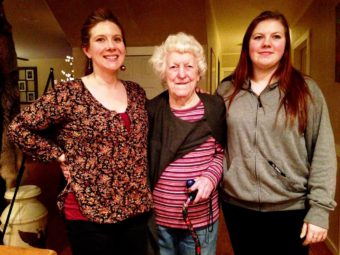
Elizabeth Tyner, 92, lives with her granddaughter Melinda Cook, left, and great-granddaughter Shawnee Cook, right. Tyner is among Southeast seniors aging at home. (Photo by Angela Denning/KFSK)
Some Southeast Alaska families have stayed with the tradition of helping loved ones age in place. Elders live at home, with children and grandchildren, instead of moving into assisted living or a nursing home. It’s a friendlier and lower-cost option for older residents of the region, whose numbers are growing faster than the state as a whole.
As part of CoastAlaska’s Aging Southeast series, we talk to one Petersburg family with four generations living under the same roof.
Elizabeth Tyner sits at the kitchen table in a red striped shirt, blue jeans and blue Crocs sandals.
“I’m 91 years old. I’ll be 92 in a week or so.”
Her short white hair curled, her hands clasp a tissue because she has a cold. She readily talks about her life. Over the decades, she’s sold auto parts and worked at a thermometer factory.
“What it was doing was putting the ink in there,” Tyner said. “It really wasn’t ink it was …”
“Mercury,” her granddaughter prompted.
“Yeah, Mercury,” Tyner said. “You shook the stuff down where it went up and down in there so you could tell the temperature. It was real interesting, it really was.”
Her granddaughter, Melinda Cook, is ready to fill in the details. Cook knows her grandmother well. She has lived with Tyner for nearly two years and spent a lot of time with her growing up.
“She migrated here because we migrated here,” Cook said. “Because none of us stayed where we were from. She’s originally from New York and ended up in Florida and we’re all from Florida and ended up in Alaska. ”
“And as she got older it just seemed like the natural progression for her come be with us.”
Cook uses the word “natural” a lot. She sees aging as a natural process and family helping as part of that. For Tyner, she likes the busy house of four generations.
“I got all these kids around me here (laughs) it’s wonderful … it’s wonderful!” she said. “They play on the floor and I get down on the floor and play with them and do whatever is necessary. We have a good time.”
When Tyner first moved to Petersburg in 2011, she lived in independent housing for seniors. She shared a two-bedroom apartment with a friend for $1,400 a month. Cook said that worked well for several years until the day her grandmother fell.
“She didn’t pull the alarm. She laid on the floor for four hours,” Cook said.
The Petersburg Medical Center includes long-term care for older residents, among others. (Photo by KFSK)
Tyner eventually called the family, which contacted 911. There were other signs that decision-making was becoming difficult.
But switching to assisted living, including daily food service and as-needed care, would have cost about $6,000 a month. Petersburg’s facility takes Medicaid waivers but residents can have no more than $2,000 in the bank and no assets.
That’s not Tyner’s case. She’s worked hard to build up a nest egg. But even that savings would only last a few years. So, she moved in with her family and now pays $500 a month for three caregivers, five days a week.
“Just making sure she’s drinking water, getting meals, because we started finding that that was necessary,” Cook said.
For Cook, having Tyner at home is the right thing to do. Her family has taken care of their elderly for generations.
“I mean, we all kind of have our assignments in this generation,” she said. “My cousins have their parents. I mean literally, every one of us in my generation has an elder living with them at this time.”
Like most of Southeast, Petersburg’s population is aging faster than Alaska as a whole. A recent borough study shows that in about 15 years, senior numbers will double to 28 percent.
In the village of Kake, on the next island over, there are 80 to 90 elders out of a population of about 600. Most are Alaska Natives.
The village has no assisted living or nursing homes. Families take care of their elders at home until they need medical help and have to go off-island. Many families rely on in-home caregivers.
“I think living at home is what they want the most. They don’t want to leave their homes and go to assisted-living places,” said Juanita James, site manager and cook at Kake’s senior center, which provides lunch and rides around town.
“They’d rather have their loved ones close by that don’t have much more time to live and stuff and their relatives are used to making their cultural food for them and taking them to like when they’re having Indian dance at the community doings and stuff.”
“They thrive better at home,” said Keith Smith, who works for Southeast Alaska Independent Living’s Ketchikan office.
“I think that people live longer, their minds stay healthier when they are able to stay in the midst of their life like that,” Smith said.
SAIL is a non-profit resource center that helps seniors and others with disabilities live at home and maintain independence. It has offices in Southeast’s larger communities and also serves more remote towns. SAIL helps clients problem-solve.
Smith said oftentimes, that means giving advice on structural or architectural changes to a house, getting the right home health-care provider or even just knowing about the right tools.
“One of the gentlemen I’m working with is just like overwhelmingly happy when he discovered the device … since he can’t bend over anymore. So there’s a special device that from 3 feet away you can clip your own toenails. That is huge for him,” Smith said.
For Cook’s family, it meant moving to a house with an open floor plan and remodeling a bathroom. Although Tyner is mobile right now, there is plenty of room for a walker or wheelchair if it’s ever needed.
The door opens and Cook’s 18-year-old daughter Shawnee arrives home from an evening workshop at school on financial aid for college. The teen’s 1-year-old is already asleep. Shawnee said it’s great her son can live with his great-great grandmother.
“He knows that she’s the person to go to when he wants something to eat,” she said.
“Yeah, yeah. He will,” Tyner agreed. “I’m trying to teach him a little bit about dancing. I’ve got him shaking his shoulders, you know, and moving his butt, you know, and going up and down.”
It’s not always easy. Tyner’s dementia crops up every now and again, like the time she accused one of her great-grandsons of taking a box of hers. But, at least for now, the family agrees it’s better for everyone to be sharing life under the same roof.
Also sharing space is Cook’s partner and her two sons—ages 14 and 20. That’s four generations in the same home.
“We’ve had a good time with it,” Tyner said. “I wouldn’t trade it. Would you Melinda?”
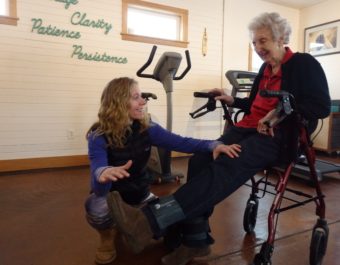
Haines physical therapist Marnie Hartman works with 92-year-old patient Marge Ward. Hartman said most of her business comes from people 65 and older. (Photo by Emily Files/KHNS)
As senior populations grow throughout Southeast Alaska, what kind of impact do they have on the economy? According to experts, it’s a good one. A state report on Alaska’s aging population said seniors contributed an estimated $2.4 billion to the economy in 2014. That comes mostly from retirement income, health-care spending and wages.
As part of CoastAlaska’s Aging Southeast series, KHNS’s Emily Files takes a look at the senior economy from Haines.
Ron Jackson is 75 years old. He moved to Haines 15 years ago, after retirement.
“This was the closest thing to home that I’d ever felt. So that was pretty cool. It was like, I belong here. And I’ve been here longer than I have any place in my life.”
Ron Jackson at a Haines coffee shop. He said, “Senior income is stable … it survives the ups and downs of an economy.” (Photo by Emily Files, KHNS)
As Jackson puts it, in Haines, there’s “gray hair everywhere.” Eighteen percent of residents are 65 or older. And seniors are on track to make up more than a third of the population by 2024.
Haines also has the oldest median age in the state – 48.5. That’s about 14 years above the state average and nine years above the region.
How does the abundance of seniors in this 2,000-person town impact its economy?
“One thing is that retirement income works as an injection into the economy, where it’s basically outside dollars that retirees are able to use on goods and services purchased locally. So it’s money that wouldn’t otherwise be circulating the economy,” said state economist Conor Bell.”
“It does seem that we have a thriving senior community. A lot of our business is from the seniors,” said Christy Tengs, who owns the Bamboo Room Restaurant. The majority of customers she saw on a recent Monday morning were seniors.
Jackson said older customers are especially important in communities such as Haines, where the economy booms in the summer and busts in the winter.
“Throughout that entire year, a senior income is stable, generally it’s some annuity that’s been earned or Social Security and it survives the ups and downs of an economy,” Jackson said.
Economist Bell said another benefit that comes from a large senior population is increased demand for healthcare.
Marnie Hartman, a doctor of physical therapy in Haines, said that’s been her experience.
“I would say probably 50 to 60 percent of my patient base, depending on the flow at that time, qualifies for Medicare, which is 65 and older,” she said.
After nine years at the local clinic, she opened her own practice. She wasn’t sure if she would have enough patients. But she’s been almost too busy to handle the load.
Those 65 and older have a positive economic impact by bringing in stable, outside incomes and more healthcare spending. But what about the tax breaks they receive?
Take for example, the state-mandated senior property tax exemption. It tells municipalities not to charge property tax on the first $150,000 value of a home.
“So if you had a $200,000 house, you were only paying on $50,000,” said Kathie Wasserman, executive director of the Alaska Municipal League.
AML is fighting the tax-exemption mandate. She said the state should reimburse local governments for the money lost on the exemption.
“We have always said that municipalities need the freedom to look at this policy within their own community and say, ‘OK, this is our financial position at this time and we can afford this much, but we can’t afford to exempt everybody.’”
State data shows that in Fiscal Year 2015, the exemption cost Southeast communities more than $5 million.
In addition to that lost revenue, some municipalities have senior sales tax exemptions. Sitka, Petersburg and Juneau leaders are among those who have considered doing away with the breaks. With a rapidly aging population, some say they’re unsustainable. But all of those efforts were met with community backlash.
“I think I paid my dues, I really, truly do. I’m 80 years old and I’m still working. And, I don’t know, it’s just disgusting that you keep picking on the old people,” Sitkan Shirley Robards told her community’s borough assembly in 2015.
The only one of those three Southeast towns that successfully scaled back senior tax breaks is Juneau.
Economist Bell said things like tax exemptions lead some people to view an aging population as inherently bad for an economy. But he disagrees.
“It’s underrated the amount of impact retirees and an aging population can bring to a community,” Bell said.
Jackson, the 75-year-old retiree, said Haines seniors are involved.
“The definition of a senior isn’t an old person who sits around a lot and drains the system. They’re out there hiking the trails and working on projects,” he said.
He said aside from spending at local businesses, seniors volunteer and serve in government. And he’s not alone in that view. Many in Haines say the same thing – seniors here are active, they contribute to the community.
Ketchikan’s Fred John sings and plays a gospel song in his kitchen. He’s volunteered at Ketchikan’s prison and other locations. (Photo by Leila Kheiry/KRBD)
Go to any nonprofit meeting in Southeast Alaska, and you’ll probably find at least one senior citizen board member. Others help out at fundraisers, baking cookies, sewing quilts, selling raffle tickets or cleaning up after an event.
As part of CoastAlaska’s Aging Southeast series, KRBD’s Leila Kheiry talked to a few of the region’s active senior volunteers about what they do for their communities, and why.
Fred John gives through music.
The Tlingit and Tsimshian elder has been playing music most of his 87 years, and much of that time has been spent performing gospel and worship songs. He traveled extensively in his youth with a church group, and still is happy to plug in a guitar and belt out a tune whenever he’s asked.
John has been honored with various awards that hang on the wall of his home, on the outskirts of the Village of Saxman, just a few minutes’ drive from Ketchikan.
“This I got from the Salvation Army, called Soldier of the Year,” he said, pointing out a framed certificate.
Another plaque was handed to John by Sen. Lisa Murkowski in 2010. It’s a Ketchikan Chamber of Commerce award recognizing his volunteer work at the local jail. He still volunteers there. Every week, he heads to the Ketchikan Correctional Center to play for inmates.
Musician Fred John looks through a photo album from his time traveling and singing with a church group. (Photo by Leila Kheiry/KRBD)
And John’s efforts have made a difference. He shows me a photograph from the newspaper showing him performing for a group of yellow-jumpsuit-clad men, and points to three of them.
“They’re playing guitar with me in the church now,” he said. “They gave their hearts to the lord. This guy, and this guy here, and this guy here. And I’m standing right there. And they’re doing good.”
How to provide services for older Alaskans is an ongoing discussion statewide and within individual communities. But, like John, many of Alaska’s elders give back to their home towns through volunteer work.
Ketchikan’s Ed Zastrow is another active senior. The 80-year-old frontman for the local AARP chapter advocates for retired residents. He helped coordinate and publish a directory of local senior services, and he was the lead organizer for Pioneer Heights, a senior housing project.
Zastrow is quick to point to other older residents who contribute.
“On a local level it’s almost incredible,” he said.
Through his volunteer work as the AARP coordinator, Zastrow has to fill out a form every year estimating the hours donated by older volunteers in Ketchikan.
“And last year, we put in a little over 2,700 hours of volunteer work,” he said.
More than 1,400 seniors are registered for the Ketchikan Gateway Borough senior tax exemption, which gives a pretty good idea of how many live here. And if Ketchikan’s statistics follow the rest of the state, a third donate their time.
Conor Bell, an economist with the state Department of Labor, said about 30 percent of Alaskans 65 to 74 volunteer.
“That’s lower than the average rate, but those who do volunteer do so at much greater volume,” he said.
Bell said national statistics show that while there are fewer donating their time, seniors volunteer put in about double the hours of other age groups.
Petersburg volunteers Al and Sally Dwyer in traditional Norwegian clothing. (KFSK photo courtesy of the Dwyers)
In Petersburg, Al and Sally Dwyer put in above-average hours, playing music and promoting the town’s Norwegian heritage.
Al, the former mayor, has been a volunteer DJ at KFSK public radio for about a dozen years. The 74-year-old also plays piano and sings at the long-term care and assisted living facilities. He was recruited for that gig, and said it initially didn’t go well.
“The first time I went to assisted living, they told everybody in the place about it, and there was probably 20 people there, all in wheelchairs,” he said.
“The piano was facing the wall, so I can’t see them. After about 10 minutes, I turned around and there was only six or seven left.”
Al Dwyer said the residents eventually got to know his act and now are more likely to stick around.
He said his wife, Sally, 63, is the real volunteer of the family. She’s been volunteering for the past year at almost the equivalent of a full-time job – working with another volunteer to restore the 104-year-old Sons of Norway building.
“We were renovating it, and it turned out to be restoration rather than renovating, and it’s required 20-30 hours a week at the hall, painting or sanding or lifting boards or stacking lumber. That sort of stuff,” she said.
A lot of Sally Dwyer’s volunteer work is focused on maintaining and celebrating Petersburg’s strong Norwegian roots. But, she said she contributes to pretty much any event or group. She bakes, she sews, she quilts.
“I did four last year – quilts for fundraisers,” she said. “I’m working on one right now for the jazz band, because they want to travel to California in the spring.”
So, why? Why do these seniors donate so much time and energy?
Ed Zastrow said it’s a desire to give back to society.
“There’s hundreds and hundreds of hours put in by seniors, and I think the seniors that do that do it graciously because they want to and, like myself, I feel like I owe the community something,” he said.
Sally Dwyer said she hopes to make a difference.
“Like, with making a quilt for the jazz kids. Maybe one of the kids will get inspired and end up being a composer or a musician that does it for his living. Or one of the kids decides to go to music school and come back and teach our kids,” she said. “You just never know how your little, tiny influence will help along the way.”
Al Dwyer said it just feels good to help.
“You do something for somebody and they feel good about it, and they tell you that and you feel good,” he said. “It’s a good feeling to give.”
Close
Update notification options
Subscribe to notifications
Subscribe
Get notifications about news related to the topics you care about. You can unsubscribe anytime.