Ed Schoenfeld, CoastAlaska

Fast ferry’s future sailings uncertain

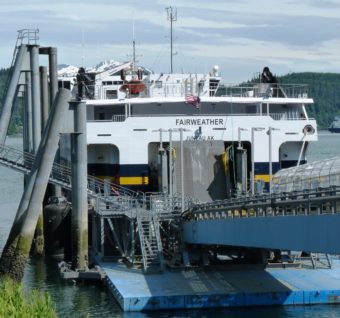
The fast ferry Fairweather docks at Juneau's Auke Bay Ferry Terminal in 2013. (Photo by Ed Schoenfeld/CoastAlaska News)
The fast ferry Fairweather docks at Juneau’s Auke Bay Ferry Terminal in 2013. It’s been sailing since 2004, but could be retired later this year. (Photo by Ed Schoenfeld/CoastAlaska News)

The Alaska Marine Highway System appears to be phasing out its fast ferries. One is in long-term storage and the other will join it this fall.

Sitka resident Mim McConnell’s family car has an ignition problem. The dealer is in Juneau and only way to get it there — the ferry system – doesn’t sail very often anymore.

“I cannot affordably get that car over to Juneau to get it repaired and then get it back here,” she said. “There’s no quick turnaround, for one thing. So I haven’t even bothered getting it fixed.”

The realtor and former Sitka mayor is one of many coastal Alaskans dependent on the marine highway system. She’s among those who’ve come to appreciate the fast ferries, which shorten sailings, allowing such a trip to happen in a day or two.

McConnell said that’s helped sports teams, school clubs and others needing a quick turnaround, which saves lodging and meal costs.

“Having affordable access on and off an island, that’s huge,” she said. “That can have a tremendous economic impact on a community.”

Fast ferry service has become less frequent in recent years.

Soon, it will be gone altogether.

A pair of slower, short-run Alaska Class Ferries will begin sailing next year.

“Once we have two new ships, it’s very difficult budget-wise to maintain the existing fleet,” said Capt. John Falvey, general manager of the Alaska Marine Highway System.

The ferry system reduced sailings because of funding cuts.

The fast ferry Fairweather will sail its usual Southeast routes this summer, connecting Juneau to Sitka, Haines and Skagway, he said. It will switch to Prince William Sound in the fall, linking Whittier, Valdez and Cordova.

A draft fall-winter-spring ferry schedule released Thursday shows it leaving service mid-November. It will be tied up for the winter with no plans for its return.

Falvey said nothing is final.

“We’ll have to see, budgetary-wise, where we are once we get at least one (Alaska Class Ferry) running on May 1, 2019. That’s our goal,” he said.

The two new ferries are being built at the Ketchikan Shipyard.

The Hubbard and the Tazlina will connect Juneau, Haines and Skagway, one of the routes the Fairweather sails.

While it will be laid up, the fast ferry will be kept ready for use. Its sister ship, the Chenega, was also tied up about two and a half years ago. The state paid about $160,000 for the first year the Chenega was in storage.

A baggage cart, nicknamed Starfish, leaves the Chenega in Sitka Sept. 3, 2015. The fast ferry is tied up for most of this fiscal year. (Photo by Ed Schoenfeld/CoastAlaska News)
A baggage cart, nicknamed Starfish, leaves the Chenega in Sitka Sept. 3, 2015. The fast ferry is tied up and may not return to service. (Photo by Ed Schoenfeld/CoastAlaska News)

The state sold another tied-up ship, the Taku, for scrap earlier this year for $170,000.

But Falvey said it has no immediate plans to sell either fast ferry.

“We let all the certificates and everything lapse on the Taku, whereas we’ve got all the high-speed code certificates and things like that in a frozen-type mode on the Chenega,” he said. “We could pretty quickly activate that ship and do the same thing with the Fairweather.”

The first fast ferry began operations in 2004, followed by the Chenega in 2005.

They sail faster because they are compact, lightweight and have more powerful engines than other ships their size.

But they burn more fuel, so they also are more expensive to run than the system’s other small ships.

British Columbia exploration boom may not lead to new mines

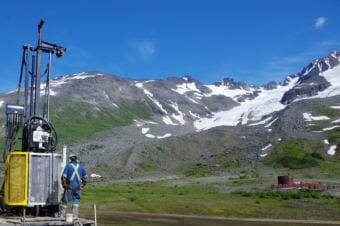
A drilling rig operator works at the Iskut project in west-central British Columbia. The Iskut is one of about a dozen exploration or mining projects near rivers that run through or near Southeast Alaska. (Photo courtesy Seabridge Gold)

The Golden Triangle describes a mineral-rich region of northwest British Columbia. Its mines and exploration projects are in the watersheds of salmon-rich rivers that enter the ocean in or near southern Southeast Alaska.

Exploration companies say they’re finding more and higher-grade ore that could lead to new gold mines. But more drilling doesn’t necessarily mean more development.
“In the northwest corner of British Columbia lies a geologic formation known as the Stikine Terrain, which holds some of the richest gold ore bodies in the world,” begins a YouTube video by iResource Media, which covers the mining industry. “This area is so rich, in fact, that they call it the Golden Triangle.”

It and similar reports describe two active mines and close to a dozen exploration projects in the area. They’re upstream from the Stikine or Unuk Rivers, which flow through southern Southeast Alaska. Or they’re in the headwaters of the Naas River, which empties into the ocean just south of the Alaska border.

One of the newer drill projects is the Iskut, owned by Seabridge Gold. Spokesman Brent Murphy said the company is in its second year of exploration.

“We had some success last year where we found some evidence of gold mineralization, and now we want to go out and see if we can find the origin and source of that gold so that we can develop a potential resource,” he said.

The project includes the closed Johnny Mountain Mine. Seabridge has removed and cleaned up abandoned fuel tanks and other contamination that project left behind.

Murphy said it looks promising. But that doesn’t mean it will become a mine.

“It’s way too early to even speculate. We are just in the very early stages of exploration,” he said.

Seabridge also owns the Kerr Sulphurets Mitchell project, which it’s been pursuing since the early 2000s. In recent years it’s been granted key permits needed for construction. The company is actively seeking investors.

KSM, as it’s known, is the largest project in B.C.’s Golden Triangle. Murphy said the company has located new deposits of valuable minerals.

“What we’ve found over the last three to four years is we’re definitely hitting higher copper grades and gold grades,” he said.

About a dozen mines or exploration projects are in what's called the Golden Triangle in west-central British Columbia. Some are new, while others are old mines under exploration as the price of gold roses. (Map courtesy Aben Resources and its Forrest Kerr project)
About a dozen mines or exploration projects are in what’s called the Golden Triangle in west-central British Columbia. Some are new, while others are old mines under exploration as the price of gold rises. (Map courtesy Aben Resources and its Forrest Kerr project)

Iskut and KSM are but two of the exploration projects claiming to have found valuable metals in the Golden Triangle. Calls to other companies were not returned. But all are clearly taking advantage of regional upgrades and the lucrative trend in the industry.

A key factor is the rising price of gold, which has been hovering around $1,300 per ounce. That’s more than twice the value of a dozen years ago.

Another factor is infrastructure. New pavement, hydroprojects and power lines have been developed with support from the British Columbia government. And a deep-water port has been developed at Stewart, the anchorage nearest to the Golden Triangle mines.

“There’s a lot of exploration work taking place and that kind of waxes and wanes,” said Kyle Moselle, large mine project manager for Alaska’s Department of Natural Resources.

He and a state biologist toured some of the Golden Triangle sites last fall and saw evidence of increased activity. The improved business climate is leading to more drilling, but that’s it.

“Does that mean that there’s a flood of mine projects coming? I don’t think so. I’ve never seen exploration work be an indication of actual mines being developed or proposed,” he said.

The number of projects makes it difficult for environmental, fisheries, tribal and government mine critics.

They say pollution from digging and milling could end up in transboundary rivers, threatening salmon and other fisheries.

“It’s hard to really prioritize which are the most important ones, which are the ones that might go ahead and which are the ones that could have effects down here in Alaska,” said Chris Zimmer, Alaska campaign director for Rivers Without Borders.

He’s tracked transboundary mines and exploration projects for years.

He’s encouraged by political changes in the federal and provincial governments. They continue to support development, but appear to be putting more emphasis on environmental protections. But he said those are long overdue.

“As I look at that, all that does is put us back to where we basically should have been 10 years ago. Fix the flaws in the B.C. assessment process over there. It’s definitely not a magic bullet and not the best way to address our concerns downstream,” he said.

Climate change is also making it easier to explore for gold and other rare minerals.

Warming global temperatures are melting back ice fields and glaciers in the Golden Triangle, allowing easier access to once hidden ore.

Celebration 2018 brings 45 dance groups to Juneau

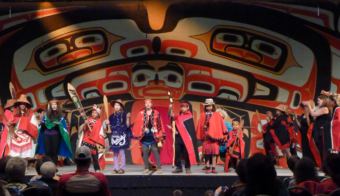
The Taku Kwan Dancers from Atlin, British Columbia, perform at Celebration on June 10, 2016. They're returning this year. (Photo by Ed Schoenfeld/CoastAlaska News)
The Taku Kwan Dancers from Atlin, British Columbia, perform June 10, 2016, at Celebration. They’re returning this year. (Photo by Ed Schoenfeld/CoastAlaska News)

Dance groups, artists, canoe paddlers and traditional food experts are gearing up for Celebration 2018, Southeast Alaska’s largest Native cultural gathering, held June 6-9 at Centennial Hall and nearby sites in Alaska’s capital city.

Celebration has happened every other year since 1982. Each Celebration has a theme. For 2018, it’s “Respect: Weigh Your Words.”

It can be hard to fully describe Celebration.

You can talk about its expected 2,000 or so dancers and 5,000 participants. Or the language, the oral traditions and the regalia. But that just doesn’t fully capture the experience.

Sealaska Heritage Institute president Rosita Worl describes one year’s grand exit, when all the groups danced out of the performance hall.

“It was like we were one people, one being, and we were all dancing,” she said. “It reminded me of a swarm of fish coming in. But everybody was kind of in unison, it was like we were part of a whole spiritual essence.”

Celebration 2018 lists 45 dance groups from Southeast and other parts of Alaska, the Yukon, British Columbia, the Pacific Northwest and California.

Every Celebration has a lead dance group representing a clan.

This year it has two: The Shangukeidí, or the Thunderbirds, and the Lukaax.ádi, or the Sockeye.

They’re from Haines and Klukwan, or the Chilkat and Chilkoot areas.

Worl said they will dance together, with clan songs from each.

The entrance song, owned by the Shangukeidí Clan, is “The Thunderbird Trade Song.” The grand exit will feature “The G̱unanaa Trade Song, one the Lukaax̱.ádi Clan bartered for with inland Athabaskan tribes.

Not all dance groups are made up of members of the same clan. Others are community, school or multi-tribal-based.

Celebration coordinator Carmaleeda Estrada said she’s enjoyed the growth of the youth groups.

Two younger cousins from Angoon formed their own dance troupe and will be part of their second Celebration this year.

“We would never have thought to start our own dance group,” she said. “So to be able to see people even younger than me taking that initiative, we have young girls in our group who are still in elementary school and they’re writing songs, they’re writing Tlingit songs. And so, just to see that from my own community is really inspirational. It really raises the bar.”

Canoes from around Southeast Alaska are formally greeted at the Douglas Boat Harbor on June 8, 2016, just before that year's Celebration. This year's canoes are scheduled to arrive June 5 between 2 and 3:30 p.m. (Photo by Ed Schoenfeld/CoastAlaska News)
Canoes from around Southeast Alaska are formally greeted at the Douglas Boat Harbor on June 8, 2016, just before that year’s Celebration. This year’s canoes are scheduled to arrive between 2 and 3:30 p.m June 5. They’re organized by the One People Canoe Society. (Photo by Ed Schoenfeld/CoastAlaska News)

Regalia, such as clan hats, vests, and button blankets, is worn by most dancers.

That’s changing, Worl said.

“Before we would only allow traditional regalia,” she said. “But we kept saying, if our culture’s going to evolve, then we have to let it and support that. So now you’re seeing a lot more Native fashion wear.”

This year’s Celebration will continue the relatively new tradition of a runway-style fashion show.

For the first time, the models will have a formal model training session.

Another new event is a seal oil contest, to be judged by taste and other factors.

Estrada said such contests will be more visible than in previous years.

“We would do that off to the side in the elders’ room and it wasn’t as prominent as it’s going to be this year,” she said. “Not only are we adding the seal oil competition to that, so now there’s three food categories, but we’re also moving that to the main stage.”

Celebration also includes a juried art show, a youth art show, a regalia care workshop, a Native artists market and the ever-popular toddler
regalia revue.

But the action isn’t all on stage. Estrada thinks back to Celebrations she attended as a child.

“You remember running around with your cousins and you don’t really realize how important and how lucky you are and what a profound event you’re at. But those things are just as fun, being able to reconnect with family and friends from all over,” she said.

Editor’s note: 360 North is under contract with Sealaska Heritage Institute to produce television and online video coverage of Celebration.

Transboundary mine meeting includes State Department, B.C. reps

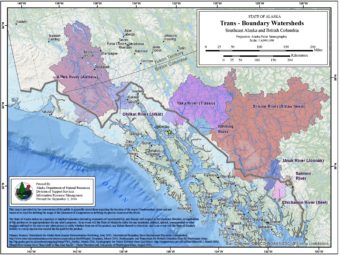
The state has identified eight transboundary watersheds feeding Southeast Alaska rivers. (Map by Alaska Department of natural Resources.)
The state has identified eight transboundary watersheds feeding Southeast Alaska rivers. A June 1 meeting will update concerned parties about efforts to protect fisheries. (Courtesy Alaska Department of Natural Resources.)

Alaskans concerned about possible impacts of British Columbia mines on cross-border rivers will get an update during a June 1 meeting in Juneau.

Lt. Gov. Byron Mallott will host the third annual transboundary mining meeting.

Mallott aide Albert Kookesh said officials from the federal, state and British Columbia governments will attend. So will tribal, industrial, environmental, fisheries and other leaders.

He said this year’s meeting will allow more time for discussion than previous gatherings.

“This is a chance for stakeholders, people who are interested in those types of transboundary issues, to come and talk to the powers that be, if you want to say it that way,” he said.

Much has changed since the previous meeting.

More mineral-exploration companies have announced discoveries of gold-bearing ore. A new coalition has taken control of British Columbia’s provincial government. And the U.S. State Department has become involved in the controversy.

Kookesh, a former Alaska lawmaker, said the State Department’s presence is new. He said officials will discuss results of a gap analysis.

“Essentially, that means, where are those areas that aren’t being really actively covered now by the transboundary groups in Alaska and Canada? And there’s a gap analysis being done by the State Department that says, ‘Here’s where we think there are areas of concern that we have to follow up on,'” he said.

Two mines on transboundary rivers, the Red Chris and Brucejack, are producing and processing ore. And other exploration projects, including the Kerr-Sulphurets-Mitchell or KSM project, have accumulated necessary permits and are seeking investors.

Tribal and government groups are already sampling water from rivers with watersheds including mine and exploration sites. Concerns focus on possible pollution that could damage salmon and other wild fish runs.

The meeting will be from 10:30 a.m. to 3:30 p.m. June 1 at the Vocational Training and Resource Center on Hospital Drive in Juneau. It’s open to the public, but will not be teleconferenced.

Ferries fully funded in operating budget

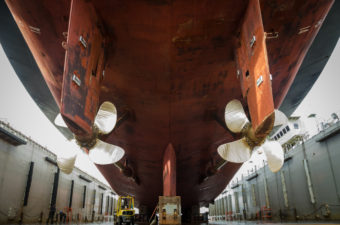
Undeneath the Matanuska.
Propellers shine as the Matanuska awaits repairs in 2014. It will get new engines and drive systems this year. That’s one change in the fully funded schedule for the next budget year. (Photo by Heather Bryant/KTOO)

The Alaska Marine Highway System got what it asked for in the Legislature’s operating budget.

Lawmakers OK’d the system’s request in their spending plan for the next fiscal year, which begins July 1.

General Manager Capt. John Falvey said despite a small decrease in funding, the total time in service for ships will actually increase by eight weeks.

“That gives us about 345.9 weeks, a little bit more, technically, than last year because of different ship configurations. Some ships are more expensive or not than others to run. So, it gives us a nice mix for the upcoming year,” he said.

The full ferry operating budget for next year is about $140 million.

The marine highway faced a shutdown in April due to a lack of money. A little-known budget provision – some called it a dirty trick – diverted ferry funding to cover Medicaid program shortfalls.

But Gov. Bill Walker replaced that money in a supplemental budget request, which the Legislature approved.

Next year’s sailings are similar to this year’s.

The ferry Matanuska tied up this month for a full engine-and-drive-system replacement. The work will continue through half or more of the next budget year.

Falvey said its Prince Rupert sailings are being covered by the similar ferry Malaspina.

“Everything else pretty much remains the same. The Kennicott and the Columbia, they’ll also be running. So I’ll say it’s pretty much the same except the Matanuska is out of the picture,” he said.

The Legislature’s capital budget for next year also includes money for ferry overhauls, certifications and terminal and dock work. That’s mostly paid for with federal funds.

The capital budget also provides $250,000 in operational funding for the Inter-Island Ferry Authority. That’s a separate, nonprofit system linking Prince of Wales Island with Ketchikan.

Juneau Assembly member Kiehl, labor leader Etheridge run for state Senate seat

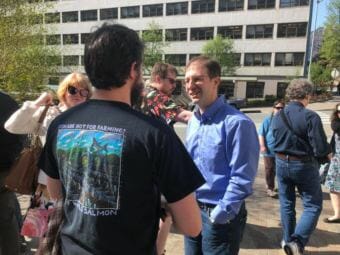
Juneau Democrat Jesse Kiehl announces his run for the state Senate seat being vacated by Dennis Egan Thursday near the Capitol. Nonpartisan candidate Don Etheridge recently announced he's running for the same Senate seat. (Photo by Ed Schoenfeld/CoastAlaska News)
Surrounded by his family, Juneau Democrat Jesse Kiehl announces he’s running for the state Senate seat being vacated by Dennis Egan on Thursday near the Capitol. Nonpartisan candidate Don Etheridge recently announced he’s running for the same Senate seat. (Photo by Ed Schoenfeld/CoastAlaska News)

Two more candidates have joined the race for the state Senate seat representing Juneau and other northern Southeast communities. A third recently announced his intention to run for a downtown Juneau-based House seat.

Jesse Kiehl is the latest to announce his intentions.  

The Juneau Assembly member tossed his hat in the ring at a Thursday campaign rally across the street from the Capitol.  

“I’m here today to make it official,” Kiehl said. “I am running for Senate District Q to represent Juneau, Haines, Skagway, Klukwan, Gustavus and Excursion Inlet.”

On Wednesday, Kiehl resigned his job as an aide to incumbent Democrat Dennis Egan, who is not seeking re-election.  

Kiehl is a Democrat and will be on the party’s Aug. 21 primary ballot. But he says he would consider working with Republicans if he’s elected. 

“I think coalitions are a great opportunity to work together for Alaska,” Kiehl said. “I’ve worked as a staffer in a bipartisan majority and I think that’s a fabulous opportunity. I’ll pursue that actively.”

Don Etheridge, his wife and grandchildren take part in a demonstration supporting public employees and construction at the Capitol June 11, 2017. Nonpartisan Etheridge is running for Juneau's Senate seat. (Photo courtesy Don Etheridge)
Don Etheridge, his wife and grandchildren take part in a Keep Alaska Open for Business rally at the Capitol June 11, 2017. Nonpartisan Etheridge is running for Juneau’s Senate seat. (Photo courtesy Don Etheridge)

Don Etheridge also recently announced his bid for the Senate seat. 

The longtime labor leader and lobbyist served one term on the Assembly about 20 years ago. He’s also been an active member of Juneau’s Docks and Harbors board. 

A nonpartisan candidate, Etheridge will skip the primaries and run in the Nov. 6 general election. He said not being a party member will make it easier to compromise and get things done. 

“You can’t just go in there with a locked-in position and (be) not willing to work on the issues,” Etheridge said. “As a longtime negotiator with the unions you learn how to do that.”

Fisheries corporation CEO Larry Cotter also is a candidate for the same Senate seat. The nonpartisan will only run in the general election. Cotter announced his political intentions in late January. 

Separately, there’s a third candidate for the downtown Juneau-based House district that also includes other northern Southeast cities. Steven Handy is a former telecommunications worker and legislative aide who will run in the  Democratic Party primary. But he says he wants to look beyond party labels. 

“I understand the political reality of it. But I don’t like the term ‘reaching over the aisle,'” Handy said. “I’d like to think that it’s a body of 40 people who are working toward resolution of issues that affect everybody in the state.”

Handy will face retired teacher Sara Hannan in the primary. She made her plans public in February. 

Construction worker and labor leader Chris Dimond filed for the same seat in March. He’s nonpartisan and will only run in the general election.  

Incumbent Democrat Sam Kito III is not seeking re-election. 

Two candidates have already filed for Juneau’s Mendenhall Valley-based House seat. Republican Jerry Nankervis, Juneau’s deputy mayor and a retired police captain, will run in his party’s primary. Nonpartisan Rob Edwardson, also a Juneau Assembly member and an aide to outgoing incumbent Democrat Justin Parish, will run in the Democratic primary. Parish is not seeking re-election. 

Recent party rule changes allow nonpartisan candidates to run in Democratic primaries. 

Other candidates could also join Juneau’s three legislative races. The final filing deadline is June 1. 

Site notifications
Update notification options
Subscribe to notifications