
Ed Schoenfeld, CoastAlaska

Coach, teacher and ally among eight honored for tribal achievements

Longtime educator and coach Gil Truitt speaks after receiving the President’s Lifetime Achievement Award during an April 19 ceremony in Juneau. He and seven others were honored by the Central Council of Tlingit and Haida Indian Tribes of Alaska. (Photo by CCTHITA)
Longtime educator and coach Gil Truitt speaks after receiving the President’s Lifetime Achievement Award during a Central Council of Tlingit and Haida Indian Tribes of Alaska fundraiser on April 19. Seven others were also honored. (Photo courtesy Tlingit & Haida)

Gil Truitt spent 34 years teaching and coaching mostly Alaska Native students at Sitka’s Mount Edgecumbe High School. He’s been called a legend who helped raise a generation of leaders and culture bearers.

Now, he’s received the highest form of recognition given by the state’s largest tribal government.

Gil Truitt was so much a part of life at the public boarding school that he was known as “Mr. Mount Edgecumbe.”

He decided to become a teacher while attending the school in the 1940s. He took some time off, then went to college to study education.

Central Council of Tlingit and Haida Indian Tribes of Alaska President Richard Chalyee Éesh Peterson picks up the story from there.

“Dr. Truitt returned to his longtime hometown of Sitka, Alaska, to fulfill his dream of giving back to his community, to Mount Edgecumbe High School and students. He not only gave his time to the school, but exemplified courtesy, commitment, sportsmanship, quality and professionalism to the students and his coworkers,” he said.

Peterson presented Truitt with the President’s Lifetime Achievement Award during an April 19 ceremony in Juneau. It was part of the organization’s 83rd annual tribal assembly.

Watch the language fundraiser and awards ceremony.

The recognition is one of many Truitt has received during his career and subsequent retirement. He responded with appreciation.

“A person does not become a teacher for recognition, to become rich or to become popular. But believe me, when those recognitions come, it is worth every second, every hour, every year that a dedicated teacher will spend with the young people,” he said.

Truitt was one of eight tribal citizens honored at the President’s Award Banquet. It raised more than $36,000 to support the central council’s language initiatives.

DonnaRae James was recognized as a culture-bearer everyday hero for organizing and leading traditional-skills workshops in Northern California. (Photo by Tlingit & Haida)
DonnaRae James is executive director of CAlaska Culture, which brings together Alaskan Natives living in Northern California to learn and practice their traditional culture. She was named an everyday hero for being a culture bearer. (Photo courtesy Tlingit & Haida)

DonnaRae James was named an everyday hero for being a culture bearer and organizing and leading traditional-skills workshops in Northern California.

“For me to use my hands to create in much of the same way as my ancestors did helps to ground me in my life as well as my culture. I’m honored to teach others the skills I have and I feel that it brings our ancestors forward each time I share knowledge,” she said.

Others honored as everyday heroes included emerging leader Eva Rowan, inspiring educator Ronnie Fairbanks, language warrior Ben Young, youth mentor Barbara Dude and Barbara Franks for holding each other up.

Read biographies of the award winners.

Nancy Barnes was recognized as an important tribal ally. She’s a dance leader and longtime legislative staffer who’s been involved in language revitalization and other cultural and political work.

Barnes was named as an ally because she is Tsimshian and Alutiiq, not Tlingit or Haida. But she said all share similar goals.

“As someone once said, we’re all in this canoe together. We have many of the same issues and we should always help each other. We are strong when we come together and lift each other up,” she said.

Nancy Barnes addresses an April 19 fundraising banquet after being honored as a tribal ally by Central Council of Tlingit and Haida Indian Tribes of Alaska President Richard Chalyee Éesh Peterson. (Photo courtesy Tlingit & Haida)

Southeast tribal corporation boosts government contracts

Central Council of Tlingit and Haida Indian Tribes of Alaska President Richard Peterson advocates business development as a way to replace federal funding. “We’re only as sovereign as we can afford to be,” he told delegates at the council’s tribal assembly, which took place April 18-20 in Juneau. (Photo by Tlingit & Haida)

An Alaska Native corporation will soon provide support services for the U.S. Navy in Guantanamo Bay, on the island of Cuba. Tlingit Haida Tribal Business Corp. won the $18 million contract earlier this month.

It’s another step in the growth of the profit-making arm of the state’s largest tribal government.
Tlingit Haida Tribal Business Corp. is owned by the Juneau-based Central Council of Tlingit and Haida Indian Tribes of Alaska. The council lists more than 30,000 tribal members in Southeast, the rest of Alaska and around the nation and the world. Its business operations are separate from those of Native corporations formed under the Alaska Native Claims Settlement Act.

Business corporation subsidiary KIRA announced the Guantanamo contract April 12. It will manage maintenance services, port operations and waterfront administration for the base.

The corporation announced a similar, $44 million contract about a week earlier for the U.S. Marine Corps air station in Beaufort, South Carolina.

The contracts are among more than a dozen providing military and other government support services from Florida to Alaska.

CEO Richard Rinehart said the corporation continues to seek more work.

“I look at it as it’s like longlining. We have all these lines out with lots of hooks. And we’re out there fishing and by having more lines in the water, we’re hopeful to bring more home,” he said.

Rinehart and others discussed the business corporation’s progress at the central council’s recent tribal assembly in Juneau.

He said sales were $57.7 million in 2017, close to twice the amount of the previous year. Rinehart projects about 30 percent more sales for the current year.

Net income last year was only $865,000. But it was a third more than the previous year. Rinehart said the amount will increase as startup costs are paid off.

General Manager Bob Hamilton said military and other contracts are due, in part, to the corporation’s 8(a) status. That’s a provision in federal law that gives minority-owned and disadvantaged businesses a bidding preference.

He said the corporation began with janitorial contracts.

“And now we’re in IT, security, aircraft logistics as far as support and services for aircraft and we’re actually in port management. So we’ve really come a long ways,” he said.

Tlingit Haida Tribal Business Corp. officials say it employs about 600 people.

Most of the jobs are in other parts of the country. But the corporation’s hiring policy includes a preference for tribal members.

Tlingit Haida Central Council President Richard Peterson made business development part of his platform when he ran for office four years ago. He told this year’s tribal assembly it’s still a top priority.

“We’re only as sovereign as we can afford to be. We need economic sovereignty. We need to be able to manage ourselves sustainably, not so dependent on the federal government, so that we can exercise true self-determination and do what we see fit for our tribal citizens,” he said.

Peterson was re-elected president at the tribal assembly, which was held April 18-20.

Former ferry Taku headed to the scrapyard

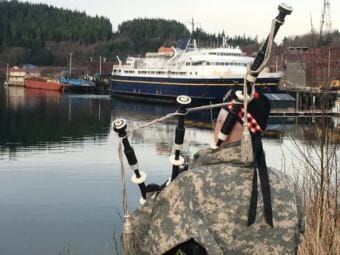
Rob Alley plays the bagpipes as a send off for the ferry Taku as the ship departs Ketchikan’s Ward Cove on March 13, 2018.
Rob Alley plays the bagpipes as a send-off for the ferry Taku as it departs Ketchikan’s Ward Cove on March 13, 2018. Alley first arrived in Alaska aboard the Taku in 1992. Now, the ship is headed to the scrapyard. (Photo by Leila Kheiry/KRBD)

The former state ferry Taku sailed past Singapore on Friday on the way to being scrapped. It will go for close to 10 times its purchase price.

Jabal Al Lawz Trading bought the 55-year-old ship earlier this year.

The Taku left Ketchikan’s Ward Cove, where it had been stored, March 13. The company sailed it across the Pacific Ocean in hopes of finding a buyer to keep it in service. But negotiations with interests in Singapore and Fiji didn’t work out.

Co-owner Ben Evans of New Zealand said it will end its sailing days in India later this month.

“She’s going to go to the scrapyard and sold for demolition. So that’s the end of the Taku,” he said, calling it a tragedy.

The state sold the ship in January for $170,000.

Evans said his company will probably get about $1.5 million for the ship. But sailing it 12,000 miles across the Pacific was expensive.

“It costs us $55,000 to insure it for the voyage. My crew payroll’s running about $2,000 a day. The fuel bill was probably just under $400,000. There’s some big figures there, you know,” he said.

State officials put the Taku up for sale a little more than a year ago. The original minimum bid was $1.5 million. But it took several tries to sell it, each with a lower price.

The Taku has not been a working ferry for several years. It was tied up in 2015 because of its age, as well as budget cuts.

Robert Venables heads up the state’s Maine Transportation Advisory Board. He also works for the Southeast Conference, which pushed the state to start the ferry system more about 60 years ago.

He said the ship’s condition left few choices.

“It’s not surprising, but it does leave you with a little bit of sadness that she’s not going to be in service,” he said.

Evans said most of the Taku will be recycled. Some parts, such as generators, will be sold whole.

The cut-up hull will be reprocessed into rebar. Among other things, it’s used to strengthen concrete in building construction.

Co-owner Evans said an investor in Fiji wanted to use the Taku as a ferry. He said interests in Singapore were interested in retrofitting it into what’s called a superyacht.

But all backed out.

Sealaska dividends boosted by other corporations’ oil and zinc earnings

A worker portions halibut as part of a processing line at Odyssey. (Photo courtesy Sealaska Corp.)
A worker portions halibut at a processing line at Odyssey, one of Sealaska’s recent Seattle-area seafood investments. The corporation says those investments boost earnings and dividends. (Photo courtesy Sealaska Corp.)

Sealaska Corp. will distribute more than $23 million to its shareholders Friday. It’s twice last spring’s amount, in part because the Southeast regional Native corporation’s own businesses are making more money.

But the largest part of many shareholders’ checks come from other regional Native corporations’ earnings.

The Alaska Native Claims Settlement Act of 1971 created 12 regional corporations.

Some ended up with large stands of trees, rare mineral deposits or other valuable natural resources. Others did not.

So the act – and a later legal agreement – required those with more to share their wealth with those with less. It’s known as section 7(i/j).

Juneau-headquartered Sealaska used to be one of those with more. It made a lot of money off its timberlands and shared 70 percent with other regional corporations. But in more recent years, it’s been getting considerable revenue from two of its northern cousins.

One is Arctic Slope Regional Corp., which is in the oil business.

“That’s been down from historic levels and is still down from historic levels,” said Anthony Mallott, Sealaska’s president and CEO.

The other owns the rights to a profitable mine in northwest Alaska.

“This last year, zinc prices have been headed upward. And there’s more income from the Red Dog Mine that NANA (Regional Corp.) is the landowner of,” Mallott said.

Dividend totals differ. This year, they range from $13.50 to $2.36 per share. That’s because the corporation’s more than 22,000 shareholders are divided into classes.

For those getting the largest dividends, more than 80 percent comes from the shared revenue pool. A little more than 10 percent comes from the corporation’s own businesses. The remainder is from the corporation’s permanent fund earnings.

Mallott said they’re doing well.

“The land-management (and) natural resource business is one of the leaders. We’re actively investing in the seafood side, meaning expectations that seafood will quickly be the greatest source of income for Sealaska,” he said.

The corporation also continues to earn money through investments and government contracting.

“They were all profitable in 2017 just like they were all profitable in 2016. And they’re all growing,” he said.

“If this a trend line for Sealaska, that’s great news,” said Nicole Hallingstad, a former vice president and corporate secretary for Sealaska.

She’s also run for its board of directors as an independent – and sometimes critical – candidate.

“Shareholders want to support the corporation and they’re excited that the corporation seems to be on a trend of profitability,” she said.

It’s hard to tell how well Sealaska’s different subsidiaries are doing. That’s because the corporation reports financial results by sector, not for each separate company.

Hallingstad said that’s understandable because corporations don’t want competitors to know too many details. But she thinks Sealaska could be more transparent in its dividends breakdown for shareholders.

“It would be great if there was a number that showed the earnings from our subsidiary holdings as opposed to the investment holdings. And that way, shareholders really can begin to track what our subsidiary operations are doing,” she said.

About five years ago, Sealaska’s revenues dropped significantly due to more than $30 million in losses from its construction subsidiary and some other operations.

The losses were spread out over several years. But Mallott said they’re no longer part of the dividend equation.

Read a study of the shared resource earnings pool here: A Summary of the Economic Benefits of ANCSA Sections 7(i) and 7( j) Revenue

Alaska Energy Desk’s Elizabeth Jenkins contributed to this report.

State Senate makes small cut to ferry system budget

Juneau Democratic Sen. Dennis Egan addresses the Alaska Senate in 2014. He plans to introduce an amendment restoring reductions to the chamber’s ferry system budget. (Photo by Skip Gray/Gavel Alaska)

The state Senate’s spending plan cuts funding from the Alaska Marine Highway System – but not a lot.
Its version of the operating budget shrinks the ferry system’s fuel budget by $370,000, about 2 percent of the total sought.

It also takes $2 million for operational costs out of what’s called the Marine Highway Fund, which holds ticket and other revenues until they’re needed. The House budget put $13 million into the fund and the Senate committee reduced it to $11 million.

Juneau Democratic Sen. Dennis Egan is one of three members of the Senate Finance Transportation Subcommittee. He objected to the change.

“It’s not sustainable. We shouldn’t be spending more out of that fund than we expect to get in ferry revenue,” he said. “The way to spend more from the ferry fund is to get more people riding the ships.”

The ferry system came close to shutting down this month because money had been removed from the Marine Highway Fund. That was replaced in a supplemental appropriations bill passed in March.

The Senate is still working on its full operating budget bill for the fiscal year beginning in July. During an April 3 meeting, Egan said he would try to restore cuts to the Marine Highway Fund through an amendment.

“The Alaska Marine Highway System is our road. It just happens to be on water. It needs a stable budget like the rest of the department. Roads, airports and ferries,” he said.

The Senate has proposed deep cuts to the marine highway budget in previous years.

Alaska ferry officials consider fuel alternatives

FVF Fairweather engine room
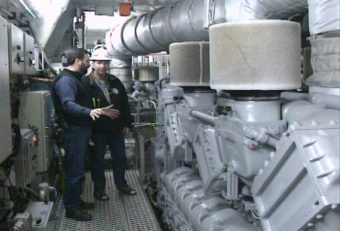
The fast ferry Fairweather’s engines run on diesel. Marine highway officials are not considering replacing them with electric engines. But they’re installing dual-fuel engines that could use natural gas on three ships. (Photo by Skip Gray/KTOO)

Washington state is considering converting some of its ferries to electrical power, and its Legislature recently voted to spend $600,000 to study the option.

Alaska, on the other hand, is not. But officials here are considering a different alternative ferry fuel.

Alaska’s nine working ferries all burn diesel, which is expensive.

It also contributes to climate change, which melts sea ice and permafrost, damaging roads and communities.

So it would make sense for the state ferry system to look for alternatives, such as electricity.

“It’s not a new question. This question has come up in years past with the marine highway,” said Capt. John Falvey, general manager of the Alaska Marine Highway System.

He said research showed it would be much harder to make electrical engines work in his fleet.

“Because we run longer, on average, routes than Washington State Ferries does, with their entire fleet being a day fleet where they will stop once a day to be able to recharge their batteries,” he said. “(It) makes it a little tougher for the marine highway.”

Falvey said the most likely ship to be converted would be the Lituya. The small ferry sails a short route connecting Ketchikan and Metlakatla, in southern Southeast.

He said electric engines also might work in Prince William Sound and northern Lynn Canal, which also have some short routes.

The cost would be high at a time when the ferry system barely has enough money to keep its fleet sailing.

He said other challenges include the time needed to recharge batteries and the availability of cheap electricity at some ports.

Falvey’s not writing off electrical conversions forever.

“Not to say technology hasn’t changed. And maybe we look at it again,” he said. “That’s something that I could do if I was asked.”

Renewable Energy Alaska Project Executive Director Chris Rose believes electricity will be an option in the future.

“I think the price of the batteries has been a key factor,” he said. “And as that price comes down, it will open up opportunities for entrepreneurs to figure out ways to displace fossil fuel-burning motors with electrical motors.”

Alaska’s ferry system is planning for a different alternative fuel. Falvey said it’s liquefied natural gas.

“Right now, LNG is cheaper than diesel fuel and it burns a lot cleaner,” he said. “We are seriously looking at that.”

The marine highway is installing engines on two new Alaska-class ferries that will burn either diesel or natural gas. The small ships will link Juneau, Haines and Skagway.

Falvey said it’s also installing dual-fuel engines on the larger ferry Matanuska.

The same will happen when a replacement for the large Southwest ferry Tustumena is built.

“Some of the issues with LNG in the past has been the supply chain coming into Alaska,” he said. “But it appears that as time goes by that may become less and less of a problem.”

He also said onboard storage could be tricky. Safety rules are very strict and have limited LNG use on passenger vessels.

Those rules are evolving, he said. And cruise ships that run on natural gas are being built and put into service.

Site notifications
Update notification options
Subscribe to notifications