Ed Schoenfeld, CoastAlaska

Sealaska Corp. doubles April payout to shareholders

Sealaska directors on Friday approved a spring distribution totaling $23 million. The amount paid to each shareholder depends on the number of shares, as well as their class.
Sealaska directors on Friday approved a spring distribution totaling $23 million. The amount paid to each shareholder depends on the class of their shares. (Graphic courtesy Sealaska Corp.)

Sealaska’s spring shareholders’ payout is more than twice the size of the previous year’s.

The Southeast regional Native corporation announced Friday it will distribute $23.1 million to tribal members beginning April 13. Last spring’s dividends totaled $10.6 million.

The Juneau-headquartered corporation has more than 22,000 shareholders, almost all of Tlingit, Haida or Tsimshian descent. Dividends will range from approximately $236 to $1,586 each, depending on the class of shares and the number owned.

In a press release, officials said the corporation is also investing more money into its scholarship endowment. President and CEO Anthony Mallott cited rising costs for secondary education and the need to advance shareholders and their descendants.

The corporation’s board will also look into creating a burial-assistance program. Some Sealaska critics have lobbied for the benefit.

Officials cited increased business earnings as one reason for the larger payout and scholarship increase.

Sealaska began investing in Seattle-area fish-processing businesses in 2016.

Campaign takes different approach to racism

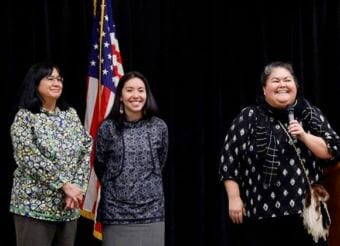
First Alaskans Institute officials discuss racism and reconciliation at the Elizabeth Peratrovich Hall on Thursday in Juneau. From the left are Angela Gonzales, Andrea Sanders and Liz Medicine Crow.(Photo by Skip Gray/360north)
First Alaskans Institute officials discuss racism and reconciliation at the Elizabeth Peratrovich Hall on Thursday in Juneau. From the left are Angela Gonzales, Andrea Sanders and Liz Medicine Crow. (Photo by Skip Gray/360 North)

A statewide Native organization wants Alaskans to recognize, discuss and repair the impacts of racism.

The Anchorage-based First Alaskans Institute brought its Truth, Racial Healing and Transformation campaign to Southeast on Thursday.

President and CEO Liz Medicine Crow spoke at a Juneau hall named for Tlingit civil rights leader Elizabeth Peratrovich.

“What we’re trying to achieve is a process by which we transform the way that we as a society view one another and work with one another and value one another,” she said. “When you transform things, they can never go back to how they were.”

Medicine Crow said the effort seeks to tell the truth about racial relations without being punitive.

She also said the campaign can benefit all Alaskans.

“It is not just about Alaska Native people. It is about righting wrongs,” she said. “It is about utilizing justice as a tool to advance us as a society and not just to delineate somebody being in the wrong or in the right.”

The program was held in Juneau as part of the institute’s Alaska Native Civic Engagement Training, which will repeat April 6-7 in Fairbanks.

State ferries won’t stop sailing April 16, after all

Ferry props wait for use Feb. 19, 2014, at the Alaska Marine Highway Warehouse in Ketchikan. The ferries will continue sailing this spring and early summer thanks to a bill signed Tuesday. (Photo by Ed Schoenfeld/CoastAlaska News)
Ferry props wait for use at the Alaska Marine Highway Warehouse in Ketchikan on Feb. 19, 2014. The ferries will continue sailing this spring and early summer thanks to a bill Gov. Bill Walker signed Tuesday. (Photo by Ed Schoenfeld/CoastAlaska News)

The Alaska Marine Highway System will not have to shut down in April.

Gov. Bill Walker signed a supplemental appropriations bill Tuesday funding the ferry system through the end of the current fiscal year in June.

The gap would have left an 11-week hole in the system’s budget. April 16 was set as the shutdown date.

Sitka Republican Sen. Bert Stedman represents many of the Southeast communities most dependent on the ferry system.

“I think that’s great. We can get the marine highway through the first of July and then have a fairly flat schedule going forward, with a few little improvements for the next year and continue to try to move the marine highway forward instead of backwards,” he said.

The supplemental bill provides about $24 million for the ferry system.

The shortfall was caused by an earlier spending bill meant to fund Medicaid if it ran out of money. It called for that money to come from the ferry system. Those terms were not widely known.

Stedman sounded the alarm about the shortfall in September. He called it “skullduggery and downright sleazy.”

“It’s not how we should do budgets or how we should deal with the public purse. So I think the negative press from those type of actions goes a long way to keep them from recurring” he said.

The $110 million fast-track supplemental bill also funds gaps in state Medicaid and prison programs.

Ferry funding for the budget year beginning in July still needs to be approved by the full Legislature. So far, it’s passed the House but not the Senate.

Landless communities continue fight for land

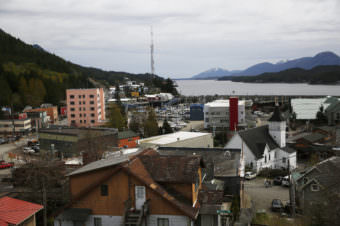
Ketchikan sits on an island at the southernmost end of southeast Alaska, a prime spot for cruise ships navigating Alaska's Inside Passage. (Photo by Elissa Nadworny/NPR)
Downtown Ketchikan in spring 2017. The Southeast city is one of five without its own Alaska Native corporation. A bill before Congress would change that. (Photo by Elissa Nadworny/NPR)

Representatives of five Southeast Alaska communities continue their fight for recognition under the Alaska Native Claims Settlement Act.

But they’re still facing opposition.

It’s been almost a half-century since Congress passed the Alaska Native Claims Settlement Act, which created more than 200 corporations with land, money and shareholders.

It left out Ketchikan, Wrangell, Petersburg, Tenakee Springs and Haines, known as the landless communities.

Alaska’s Congressional delegation has introduced a number of bills over the years to address the situation. None has passed.

Supporters haven’t given up, and they said it’s not about money.

“It’s about the land, said Joseph Reeves, president of the Landless Natives of Ketchikan. “The land is our centerpiece and we ain’t ready to give up that idea.”

“Let’s have just a sliver of what we used to totally own,” he said. “And that’s all it is, 23,000 acres in Ketchikan out of the millions of acres around us that we always owned.”

He supports terms of the latest legislation, the Alaska Native Claims Settlement Improvement Act, which also includes provisions to transfer land in other parts of Southeast and the rest of the state.

U.S. Sen. Lisa Murkowski co-sponsored the measure with Sen. Dan Sullivan.

“This is a matter of equity,” she said. “To have five communities that were left out was not right then and it’s not right to this day that they continue to be on the outs.”

The bill was introduced last summer and had its first hearing in February.

It remains in the Senate Committee on Energy and Natural Resources, which Murkowski chairs.

Its best chance of passing is to be part of a larger lands measure.

The bill is opposed by a number of environmental organizations, because it would transfer a total of more than 100,000 acres of Southeast’s Tongass National Forest to the five new corporations.

One critic, Andy Moderow of the Alaska Wilderness League, also opposes land transfers elsewhere in the state.

“Under the guise of correcting past wrongs, Sen. Murkowski is pushing ahead with a bill that will create a whole bunch of new sets of problems in Southeast Alaska and around Alaska by privatizing up to 600,000 acres of land in our state with very few protections for areas that currently are public resources,” he said.

The Southeast Alaska Conservation Council, or SEACC, also opposes the measure as written.

There’s no consensus on why the five communities didn’t get their own corporations.

Some have said they weren’t historically Native communities or didn’t have large enough Native populations.

A University of Alaska study showed strong similarities to other communities that did get corporations.

Others said the Forest Service and the then-thriving timber industry didn’t want to lose access to the land.

Still others have said it was a paperwork mistake in the rush to pass the legislation.

Reeves thinks that like its predecessors, this bill may not make it through Congress. But he and others will continue the work begun decades ago by people who are now elders or have passed away.

“We still have their children and their children’s children here that will benefit from this,” he said. “It will help them in their seeking of an identity as an Alaska Native person in this community. To be a part of an ANCSA corporation is something that we hope will help our people for generations to come.”

Most of the people who would gain stock in the new corporations already are shareholders of Sealaska, Southeast’s regional Native corporation. That’s the case for most members of the region’s other 13 urban or village corporations.

Gold Medal is more than a basketball tournament

Siblings Marie and Thomas Beierly enjoy a moment during the Gold Medal Basketball Tournament, held March 18-24 in Juneau. Both are announcers during the games. (Photo by Ed Schoenfeld/CoastAlaska News)

Southeast Alaska’s Gold Medal Basketball Tournament began more than 70 years ago, which means many players and volunteers are following in their parents’ footsteps.
Gold Medal has always been a family event for Walter Soboleff Jr.

He remembers his parents helping those coming into town from smaller Southeast communities in the mid-1950s.

“Our house would fill up with ballplayers in sleeping bags. We’d go down to the boat harbors and pick up ball teams,” he said. “They’d come in the seine boats. There were no ferries back in those days.”

Soboleff was just a kid then, so it wasn’t all about the competition.

He ran around with friends and played under the bleachers – until the stars came out.

“Anytime Herbie Didrickson or Moses Johnson played, I had to be there,” he said. “They were to basketball what the Beatles were to rock ‘n’ roll.”

He’s not a player, but he works the event. This year, he’s at the merchandise table.

Mary Lekanof also remembers watching Didrickson and Johnson play in the 1950s.

She said the stands were smaller then, but plenty of people packed in.

“Oh my goodness! It used to be held in the Juneau High School gymnasium,” she said. “They had a lower level, then they had a balcony. They had hundreds of people.”

Now, there can be more than 1,000 people for the final games.

They all fit in the larger Juneau-Douglas High School gym, with lots of bleachers but no balconies.

Mary Lekanof is a Juneau Lions Club member who volunteers before and during the Gold Medal games. Here's she works at the merchandise table. (Photo by Ed Schoenfeld/CoastAlaska News)
Mary Lekanof is a Juneau Lions Club member who volunteers before and during the Gold Medal games. Here she works at the merchandise table. (Photo by Ed Schoenfeld/CoastAlaska News)

Lekanof, working the merchandise and ticket tables, has seen other changes over the years.

Some descendants of those early players and fans moved south.

“Today you see people that are from Washington State,” he said. “They save all year so they can come up here for the Gold Medal,” he said.

Marie Beierly started working Gold Medal in the mid-1980s. Like Soboleff, she followed in her father’s footsteps.

“I was just sweeping floors and my dad was sitting here at the announcers table and he asked me to help him. He said, ‘Just give me a name and how many fouls they have.’ I did that for him for a couple years until he just started passing over the mic and told me to announce this guy’s name. So I did,” she said.

Her brother, Thomas Beierly, also announces games in the stands and on the radio.

The former player said he’s enjoyed some loosening of the rules.

“Back when I was growing up here at Gold Medal, it was fabulous,” he said. “But people were so strict of players coming in to Gold Medal. But now we have the door open for other people to come in that want to enjoy and play.”

The tournament runs four brackets, with teams representing about a dozen Southeast Alaska communities. That brings many hundreds of people into Juneau, giving it an economic boost.

Soboleff said that’s changed from the earlier years.

“People have money now to spend and they didn’t. I don’t remember anyone having any money back in the old days,” he said. “Now, I go to Costco and Fred Meyer and I see everybody. All of Southeast is here.”

Gold Medal includes 40 games during the week of March 18-24. It raises funds for the Juneau Lions Club, which supports scholarships, eyesight assistance and donations to other organizations in Southeast.

Gold Medal sweatshirts are among tournament gear sold to offset costs and support scholarships and other programs in Southeast Alaska. (Photo by Ed Schoenfeld, CoastAlaska News)
Gold Medal sweatshirts are among tournament gear sold to offset costs and support scholarships and other programs in Southeast Alaska. (Photo by Ed Schoenfeld/CoastAlaska News)

New state Forest Service leader has Alaska experience

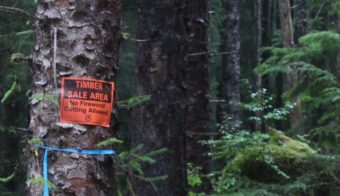
A timber sale sign is posted in the Tongass National Forest on Prince of Wales island. (KRBD file photo)
A timber sale sign is posted in the Tongass National Forest on Prince of Wales Island. The new Forest Service regional forester for Alaska, who takes over in April, was a district ranger on the island. (KRBD photo)

The U.S. Forest Service controls 22 million acres in Alaska, including most of Southeast. It’s overseen by a regional forester, whose staffers manage logging, mining, recreation and fish habitat.

The agency is getting a new top official in April. David Schmid will have to deal with a particularly controversial land management plan that’s under attack.

David Schmid

Schmid began his Forest Service career in Alaska. He and his wife moved here in the early 1980s for his first agency job, in Southcentral’s Chugach National Forest. Later, he worked in the Tongass in Southeast.

“Over the years I think we spent 23 years together in Alaska and just having an opportunity to come back and re-engage with folks and work on Alaska issues has just been a dream of mine,” he said.

He’s leaving his post as deputy regional forester for the agency’s Northern Region, based in Missoula, Montana.

He’ll take over the Juneau-based Alaska Region job from Regional Forester Beth Pendleton, who’s retiring after eight years in the position. She’s spent about 30 years in the Forest Service, two-thirds of it in Alaska.

Pendleton served as acting associate chief of the nationwide agency during the transition to the Trump administration. And recently, the agency’s chief stepped down amid allegations of sexual misconduct.

Despite shakeups at the top, she said there was no pressured to leave.

“My plans to retire were in 2018. So this is per my choice to retire at this time,” she said.

Beth Pendleton

Pendleton oversaw the Forest Service’s Alaska region during development of the most recent Tongass Land Management Plan. It’s been challenged in court and in Congress, largely because it begins the phase-out of old-growth logging.

She believes the plan will survive because it’s flexible and can absorb change.

“We’ve been really focusing on that transition to young-growth harvests and renewable energy. There is an adaptive management component that’s associated with the plan, where there’s room … to further amend the plan in the future if needed,” she said.

She said she’ll bring her replacement up to speed before she leaves the office.

Schmid hasn’t been part of this version of the Tongass planning battle. But he’s familiar with the issues from his days as district ranger for Thorne Bay, on Prince of Wales Island. Before the big mills closed, it was a center of Alaska’s timber industry.

He said he’s dealt with similar conflicts in his current job.

“I think I’ve had something like 75 or 80 objection resolution meetings here in Montana and Northern Idaho and North Dakota. And often times, mostly around tribal planning or large vegetation management, I would say it was almost identical to my experiences in Alaska with some very polarized issues,” he said.

A March 15 Forest Service press release announcing the transition said Schmid will be acting regional forester. But he said he’ll be here for the long haul.

The Forest Service has nine regional offices. Not a lot are overseen by women.

But Pendleton said she’s not unique.

“I would say in the last 10 to 15 years we’ve seen more women and minorities come into some of these leadership positions. And I have had nothing but support and encouragement as I have worked in the agency and as I have served here in Alaska,” she said.

A recent investigation showed a pattern of gender discrimination, bullying, sexual harassment and assault against women in fire crews and some other sections of the Forest Service.

Site notifications
Update notification options
Subscribe to notifications