Ed Schoenfeld, CoastAlaska

Southern Southeast scrap metal recycling to restart this spring

Scrap metal and junk cars are piled up at Petersburg’s landfill this month. (Photo by Joe Viechnicki/KFSK)
Scrap metal and junk cars are piled up at Petersburg’s landfill in 2017. Eight Southeast cities are working to set up regular barge runs to recycle metal junk. (Photo by Joe Viechnicki/KFSK)

Eight Southeast Alaska communities will resume scrap metal recycling as early as this April.

The Southeast Alaska Regional Solid Waste Authority is working with Waste Management, a large garbage removal and recycling business. The authority includes Petersburg, Wrangell, Craig, Klawock, Thorne Bay, Kasaan, Hydaburg and Coffman Cove.

Petersburg Public Works Director Karl Hagerman said old cars, broken construction equipment and other scrap metal has been piling up for several years.

Hagerman said prices have been low, so it would have cost more to ship scrap metal south than could be recovered by selling it for recycling. He said the price was $175 a ton last summer, but could be up to $230 a ton later this spring.

“That’s the value in Seattle, not in Petersburg, Alaska. So, the trick is transportation and the cost of getting that metal to market,” he said.

The solid waste authority reached a scrap metal recycling agreement with another company about four years ago. But it fell through. Wrangell has had a large amount of scrap metal barged off through a separate agreement.

Hagerman told the recent Southeast Conference Mid Session Summit that the spring collection will be a one-time deal.

“The second part of the scrap metal agreement with Waste Management is hopefully to set up a long-term agreement with the company to remove metal from the communities on an ongoing basis,” he said.

The authority is also looking at what’s needed to continue hazardous waste pickups from Southeast communities.

The current contract is running out and the company doing the work doesn’t want to continue. Hagerman said a committee is considering three proposals to keep the pickups going.

Several larger Southeast communities have their own contracts for recycling scrap metal and hazardous waste.

Learn more about Southeast trash issues through our eight-part series, Talking Trash. 

Two from Juneau file for Kito’s House seat

Southeast Alaska's House districts are 33, 34, 35 and 36. The Senate districts, which each include two House districts, are Q and R. (Map courtesy Alaska Redistricting Board)
Juneau’s House Districts are 33, which also includes Haines, Skagway, Gustavus and Klukwan, and 34, including the Mendenhall Valley and neighborhood to the northwest. Its Senate district is Q. Each has candidates running for election this year. (Map courtesy Alaska Redistricting Board)

Two more Juneau residents are running for the state Legislature. Both are competing for the same seat, though two other seats also are on the ballot.

Educator Sara Hannan and union organizer Chris Dimond filed for the House District 33 seat, which includes downtown Juneau, Douglas Island, Thane and some other capital city neighborhoods, plus Haines, Skagway, Klukwan and Gustavus.

Incumbent Democrat Sam Kito III said he will not decide whether to file for re-election until mid-March.

He expects to know then whether a proposal to take away Juneau lawmakers’ per diem payments will move forward.

He said he’s putting his daughter through college and can’t afford to remain in office without those payments.

Sara Hannan hosts Mudrooms on February 13, 2018, at Northern Light United Church. (Photo by Melissa Griffiths)

Hannan said she’s been a Democrat since she first registered to vote. So she filed to run in the party’s Aug. 21 primary.

“People think that being a member of a party might have a negative. But there’s the old joke, ‘I’m not a member of an organized party. I’m a Democrat,’” she said. “I truly think of the Democratic party holding the big tent. Everybody’s invited in.”

If elected, she said she would caucus with Democrats.

Hannan is a retired teacher who works for SERRC, an education resource center with offices in Juneau.

Chris Dimond is running for House District 33 as an independent. He’s a carpenters’ union organizer in his first campaign for public office. (Photo courtesy Chris Dimond)

Labor leader Chris Dimond is running for the same House seat.

He said he thought of running as a Democrat. But he decided to file without party affiliation. That means he’ll skip the primary and appear on the Oct. 2 general election ballot.

“My goal would be to bring moderates from both parties together so we have a true bipartisan working group, like the Senate had several years ago,” he said. “I think the House needs that. I think Alaska needs that. I’m hoping that being undeclared and independent will give some freedom to work better with the two parties.”

If push comes to shove, he said he would likely caucus with Democrats.

Dimond is a representative of the Pacific Northwest Regional Council of Carpenters. It includes two carpenters’ union chapters and a pile-drivers union, with a total of about 2,000 members, all in Alaska.

Dimond and Hannan filed letters of intent with the Alaska Public Offices Commission in mid-February.

Dimond said he’s running to provide leadership.

“Like all Alaska parents, I want to leave the next generation of Alaskans, which includes my three children, a healthy robust state. And that’s going to take leadership,” he said.

Hannan said she couldn’t run for office while she was a high school teacher, because she didn’t have enough free time. But her new job is less demanding.

“Now’s an opportunity for me to run and make a difference. I’ve got the time and energy and commitment and it’s not something that I think I’d do for 20 years,” she said. “I don’t have to worry about proceeding to be re-electable and establishing a political career.”

Juneau’s second House seat is District 34, which includes the Mendenhall Valley, the Juneau Airport area and neighborhoods to the northwest.

The incumbent is Democrat Justin Parish, is running for re-election within his party. Juneau Deputy Mayor Jerry Nankervis is running as a Republican.

Juneau’s third legislative seat represents Senate District Q, which includes all of Juneau, Haines, Skagway, Gustavus and Klukwan. It’s held by Democrat Dennis Egan, who is not seeking re-election due to deteriorating health.

Juneau’s Larry Cotter filed for that seat in January. The fisheries development manager is running without party affiliation.

Forest Service official says fighting Lower 48 wildfires is cutting into Alaska forest services

The Pioneer Fire has been burning in Idaho since July, and hot, dry weather caused the fire to grow rapidly this week. (National Forest Service)
Idaho’s 2016 Pioneer Fire is one of an increasing number of wildfires in national forests. The cost of fighting such blazes is cutting into other U.S. Forest Service programs, including those in Alaska. (Photo courtesy National Forest Service)

Wildfires in the Lower 48 are affecting what the federal government can do in the Tongass and other national forests.

U.S. Forest Service Associate Deputy Chief Chris French told Southeast Alaska leaders his agency is spending more and more money on firefighting.

“We’ve seen 8,000 positions across the agency that we have essentially shifted from either providing services, forest management (or) recreation management to fire suppression,” he said.

French said firefighting is expected use up about 60 percent of the Forest Service budget within a few years. That’s three to four times what it was 15 years ago.

He said his agency is also spending more time and money responding to floods, droughts, diseases and insect infestations. He didn’t speak about climate change, but many scientists have said that’s the reason behind such extreme events.

French addressed the Southeast Conference Mid Session Summit in Juneau earlier this month.

He also said he’s looking at ways to speed up the agency’s permitting process. He said it has a backlog of more than 6,600 special use permits.

“This includes permitting outfitter guides, folks that are coming to us asking for access to mines or permitting ski areas or even range allotment permits” he said.

He said the agency is looking at excluding more types of projects from extensive environmental assessments. That will include an analysis of prior reviews under the National Environmental Policy Act.

Can Southeast share the wealth of tourism growth?

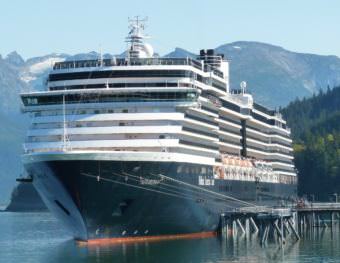
Passengers walk a downtown Juneau dock where three cruise ships are tied up June 11, 2017. (Photo by Ed Schoenfeld/CoastAlaska News)
Passengers walk a downtown Juneau dock where three cruise ships are tied up June 11, 2017. A little more than 1 million people rode ships to Alaska that summer. By 2019, the number will be 19 percent higher. (Photo by Ed Schoenfeld/CoastAlaska News)

The number of cruise ship passengers visiting Alaska will jump almost 20 percent over the next two years.

Port cities need to plan for the infrastructure needed to support that many people.

One industry idea could change community control of the fees cruise ships pay.

Cruise lines are bringing more and more tourists to Alaska.

Passenger numbers topped a million for the first time in almost a decade last summer.

Cruise Lines International Association Alaska President John Binkley said they’ll continue to go up.

About 1.31 million passengers are expected to arrive in 2019, 19 percent more than last summer, according to projections Binkley released at the recent Southeast Conference Mid Session Summit.

“Sometimes there’s new ships that are coming into the market,” he said. “Sometimes there’s larger ships that are replacing smaller ships. And sometimes they’re adding to the shoulder seasons to have more voyages.”

Starting this summer, the larger ships will really be larger.

The Norwegian Bliss will carry up to 4,000 passengers, plus crew, starting this June.

The Ovation of the Seas will come in the following year, with as many as 5,000 passengers per sailing, double the capacity of some ships already traveling the region.

Binkley said the growth requires more infrastructure.

“It’s not just one community having the facilities to be able to handle that ship,” he said. “You have to have at least three ports to be able to have a ship like that be able to deploy to Alaska,” he said.

Only Ketchikan, Juneau and Skagway can handle such vessels.

They’re the biggest Southeast ports and they get the largest share of passenger fees.

Binkley said those total about $45 million a year, statewide. He said pooling that would allow other cities to boost their industries, too.
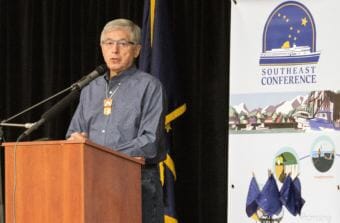
“We could be building a brand new dock each and every year in new communities around Southeast Alaska if we worked together and said … what’s the best way to take these dollars that we have and utilize them to grow the industry and have everybody in Southeast share and benefit from the industry,” he said.

It’s not a formal proposal, but the cruise association has already sued the capital city, challenging local control of how such funds are used.

Juneau City Manager Rorie Watt agrees more regional planning is needed.

But he takes a different approach.

He invited other community leaders to join the Southeast Cruise Port Association, which held its first meeting during the Mid Session Summit.

“I’m not under any illusion that we’re all going to cede local control of our communities to each other,” Watt said. “But I think we can get together on some very broad ideas.”

Those include improved communication and regional readiness for changes, such as quickly growing passenger numbers.

The industry’s share-the-wealth idea is of interest to Russell Dick, CEO of the Huna Totem Corp., which owns the Icy Strait Point attraction.

The renovated cannery and mile-long zip line completed its first dock two years ago, which brought more ships and visitors.

Dick said it’s looking toward construction of a second dock, which would support further growth.

“It’s all about tour capacity, having the infrastructure in place to handle the increase in ships and ship passengers,” he said. “And for us, that’s quite a bit. That’s a lot of people coming through.”

The cruise business is a significant part of Alaska’s visitor industry.

A cruise association report said ships, passengers and crew members spent about $1 billion during last summer’s season. And the passengers made up more than half of all visitors to the state.

Editor’s note: This report was updated to reflect cruise ships also brought a million passengers to Alaska in 2009.

Mallott lambastes Juneau’s annexation bid

Lt. Gov. Byron Mallott addresses the Southeast Conference Mid Session Summit on Wednesday, Feb. 14, 2018, in Juneau. He urged capital city leaders to talk more with its neighbors about annexation plans. (Photo by Heather Holt)

Lt. Gov. Byron Mallott said Juneau is not behaving like a good neighbor.

During a Wednesday speech to the Southeast Conference Mid Session Summit, he lambasted officials for trying to annex parts of nearby Admiralty Island.

Leaders from Angoon, the island’s only city, oppose what they call a land grab.

“Juneau needs to recognize that it’s the capital of Alaska but also the regional center of Southeast,” he said. “And it has a responsibility and an obligation to reach out affirmatively to every other community in Southeast and say, ‘Let’s be neighbors and let’s work together and let’s build a place that is unassailable by the Legislature or anyone else who would seek to divide us.'”

The Juneau Assembly voted in January to add four parcels to its borough, including parts of northern Admiralty Island.

It later dropped one parcel after hearing objections from cabin-owners, most of whom live in Juneau.

A former Juneau mayor, Mallott said officials should respond similarly to objections from the island’s traditional residents.

“The people of Angoon feel so passionate and spiritual about all of Admiralty Island,” he said. “They’re concerned about economic development on that side of the island now. What’s the future of their island, that they share with the rest of our country as one of the most beautiful places on the face of the Earth.”

Most of Admiralty Island’s million acres are protected as a national monument.

It’s used for subsistence hunting and fishing. But it also has a mine on its north end that has already been annexed by the capital city.

Juneau Mayor Ken Koelsch said Mallott is wrong about officials not reaching out to its neighbors.

“We attempted to go over to Angoon several times and were not able to find one (time) that was acceptable to the mayor and the group over there that we were trying to meet up with,” he said.

Koelsch said he’ll continue to try to set up a meeting.

He also noted that Angoon Mayor Pauline Jim has since come before the Assembly.

Angoon residents cite their traditional ties to the island.

Koelsch said Juneau also has longtime connections to the land it’s trying to annex. The land includes historic trade routes and areas are claimed as traditional territory by Juneau’s Aak’w Kwáan and Taku Kwáan.

The annexation process can take a least a year.

Koelsch said that gives Angoon and other opponents more chances to object.

“The Local Boundary Commission that’s set up by the state has public hearings once we put the application in and it involves everyone possible that could be affected by it,” he said.

Juneau began looking at the parcels after losing a boundary battle with Petersburg.

Both boroughs claimed rights to absorb acreage on the mainland between the two communities.

Juneau lost, in part because Petersburg petitioned for the property first. So it began looking at other areas within model borough boundaries set years before.

Industry leaders say salmon initiative would hinder development

A panel of industry leaders discusses timber, mining and other topics during the Southeast Conference Mid Session Summit Feb. 13 in Juneau. (Photo by Heather Holt)
A panel of industry leaders took up timber, mining and other topics Tuesday, Feb. 13, 2018, during the Southeast Conference Mid Session Summit in Juneau. Josh Kindred of the Alaska Oil and Gas Association, right, spoke against the Stand for Salmon initiative. (Photo by Heather Holt)

Industry representatives are telling Southeast leaders they need to oppose the Stand for Salmon initiative and related legislation.

The measure, which is being challenged in the courts, would create stronger protections for Alaska’s salmon streams and rivers.

During the Southeast Conference Mid Session Summit in Juneau, power company and oil industry officials told about 100 regional officials Tuesday that the initiative would hinder development.

“What’s implied is that currently in Alaska, salmon or anadromous fish habitat isn’t protected,” said Josh Kindred, environmental counsel for the Alaska Oil and Gas Association. “And nothing could be further from the truth,”

He said the initiative and somewhat similar legislation would require unnecessary environmental reviews and its new regulations would be unenforceable.

“One of the fundamental problems here is that if this passes, you are basically giving the state five years of litigation,” Kindred said. “Given all the ambiguity in the proposal, all the gaps, all the contradictions, the state is going to be sued on this time and time again, because there is no clear path for the state to implement this without getting sued.”

That’s not the case, backers said. They said the Stand for Salmon initiative would update a 60-year-old law that does not give enough priority to Alaska’s fisheries.

The Alaska Power Association told the conference it also opposes the proposals.

Spokesman Michael Rovito said the legislation, House Bill 199, could hold up new and updated hydropower projects.

“It contains a grandfather clause to where if you already have an existing project, as long as you don’t make any significant changes, you fall under your past permitting regime,” Rovito said. “But as soon as you make a significant change, you can fall under this new major permit.”

Sealaska Corporation also is concerned about the additional limits on development.

CEO Anthony Mallott said it requires too much regulation. The regional Native corporation is Southeast’s largest private landowner.

Initiative opponents have organized a well-funded campaign through the group Stand for Alaska.

The business leaders urged the Southeast Conference to adopt a resolution opposing the Stand for Salmon initiative.

It’s already considering such a resolution, which will likely be approved.

Site notifications
Update notification options
Subscribe to notifications