Ed Schoenfeld, CoastAlaska

Kake hydro gets boost in governor’s budget

Diesel generators in the Kake Powerhouse provide electricity to the town’s residents. The Gunnuk Creek hydroproject would replace about half of the power. (Photo courtesy Inside Passage Electric Authority)

A hydroelectric plant for a small Southeast Alaska community is a step closer to reality. Gov. Bill Walker included funding for Kake’s Gunnuk Creek project in his capital budget proposal.

Kake is a village of about 600 people on Kupreanof Island, about 100 miles southeast of Juneau.

It gets its power from diesel generators, which makes it expensive.

Officials have been looking for alternatives for years.

The most likely option, at this point, is a small hydroelectric project using water from nearby Gunnuk Creek.

“It is shovel-ready,” said Jodi Mitchell, CEO and general manager of Inside Passage Electric Cooperative, a nonprofit group that also runs systems in Hoonah, Angoon, Klukwan and the Chilkat Valley.

Mitchell said Gunnuk Creek, if built, will be the third such project for its communities.

Two more are on the list.

“We have an opportunity with these hydroprojects to fix a problem and completely get ourselves off diesel,” he said.

Gunnuk Creek is ready to be built. but it’s been stalled for several years. Now, it’s included in the governor’s spending plan for the next budget year.

The nearly $4 million isn’t enough to complete all the work, but it’s a solid start.

Mitchell hopes to get additional funding through a federal grant. She said the cooperative could also borrow the remaining $3 million.

Kake is represented in the state Senate by Bert Stedman, a Sitka Republican. He supports construction, but sees some issues.

“My concern with this project is that we build Gunnuk Creek, but it’s on a postage stamp rate amongst other communities, he said. “And I’m not sure how much the communities, including Kake, are going to see their utility rate impacted.”

The rate is based the average of costs for all of the electric cooperative’s customers, which means Kake will only see some of the benefits of cheaper electricity.

But Mitchell said customers there will still pay lower bills.

“I believe now that the economics of that, even if we were to borrow the money, would still result in a small rate reduction for our consumers, our member owners,” she said.

For years, officials hoped Kake’s needs would be met by a new, 60-mile power line to Petersburg, which would connect to a regional grid linked to two large hydroprojects.

The line and an accompanying road have been studied intensely. And, it has some of the permits it needs. But it’s been shelved because the tens of millions of dollars it would cost isn’t there.

The power line project recently lost a $2 million grant from the Alaska Energy Authority. And some on the hydro agency that held the grant hoped the money could be spent on Gunnuk Creek or another project in the region.

Energy authority spokeswoman Katie Conway said that’s not how it works.

“The Gunnuk Creek project is not connected at all to the Kake-Petersburg intertie,” Conway said. “It is unique, the project was high enough on the list through the solicitation process and the application-vetting process required in order for projects to get funding.”

Gunnuk Creek will use a dam built last decade to provide water to Kake. The structure was also designed to be used for a hydroproject.

Mitchell said it needs a 2,100-foot penstock, or large pipe, to carry water down to generators. She said they’ll provide more than half of Kake’s electricity. The rest will come from its diesel power plant, which was recently upgraded to be more efficient.

The penstock will also provide water for the local hatchery. That was purchased last spring by a regional aquaculture association based in Sitka.

Can an Alaska lawmaker restore net neutrality in the state?

Protesters demonstrate in favor of net neutrality near the home of Federal Communications Commission Chairman Ajit Pai in May 2017. Some Alaska officials are looking at what they can do to restore the Obama-era policy.
Protesters demonstrate in favor of net neutrality near the home of Federal Communications Commission Chairman Ajit Pai in May. Some Alaska officials are looking at what they can do to restore the Obama-era policy. (Creative Commons photo by Anne Meador/cool revolution)

Alaska could join the ranks of states fighting to restore net neutrality. While the Walker-Mallott administration has no immediate plans, a state lawmaker does.

Rep. Scott Kawasaki doesn’t like what just happened to the internet. In particular, he’s opposed to the increased power telecommunications companies have over their customers.

“As it stands with repeal of net neutrality, it sounds like they’re going to have the ultimate hammer and be able to direct traffic and that’s simply not the way the internet was made great. And I think we can do better,” Kawasaki said.

The Fairbanks Democrat is preparing a bill addressing those concerns.

Rep. Scott Kawasaki, D-Fairbanks, at a press availability held by House Democrats Feb. 23, 2016. (Photo by Skip Gray/360 North)
Rep. Scott Kawasaki, D-Fairbanks, speaks at a press availability held on Feb. 23, 2016. (Photo by Skip Gray/360 North)

He hasn’t worked out all the details. But he said it will attempt to reverse the Federal Communications Commission’s recent decision on net neutrality.

“You couldn’t throttle down certain sites; certain sites wouldn’t be demoted or certain sites wouldn’t be enhanced. Basically, that every Alaskan would have the freedom to choose which site they’d like to go to without having it be essentially slowed down by the internet service provider,” Kawasaki said.

Gov. Bill Walker and Attorney General Jahna Lindemuth support the principles of net neutrality. In a letter to the FCC, they say unrestricted broadband internet is a lifeline for rural Alaskans. They point to telemedicine, distance education and other services that are provided online.

The administration said it hasn’t determined what to do next. But Washington state has.

“We’re here to say that we are not powerless today and we will act to protect Washingtonians against violations of net neutrality,” said Democratic Gov. Jay Inslee, just before the FCC’s vote.

Inslee said the state can use its purchasing power to favor compliant companies. It can make access to utility poles more difficult for others. And it could permit public utility districts to offer retail broadband to increase consumer choice.

Fairbanks legislator Kawasaki said his bill will include some of the same terms. He’s also looking at similar legislation proposed in California.

Alaska’s two large internet service providers say they’ll maintain net neutrality, even if they don’t have to.

“We believe in a free and open internet,” said Heather Handyside of GCI, Alaska’s largest internet provider. “GCI’s always believed customers have the freedom to make their own choices on the internet. We do not impede or prevent or direct or in any way discriminate on the access that customers have,” she said.

GCI’s largest competitor said the same thing.

“We plan to continue offering unlimited internet, just as we always have. We do not prioritize internet traffic today and we don’t plan to do so in the future,” said Hannah Blankenship of Alaska Communications, which some know as ACS.

Kawasaki worries that could change if new providers join the Alaska market. Or, if either company is bought out by someone with a different approach.

But he understands there’s limits on what Alaska’s government can do.

“It looks like state laws and state statutes probably won’t hold up because the FCC and the federal government and Trump, specifically, said that states would not have any power or authority, even if it’s within their own state,” he said.

The FCC decision’s backers say it will increase competition, which could lead to better service and lower rates.

Kawasaki doesn’t expect either to happen in Alaska.

Northwest News Network’s Tom Banse contributed to this report.

Walker budget proposes fix for spring ferry funding foul-up

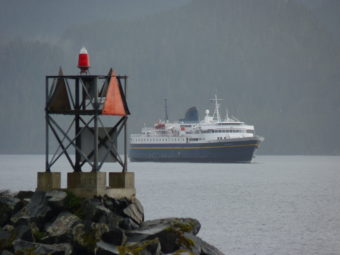
The ferry Malaspina makes a rare appearance near downtown Sitka in 2010. A new report suggests a public corporation be formed to manage ferry operations. (Photo by Ed Schoenfeld/CoastAlaska News)
The ferry Malaspina makes a rare appearance near downtown Sitka in 2010. All marine highway vessels will have to shut down this spring if a budget gap isn’t filled. (Photo by Ed Schoenfeld/CoastAlaska News)

Gov. Bill Walker’s new budget fills a gap that could have shut the ferry system down for much of the spring. The spending plan, released Dec. 15, also funds the full Alaska Marine Highway schedule for the next fiscal year.

A complex provision in this fiscal year’s budget cut about a fifth of the marine highway’s funding.

If the money isn’t replaced, General Manager Capt. John Falvey said ships will stop sailing.

“We feel we can operate the ferry system until approximately the middle of April 2018. Then we would in essence have to shut the system down,” he said.

It wouldn’t start up again until the next budget year starts July 1. So all ferries would be tied up for about two and a half months.

But there’s a remedy in the Walker administration’s budget. It restores the funds – about $24 million. And that would allow the ferry system to continue serving its about 35 port communities — if it remains in the spending plan.

The fast ferry Fairweather docks at Juneau's Auke Bay Ferry Terminal in 2013. (Photo by Ed Schoenfeld/CoastAlaska News)
The fast ferry Fairweather docks at Juneau’s Auke Bay Ferry Terminal in 2013. (Photo by Ed Schoenfeld/CoastAlaska News)

“I would think the Legislature will support it,” said Sitka Republican Sen. Bert Stedman, who chairs his chamber’s transportation committee.

He said he expects opposition. But so far, House and Senate Finance Committee leaders haven’t disapproved.

“The co-chairs have been notified over a month ago by letter that this was coming and if they didn’t agree to it to let the administration know. As far as I know, there was no objections to it,” he said.

The Alaska Marine Highway System money is in what’s called the supplemental budget. It includes appropriations that fills gaps in this fiscal year, which ends June 30.

Funding for the fiscal year starting July 1 is listed in the operating budget. Walker’s version proposes a small drop in ferry system funding, less than 1 percent.

But Falvey said service will increase slightly, because some ships are cheaper to sail than others.

“We will run the Columbia a little less and the Malaspina a little bit more. Because of the ship configuration that we have this year, even with a little less money, we will be able to run a few more weeks of service,” he said.

Next year’s marine highway budget is just under $140 million.

Walker’s spending plan also includes money for a small, separate nonprofit Inter-Island Ferry Authority.

“It’s the thing that keeps us solvent,” said General Manager Dennis Watson.

It sails one route connecting Hollis on Prince of Wales Island and Ketchikan.

“We come within 15 to 20 percent of making our operating costs out of the fare box. So we fall a little bit short at the end of the year. And this helps. This makes up that,” he said.

The amount is $250,000, the same as has been requested in earlier years.

The governor’s budget lists his administration’s priorities. But the Legislature will make the final decisions. That means it could take months before either ferry system knows what it’s funding will be.

Two really, really big cruise ships headed to Alaska

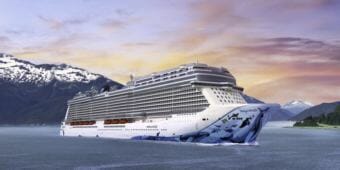
The Norwegian Bliss, shown in a promotional image, will begin sailing Alaska waters in about six months. It's one of two megaships slated to sail the Inside Passage. (Image courtesy Norwegian Cruise Line)
The Norwegian Bliss, shown in a promotional image, will begin sailing Alaska waters in about six months. It’s one of two megaships slated to sail the Inside Passage. (Image courtesy Norwegian Cruise Line)

Larger and fancier cruise ships will begin visiting Alaska ports starting this summer. The so-called “megaships” are part of a trend that’s sending more and more tourists to Alaska by sea.

If you think Alaska cruise ships are big, you ain’t seen nothing yet.

The 4,000-passenger Norwegian Bliss starts making port calls in June. The 5,000-passenger Ovation of the Seas shows up the following year.

Add 1,200 to 1,500 crew members and either will exceed the population of all but three Southeast cities.

“I believe people will notice the size difference in these ships, particularly the Ovation of the Seas,” said John Binkley, president of Cruise Lines International Association’s Alaska branch. “That is significantly bigger than the ships that people would normally be seeing throughout Alaska.”

The Bliss and Ovation will carry up to twice as many passengers as some ships already sailing here.

Chris Gray Faust is senior editor of Cruise Critic, an analysis and sales website owned by TripAdvisor, a popular travel-review app. She said Alaska is catching up with other cruise destinations.

“The large ships have been going to the Caribbean for several years. They’ve been over in Europe. They’ve been over in Asia and Australia,” she said.

So, why are they headed our way?

Gray Faust and Binkley said cruise lines are responding to several years of increased demand.

“It’s a somewhat exotic destination, yet it’s on U.S. soil,” Binkley said. “And it’s someplace that people feel comfortable and safe to visit.”

That was also the case after the 9/11 terror attacks.

The 5,000-passenger Ovation of the Seas begins its 26-mile conveyance to the North Sea March 11, 2016. It will begin sailing Alaska's Inside Passage beginning in 2019. (Photo courtesy Royal Caribbean International.)
The 5,000-passenger Ovation of the Seas begins its 26-mile conveyance to the North Sea March 11, 2016. It will begin sailing Alaska’s Inside Passage beginning in 2019. (Photo courtesy Royal Caribbean International)

Gray Faust said there’s also additional interest from overseas.

“Ovation of the Seas has been designed for an international passenger base. It’s been based in Asia and also Australia. And it already has some name recognition in those regions,” she said. “And by bringing it to Alaska, I think you’ll see more of those international passengers also come up.”

The Ovation is leaving its China and Australia routes due to a drop in demand.

The Norwegian Bliss is a new ship that adds to the overall number sailing Inside Passage waters. Binkley said the Ovation of the Seas will replace a smaller ship.

“We are gaining slightly on the number of ships, but most of the capacity increase, the increase in the number of passengers is because of the larger ships, rather than additional ships,” he said.

The Bliss will sail week-long round-trips out of Seattle, stopping in Ketchikan, Juneau and Skagway. It will also sail to Sawyer Glacier in Tracy Arm Fjord, south of the capital city.

The Ovation will be based in Seattle, too. Its Alaska itinerary hasn’t been posted yet. But it’s likely to follow a similar route.

Gray Faust said ships that large have added on-board attractions.

She points to the Norwegian Bliss, which advertises the largest go-kart race track on the seas. It also has a laser tag set that looks like it’s on the Death Star from “Star Wars.”

“One thing that’s very nice for passengers going to Alaska is they have a 20,000-square-foot observation lounge with 180-degree views,” she said. “Passengers in that lounge, they’ll really get the beauty of the landscape right there. They’ll be able to see it all as they come in.”

The Ovation of the Seas advertises skydiving and surf simulators, as well as robotic bartenders. But it’ll give the Bliss a run for its money in terms of scenery.

“They have what’s known as the North Star, which is a compartment that rises above the ship, like a traveling viewing compartment,” she said. “People should be able to get good views from that and certainly from the shore, people will notice that.”

The Bliss is owned by Norwegian Cruise Line. The Ovation is owned by Royal Caribbean International. Both sail other ships to Alaska.

Editor’s note: This report was updated to state that both cruise lines already sail the Inside Passage. The original version said only Norwegian sailed here.

Summer ferry schedule adds Cordova sailings

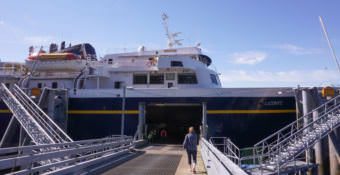
A passenger boards the Alaska Marine Highway System ferry LeConte in Pelican on Aug. 6, 2017.
A passenger boards the Alaska Marine Highway System ferry LeConte in Pelican on Aug. 6, 2017. Next summer’s ferry schedule has been finalized and is open for reservations. (Photo by Jeremy Hsieh/KTOO)

The Alaska Marine Highway System began taking summer season reservations Monday.

The schedule covers May through September 2018. It lists pretty much the same routes and port calls as this year’s summer season.

Ferry spokeswoman Aurah Landau said the schedule hasn’t changed a lot since a draft version was released for comment in October. But it details plans for Prince William Sound sailings that weren’t listed before.

“That was left blank due to budget questions,” Landau said. “And we heard from Cordova that they really wanted service there and we were always planning to give them service. But then this new schedule documents how this service will happen.”

Reservations can be made through FerryAlaska.com or by calling 1-800-642-0066. They also can be made at any ferry terminal during open hours.

The schedule is based on a spending plan that the Legislature could change. If the budget is cut, officials say reductions will most likely hit next winter’s schedule.

Mechanical problems sometimes disrupt ferry service.

No one can predict all breakdowns. But Landau said the fleet’s in pretty good shape right now.

“We haven’t seen any repair issues since the draft has come out and we don’t anticipate any repair issues changing the schedule. Most of the boats have been in long overhauls recently, so we’re looking like we’ll be in pretty good shape for the summer,” she said.

The current year’s schedule shifted after the ferry Columbia struck an unknown submerged object. It resumed sailing at the end of October.

And this winter’s schedule has been reduced because the ferry Malaspina needs extra repairs. Sailings to and from Prince Rupert will be canceled for two months beginning Dec. 22.

Canada rejects transboundary mine permit protest

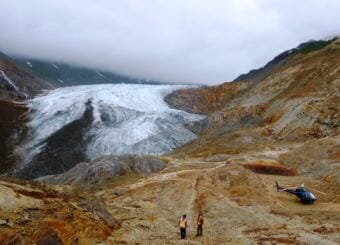
Seabridge Gold staff stand in a rust-colored valley that’s part of its Kerr-Sulphurets-Mitchell exploration project in 2014. A federal agency in Canada has rejected a permit appeal from an Alaska conservation group.  (Photo by Ed Schoenfeld/CoastAlaska)

An Alaska environmental group has lost its appeal of a large Canadian mining project planned for just across the border.

The developer said the decision shows it’s behaving responsibly. But the conservation group said project owners, and Canada’s government, didn’t follow their own rules.

About a year ago, the Southeast Alaska Conservation Council tried a new tool to protest plans for the Kerr-Sulphurets-Mitchell transboundary mining project.

It appealed to a Canadian agency called the National Contact Point. SEACC staff scientist Guy Archibald said it’s supposed to address international business disputes.

“We’re exploring every venue we can to try to protect the transboundary rivers and the communities and fisheries they support from the large-scale development of Canadian mines across the border,” he said.

Guy Archibald of the Southeast Alaska Conservation Council, left, discusses issues with former Sitka Mayor Mim McConnell, right, during a 2015 transboundary mine meeting in Juneau. (Photo by Ed Schoenfeld/CoastAlaska News)

It tried to convince Canadian authorities that project owners didn’t fully follow guidelines requiring stakeholder engagement and environmental protections.

But last month, that agency rejected that appeal.

“There is no formal requirement for us to engage in Alaska,” said Rudi Fronk, chairman and CEO of Seabridge Gold.

The Toronto-headquartered corporation owns the KSM — and another British Columbia mine-exploration project.

“The confirmation from the National Contact Point in Canada just clearly reinforces the process we went through during the environmental assessment process, that the engagement we had not only with the Canadian authorities, but also the Alaska authorities, was appropriate and bountiful,” he said.

(Read the National Contact Point report rejecting SEACC’s appeal of the KSM project.)

SEACC acknowledges meetings took place, involving conservation, tribal, fisheries and other Southeast Alaska groups.

But Archibald said the Canadian government failed to look into what happened at those meetings.

“They did not consider at all whether that communication between Seabridge Gold and SEACC was adversarial at all. Or particularly informative at all,” he said. “Just that Seabridge had attended some meetings, presented their PowerPoint and that was adequate.”

Seabridge Gold said it’s listened to concerns and made changes in its plans.

(Watch Seabridge Gold’s Rudi Fronk discuss plans for the KSM Mine.)

For example, it moved its tailings storage site at the request of British Columbia tribal leaders. And Fronk said it added protections to its design for that site, where waste rock is kept after being processed.

The KSM, Red Chris and Galore Creek projects are among several planned for northwest British Columbia, near the Alaska border. (Map courtesy Seabridge Gold)

“There is no requirement, or there was no requirement, in British Columbia to actually line the tailings facility,” he said. “But we agreed that we would line a portion of the tailings facility to deal with material that went through the mill that would actually touch cyanide.”

The company continues drilling at its KSM site to locate valuable concentrations of gold, copper and other metals.

But its biggest challenge is to find investors and partners to turn the exploration project into a mine.

Fronk said the corporation has turned down several offers because they were not the right match.

He said non-disclosure agreements prevent him from identifying those companies.

SEACC, meanwhile, continues to push for high-level talks between U.S. and Canada’s federal governments.

It, other organizations, the Walker-Mallott administration and Alaska’s Congressional delegation want stronger protections for Alaska fisheries.

(Take a tour of the KSM exploration projects during the summer drilling season.)

Site notifications
Update notification options
Subscribe to notifications