Ed Schoenfeld, CoastAlaska

Business leaders call for medical bill transparency

The Ketchikan Medical Center plans improvements to its bill-estimation system. Local business leaders and some city council members want accurate cost estimates to be readily available. (KRBD file photo)
The Ketchikan Medical Center plans improvements to its bill-estimation system. Local business leaders and some city council members want accurate cost estimates to be readily available from all medical providers. (File photo by KRBD)

Ketchikan business leaders are calling on the city’s medical providers to share more information about their bills, as part of a larger discussion that’s attracting attention around the state and nation.

Some Ketchikan officials want to make it easier for residents to find out what medical procedures cost before they’re done.

The Ketchikan City Council brought up the issue earlier this fall.

Some members asked about passing an ordinance similar to one the Anchorage Assembly approved earlier this year.

Now, business leaders are asking for the same thing.

“We saw what the municipality of Anchorage did and we thought, ‘Wow, that’s a great idea,’” said Chelsea Goucher, president of the Ketchikan Chamber of Commerce Board of Directors.

The chamber recently shared a statement she authored in favor of medical bill transparency.

She said such a measure would level the playing field as well as improve the quality of life in the Southeast Alaska city, and that’s good for business.

“We think all providers will benefit from moving in that direction as well as the public,” she said. “Just to have choice, a better understanding of kind of what they’re getting into it before they get into it. It’s something that for one provider to do it and not the others doesn’t really solve the problem.”

Anchorage’s ordinance instructs hospitals, clinics and doctors’ offices to give patients a non-binding price estimate for services on request. It includes supplies and other costs involved in a procedure.

That effort, and the one in Ketchikan, are part of a growing nationwide movement toward medical cost transparency.

Some offices already make that information available, but not a lot.

“I think, on balance, it’s a rarity,” said Niall Brennan, president and CEO of the Health Care Cost Institute, a non-partisan, non-profit Washington, D.C.-based firm that collects and analyzes health-cost data.

“For every provider that has made an effort, there are dozens who deliberately or inadvertently make it extremely difficult for anybody to understand the true costs,” he said.

The Ketchikan City Council discussion focused on the local hospital.

Member Judy Zenge said patients have a right to know what procedures will cost – and that isn’t happening.

“We have a $52,567,000 hospital and a lot of people I know don’t go there. And part of it is because they can’t find out how much things are going to cost,” she said.

The city-owned Ketchikan Medical Center is managed by PeaceHealth, a Catholic health-care ministry.

Chief Administrative Officer Ed Freysinger acknowledged council members’ concerns – and those of the public. He said PeaceHealth also wants to increase billing transparency.

“We’re evaluating options to improve access to tools to gain that estimate,” he said. “Right now, we do it through a phone access. We are looking an option to have it available through our website.”

Such a system would cover all PeaceHealth facilities, which are in Alaska, Washington and Oregon, he said, but there’s no set date for completion.

Niall Brennan of the Health Care Cost Institute said an online system is best.

“Making somebody call a phone number to understand the cost of a service is not really acceptable in this day and age,” he said.

He said the information must be presented so it can be easily understood and downloaded onto an individual’s computer.

But, there’s disagreement.

“There are online systems, but they don’t always capture all the relevant information that people need to know,” said Becky Hultberg, president and CEO of the Alaska State Hospital and Nursing Home Association.

She said patients do better on the phone.

“We really encourage individual conversation, first with the insurer, because the insurer actually has the most information about the patient’s out-of-pocket costs,” she said. “Because they know the deductible, they know the co-payment and they understand the individual’s plan.”

And if that doesn’t work, she advises patients call the hospital or other provider. Those who are uninsured or have high deductibles should do the same – and ask about discounts or financial assistance.

The Ketchikan City Council plans to discuss the issue in more detail at a Dec. 21 meeting.

State ferry Taku won’t become a Portland hotel after all

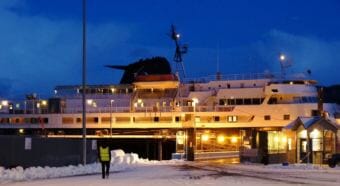
The ferry Taku waits to load passengers in Sitka Jan. 22, 2012, while it was still sailing. It’s been sold to a company based in Dubai after a Portland, Oregon, bidder withdrew its offer. (Photo by Ed Schoenfeld/CoastAlaska News)
The ferry Taku waits to load passengers Jan. 22, 2012, in Sitka, while it was still sailing. It’s been sold to a company based in Dubai after a Portland, Oregon, bidder withdrew its offer. (Photo by Ed Schoenfeld/CoastAlaska News)

The state ferry Taku is not hip enough for Portland, Oregon.

Earlier this fall, a company based there placed the winning bid of $300,000 for the 54-year-old vessel. KeyMar LLC’s plans were to turn it into a floating hotel.

The company withdrew its bid earlier this month, said John Falvey, Alaska Marine Highway general manager.

“They cited regulatory issues, potentially, other competing projects within their group, within their company … and things like that,” he said.

KeyMar representative Jonathan Cohen said his group could not gain enough support from neighboring property owners to win the required permits.

“The team did not want to introduce a property that wouldn’t be fully embraced by the surrounding community,” Cohen wrote in an email. He said the group is instead turning an old Columbia River school into a hotel.

After the Portland company pulled out, the state informed two other bidders from the last round that the 350-foot ferry was again for sale.

Falvey said the top bidder offered $171,000, two-thirds more than the minimum needed.

“Tuesday at 3 o’clock, we opened the bids. And the winner was the Jabal Al Lawz Trading Co., from the (United Arab) Emirates, who I believe is purchasing the ship to take it for scrap,” he said.

So it might end up in a marine junkyard. But he’s not sure.

Attempts to contact the company were not successful. But the Juneau Empire reports the company plans to use it as a ferry in the Philippines.

Falvey said the company already paid a $25,000 deposit. The balance will need to be in hand before he can sign sale documents. The timing has not been determined.

“We prefer to do it before the end of the year. But that may not happen with the holidays and things like that. If they’re going to get a crew here, they’ve got to bring a foreign crew to the United States and they need to get visas and things like that,” he said.

He said the state will continue to pay to store the Taku at Ketchikan’s Ward Cove for 30 days after the sale is completed.

After that, storage or transport is up to the buyer.

Falvey said the company indicated it could be reflagged to another country, which would allow transit through U.S. waters.

Right now, the Taku lacks equipment and certifications needed to sail under the U.S. flag.

The Taku was tied up in 2015 as the ferry system looked for ways to balance its budget. The ship can carry about 350 passengers and 50 vehicles. It has 40 staterooms, a cafeteria, observation lounges and a covered solarium.

State officials have been trying to sell the Taku since last spring. It was first priced at $1.5 million.

Editor’s note: This report was updated Dec. 1, 2017, with information from the Portland bidding group .

Some of Southeast’s recycling is headed to the landfill

Sitka's recycling center has separate bins for different materials. But mixed paper containers are gone, due to new restrictions tied to import rules in China. (Photo by Robert Woolsey/KCAW)
Sitka’s recycling center has separate bins for different reusable materials. But its mixed paper containers are gone, due to new restrictions tied to import rules in China. (Photo by Robert Woolsey/KCAW)

Much of the cardboard, plastic bottles and other items recycled in Alaska end up in China. The East Asia country is about to impose new rules limiting what it will accept.

Here’s how that affects our part of the world.

Locals sort through tubs and boxes of empty bottles and cans on a recent afternoon at Juneau’s recycling center.

They toss aluminum in one bin and plastics numbered 1 and 2 in another. Cardboard has its own place, as does mixed paper. Nearby containers hold glass and tin cans.

Those recycling generally like the idea of reusing items and keeping them out of the nearby landfill.

But soon, that’s going to be a little harder to pull off.

A substantial amount of Alaska’s recycling is shipped to China, where it’s shredded or melted down or both before being turned into new products at that nation’s numerous factories.

“China takes so much of the U.S. materials they have a lot of market power,” said Mary Fisher, executive director of Alaskans for Litter Prevention and Recycling.

She said China will start limiting what it takes at the beginning of next year.

Juneau residents drop off cans, bottles, paper and cardboard at the local recycling center.  (Photo by Casey Kelly/KTOO)

Plastics No. 1 and 2, such as soda bottles and milk jugs, will continue to be accepted.

The same is true for aluminum cans and corrugated cardboard.

But the higher-number plastics, Nos. 3 through 7, — including some takeout food containers, plastic cups and shower curtains — will not.

Neither will mixed paper, such as mail, magazines and newspapers.

“Most communities in Alaska are not accepting mixed plastics like that. So I don’t see that as being a major impact up here. And the mixed paper, a little bit more problematic as China uses a lot of mixed paper,” Fisher said.

A number of Southeast Alaska communities barge their recycling – as well as their garbage – south.

Republic Services has the contract to barge recycling from Ketchikan, Sitka and Petersburg. It recently informed those communities it stopped recycling plastics Nos. 3-7 earlier this month.

Sandra Woods is a municipal landfill specialist for the state.

“What they’ve told everybody is they’re going to accept everything like they have been. But it’s important that the communities know that plastics 3-7 and the mixed paper is going to be landfilled after China no longer accepts it,” she said.

China also is cracking down on what’s called contamination, or too many unrecyclable items, mixed in.

Juneau’s municipal solid waste coordinator Jim Penor blames curbside recycle, which also is done in Juneau, as well as Petersburg.

“When you think of the single-stream recyclable collection program at the curbside, and everybody can just throw in everything all in one bin,” he said. “That, I believe, has created the problem that has increased the percentage of contaminates going to China.”

The new import rules don’t kick in until January.

But Penor said it’s already had an impact on recycling revenue, which helps fund local collection and shipping efforts.

“I was getting approximately $130 a ton for cardboard up until October,” he said. “In October, it went to $40. I was getting $85 to $100 a ton for my plastics. That went to $10.”

He said contamination can only improve at the home or business level – or with expensive sorting.

It is possible China will roll back some of its restrictions before they take effect. Or, they may be short-term.

Penor said it gives large recyclers that take Alaska’s material motivation to look for other customers.

“They’re looking at world markets. Where else can we ship our stuff? We’re shipping it to China. Can we get Vietnam excited about making some manufacturing plants using recycled material from the United States? The Netherlands, Australia, different places,” he said.

Some recyclables haven’t been shipped south to find new uses for a while.

Glass, for example, mostly stays here, due to low prices and high shipping costs. But some places crush it and use it for sand or gravel.

Learn about other garbage issues and solutions in Southeast Alaska through CoastAlaska’s Talking Trash series.

State, delegation push feds on transboundary mining

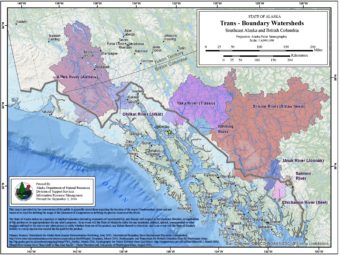
The state has identified eight transboundary watersheds feeding Southeast Alaska rivers. (Map by Alaska Department of natural Resources.)
Eight transboundary watersheds feed into Southeast Alaska rivers. Alaska officials are pushing for stronger protections. (Map courtesy Alaska Department of Natural Resources)

Alaska leaders want Secretary of State Rex Tillerson to push Canadian officials to better protect Southeast fisheries from British Columbia mine projects.
The governor, lieutenant governor and Congressional delegation made the ask in a joint letter sent Nov. 13 to the U.S. State Department.

Lt. Gov. Byron Mallott said officials want environmental protections discussed at an upcoming meeting of the department and its Canadian counterpart.

“We focused on asking them to have the B.C. mining projects, the transboundary treaty and the implementation of it as it relates to transboundary rivers in Alaska be included on their agenda,” he said.

State officials made similar requests to John Kerry, the previous secretary of state. But his department sent the issue back to Alaska, since it already was consulting with British Columbia.

Since then, tribal, environmental and fisheries groups have demanded stronger action to protect watersheds where Alaska salmon spawn and grow.

Chris Zimmer works for Rivers Without Borders, an environmental group that has warned of the dangers of transboundary mining for more than a decade.

“This is what’s been needed all along, is this concerted approach from our members of Congress and the state to the U.S. federal government,” Zimmer said. “And then hopefully what that will result in is a concerted approach to B.C. and Canada both, to deal with some current issues we have with transboundary mining.”

Two mines and more than a half-dozen exploration projects are active not far from the Alaska border.

Another long-closed mine is leaking acidic water.

The U.S. State Department’s Bureau of Western Hemisphere Affairs said the agency is aware of the concerns expressed in the letter.

“This is an issue we have raised with our Canadian counterparts at a number of levels with both provincial and federal governments, and we will continue to engage with them on it,” a spokesperson wrote in an email.

British Columbia officials said they’ve improved permitting and regulation of mines and mining projects with Alaska and other downstream interests in mind.

Mine owners and developers have said their projects don’t pose serious threats to Alaska.

The letter asks for specific steps beyond what’s already been done to be taken to protect Alaska waters.

Lt. Gov. Byron Mallott signs a statement of cooperation with British Columbia Thursday. It targets protecting transboundary rivers. (Photo courtesy Office of the Governor)
Lt. Gov. Byron Mallott signs a statement of cooperation with British Columbia in 2016. The Walker-Mallott administration is asking for further action to protect transboundary rivers. (Photo courtesy Office of the Governor)

Mallott said one important effort would standardize monitoring downstream from the mines and projects.

“Right now, water quality and other environmental data is gathered as the result of specific permits for specific projects,” Mallott said. “And we believe that that kind of monitoring should be undertaken on a consistent, over-time basis by our governments.”

The state signed a memorandum of understanding with British Columbia about a year ago.

But the provincial government has changed leadership, as have both federal governments.

Mallott said his administration continues working with provincial officials. He and other officials met with their British Columbia counterparts this month.

But he said the State Department needs to become a strong partner in those efforts.

The group Salmon Beyond Borders has recently criticized the state for acting too slowly. But spokeswoman Heather Hardcastle said the letter is a step in the right direction.

“They need to know that they’re not stepping on the toes of the state or the delegation, but instead (are) carrying out, really, united asks,” Hardcastle said.

The letter to Tillerson was signed by Mallott, Gov. Bill Walker, Sens. Lisa Murkowski and Dan Sullivan, and Rep. Don Young.

It said the state department should:

  • Encourage B.C. officials to develop public outreach tools to better explain their processes for considering the cumulative impacts of proposed mining projects on transboundary waters during the environmental assessment process.
  • Determine whether an International Joint Commission reference is a suitable venue to evaluate whether mines operating in the transboundary region between B.C. and Alaska are implementing best management practices in the treatment of wastewaters and management of potential-acid-generating mine tailings and waste rock.
  • Establish a formal consultation process with U.S. state agencies, other federal agencies, tribes and Alaska Native Claims Settlement Act corporations during the environmental assessment process, similar to the consultation process afforded to a cooperating agency under the National Environmental Policy Act in the U.S.
  • Support and work toward robust funding and other needed resources for developing a reliable database of water quality and related data for transboundary waters that can be used to track cumulative impacts, trends and significant episodic changes associated with operating and historic mines in the  transboundary region.
  • Establish an interagency task force led by the Department of State and including the Department of Interior, the Environmental Protection Agency and other agencies as necessary, to work in collaboration with the State of Alaska, and develop recommendations and direct funding to ensure protection of transboundary rivers.

Editor’s note: This report has been updated with comments from the U.S. State Department.

Downtown Juneau’s warming shelter approved

Municipal officials plan to open a warming center for the homeless later this month.

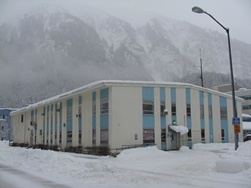
The Alaska Department of Public Safety building will be home to Juneau’s warming shelter. (File photo by Casey Kelly/KTOO)

The Juneau Assembly approved an ordinance appropriating $75,000 to the project at its Nov. 6 meeting.

The center will be open when the temperature drops below freezing.
It will operate through April in the old Department of Public Safety Building on Whittier Avenue, near Centennial Hall.

It’s expected to hold about 25 people.

The Assembly considered and supported the proposal at an Oct. 23 work session. But it needed a full vote in a regular meeting to become official.

Monday’s vote was unanimous. Funding will come from municipal tobacco tax revenues.

The city also considered using its downtown transit center for the warming shelter.

The City of Ketchikan also voted this fall to fund a seasonal warming center for homeless residents. The cost there is $80,000.

State challenges national forest roadless rule again

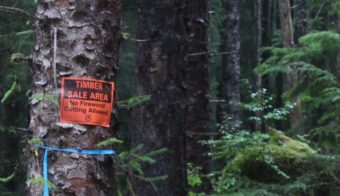
A timber sale sign is posted in the Tongass National Forest on Prince of Wales island. (KRBD file photo)
A timber sale sign is posted in the Tongass National Forest on Prince of Wales Island. The state is in court again, trying to end the U.S. Forest Service’s roadless rule, which limits logging and other development in the Tongass. (KRBD file photo)

The state of Alaska is again trying to overturn the U.S. Forest Service’s roadless rule.

Officials on Nov. 6 appealed a September court decision that threw out an earlier state challenge.

The rule mostly blocks logging in undeveloped areas of the Tongass National Forest.

It was established more than 15 years ago, but the Tongass was given an exemption, which was later overturned.

Assistant Attorney General Tom Lenhart said the state continues to challenge the roadless rule because it’s damaging Southeast Alaska’s economy.

“It’s played a key role in the almost complete demise of the timber industry,” he said. “It’s impacted utility companies and rural communities who may have future plans to build additional roads to connect to the outside world.”

The Southeast Alaska Conservation Council is one of the environmental groups that supported the rule in court.

Attorney Buck Lindekugel said the state’s appeal doesn’t make sense.

“They seem stuck in the past. Today’s economy here in Southeast is driven by tourism, recreation and fishing, not old-growth logging,” he said.

State Forester Chris Maisch manages state timberlands near the Tongass National Forest.

He said the timber economy could rebound if the roadless rule is overturned.

“It essentially provides the ability to manage in a much more flexible manner, not only just forest resources, but energy resources as well as mining resources on the forest,” he said.

Among other arguments, the state said the roadless rule violates federal legislation requiring the U.S. Forest Service to meet the demand for Tongass timber.

The state filed this case in 2011 in the U.S. District Court for the District of Columbia. The appeal was made to the D.C. Circuit Court of Appeals.

The state’s Lenhart said some earlier rulings have been close, so it’s worth another try.

“We’re relatively optimistic that a three-judge panel at the D.C. Circuit may well come to a different conclusion and may in part or in total invalidate the roadless rule this time,” he said.

SEACC’s Lindekugel said the appeal is a waste of time and money.

A separate challenge has already been rejected by the U.S. Supreme Court.

“Instead of working with local communities to change things on the ground for the long-term interests of everybody, they’re focusing on a fraction of the economy by propping up the timber industry at everybody’s expense,” he said.

Site notifications
Update notification options
Subscribe to notifications