Talking Trash

Alaska recyclers find new overseas markets

Cardboard and plastics pile up at the Juneau Recycling Center on March 28, 2018. Some recyclables are no longer accepted by China, one of the world's largest buyers. (Photo by Ed Schoenfeld/CoastAlaska News)
Cardboard and plastics pile up at the Juneau Recycling Center on April 28. Some recyclables are no longer accepted by China, one of the world’s largest buyers. (Photo by Ed Schoenfeld/CoastAlaska News)

Almost a year ago, recycling businesses in China announced plans to stop buying mixed paper and some types of plastic containers. That worried Alaska and West Coast businesses that collect, sort and ship those materials overseas.

At least one major wholesaler said it would remove the paper and plastics from its recycling stream and dump it in its landfill. But so far, that’s not happening much.

China began restricting its recycling intake Jan. 1.

Waste Management Communications Manager Jackie Lange said it was a big deal.

“In the broader region and across the country and in fact, around the world, there are a lot of changes that are being driven by what China is doing,” she said.

Waste Management operates about 150 recycling centers around the nation, including Juneau’s. It’s the biggest garbage company in the U.S.

Republic Services is another large recycler and trash collector. It takes reusable materials from Ketchikan, Sitka and Petersburg, along with more than 60 other U.S. cities.

Washington state General Manager Don Tibbets said his company continues to collect and sort the same things it did before Jan. 1. But not all newspapers, magazines, junk mail and other mixed paper is being shipped.

“We’re having to stockpile and store this material until we can find markets that are able to accept all of it,” he said.

Tibbets said Republic found new markets in India, Malaysia and Vietnam. But those nations don’t have as much capacity as China.

“Unfortunately, paper degrades rather fast and rather quickly in the natural environment. So after some time of being stored, it degrades to the point where it’s just no longer marketable,” he said.

Tibbets said about three-quarters of Republic’s mixed paper is being recycled and the rest is being thrown away.

Republic Services’ Don Tibbets looks over piles of garbage at the Roosevelt Regional Landfill in Washington state on Sept. 22, 2017. Tibbets served as general manager of the landfill, which takes in about 22,000 tons of Southeast Alaska garbage each year.
Republic Services’ Don Tibbets looks over piles of garbage at the Roosevelt Regional Landfill in Washington state on Sept. 7, 2017. Tibbets served as general manager of the landfill, which takes in about 22,000 tons of Southeast Alaska garbage each year. (Photo by Tom Banse/Northwest News Network)

Tibbets said plastics are less of a problem.

“They’re actually a small portion of the recycle stream. So that amount of material, we’re still able to move overseas,” he said.

China still accepts most plastic bottles and containers marked Nos. 1 and 2, but not Nos. 3-7. But few local recycling centers accept that material.

Learn about other garbage issues and solutions in Southeast Alaska through CoastAlaska’s Talking Trash series.

The new restrictions have sent worldwide recycling wholesalers searching for new markets. In some cases, that’s driven prices down.

It’s of concern, especially in the 49th state.

“In Southeast Alaska, recycling is a very financially based enterprise,” said Petersburg Utility Director Karl Hagerman.

He’s also been active in the Southeast Alaska Regional Solid Waste Authority, a regional organization of cities that barge recycling and garbage south.

He said selling recyclables lower the expense.

“If the cost to recycle exceeds the cost to ship as solid waste, then it doesn’t really pencil out financially and we may have to look at doing something differently,” he said.

Juneau residents drop off cardboard, paper, aluminum and plastics at the Juneau Recycling Center on March 28, 2018. (Photo by Ed Schoenfeld/CoastAlaska News)
Juneau residents drop off cardboard, paper, aluminum and plastics at the city’s recycling center on April 28. It’s operated by Waste Management. (Photo by Ed Schoenfeld/CoastAlaska News)

While the worldwide market has changed, many collection sites have not.

Tibbets of Republic Services said it’s a bad idea to alter recycling habits.

“We don’t advise that because the consumer curve or learning curve can be very steep. So, we don’t want to change any practices. We don’t know if this is going to be a long-term or a short-term market correction,” he said.

Recycling companies and buyers do want to see one change. That’s less food, liquids and non-recyclables mixed into the stream.

Waste Management calls it “WishCycling.” That’s when customers put what they think should be recycled in bins and at collection sites.

The company said the problem means an estimated one-quarter of what its customers recycle has to be thrown out.

Some of Southeast’s recycling is headed to the landfill

Sitka's recycling center has separate bins for different materials. But mixed paper containers are gone, due to new restrictions tied to import rules in China. (Photo by Robert Woolsey/KCAW)
Sitka’s recycling center has separate bins for different reusable materials. But its mixed paper containers are gone, due to new restrictions tied to import rules in China. (Photo by Robert Woolsey/KCAW)

Much of the cardboard, plastic bottles and other items recycled in Alaska end up in China. The East Asia country is about to impose new rules limiting what it will accept.

Here’s how that affects our part of the world.

Locals sort through tubs and boxes of empty bottles and cans on a recent afternoon at Juneau’s recycling center.

They toss aluminum in one bin and plastics numbered 1 and 2 in another. Cardboard has its own place, as does mixed paper. Nearby containers hold glass and tin cans.

Those recycling generally like the idea of reusing items and keeping them out of the nearby landfill.

But soon, that’s going to be a little harder to pull off.

A substantial amount of Alaska’s recycling is shipped to China, where it’s shredded or melted down or both before being turned into new products at that nation’s numerous factories.

“China takes so much of the U.S. materials they have a lot of market power,” said Mary Fisher, executive director of Alaskans for Litter Prevention and Recycling.

She said China will start limiting what it takes at the beginning of next year.

Juneau residents drop off cans, bottles, paper and cardboard at the local recycling center.  (Photo by Casey Kelly/KTOO)

Plastics No. 1 and 2, such as soda bottles and milk jugs, will continue to be accepted.

The same is true for aluminum cans and corrugated cardboard.

But the higher-number plastics, Nos. 3 through 7, — including some takeout food containers, plastic cups and shower curtains — will not.

Neither will mixed paper, such as mail, magazines and newspapers.

“Most communities in Alaska are not accepting mixed plastics like that. So I don’t see that as being a major impact up here. And the mixed paper, a little bit more problematic as China uses a lot of mixed paper,” Fisher said.

A number of Southeast Alaska communities barge their recycling – as well as their garbage – south.

Republic Services has the contract to barge recycling from Ketchikan, Sitka and Petersburg. It recently informed those communities it stopped recycling plastics Nos. 3-7 earlier this month.

Sandra Woods is a municipal landfill specialist for the state.

“What they’ve told everybody is they’re going to accept everything like they have been. But it’s important that the communities know that plastics 3-7 and the mixed paper is going to be landfilled after China no longer accepts it,” she said.

China also is cracking down on what’s called contamination, or too many unrecyclable items, mixed in.

Juneau’s municipal solid waste coordinator Jim Penor blames curbside recycle, which also is done in Juneau, as well as Petersburg.

“When you think of the single-stream recyclable collection program at the curbside, and everybody can just throw in everything all in one bin,” he said. “That, I believe, has created the problem that has increased the percentage of contaminates going to China.”

The new import rules don’t kick in until January.

But Penor said it’s already had an impact on recycling revenue, which helps fund local collection and shipping efforts.

“I was getting approximately $130 a ton for cardboard up until October,” he said. “In October, it went to $40. I was getting $85 to $100 a ton for my plastics. That went to $10.”

He said contamination can only improve at the home or business level – or with expensive sorting.

It is possible China will roll back some of its restrictions before they take effect. Or, they may be short-term.

Penor said it gives large recyclers that take Alaska’s material motivation to look for other customers.

“They’re looking at world markets. Where else can we ship our stuff? We’re shipping it to China. Can we get Vietnam excited about making some manufacturing plants using recycled material from the United States? The Netherlands, Australia, different places,” he said.

Some recyclables haven’t been shipped south to find new uses for a while.

Glass, for example, mostly stays here, due to low prices and high shipping costs. But some places crush it and use it for sand or gravel.

Learn about other garbage issues and solutions in Southeast Alaska through CoastAlaska’s Talking Trash series.

Talking Trash: Glass reused in Southeast landfills

A pile of glass at the Petersburg landfill gets crushed and used in layers to build a road. (Photo by Angela Denning/KFSK)

Many communities in Southeast Alaska recycle, but none of them recycle glass in the traditional sense.

Most recyclables in Petersburg go into a single bin at people’s homes. Plastics, aluminum, paper, it’s all picked up by the borough once a week.

But glass is different.
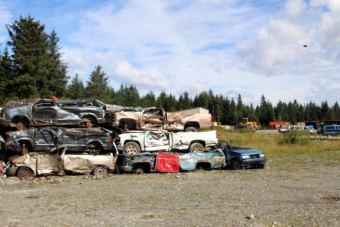
If residents want to recycle glass they must bring it to a dumpster like this one, labeled “Glass Only,” and drop bottles through a hole in the lid. There’s three of these drop offs around town.

In the first half of this year, the borough collected 50,000 pounds of glass.

“It does save money,” said Karl Hagerman, Public Works director in Petersburg. “Any weight that we can take out of the solid waste stream, we’re saving that money. It removes it from the waste stream, it’s not in our recycling stream. It’s the best solution right now.”

For years, the town has shipped its trash to Washington because it’s cheaper than maintaining it in the local landfill.

The borough pays about $113 a ton to ship solid waste and about $20 a ton for recyclables because there are rebates for reusable products.

But that wasn’t always the case. When glass was included in recycling, the borough could sometimes pay more to ship it than the trash.

“It was a huge problem,” Hagerman said. “The amount of glass that was included in our recycling stream became a burden to the recycling facility in Seattle.”

“They can only receive as much as they can use,” said Matt Stern, director of Recycling Operations for Waste Management-Pacific Northwest. “So, it’s not an unlimited market.”

Petersburg Public Works employee, Kevin Granberg, loads glass into a dump truck to take to the landfill. (Photo by Angela Denning/KFSK)

Stern says fewer facilities are processing mixed glass now. In the area that Stern covers — Idaho, Oregon, and Washington – there’s only one remanufacturer of glass, located in Seattle.

He said mixed glass takes extra sorting.

“It tends to have a certain portion, 10 plus percent of non-glass material with it,” Stern said. “Whether it’s plastic caps or chicken bones or whatever might make it in with the glass.”

The colors have to be separated too.

Another reason there’s not much interest in glass is because of the material. Glass is mostly silica or sand and it’s just not valuable.

“There’s no shortage of sand,” Stern said. “As so it’s not replacing sort of a critically limited resource, so I think that’s part of the problem.”

The flip side of that is that glass is arguably better for the landfill than toxic products such as plastics. It doesn’t leach chemicals into the soil.

Which brings us to Petersburg’s landfill. We drive to the back where the sanitation department is building an access road. It’s made from layers of rock and broken up glass.

Crates of glass bottles sit on top of a “glass only” dumpster in Petersburg. (Photo by Angela Denning/KFSK)

This dump truck crushes the glass into small chunks in the back of the bed. Then the back door lifts high off the ground and a rainbow of glass comes raining down onto the road.

What’s left is a heap of shining pieces in greens, blues, browns and clear.

Petersburg is not alone. Nearly all of the communities in Southeast do something similar.

Ketchikan, Sitka, Skagway, and Juneau also collect glass, crush it, and use it at the local landfill. Wrangell doesn’t have a landfill anymore so it ships its glass south with the trash.

Haines’ private landfill wouldn’t talk about what they do with their glass.

In Juneau, Jim Penor is the solid waste coordinator for the city and borough. He’s been in the business for nearly 45 years. He says the challenge with recycling glass is its heavy and it’s not worth much.

“Last I checked in glass, about three years ago, it was two cents a pound, at market, two cents a pound,” Penor said. “Well, it costs us upward of 10,13 cents a pound just to ship it out of here.”

Some Southeast towns are looking at using glass for road beds, sanding icy surfaces and other uses. Penor says that would be great but it’s an expensive process.

“You’ve got to crush it, you’ve got to remove any labels or any paper that’s possibly on the glass has to come off,” Penor said. “Then it has to go through another crushing machine. And then it goes to the fine, making the mesh glass and now that’s usable.”

He says the necessary equipment is just over $3.5 million.

Petersburg’s Karl Hagerman would like to pursue that possibility in the future.

But for now, Petersburg, Juneau and many other towns in Southeast will continue to encourage residents to separate out their glass and save their communities some money.

Talking Trash: Once a bear attractant, Yakutat’s dump now award-winning

Yakutat’s dump was out of state compliance for decades, attracting bears at all hours. Through new staff, a 1 percent sales tax, and grant money from the Yakutat Tlingit Tribe, the city now operates one of the tidiest dumps in the state without barging their trash off-site. (Photo by Emily Kwong/KCAW)

As far as dump make-overs go, Yakutat has the ultimate Cinderella story.

The remote fishing community is hundreds of miles from any other city.

Barging trash away is too expensive. So, as the dump filled to the brim, what was Yakutat to do?

There was a time when dumping your trash in Yakutat meant dodging bears.

Kris Widdows describes it as part of the evening’s entertainment.

“You’d come out to the dump at night and watch the bears get in the garbage. It was like going to the movies,” she said, a movie where a burning pit of garbage became a watering hole for bears.

Locals and visitors alike would pull their cars up to the edge and toss everything — their plastic bottles and dirty diapers, food scraps and oil — into the same pile.

The town bears would feast.

Widdows, who helped form Yakutat’s solid waste committee, remembers one encounter in particular.

“We were out here watching the bears and had one climb in the back of our pick-up truck looking for garbage,” she said. “That was common.”

This is how it was in Yakutat for decades.

The Department of Environmental Conservation wasn’t happy, but the city didn’t have the necessary funds to bring the dump into compliance.

That started to change in 2006 with federal grant money through the Yakutat Tlingit Tribe.

Widdows recalls how tribal environmental officers Maryann Porter and Violet Sensmeier worked with concerned citizens like herself to tidy up the dump.

That also meant finding a way to pay for it.

“In villages and small towns like this, everybody has a unique challenge. You can’t send it out and you don’t have as many people to help with the cost,” Widdows said.

To bring revenue into the solid waste fund, Yakutat now dedicates 1 percent of its sales tax to the solid waste fund.

This boost, combined with new staff phasing in safer practices, created the award-winning landfill you can see today.

I step inside a wide open yard.

There’s trucks busily sorting trash into piles: one for washers and dryers, one for refrigerators, one for cars, all squished and neatly stacked like Jenga blocks.

Everything is marked with a hand painted sign, as if we are inside a trash museum.

Widdows and I are sitting at the bottom of a mountain of giant tires. There are flies circling our heads, but otherwise, it doesn’t smell at all.

Kwong: This is quite a dump, but I mean that in a good way!

Widdows: (Laughs) That could have come out two ways!

Kwong: How is it not stinky?

Widdows: It doesn’t sit there where the public has access to it. Half an hour and he takes it away.

The “he” in question is manager Aaron Gray, who drives one of the trucks moving boxes into a trench for burning later that night.

Widdows tells me he lights the match when certain weather conditions align, so smoke won’t hang in the air.

Wearing a baseball cap and layers of T-shirts, Gray said he’s not a neat-freak person by nature.

“I’m just getting paid to do my job and do my work, so that’s what I do. There’s a lot of little things out here to keep you busy.”

When we spoke it was August, with sport fishermen and summertime construction creating more waste for Gray and his team to organize.

They have their system down pat: cardboard is burned daily; glass is crushed; and recyclables are sorted in marked shipping containers.

Everything is dealt with in-house, except for the occasional shipment.

The City and Borough of Yakutat makes money from batteries and aluminum, but Gray says that’s the only trash of value.

“The glass and the cans and the plastics and stuff like that, we don’t make a profit,” he said. “It’s going to cost us money to send it out.”

Into the future, Yakutat will have to contend with scrap metal, e-waste, and tires that continue to accumulate in the landfill. The city recently spent $17,000 to recycle e-waste in Seattle. Alaska Marine Lines shipped it for free. (Photo by Emily Kwong/KCAW)

The city recently paid for a decade’s worth of e-waste, or electronic waste, to be barged out of Yakutat.

Alaska Marine Lines shipped it to Seattle for free, but it still cost $17,000 to recycle.

“Particularly where we’re located there’s nothing free,” said City and Borough Manager John Erickson.

Leaning back in his chair, Erickson lays out the challenges for budgeting solid waste removal into the future.

The city will have to dig a new cell for the landfill in five years, a $200,000 cost, he estimates.

Yakutat also will run out of space to house old cars.

The city used to get its scrap metal picked by for free by the Juneau-based Channel Construction.

With the price of scrap metal in decline, they stopped coming. Yakutat is an expensive trip for a barge.

“We’re 225 miles from Juneau. 220 miles from Cordova. We’re very remote,” Erickson said, lightly knocking his knuckles against the desk. “We just have to wait. Those cars piling up out there at the dump, they’re going to be there a long time I think.”

Yakutat is definitely on the map for Sandra Woods, the state landfill inspector for Southeast.

When she first came to Yakutat in 2008, she was afraid to get out of the car for the sheer volume of bears.

She gave it a failing grade of 44 percent (080804 inspection).

Now, the landfill is close to full compliance with a score of 87 percent (2017 Inspection Report) and has earned two awards from the Department of Environmental Conservation’s solid waste program for its meteoric improvement.

Woods said it’s people on the ground like Gray who make all the difference.

“I just remember meeting him and knowing that he was the one that put this into place,” she said over the phone. “Yakutat has really changed the way they do things without having to really ship their waste out.”

Talking Trash: Isolated Gustavus deals with national park-sized garbage problem

Gustavus’s Disposal and Recycling Center manager Paul Berry stands atop bales of municipal solid waste buried at the city’s landfill site. (Photo by Jacob Resneck/KTOO)

Operating a landfill off the road system in Southeast Alaska has its own challenges.

But what if the community is next to a national park that gets thousands of visitors each summer? That’s the lay of the land in tiny Gustavus.

In this town, there’s a joke that nothing’s ever free. Because even if someone gives you something, you’ll eventually have to pay to throw it away or recycle it at the city-run landfill.

“I marvel at it, that someone will spend $0.60 a pound to recycle their TV,” said Paul Berry, the main architect of the city’s Disposal & Recycling Center. We’ll hear more from him in a minute.

Because one of the main challenges here comes from Glacier Bay National Park. A half-million people visit the park each year, most by cruise ship. But those flying or ferrying in leave behind what they don’t want or need. For decades the National Park Service had its own dump but then the inevitable happened. Mark Ortega is the park’s utilities supervisor.

“We basically ran out of room, footprint-wise,” Ortega said.

Glacier Bay National Park utilities supervisor Mark Ortega walks past a row of recycling bins on Sept. 5 near the National Park Service’s visitors center at Bartlett Cover (Photo by Jacob Resneck/KTOO)

The Park Service turned to the city of Gustavus, which is small, with less than 500 year-round residents.

The park service pays the city to take its waste – but first it’s meticulously sorted. That’s national park maintenance worker Dan Grivois’s job.

“We typically get around anywhere from 100 to 200 pounds of trash every day,” Grivois said. “My job is basically to get the biggest diversion rate out of that as I can.”

To cut down on space – and expense –  the park burns its waste in a towering incinerator.

Internal temperatures reach a biblical 1,300 degrees Fahrenheit.

The remaining white ash is delivered to the city’s Disposal and Recycling Center.

Manager Paul Berry is proud of the operation.

“Food waste composting and 60 to 70 percent of your material coming in that building being recycled one way or another,” Berry said. “I mean that’s Seattle and San Francisco standards. That’s not something you’d typically see in rural Alaska.”

National Park Service maintenance worker Dan Grivois loads the park’s waste incinerator on Sept. 5. (Photo by Jacob Resneck/KTOO)

There are more than a dozen bins for sorting recycling, each number of plastic, cardboard, appliances, metals – even dirty diapers — have their place.

Yet aside from the faint smell of mulch from the compost heap, there’s almost no odor.

“You have a food waste composting operation and an active landfill and there are no resident seagulls, there are no resident ravens,” Berry said. “We haven’t had a bear inside the facility since 2001 and that was the year we put up the electric fence.”

It wasn’t always like this.

Berry recalls his first visit in the early 1980s. It was a different scene. Imagine a shallow pit filled with household waste and diesel fuel.

“If it wasn’t already burning or smoldering you would light it and leave,” Berry said. “You know, there was some salvage. I remember seeing a TV set there. But it was pretty bad and my impression at that time was … yuck.”

The state owned it back then.

When the federal EPA tightened up landfill regulations, the community had to clean up its act.

The city incorporated in 2004 and one of the first things it did was take over the dump.

The city soon realized that if things didn’t change, the landfill would fill up in a few years.

And there aren’t exactly other sites.

“You see, Gustavus is surrounded by national park wilderness,” Berry said. “You can’t go out of town like you usually do in a lot of communities and start a new facility on state land somewhere. It just ain’t there.”

Gustavus is remote. It only got state ferry service in 2010.

Yet it gets about 20,000 annual visitors who stay at lodges and step off tour boats.

To stay on top of this influx, it aggressively recycles. About 40 tons are shipped annually to Seattle.

It raises as much money from the recycling as it can. Still, that’s only 4 percent of the operation’s income. Because back to the joke – everything costs money to dump or recycle here.

Well, almost everything.

They’ll take aluminum cans. But what most people in the country drop off for free – such as plastic water bottles and cardboard – in Gustavus they’re charged 19 cents a pound — even more if it’s unsorted.

“We are funding it by charging people to recycle, which strikes some people as like, ‘What?!’” Berry said.

That’s the secret to Gustavus’s success, Berry said. Community buy-in. So how could other places replicate this?

Berry says it takes three things.

“You have to have an individual who is willing to do it,” Berry said. He’s talking about himself.

“You have to have a small group of people with influence in the community to support that individual.”

That would be Gustavus’s grassroots landfill committee that began organizing in the 1990s.

“And then finally, you have to have a community that’s willing to do it.”

Despite the high recycling rate, this landfill will likely be out of space in four to eight years.

With few choices for a new site and little room to expand, Gustavus will probably start barging its solid waste to a landfill in the Lower 48.

Talking Trash: The garbage that doesn’t make it to the dump

At an informal, and illegal, dump 25 miles out the Haines Highway, residents have tossed everything from old washing machines to broken chest freezers. (Photo by Abbey Collins/KHNS)

Haines is a scenic town, surrounded by the ocean and towering mountains. But there’s one big eyesore that’s taken over parts of the area: garbage.

Like some other cities, illegal dumping is a problem the community can’t seem to get a handle on.

But, there’s hope that could change with a different system for waste disposal.

About 25 miles out the Haines Highway, there’s a pullout.

From the road, a large sand pile obstructs trails leading to the Chilkat River. In the summer they provide a short route down to the water. In the winter, a popular cross-country ski track.

Over the years, the area has also become an informal and illegal dump.

Takshanuk Watershed Council interim director Derek Poinsette lives out the highway and drives by the 25-mile eyesore regularly.  He said illegal dumping here has been an issue for as long as he can remember.

The watershed council runs community cleanups, and Poinsette says this particular trash pile gets removed every couple years.

Poinsette said it’s not just an eyesore, illegal dumping causes environmental concerns as well.

So, why would people bring garbage here instead of the sanctioned landfill? Poinsette points to money.

“I think it’s just expensive,” Poinsette said. “Anything that has any weight to it is expensive to get rid of.”

That’s been a driving factor in the conversation a local working group started last year. The question before them: is there a better way for Haines to deal with solid waste?

Right now, Haines has one option for garbage disposal, privately owned Community Waste Solutions. Many residents load their garbage in their car or truck, drive it to the landfill, and pay by weight.  Mixed waste costs $0.27 per pound.

There’s one other option for some items, the non-profit Haines Friends of Recycling also will take things such as refrigerators and washing machines for a fee.

For people who don’t generate a lot of trash, or get rid of waste by burning it or recycling, the garbage company’s pay-by-the-pound is a pretty cheap system. But that’s not true for everyone.

“It’s expensive to get rid of your trash here,” said Darsie Culbeck, who chairs Haines’ solid waste working group. He said illegal dumping isn’t the main motivation for the conversation they’re having.

But it’s a symptom of the bigger problem.

“I’ve been here 30 years, as a wilderness guide and a person that’s out in the bushes quite a bit,” Culbeck said. “It’s a big problem. There’s lots of trash out in the – if you do the community cleanups in the spring and walk the ditches there’s garbage all over the place, it’s disgusting.”

That’s the weird thing, right? This has been a problem for a long time. It’s common knowledge that there are trashed appliances sitting out at 25 mile, and garbage in pullouts along the highway.

So, why is it still happening?

“Usually things are deposited in the dead of night by people who don’t leave their names behind,” Haines Borough Manager Debra Schnabel said. “It’s impossible to identify who was the previous owner. And that’s the nature of it.”

Schnabel grew up in Haines and she does remember a time when this wasn’t such a big issue.

She points to what she sees as the turning point: when the borough ended mandatory trash pickup.

Reinstating mandatory pickup isn’t necessarily the answer here, Schnabel said. But she does think accountability should be introduced back into the system.

“You can have an account with the borough but you can manage it yourself,” Schnabel said. “You can choose to take it to the dump. You can choose to recycle 100 percent or 90 percent. As long as we know what you’re doing with your garbage. I’m not telling you what you have to do but it has to be done in a safe manner.”

Illegal dumping is a problem that persists throughout Southeast.

In the last year, Tongass National Forest law enforcement officers responded to nearly 30 cases.

Public Affairs Officer Paul Robbins said it’s a consistent problem. There are particularly problematic areas, such as Sitka’s Harbor Mountain Road and Ketchikan’s Brown Mountain Road.

In Haines, the solid waste working group has struggled to find the right answer.

“Remember we’ve been talking about this for a year,” said Culbeck at a September meeting. “Or, some people 25 years or however long. And it’s political. This is going to be hard to move through and we need to keep it as simple as we possibly can.”

The issue is political for a couple reasons that mostly come down to cost.

Residents who don’t generate a lot of trash worry about paying more for disposal – through taxes or a utility fee.

In Haines, the waste group has a recommendation for the assembly that includes setting up a transfer station in a central location, funded through a sales tax hike. That would reduce the cost per-pound to just $0.02 to $0.08.

Illegal dumping brings penalties.

Fines for littering range from $50 to $100. But, because it’s so hard to figure out who’s doing it, they don’t serve as much of a deterrent. Whether a new strategy for waste disposal is the light at the end of the trash-filled tunnel remains to be seen.

Site notifications
Update notification options
Subscribe to notifications