Jacob Resneck, CoastAlaska

Jacob Resneck is CoastAlaska's regional news director based in Juneau. CoastAlaska is our partner in Southeast Alaska. KTOO collaborates with partners across the state to cover important news and to share stories with our audiences.

Scrubbers are supposed to clean cruise ship stack emissions. Critics say they pollute the water instead.

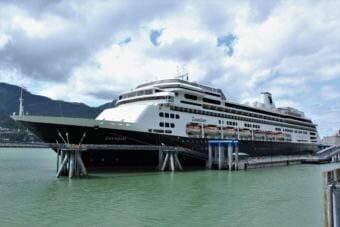
The Holland America cruise ship Zaandam docked in Juneau on June 22, 2018. (Photo by Adelyn Baxter/KTOO)

Cruise ships are now returning to Alaska for the first full-length season since the pandemic. It’s a relief for coastal port economies whose visitor sector has struggled.

But more ships also means more pollution from these large ships — to the air, the water or both — even as the industry says it’s committed to net zero emissions by 2050.

For the past several years there’s been a debate among regulators over what to do about a controversial anti-air pollution device called scrubbers. Scrubbers dissolve chemicals from ships’ exhaust into seawater, allowing them to burn cheaper, dirtier fuels.

A two-year CoastAlaska investigation uncovered dozens of reports from independent cruise ship monitors alerting state authorities to foamy discharges from the kind of scrubber systems used by ships owned by Carnival Corp. and its subsidiaries, which make up a large portion of the Alaska cruise ship fleet.

State and federal authorities didn’t take steps to curb the emissions. State environmental regulators in Alaska say they don’t regulate scrubber discharges. Meanwhile, a federal law meant to protect the owners of small fishing boats from massive fines has, in practice, prevented state officials on much of the West Coast from clamping down on water pollution from scrubbers aboard cruise ships.

Critics say it’s a weakness in environmental regulations that for years has allowed the cruise industry to pollute Alaska’s waters.

‘Air pollution to water pollution’

The devices — which are formally called exhaust gas cleaning systems — are commonly known as scrubbers because they use seawater to “scrub” sulfur from an engine’s exhaust. They’re required by the International Maritime Organization, which has mandated lower sulfur emissions in the atmosphere. Regulators say sulfur emissions are harmful to human health and a major driver of acid rain.

For the cruise industry, scrubbers are a way to save money by allowing ships to burn cheaper, dirtier fuels. But the toxic chemicals removed from smokestack exhaust don’t just disappear.

A video shot from the deck of the Holland America Line cruise ship Amsterdam in the summer of 2019 captured a churning and bubbling of water spewing from the ship’s starboard side. By 7 a.m. — about 1 minute 22 seconds into the video — what appears to be a sea lion swims through the oily water.

Former Ocean Ranger Robert Layko was on a different ship that day. But he says he saw these kinds of oily discharges all the time.

“If they were running their open-loop scrubbers in port, you could see a sheen — black, like soot — on the side of the ship where their discharge was coming out,” Layko said.

The Ocean Rangers were an independent monitoring program unique to Alaska. And for years they tracked all manner of pollution and reported them to the ship’s deck officers and state regulators.

The Ocean Ranger that summer morning in Hoonah logged a report with state regulators. It sat in a file until it was turned over in a records request to CoastAlaska that included the June 22, 2019 video, which said the sheen was likely generated by the Amsterdam’s scrubbers.

Carnival Corp. and its subsidiaries, like Holland America, first installed these systems in 2014. Dark billowing smoke from the ship’s stacks led to widespread complaints but little action by state regulators.

“We’re supposed to report any pollution incident we see,” Layko said, who spent eight seasons as an Ocean Ranger. “When I was on the ships, I would tell them that I’m going to report those because it’s my job and it’s pollution to me, and they say their scrubbers are all in compliance.”

Some scrubbers run a closed-loop system. The washwater gets heavily filtered, leaving a thick sludge that’s sent to landfills in the Lower 48.

But in the open-loop systems used by Carnival, Holland America and Princess ships, there’s no sludge to be hauled away at the end of a voyage. The seawater used to dissolve sulfur, arsenic and other potentially harmful contaminants goes right back overboard.

Shipping industry critics say scrubbers have allowed the shipping industry to skirt regulations by exchanging one form of pollution for another.

“What would normally be emitted as air pollution and dispersed in the atmosphere is now being concentrated and dumped directly overboard,” said Bryan Comer, a maritime expert with the International Council on Clean Transportation in Washington D.C. who has written about open loop scrubbers.

Congress preempts states from scrubber regulation

Layko reported the oily sheens he saw to the Alaska Department of Environmental Conservation. But there’s little states can do to control discharges from exhaust scrubbers.

That’s because states like Alaska lost much of their authority to regulate scrubber discharge through an act of Congress. Alaska’s delegation were champions of legislation called the Vessel Incidental Discharge Act.

Sen. Lisa Murkowski (R-Alaska) says it was over concerns for the commercial and charter fishing fleet.

“What we really set out to do with VIDA was to address the incidental discharge off of fishing vessels,” Murkowksi told CoastAlaska in 2019.

She says her office got involved to protect the skippers of fishing boats from fines under the Clean Water Act. When deckhands spray down their boats, sometimes the water that washes overboard includes some oily residue.

A small group of environmental demonstrators gather near the Capitol in downtown Juneau on April 26, 2022 to protest pollution from large cruise ships. (Photo by Paige Sparks/KTOO)

But some state regulators say the 2018 law’s definition of “incidental” goes far beyond small fishing boats and cripples the ability of state water quality monitors to regulate ships the size of office buildings that discharge hundreds of thousands of gallons of scrubber water every hour.

Washington State Department of Ecology’s Amy Jankowiak, a supervisor in its water quality section, told CoastAlaska there’s specific language in the law “that preempts states from regulating quite a few of the different types of discharge types coming off of vessels.”

But the law’s passage was just the first step in a complex process. The EPA now has to write the regulations that say exactly how and when scrubbers can discharge in U.S. waters, which fall to the U.S. Coast Guard to enforce. But today, four years after the law was passed, it has yet to do so as the regulations remain to be finalized.

Jankowiak says Washington’s Ecology Department has done its own research into scrubber discharges. Not only were they acidic — which can harm sea life — state scientists also found a host of contaminants.

“Polycyclic aromatic hydrocarbons, or PAHs, were significantly high,” she said, “and toxics including some metals, arsenic, cadmium, copper, nickels, selenium, zinc — all were higher than our water quality criteria.”

Washington state is calling on the EPA to ban scrubbers while more research is done. California has banned heavy fuel oils near its coastlines since 2008, making scrubbers unnecessary.

“We believe that there are enough concerns for the water for water quality, not just in our waters, but in other states’ waters,” Jankowiak said.

Alaska state regulators mum on scrubbers

Alaska state regulators have attended listening sessions on the debate over scrubbers in U.S. waters, EPA records show. But DEC officials have declined to wade into the debate themselves. The state of Alaska’s cruise ship program has a public-facing website that explains the technical aspects and notes that it’s up to the EPA to regulate scrubbers.

“The department has not taken any regulatory action regarding scrubbers,” DEC spokeswoman Laura Achee wrote in an email.

But DEC has a lot of data in its files. Ocean Rangers routinely monitored scrubbers and their performance and passed them on to cruise ship program staffers. Between 2017 and 2019, the marine engineers collectively logged at least 80 oily sheens and referred them to state’s Spill Prevention and Response Division for potential enforcement.

SPAR officials say they logged 24 scrubber discharge reports in 2017, 38 reports in 2018 and 18 reports in 2019. No further action was taken, staffers at the agency confirmed.

DEC is supposed to forward reports of scrubber water pollution to the U.S. Coast Guard.

A records request by CoastAlaska found that of the 18 documented observations by Ocean Rangers in 2019, only one was forwarded to the Coast Guard for potential action. But again, there’s no record of enforcement by either agency.

The pandemic erased the 2020 cruise season. And in 2021, Ocean Rangers were removed from cruise ships after Gov. Mike Dunleavy shut down the program. (He vetoed the money from cruise ship passengers that funded it.)

The Dunleavy administration has been hostile to the program, saying no other industry has that kind of 24/7 scrutiny.

“Most of these Ocean Rangers were not even Alaskans,” DEC Commissioner Jason Brune said during an appearance on a state-sponsored podcast last November. “They were retired marine engineers from the Lower 48 that were getting a free vacation on these cruise ships.”

He reiterated that the Dunleavy administration wants agency staff to inspect vessels and permanently end the program that was created by a 2006 voter initiative and remains popular among coastal communities.

The Legislature is still hearing the governor’s bills that would formally end the program.

Scrubber manufacturers tout systems’ potential

The shipping industry insists scrubbers are both safe and effective. Donald Gregory heads the Exhaust Gas Cleaning Systems Association in the U.K., which represents global manufacturers. He predicts one day that all large ships will be outfitted with the technology.

“But it won’t be fitted to remove the sulfur dioxide, necessarily,” Gregory said. “It’ll be fitted to take out black carbon, and to take out some of these other compounds. And that’s where the real benefits will be.”

That would also allow the shipping industry to delay switching to cleaner, more expensive alternatives to fossil fuels.

Gregory also dismisses concerns about water pollution.

“What’s going overboard is going overboard anyway — through the funnel — if it’s not being scrubbed,” he said in an interview from Greater London.

But without the scrubbers, ships wouldn’t be allowed to burn the dirtier fuels in the first place.

Cruise industry says scrubbers are ‘interim solution’

CoastAlaska repeatedly requested interviews from Cruise Lines International Association. The industry group declined.

But the topic does come up when cruise execs attend public forums. During an appearance last summer on Wrangell public radio station KSTK’s Talk on the Rock, CLIA executive Brian Salerno said scrubbers perform well.

“They do meet all the international standards,” he told KSTK interviewer Sage Smiley. “They meet the EPA standards for the U.S., there have been quite a few tests on them, particularly with the washwater.”

CLIA touted last year the fact that 76% of the large cruise ship fleet is equipped with scrubbers.

“I realize not everybody is prepared to look at them in the same way,” Salerno said. “But as an interim solution for now, they’re doing the job. I think long term, though, you know, we need new solutions.”

Scrubbers save Carnival ships in Alaska $150,000 a week

In court filings, Carnival Corporation says its brands have spent at least $500 million on installing scrubbers on its fleet. So why the huge investment? It says it’s to cut costs.

“The exemption gives us the flexibility to use whatever fuel source we determine. And that’s significant for us because it gives an economic value,” Carnival spokesman Roger Frizzell told CoastAlaska in 2013 when the scrubbers were first being installed ahead of more stringent sulfur limits in marine fuel.

Carnival reported to the EPA that switching its vessels in Alaska to cleaner-burning marine gas oil would be too expensive.

At 2019 prices, it says burning lower-sulfur fuels would increase a ship’s fuel bill by an extra $150,000 a week.

Jim Gamble, the Arctic program director for conservation group Pacific Environment, is pushing for a ban on heavy fuel oil in Alaska waters and, by extension, scrubbers that allow bunker oil on board ships in U.S. waters.

His organization is part of the Clean Up Carnival campaign — a coalition of environmental groups urging the Miami-based cruise giant to stop burning heavy fuel oil on its ships.

“A company like Carnival can easily afford to come into Alaskan waters and follow every regulation,” Gamble said.

He says the environmental cost is higher than the money Carnival saves by running scrubbers to burn cheaper fuels.

EPA allows Carnival ships in Alaska to discharge scrubber water that’s two, three times as acidic

Carnival has received special permission for its open loop scrubbers to exceed water pollution rules while in Alaska waters. That’s according to waivers obtained through a Freedom of Information request filed by CoastAlaska. The EPA has green-lit discharging scrubber washwater with a pH more acidic than what’s allowed under its 2013 permits.

“The pH scale is logarithmic,” explained Bryan Comer of the ICCT Marine Program, in an email. “That means that allowing Carnival to emit washwater with a pH of 5.7 instead of 6.0 is really allowing them to emit water that is twice as acidic. And on the occasions where they emit contaminated washwater with a pH of 5.5, that’s 3.2-times more acidic than if it had a pH of 6.0.”

Scrubber discharges aren’t always obvious but critics say the volumes are significant. Some estimates by Washington state say they churn out around 475,000 gallons every hour.

Cruise ships may avoid extra scrutiny by not running them in port where the sheens are more visible. And since last year, there have been no Ocean Rangers on board to watch and record them.

Robert Layko, the retired Ocean Ranger, says he’s worried scrubber water pollution will now go unreported.

“If we’re not watching them, it’s up to the public to watch them and the public — they’re not engineers,” Layko said. “It seems to me like the state kind of dropped the ball a little bit.”

DEC confirmed that in 2021 it received three public complaints about cruise ships, two for air quality and one for water. The agency says none of the complaints resulted in action.

A Carnival spokesperson confirmed that its fleet would continue to operate under its waivers for the 2022 cruise season. The EPA declined to comment on progress of its exhaust gas cleaning system regulations which are expected to be finalized at the end of the year.

In Alaska, the public can report suspected cruise ship pollution to the state Department of Environmental Conservation’s cruise ship program by emailing: DEC.WQ.Cruise@alaska.gov

Alaska Senate bill would expand regulation of ‘forever chemicals’ in drinking water

A property where PFAS have contaminated the well water in Gustavus. (Photo by Claire Stremple/KTOO)

Alaska lawmakers are considering a bill that would expand testing and regulations for PFAS chemicals in drinking water, which has been linked to cancer and other serious health conditions.

Sen. Jesse Kiehl, D-Juneau, has sponsored legislation that would police seven varieties of the so-called “forever chemicals,” which don’t break down and often enter the environment from firefighting foams used at airports.

These things are bad for people in extremely small amounts. We’re talking about parts per trillion in your drinking water,” Kiehl told the Senate Finance Committee on April 12.

PFAS action levels altered in 2019

State regulators in 2018 began policing six varieties of PFAS in the final days of Gov. Bill Walker’s administration after PFAS was discovered in drinking water in wells across Alaska. The incoming Dunleavy administration watered down those regulations the following year. They now mirror federal standards and apply to two of the most common varieties of PFAS.

Among other things, Senate Bill 121 would expand action levels to seven varieties and lower the threshold of what are considered acceptable levels of PFAS in drinking water. The upshot would be more households and businesses with PFAS in their groundwater could be eligible to receive alternative sources of drinking water from the state by entering the regulatory standards directly into law.

Kiehl told the Senate committee that the bill would also heavily restrict the use of the most common contamination source in Alaska — firefighting foams that contain PFAS — except in certain cases.

The bill has an exception for those in the oil and gas business until an alternate firefighting substance is found,” he said.

Many firefighting foams designed to put out fuel fires contain PFAS.

Rural Alaskans speak out on health risks

Yakutat Borough Manager Jon Erickson testified in support of the PFAS bill. He says his Southeast community has PFAS contamination in wells near the state-owned airport.

And there are a number of other businesses out there,” he testified by telephone. “And they are all using PFAS at this time. DOT saw the problem and so they send in cases of bottled water. So the restaurants can still operate.”

He says extending municipal water in the area that’s not PFAS contaminated would cost the community of 600 people at least $6 million, according to estimates from state officials.

Native Peoples Action — an Indigenous rights network — supports the legislation, the Anchorage-based nonprofit’s policy director Jackie Boyer told the committee.

“Studies have also shown that Alaska Native suffer at greater risk for certain cancers,” Boyer said. “So it’s all very concerning that there are so many confirmed contaminated sites in Alaska.”

A companion bill in the House was introduced last year. But it’s unclear when either chamber would vote to establish the new PFAS standards in the law. Additionally, if passed, the law would give state regulators the authority to make the standards more stringent, but they could not relax the action levels to less than outlined in the bill.

The legislation also outlines that state air permits would be required to incinerate PFAS chemicals to ensure they don’t leech into the environment in the process. So far that’s been a technically challenging prospect, as the long-chain compounds are very difficult to break down.

Southeast Conference pitches wood pellet production in Ketchikan

A wood pellet boiler. (Photo by Elizabeth Jenkins/Alaska’s Energy Desk)

Southeast Conference is proposing a pilot project using wood pellets as an alternative energy source in Ketchikan. The regional civic and business organization has expressed interest in developing a biofuel plant on Gravina Island and wants support from the borough, which owns a 200,000-square-foot parcel.

The Juneau-based nonprofit recently secured $1 million in federal funding through the U.S. Department of Agriculture’s Southeast Alaska Sustainability Strategy for its effort.

“We think that this is a model that could be replicated in many other rural communities,” Executive Director Robert Venables told CoastAlaska on Friday. “But we need a test site for some some research and development of how this model would work and under different operating conditions,” he added.

He’ll be making Southeast Conference’s presentation on Monday, April 4 to the Ketchikan borough assembly to consider a long-term lease on the former mill property to produce wood pellets as a sustainable alternative to heating oil.

Specific terms over a lease of the 5-acre site have not been disclosed.

In a memo to the assembly, borough staff have expressed caution, noting that wood pellet-fired boilers have not always performed as well as anticipated.
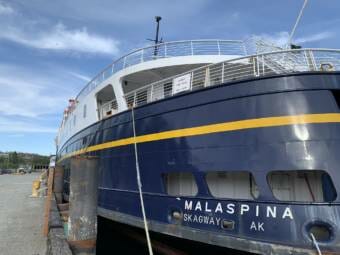
“The request has many unanswered questions and challenges,” wrote Richard Harney, director of Planning and Community Development. “The borough has championed biofuels
over the last 10 years, with numerous resolutions supporting the use of biofuel instead of oil. However, acquiring enough wood waste to produce locally sourced pellets for the boilers has been unsuccessful.”

A biofuel project at Coast Guard Air Station Sitka more than a decade ago was ultimately unsuccessful.

But Venables says it’s worth exploring the concept, and he’s optimistic that there are untapped biofuel sources that are often discarded.

“What we see in rural Alaska is a lot of one-way shipments of pallets and cardboard boxes that often gets just burned in open pits and create an environmental issue and certainly do nothing to lower the cost of energy,” he said.

Malaspina ferry could get second life as Alaska attraction

The state ferry Malaspina sits in layup in Ward Cove near Ketchikan on May 10, 2020. (Photo by Eric Stone/KRBD)

The Department of Transportation said Tuesday that four parties have expressed interest in the Malaspina, a mainline ferry that’s been a mainstay of the fleet since the 1960s. It’s the latest twist in the process initiated by the Dunleavy administration to unload an iconic state ferry that’s been idle for more than two years.
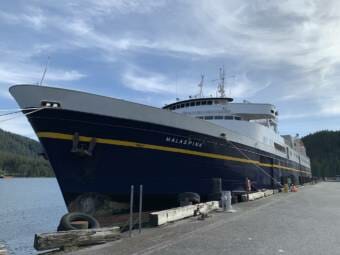
The Malaspina ferry hasn’t sailed since December 2019. The Dunleavy administration decided then to tie it up at a private facility near Ketchikan rather than invest at least $16 million into the steel work needed to keep it seaworthy.

But even idle, the state is paying upwards of $75,000 a month in mooring fees and insurance costs at the private Ward Cove facility.

DOT announced on Feb. 18 that an unnamed U.S. buyer who would keep the 450-passenger ship in Alaska was interested. It solicited proposals from other interested parties and got three more prospective buyers by the March 7 deadline.

“Hopefully we’ll have something in there that can allow the Malaspina to remain in Alaska,” DOT spokesperson Sam Dapcevich said Wednesday, “and that preserves the vessel’s historical value and promotes the marine highway system.”

Records request reveals interested parties include Ward Cove Dock Group

CoastAlaska put in a public records request to DOT for the letter so interest from prospective buyers.  It was denied by the agency which said it would only release them after the sale was finalized.

John Binkley poses for a photo on Juneau’s downtown waterfront on Sept. 9, 2019. (Photo by Adelyn Baxter/KTOO)

But it did release the names of four interested parties. On top of the list is M/V Malaspina, a limited liability company incorporated on the March 7 deadline set by DOT to express interest in the ferry.  Its agent is listed as John Binkley, a prominent Fairbanks Republican.

He also owns half of the Ward Cove Dock Group with the Spokely family of Ketchikan, a partnership with the family firm that’s paid by the state to store the Malaspina and other idled marine highway vessels.

Binkley confirmed he and his partners are interested but said he wasn’t ready to talk about it.

Other interested parties were more forthcoming.

“We like these projects — we like to think big and nothing really scares us,” said Greg Meyer of Cordova. He and his wife own a waterfront restaurant in the Prince William Sound community. He says his family was sad when the ferry Taku was sold for scrap in 2018.

The Malaspina could be redeveloped on tidelands that are part of a former Cordova cannery property they own.

“We would be interested in converting the ferry into a floating hotel/restaurant,” Meyer wrote in his pitch letter to the state.

A1945 photo of the the Cordova waterfront property now owned by Greg Meyer and Sylvia Lange of Cannery Row LLC. The couple has proposed to beach the Malaspina on tidelands it owns as a restaurant and hotel. (Photo courtesy of Greg Meyer)

There are other potential uses for the former passenger ferry, he told CoastAlaska.

“Cordova has a housing shortage,” Meyer said by phone. “And we have seasonal workers that can never get housing in the summer. So it would help us to stimulate our economy.”

Another interested party is Meridian Global Consulting, a Mobile, Alabama-based firm that said in its letter that it owns three vessels of similar size.

“Meridian’s intent in purchasing the Malaspina is to use her as a floating hotel and
restaurant in and around Alaska,” wrote the firm’s owner Jonathan McConnell.

But how interested the firm is depends on the terms set by the state agency.

“If they’re going to ask, you know, $4 million for this vessel — then it’s not worth it,” McConnell said by phone from Riyadh, Saudi Arabia.

This isn’t the first time he’s approached the state to buy the Malaspina. Last year Meridian offered $625,000 for the ship to be repurposed as a floating barracks. It would house security contractors working to protect international shipping off the Horn of Africa.

But now the state says it wants the Malaspina to remain in Alaska. And he says his firm could do that. McConnell says he’s talking to partners in Alaska to turn it into a floating attraction.

“It’s a pretty neat experience to be able to eat a meal on board an old, beautiful vessel,” McConnell added.

The fourth interested party is HighSeas, Ltd., which DOT says is registered in India. A BBC investigation last year found the firm had bought a historic British ocean liner at auction saying it would be used as a floating hotel in Dubai. But it was broken up for scrap.

The firm’s chairman didn’t immediately respond to a message seeking comment.

State looking to avoid a Taku scenario

DOT’s regional spokesman Sam Dapcevich says his agency acknowledges there has been commercial interest in the ship. But it wants to ensure that the Malaspina comes to a dignified end.

“The state doesn’t want the vessel to end up a derelict somewhere because someone bought it and didn’t have the means to take care of it,” Dapcevich said. “We prefer that it not be cut up for scrap, like what took place with the Taku years ago.”

Other ideas thrown around last year included scuttling the Malaspina in deep water. Gov. Dunleavy had also offered to give it away to the Philippines. But state officials say the government in Manila wasn’t interested.

DOT hasn’t committed to any timeline but says any transfer would have to be approved by the federal government because of federal highway dollars used for its upkeep.

State says it’s considering offers for Alaska’s idled Malaspina ferry

The Malaspina ferry, tied to a dock.
The state ferry Malaspina sits in layup in Ward Cove near Ketchikan on May 10, 2020. The state says it costs around $75,000 a month in moorage, utilities and insurance. (Photo by Eric Stone/KRBD)

The Dunleavy administration announced Friday that an unnamed U.S. buyer is interested in purchasing one of Alaska’s original mainline state ferries for an undisclosed amount.

It’s the latest twist in the fate of the ferry Malaspina, which hasn’t sailed since December 2019.

Now, the state is asking other interested parties to step forward before March 7. DOT officials say their preference would be for the 59-year-old vessel to remain in Alaska, though that wouldn’t be a requirement.

Last year Gov. Mike Dunleavy offered to give the ship away to the Philippines. But the offer wasn’t accepted due to the amount of work needed to rehab a vessel that had been stripped and suffered storm damage while moored in Ketchikan.

The 450-passenger vessel has been sidelined since the state agency balked at the estimated $16 million in steel work needed to keep the ship seaworthy.

DOT emails detailed spiraling costs of keeping ship in state ownership

A CoastAlaska investigation last year found that the state is paying nearly $75,000 a month to keep it. That includes insurance costs and mooring fees at a private berth in Ketchikan owned by the Ward Cove Group.

Several interested buyers said last year that their inquiries to purchase the ship had been ignored even as agency officials privately expressed concern over the mounting costs of keeping the idled ship in the fleet. That’s according to interviews and review of several hundred emails released to CoastAlaska in a records request.

Alaska Marine Highway System officials last year told lawmakers they were working with the Environmental Protection Agency to prepare to scuttle the Malaspina in deep water. But a notice posted on a state website says that “Letters of interest that propose scuttling the vessel are not being considered at this time.”

In response to CoastAlaska’s questions, DOT says its priority is finding “what is in the best interest of the state in exchange for the vessel,” DOT spokesperson Shannon McCarthy wrote. “While typically, this means top dollar, there is value in preserving the vessel’s historical value for Alaskans.”

“The ship served as a primary mode of transportation for many communities over five decades the public is rightfully nostalgic for the vessel,” she said.

The Malaspina was built in 1963 and was one of the marine highway’s original three mainline ferries. The Taku was sold for scrap in 2018; the Matanuska is still in service.

New oversight board faces hard choices about the Alaska Marine Highway’s future

The M/V Kennicott leaving Wrangell on Jan. 8, 2021 (Photo by Sage Smiley/KSTK)

A new oversight board tasked with revitalizing Alaska’s state-run ferry system met for the first time on Feb. 11. Members of the nine-person Alaska Marine Highway Operations Board heard about new opportunities from the promise of hundreds of millions in federal funds expected to flow into the system. But there will be some difficult decisions ahead on how best to invest the money.

Shirley Marquardt, a former executive director of the marine highway, was selected to chair the Alaska Marine Highway Operations Board. The Alaska Legislature created the board by unanimous consent last year.

The former Unalaska mayor remarked that the combination of federal funding and united support for the ferry system was an opportunity to finally modernize the fleet, which largely relies on ships built in the 1960s and 1970s that are decades past their service lives and frequently break down.

“But we keep putting in millions and millions and millions,” she said. “And in the time we’re doing that we’re leaving passengers sitting at the dock.”

The new board replaces the now-defunct Marine Transportation Advisory Board, which had little practical authority. That looks less likely to be the case with the new group, which includes appointees from both the House and Senate as well as the governor.

Board member Keith Hillard, a captain of the Matanuska ferry, was nominated by the three ferry unions. He complained of poor maintenance planning and a lack of coordination from shoreside management for keeping his ship in the yard for 17 weeks rather than the scheduled eight.

The chief engineer and I had no idea what was planned, what work was planned what was scoped going into the yard,” he said.

Hillard says repairs are routinely delayed due to cost-cutting. That leads to deferred maintenance until it snowballs. The Matanuska’s problems stemmed from rotted steel that he says had been identified by engineers as early as 2016, but the work wasn’t authorized by management.

“Coast Guard saw it this year and said, ‘What’s this? Why didn’t you fix this? Can’t let it go like this anymore,’” he recalled. “So we’re getting into the yard and then making the plan, versus having a plan before coming into shipyard.”

Vacancy rates remain high

Another challenge facing the ferry system is a crew shortage. More than 70% of entry-level stewards jobs are vacant.

Marine Highway general manager John Falvey told the board that the entire maritime industry is struggling with crew.

We are working very hard to try to hire more vessel, vessel staff back, we’ve we’ve lost quite a few from COVID, things like that,” Falvey said. “We’ve got a pretty aggressive marketing campaign in place, we’re working very, very closely with the Department of Labor.”

Unlicensed crew members don’t have guaranteed work hours. When ships are laid up for cost-cutting or go into overhaul, Hillard says they are left high and dry.

They pretty much get a forced four-month layoff, and unfortunately a lot of them find year-round jobs during that time and don’t come back,” he said.

It’s possible that a shortage of trained crew could delay sailings when demand increases later this year.

“Staffing goals for the summer season will not be met at current recruitment rates. If staffing goals are not met by March 1, Columbia will not be available for operations on May 1,” the agency wrote in a memo to the board.

Governance reform models

Reforming the organizational structure of the marine highway is also something the oversight board may tackle. Previous proposals have been floated to create a public corporation or a ferry authority with more independence from the executive branch. It would also allow for long-range funding rather than going to the legislature each year.

John Falvey, the marine highway’s top operations official for nearly 18 years, admitted these are all conversations worth having.

I mean, we have processes, but are they the best way to be doing it?” he said. “And we’ve been doing it a certain way for a long time. But maybe we’ve got to retool, and try to do things differently — and I know that.”

Tough questions about how to invest federal windfall

Gov. Mike Dunleavy has proposed using $135 million in federal money to fund the ferry system in the coming year. That would effectively reduce the state’s contribution to zero.

That idea is already receiving pushback. Southeast Conference, a regional civic and industry organization that advocates for economic development, passed a resolution earlier this month calling on the Dunleavy administration to primarily invest the federal funds into long-term needs of the ferry system.

Executive Director Robert Venables made that pitch to the operations board.

We know that some of those funds should be and need to be used for operations,” Venables said. “But at the same time want to find that balance between just consuming those funds, and use those funds for long term investments.”

Ferry operations board members expressed interest in meeting frequently for shorter meetings. And it could hold its next session later this month.

Site notifications
Update notification options
Subscribe to notifications