Jacob Resneck, CoastAlaska

Jacob Resneck is CoastAlaska's regional news director based in Juneau. CoastAlaska is our partner in Southeast Alaska. KTOO collaborates with partners across the state to cover important news and to share stories with our audiences.

Indigenous-led conservation and development effort gets $2M boost from foundations

""
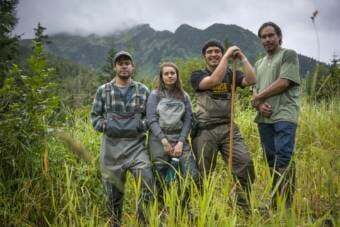
The Seacoast Trust works with the Sustainable Southeast Partnership which in turn helps coordinate the Hoonah Native Forest Partnership members (pictured) who are working to restore forestlands and watersheds on Chichagof Island. (Photo by Bethany Goodrich/Sustainable Southeast Partnership)

A regional effort to support Indigenous-led conservation and economic development in Southeast Alaska says it’s closing in on an initial $20 million fundraising goal.

Seacoast Trust, an initiative put together with $17 million seed money from Sealaska Corporation and The Nature Conservancy, announced Monday that it’s received an additional $2 million from two philanthropic organizations.

The million-dollar donations come from the Anchorage-based Rasmuson Foundation and Los Angeles-based Edgerton Foundation.

“We are thrilled to be part of such a well-crafted approach to stewardship and economic development in Southeast Alaska,” Rasmuson President and CEO Diane Kaplan said in a statement. “Strong, local leaders and broad support are key. We are especially delighted to have Edgerton Foundation as a ground-floor partner.”

The Southeast Sustainable Partnership, a decade-old effort that runs projects in towns and villages across Southeast Alaska, will coordinate the Seacoast Trust projects.

Financial oversight of the Seacoast Trust comes from Spruce Root, a Juneau-based nonprofit with ties to Sealaska.

Sealaska announced it’s earlier this year that it’s transitioning away from large-scale logging. The Seacoast Trust is one of the initiatives it says it hopes to expand economic opportunities in Southeast Alaska’s communities that had.

The trust has said in its statements that the long-term goal is to create a $100 million fund that could provide about $5 million annually for economic development in communities across Southeast Alaska.

Dunleavy administration loses lawsuit over Kake subsistence hunt

Kake residents and Elders process moose meat to be distributed to the community
Kake residents and elders process moose meat to be distributed to the community (Courtesy of the Organized Village of Kake)

A federal judge has rejected the Dunleavy administration’s legal challenge to a special rural subsistence hunt that was authorized by federal authorities during the early months of the COVID-19 pandemic. The Southeast tribal government in Kake had organized the deer and moose harvest out of concerns about food security during the early months of the pandemic.

About a year and a half ago, fresh groceries in the community of Kake were in short supply. It was the early weeks of the COVID-19 pandemic, and meat, dairy and other perishables weren’t showing up on the barge as nationwide hoarding caused shortages of basics like toilet paper, flour and other staples.

And workers key to the nation’s food web were getting sick.

Our meat supply kind of got pretty low because of the virus hitting the meatpacking plants in the Lower 48,” Organized Village of Kake’s tribal president, Joel Jackson, told CoastAlaska.

The normal hunting season doesn’t begin till the fall, and it was too early for the salmon run in the Kupreanof Island community of a few hundred people.

But there are plenty of deer and moose in the dense forests, so Jackson went looking for permission to organize a community hunt — first to the state agency that oversees wildlife.

I went to the (Alaska Department of) Fish and Game, first of all, and they absolutely said, ‘No, that’s not going to happen,’” Jackson recalled.

Special 60-day hunt opened by federal agencies

In the end, the Federal Subsistence Board authorized a special hunt for the community of Kake in June. Two bull moose and five bucks were reportedly harvested, with the meat distributed to the community.

But then Republican Gov. Mike Dunleavy’s administration filed a lawsuit claiming there was no food security risk. It raised a number of procedural objections to allowing the special hunt.

There’s long been tension between state and federal authorities over subsistence rights. And the state’s position was that the special hunt was exclusionary and an example of federal overreach.

But federal Judge Sharon Gleason rejected the state’s request for a restraining order against the Federal Subsistence Board. She also rejected the state’s objections over the board’s excluding urban hunters harvesting moose in an area of the Interior, which the subsistence board had ruled was needed for public safety. That had been a second part to the state lawsuit.

In a 49-page order issued Dec. 3, she rejected all the state’s legal arguments.

Indigenous legal firm celebrates sovereignty win

The Native American Rights Fund, which offered legal aid to Kake’s tribe, welcomed the ruling.

“The Organized Village of Kake, like many Alaska Native communities, relies on subsistence hunting to ensure food security for its tribal citizens,” NARF staff attorney Matthew Newman wrote in a statement, saying the federal authorities did well to work with a Native community like Kake anxious about its food security.

“It was ridiculous of the state to suggest anything otherwise, and the court made the right decision when it held that the board acted within its authority,” the attorney’s statement added.

And Jackson, the tribe’s president, says it was a victory for tribal sovereignty in a crisis situation.

“I hate the word ‘subsistence’ because that’s Western world,” Jackson said. “But we practice our way of life here in the villages … If worse comes to worst, and somebody tries to limit us when we’re in dire need of something, I’m not going to sit back and wait for their decision — that’s not going to happen.”

Alaska Attorney General’s office considers appeal

A spokesman for the Department of Law released a short statement accusing the judge of ignoring the Alaska National Interest Lands Conservation Act — known as ANICLA — which proscribes subsistence rights on federal lands in Alaska.

“This ruling today is entirely contradictory to ANILCA, which was intended to protect the rights of all hunters on federal lands in Alaska and retain the state’s management authority with a subsistence preference only when necessary to restrict harvest,” wrote agency spokesperson Aaron Sadler.

“The state maintains the Federal Subsistence Board overstepped its authority — in part in illegal, secret meetings at that — including by restricting hunting in Units 13A and B and by authorizing an emergency hunt in Kake last year in spite of no food shortages,” the communications director added.

He said the state was considering an appeal.

Alaska seeks private operators to fill gaps in winter ferry schedule

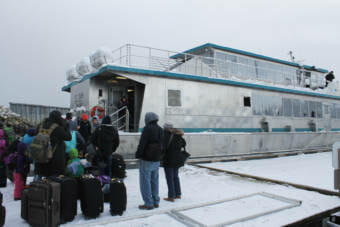
Haines residents get ready to board an Allen Marine boat chartered by the local school district in 2020. (Henry Leasia/KHNS)

The state of Alaska is looking to the private sector to offer ferry service between Juneau and four Southeast villages facing months-long gaps this winter from January to March.
An invitation to bid was posted Nov. 29 on a state website seeking operators for vessels at least 75-feet long and capable of carrying 125 passengers or multiple vehicles for some Southeast routes. It doesn’t mention a range of cost but invites bidders to make their own proposals.

The state Department of Transportation says it’s responding to concerns that a two-month gap in ferry service could bring additional hardships.

Originally we didn’t have any fill-in service plan during that time, but we have received requests from communities,” DOT’s regional spokesman Sam Dapcevich told CoastAlaska. “And we are looking for a way to meet that demand.”

Hoonah Mayor Gerry Byers says that when ferry service goes away, the cost of essentials goes up in his village of about 800 people on Chichagof Island.

Everyone has had a hard time during the pandemic,” he said. “Now, with all the prices going up, coming into winter is going to make it harder for residents to be able to live in their home communities.”

That was the fear when Gov. Mike Dunleavy’s administration announced gaping holes in the winter ferry schedule.

One reason is that at the end of the year, the LeConte, a 47-year-old workhorse that serves Southeast villages, is going into dry-dock for a scheduled two-month overhaul that will keep it offline until at least March.

DOT’s bidding documents ask for operators to provide regular and on-call service to connect Juneau with the communities of Hoonah, Angoon, Gustavus and Pelican during that period and perhaps beyond.

Drivers move their cars and trucks off the ferry LeConte at the Angoon terminal in 2010.
The LeConte unloads vehicles at the old Angoon ferry terminal in 2014. The ferry – built in 1974 – is going in for its annual overhaul and will be out of service until at least March 2022. (Ed Schoenfeld/CoastAlaska).

This wouldn’t be the first time DOT has called up private operators to fill-in. It signed contracts with vessel operators Goldbelt and Allen Marine for some routes, though that never fully materialized due to the pandemic. And local officials in the upper Lynn Canal chartered a catamaran last year to service Haines and Skagway, but that was accomplished with local funds.

But Dapcevich says this request is designed to also include at least one vessel capable of carrying vehicles and on relatively short notice for the foreseeable future.

“We would have some a contract in place with different vendors, and we could call them up and say, ‘Hey – are you available?’” he said.

Goldbelt, Inc. doesn’t have any vessels capable of carrying vehicles. But Juneau’s urban Native corporation’s chief executive says its catamarans could offer passenger-only service.

“Goldbelt does plan to put a bid in,” Goldbelt CEO McHugh Pierre told CoastAlaska. I’m really excited for Department of Transportation, and Alaska Marine Highway to be able to finally make this step to allow for routine, dependable transportation that is sized appropriately for each community.”

Allen Marine Tours which operates a fleet of catamarans for whale watching and other excursions is also evaluating the prospect of bidding, the Sitka-based vessel operator’s Zakary Kirkpatrick wrote in an email.

State ferry workers skeptical

The plan to rely more on private operators is, unsurprisingly, getting a cool reception from the unions representing marine highway crew members.

I would think that these (maintenance) issues can be anticipated,” said Ben Goldrich, a Juneau-based leader of Marine Engineers’ Beneficial Association. His union represents about 75 licensed marine engineers who work on the state’s ferries.

“And we’d like a better understanding of why the state’s not using resources that they currently have tied to the dock,” he added

One asset is the Tazlina, a $60 million Alaska Class Ferry built in Ketchikan. It briefly entered service in 2019 but has spent most of its service life tied up due to a number issues, principally its limited range due to its configuration as a day boat.

Dapcevich listed off a few reasons the Tazlina won’t be activated while the LeConte is out.

“Because we didn’t plan for it,” Dapcevich said. “We are unable to crew it up quickly enough to meet the time frame for January service.”

Another reason, marine highway officials say, is that the idled vessel doesn’t have all its certifications. And getting a short-term certificate, they say, could be cumbersome to the third-party auditor that issues its certificate.

This $60 million Alaska Class Ferry was recently built in Ketchikan. But the Hubbard has yet to enter service in the Alaska Marine Highway System and remains tied up at a private dock on Ketchikan’s Ward Cove. (Eric Stone/KRBD)

But Goldrich, the union boss, also says he’s skeptical whether DOT will be able to find a vessels that meets its needs.

I’m not sure that those vessels exist or are available,” Goldrich said. “Seems like the state ought to be using their newer resources in this case.”

In the rural coastal villages, local leaders say they’re glad that the state is supplementing the winter schedule.

“It’s better than nothing,” Byers, the Hoonah mayor, said. He says the backdrop for all of this is the federal infrastructure package’s promise of $1 billion for a new five-year essential ferry service program.

My big things is, the state got all this federal money for ferries and I think we should try to utilize it to the best advantage to help the communities survive,” Byers said.

Alaska Class Ferry to get $15 million upgrade

There is some progress in upgrading the Tazlina’s sister ship Hubbard with crew quarters that would extend that Alaska Class Ferry’s range and make it more suitable as a fill-in for the half-century old ferries that normally ply the panhandle.

DOT confirmed that Vigor Alaska is the low bidder at just over $15 million to do the work early next year. The contract has not been finalized, though representatives for the company that operates the Ketchikan shipyard say they are “cautiously optimistic” they’ll get the tender.

The bids for private ferry operators are due on Dec. 15 with the goal to finalize the contract on Dec. 28.

Correction: An earlier version of this story misreported that the Department of Transportation had chartered catamarans for service in upper Lynn Canal. That was a local initiative.

Public comment period opens as Biden moves to restore Roadless Rule protections to Tongass

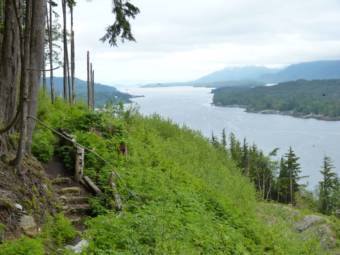
Portions of the Tongass National Forest can be seen from Ketchikan’s Rainbird Trail.
Parts of the Tongass National Forest seen from Ketchikan’s Rainbird Trail. (KRBD file photo)

The Biden administration on Tuesday formally began the process of restoring ‘Roadless Rule’ protections to millions of acres of Southeast Alaska’s federal forestlands.

It opens a 60-day comment period to undo action taken by the Trump administration that critics say could lead to more old growth logging in Tongass National Forest.

notice in the federal register published Tuesday says that Southeast’s timber industry is shrinking.

Tongass National Forest-related logging and sawmilling fell from just shy of 200 jobs in the early 2000s to around 60 workers in 2018.

The U.S. Department of Agriculture argues that restoring the 2001 Roadless Rule reflects the Biden administration’s priorities to build on the region’s tourism and fishing sectors.

The U.S. Forest Service has already frozen old growth timber sales under the current administration.

“…. a policy change for the Tongass can be made without significant adverse impacts to the timber and mining industries, while providing benefits to the recreation, tourism and fishing industries,” the notice reads.

Trout Unlimited’s Austin Williams in Anchorage says Alaska Gov. Bill Walker’s 2018 petition to exempt the Tongass National Forest from Roadless Rule protections put too much emphasis on commercial logging.

“It’s really time that we just move past that,” Williams said Tuesday. “And we recognize that there’s more value on the forest, keeping it and conserving it so that we can have, you know, fish and wildlife so that we can have tourism so that we can have cultural and traditional uses and to help fight climate change.”

The Roadless Rule would apply to about 9 million acres of the Tongass. But in practical terms, it could protect at most about 168,000 acres of old growth forest from clear cut.

Alaska elected leaders decry ‘federal overreach’

Gov. Mike Dunleavy and Alaska’s congressional delegation strongly supported the Trump administration’s exemption of Roadless Rule and has called the Biden administration’s move “federal overreach.”

“We think that discretion for the forest to be managed should continue to be at the local level,” the governor’s chief of staff Randy Ruaro, who grew up in Ketchikan when it was a lumber town, told CoastAlaska. “We don’t need Washington, D.C. with a one-size-fits-all rule for every forest in the nation.”

A lawsuit by the state to block the Biden administration’s initiative to bring back Roadless on the Tongass was dismissed last week by a federal appeals court.

A separate lawsuit by a coalition of tribes and ecological groups in favor of roadless protections remains pending but could be rendered moot by the new change in direction.

Tuesday’s action opens up a two-month comment period required before the agency can move forward.

If the Roadless Rule is applied to the Tongass, it could be reversed again by a future administration. More permanent protections would take an act of Congress.

Biden administration begins Roadless Rule do-over for Tongass

A portion of the Tongass National Forest along Peril Strait is seen from the ferry Chenega in Sept. 3, 2015. (Photo by Ed Schoenfeld/CoastAlaska News)
A portion of the Tongass National Forest along Peril Strait seen from the ferry Chenega in Sept. 3, 2015. (Photo by Ed Schoenfeld/CoastAlaska)

The Biden administration announced Friday the start date of its formal process to reinstate the Roadless Rule, which protects about 9 million acres of Tongass National Forest.

“Restoring the Tongass’ roadless protections supports the advancement of economic, ecologic and cultural sustainability in Southeast Alaska in a manner that is guided by local voices,” U.S. Agriculture Secretary Tom Vilsack said in a statement.

Successive Alaska governors have opposed the Roadless Rule since the Clinton administration put it in place in 2001. It’s been an on-again, off-again situation since then, with legal battles and politics coming into play.

The most recent whip-saw came last year, when the Trump administration exempted the Tongass from the rule.

Vilsack, who oversees the Forest Service, is again calling a do-over. He says a two-month comment period will be its first step to reinstate the Roadless Rule. And it’s a similar announcement to one made earlier this year that the Trump-era rule would be reversed.

“I don’t know how many times Vilsack can announce the same thing and have it sound like news,” said Juneau attorney Jim Clark, who has been coordinating a legal effort with some local governments and resource industries to preserve the Tongass exemption from the Roadless Rule.

He says the rhetoric around the rule’s protections of ancient forests is overblown.

“All this new exemption would do is open up 168,000 acres to timber harvest that wasn’t previously previously open,” he said Friday. “You wouldn’t know that from listening to the news — you’d think that all of the Tongass is going to be subject to clear cutting.”

And it’s true that while the rule change could affect more than 9 million acres, less than 170,000 acres of that would be old growth timber that could be logged under the current exemption.

Alaska state lawsuit rejected by federal Court of Appeals

Gov. Mike Dunleavy directed the state to join a lawsuit filed by resource industries, but the Court of Appeals dismissed the lawsuit earlier this week saying last year’s Roadless exemption is still in force, and the case was moot. But the governor’s office says the fight isn’t over.

“I would anticipate a very big vigorous response to the the efforts to control Alaska out of Washington, D.C.,” said the governor’s chief of staff Randy Ruaro, who hails from the former logging boomtown of Ketchikan. He told CoastAlaska on Friday that the Biden administration’s freeze on old growth timber sales ignores laws on the books that direct the Forest Service to make timber available to industry.

“We dispute the discretion of the Secretary to arbitrarily decide from Washington, D.C., to not follow those federal statutes and impose the Roadless Rule on the Tongass,” Ruaro added.

But opinion polls and the public record from hearings show healthy support for the Roadless Rule both in Alaska and Outside.

In Southeast, it has defenders from growing non-extractive industries like commercial fishing and tourism. Tribes whose traditional homelands are in what’s now Tongass National Forest also railed against the Trump administration’s rollback, both at hearings and in court filings.

Commercial logging of Tongass impacts subsistence

That’s because the legacy of clear-cutting and other development conflicted with rural residents’ hunting and fishing traditions.

Don Hernandez chairs the Regional Advisory Council on federal subsistence. It spent hours taking testimony over the Roadless Rule.

“It had just become pretty obvious over a long period of time that the areas of the Tongass that were most significantly impacted by past logging were all suffering harms to subsistence uses,” he said from his home on Point Baker on the northern edge of Prince of Wales Island, which is almost completely blanketed by federal forestland.

Hernandez is a commercial fisherman. He says the council heard loud and clear that people were worried about more old growth logging.

“And to expand that into other areas of the Tongass that people have come to rely on to meet their subsistence needs was just not going to be acceptable,” Hernandez said.

Tongass National Forest’s value as a carbon sink

To federal policymakers, the Tongass is seen less from a lens of conserving hunting and fishing grounds and more as a bulwark against climate change.

The Pew Charitable Trusts’ Ken Rait, who worked on developing the Roadless Rule under the Clinton administration in the 1990s, says there’s a recognition by the Biden administration that forests need to be kept intact to sequester carbon.

“And you know, there’s nowhere in the U.S. where this is more important than the Tongass National Forest,” Rait said from Portland, Oregon. “And so the decision is the right one for the Tongass, but it’s also the right one for the nation as a whole.”

The resource extraction industry and many of Alaska’s elected leaders complain that red tape will further lock up federal lands to energy and mining.

But Rait says there are safeguards in the rule. The Forest Service can — and does — issue waivers for projects in the public interest. More than two dozen to date have been granted, he says.

“The view that this is a blanket rule that will stop any development whatsoever from occurring on the Tongass just has not been borne out by the history of this issue,” Rait said.

How exactly the Biden administration plans to reverse the Trump administration policy still isn’t clear, says Clark, who served as chief of staff to former Governor Frank Murkowski, another strident Roadless Rule critic.

“It’s just a situation where we have to wait and see what the administration is actually doing,” he said.

Nov. 23 is when the Biden administration rolls out its plan for bringing back the Roadless Rule. If the last go-around is any indication, it’ll be a drawn out affair. It took more than two years to exempt the Tongass from the rule.

The federal government says more than 95% of people nationwide supported keeping the Roadless Rule in place during those hearings.

The Trump administration overturned it anyway.

A 60-day comment period will begin on Nov. 23, 2021 with the publication of a proposal to repeal the 2020 Alaska Roadless Rule. Comments can be submitted electronically using the Federal eRulemaking Portal; mailed to: Alaska Roadless Rule, USDA Forest Service, P.O. Box 21628, Juneau, Alaska 99802–1628; hand-delivered to Alaska Roadless Rule, USDA Forest Service, 709 W. 9th Street, Juneau, Alaska 99802 or emailed: sm.fs.akrdlessrule@usda.gov

Federal investigators probing ‘loss of control’ in Alaska Seaplanes crash on Juneau runway

An Alaska Seaplanes Cessna 208 on the way to Skagway and Haines crashed at the Juneau International Airport on October 22, 2021. (Lyndsey Brollini/KTOO)

Federal investigators have released more information about a commercial passenger plane that crashed at Juneau’s airport during takeoff late October. But they have yet to determine what caused the small passenger aircraft to lose control as it picked up speed on the runway, forcing the pilot to crash land.

“The $64 question at this point right now is what caused that loss of control,” said the National Transportation Safety Board’s Alaska chief Clinton Johnson. “And that’s what we’re trying to figure out.”

No one was reported hurt in the Oct. 22 crash operated by Alaska Seaplanes. The single-engine Cessna 208B was departing shortly before 9 a.m. for an 80-mile commuter flight to Skagway with a pilot and five passengers.

According to the NTSB’s two-page preliminary report released Tuesday, the plane veered sharply to the right while accelerating down the runway. The pilot’s efforts to turn the rudders left were ineffective and the plane was in danger of crashing into a float pond that parallels Juneau International Airport’s paved runway.

The pilot couldn’t stop so instead lifted off to become airborne, turned and made an emergency crash landing on the runway.

Investigators say they examined the nosewheel steering system, brakes and flight control systems but found nothing that would explain the sudden loss of control that led to “substantial” damage to the aircraft.

“During the emergency landing the right main landing gear and nose wheel collapsed, and the airplane sustained damage to both wings,” the report said.

Investigators also spoke with passengers who say nobody interfered with the controls during takeoff.

“A passenger seated in the right front seat reported that his seat was moved aft, his feet were on the floor near the control pedestal with his knees pointed toward the passenger door, so as not to interfere with any of the flight control movements,” the report said.

The report doesn’t identify the professional pilot or any of the five passengers. But Kent Craford, co-owner of Alaska Seaplanes in Juneau, says the pilot is doing very well, and he’s relieved nobody was hurt.

“She was uninjured, thankfully, as were the passengers,” Craford told CoastAlaska. “We were very, very thankful that she was able to make an emergency landing that everyone was able to walk away from.”

The investigation is continuing and is expected to take several months or even a year. Weather isn’t believed to be a factor. Visibility was good, there were broken clouds and winds were light, according to the report.


Site notifications
Update notification options
Subscribe to notifications