
Jacob Resneck is CoastAlaska's regional news director based in Juneau. CoastAlaska is our partner in Southeast Alaska. KTOO collaborates with partners across the state to cover important news and to share stories with our audiences.
Crew members handling fighter jets as they take off and land onboard the USS Theodore Roosevelt during exercises in the Gulf of Alaska during Northern Edge 2019 (Photo by Zachariah Hughes/Alaska Public Media)
The U.S. Navy says its warships will need more room to maneuver during next year’s military exercises in the Gulf of Alaska. It’s going through the permitting process and accepting public comment on the proposal next month.
John Mosher, a civilian environmental planner for the U.S. Navy, says military leadership has decided the current 55,000-square-mile area is too tight for maneuvers by its half-dozen warships
“The area that we were kind of restricted to operate in was just too limited,” he told CoastAlaska on Tuesday. “It wasn’t a realistic way of maneuvering our vessels and our aircraft as they would in a real world scenario.”
The Navy is proposing to add a 246,000-square-mile zone that would extend westward as far as Dutch Harbor in the Aleutians. It would be used for transiting and not for live-fire drills or active sonar usage, both of which would only be conducted in the existing area.
But Mosher says past exercises haven’t created any problems for fishing boats or civilian shipping in the area.
“Our vessels typically operate further away from the main channels, the main fishing grounds, things like that,” he said.
The Western Maneuver Area is the expanded area proposed by the U.S. Navy for 2023. The military says live-fire drills and active sonar would remain limited to the existing “Temporary Maritime Activities Area” that it’s used in the past. (Image courtesy U.S. Navy)
The Navy also says it won’t detonate explosives in waters that are less than 4,000 meters (13,120 ft.) deep. Mosher says that pledge is in response to comments from Alaska Native tribes and the commercial fishing industry.
“It eliminates the potential for effects on fish, on marine mammals, on marine birds and then also minimizes the potential to overlap with fishing activities,” he said.
Northern Edge is a biennial training exercise conducted in and around Alaska. It’s headed-up by the Air Force and involves service members from every branch of the military. It was last held in June 2021 and included an aircraft carrier.
The precise dates of the 2023 exercises haven’t been announced. In the past, military vessels have broadcast on automatic identification systems transponders. Mosher says whether that would happen next year is up to military planners.
A 45-day comment period will collect comments on the Navy’s proposal to expand its area of maneuvers during 2023’s Northern Edge exercises.
The Navy announced Tuesday on its Gulf of Alaska website that it’s seeking to amend its existing environmental impact statement for the proposal. A formal decision is expected in the fall, the Navy says.
Chris Woodley of the Groundfish Forum, which represents trawlers in the Gulf of Alaska, said several commercial fishing groups are just now reviewing the Navy’s plans and didn’t have any immediate comment.
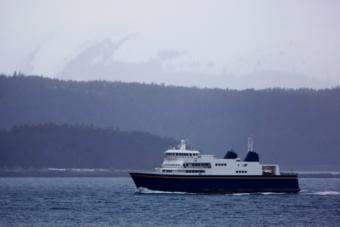
Sam Dapcevich, a state Department of Transportation spokesperson, said Friday that the Alaska Class ferry will be in action in February and March, serving Angoon, Gustavus, Hoonah, Haines and Skagway out of its base in Juneau.
“We’re really happy that we can make this work for northern panhandle communities,” he told CoastAlaska.
Upper Lynn Canal and Southeast villages had been facing more than a two-month gap in winter service.
In Angoon, the state’s ferry brings in “everything from soup to nuts,” and Angoon Trading Company, town’s only grocery store, has been struggling, says co-owner Shayne Thompson. He’s chartering a landing craft to bring in bulk groceries next week to supply the store before the state ferry arrives on Feb. 10.
The island village was recently visited by a passenger-only Goldbelt, Inc. catamaran during a Jan. 24 circuit that included Juneau and Tenakee Springs. It cost the state about $6,860 but was one-way only.
Thompson says that didn’t work for people trying to get to Juneau for shopping or medical appointments.
“People aren’t gonna hop on a ferry if there’s not a way to get back other than flying,” he said. “Because a lot of the people that ride the ferry don’t like to fly.”
Ridership records show that eight passengers arrived from Juneau on Jan. 24, and seven departed from the Admiralty Island community during that catamaran’s sailing.
Angoon doesn’t have an airport. It has floatplanes, which are often delayed in the winter. And the Goldbelt charter boats couldn’t carry vehicles or pallets of groceries for Thompson’s store.
“I don’t think the catamarans are the answer this time of year,” Thompson said.
Front Street in Angoon. (Photo by Emily Russell/KCAW)
Tazlina has seen little action since entering service in 2019
“We brought this up months ago,” said Earling Walli of the Inlandboatmen’s Union of the Pacific, the largest of the three crew unions. “It’s supposed to be a ready reserve vessel.”
In recent months, DOT has used crew shortages as a rationale for keeping the Tazlina tied to the dock.
But there have been other factors. Some of the Tazlina’s certificates had lapsed, meaning it didn’t have Coast Guard authorization to immediately sail.
Dapcevich says that was a factor. But also many of the fleet’s crew members were already assigned to ships in the yard.
“Even if we have enough crew to pull off of overhauled ships, that slows down their overhaul process which ends up affecting people in the future,” he said.
Walli says the unions have never been convinced that there weren’t enough ferry workers.
“We’ve always said that there hasn’t been any crewing issues — that they should be able to pull people off other vessels in yards,” he said. “They have the ability to pull people from the vessels and yards and put them on revenue runs. They do it all the time.”
But in any event, he says his members are glad that they’re finally being called back to work.
In Angoon, grocer Shayne Thompson says he’s relieved to have regular winter service on its way. He says rider demand in the warmer months might be higher overall, but mid-winter is when it’s a lifeline.
“I feel like instead of trying to treat the ferry system like some sort of pseudo-cruise line, they need to start pulling them offline in the spring or in the fall,” Thompson said. “So that in the dead of winter, we actually have ferry service when we really need it.”
The Matanuska ferry is slated to return from overhaul on Jan. 31. And with the Tazlina now on the board, most Southeast communities will have regular ferry service for at least another couple of months.
State and federal game managers set a 30-day hunting and trapping season that closed Dec. 15.
Fish & Game’s regional wildlife supervisor Tom Schumacher says the month-long hunting and trapping season seemed a reasonable balance between keeping the population under control and conserving the species. And it’s yielded nearly the same as last year’s winter wolf harvest.
“We don’t set a quota these days,” Schumacher told CoastAlaska. “So we just go for something that seems like a season length that will achieve a sustainable level of harvest. And I think that’s certainly the case here.”
But conservationists want the federal government to intervene. The Center for Biological Diversity filed a petition in 2020 to have Alexander Archipelago wolves listed as a distinct subspecies after a record number — 165 wolves — were trapped and killed two years ago after the quota system that capped the total harvest was lifted.
“The state still doesn’t really have a good handle on the wolf population,” Shaye Wolf, the center’s Oakland, California-based climate science director said Wednesday. “What we do know is that these wolves are suffering from high levels of inbreeding from habitat destruction from logging. So these high levels of trapping are a problem for them.”
But the Dunleavy administration has warned that federal protections for Southeast Alaska’s wolf habitat could trigger an extra layer of red tape for development across the region.
“We’re not managing necessarily, with an eye toward the ongoing ESA process,” he said. “But I believe Game Management Unit 2 does not qualify — or it was found the last time to not qualify as a distinct population segment — so I think it’s unlikely that the Fish and Wildlife Service would decide to list only wolves in that area.”
Resident hunters have long testified that the island’s wolf population is healthy. And they blame the wolf packs for preying on the island’s black-tailed deer, which are an affordable source of fresh meat. Environmentalists counter that habitat loss to logging is to blame for making deer scarce.
In reviewing the most recent petition, the U.S. Fish & Wildlife Service says it’s found some merit that Alexander Archipelago wolves face threats. It wrote that habitat loss from clear-cuts, aggressive hunting and the impacts from climate change have only gotten worse since the last Endangered Species Act petition was filed on their behalf a decade ago.
But it’s not clear when the agency will rule on the 2020 petition. In the past, the review process took about four years.
Editor’s Note: This article has been corrected to reflect that wolf harvest closed in mid-December, not mid-January.
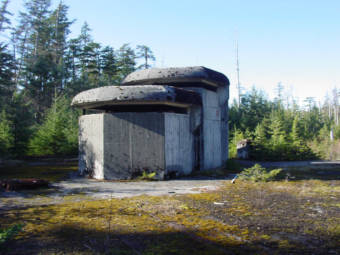
A 2004 photo of a former observation point on Shoals Point, where defenders would help triangulate the battery’s six-inch guns. Fort Babcock, plus two other gun batteries on Biorka and Makhnati islands, were designed to defend against enemy ships or submarines entering Sitka Sound. (Photo courtesy of Matt Hunter)
Eight decades after the fact, the federal government plans to spend $2.2 million to clean up a contaminated former army site on Kruzof Island near Sitka. It isn’t going to happen overnight — the Army Corps is still designing the effort. Actual work and removal of the PCB-contaminated soils isn’t expected until 2024.
But to understand how and why Fort Babcock came to be requires a 20th Century history lesson on the rise of Imperial Japan as a Pacific power. And few people in Sitka know as much about the area’s military history as high school teacher Matt Hunter.
As an amateur historian, Hunter curates a website on Sitka Harbor’s WWII-era military sites. He says that when Japan invaded its neighbors in the 1930s, the United States realized it had few Pacific defenses outside of Hawaii and the Panama Canal zone.
“But Alaska, sort of the third vertex of a strategic triangle, was completely undefended,” he said.
A critical part of Sitka Sound’s defenses
Fort Babcock was designed to be a keystone in the defense of Sitka Harbor, which during World War II hosted a significant military presence to counter the threat from Imperial Japan.
A view of sailors constructing a dock facility at Fort Babcock at Shoals Point on Kruzof Island circa 1941-1943. (Photo courtesy of Alaska State Archives via John Carroll Benton papers, Archives and Special Collections, Consortium Library, University of Alaska Anchorage.)
But today its legacy today is little more than abandoned buildings and contaminated soil near the shores of Sitka Sound.
Naval air stations were established on Kodiak Island, Dutch Harbor and Sitka. Defense of those naval bases fell to the U.S. Army which installed a battery of six-inch guns capable of striking an enemy ship from 12 miles away.
But as the tide of the war shifted, the threat from Imperial Japan receded, and by 1944 the military canceled the defense project.
“And then as soon as they finished, they abandoned them and locked the doors and left,” Hunter said.
Today the site is heavily overgrown. But among the ruins there’s still evidence of the efforts of thousands of men.
“There’s even some notes on some of the work benches, and they’re written by the men who are in the construction battalion,” he said.
A nonagenarian veteran returns in 2010
One member of that battalion came back for a visit more than a decade ago.
Pvt. Gerald S. Warren on guard duty at Fort Babcock in 1942 or 1943. (Photo courtesy of Matt Hunter via the Ted Gutches collection)
“I’m just like MacArthur wading ashore,” 93-year-old Bob Vollmer laughingly told KCAW during a visit to Kruzof Island in 2010. “MacArthur said, ‘I shall return!’”
“I didn’t like that guy, though,” he added.
KCAW’s Ed Ronco shadowed Vollmer and filed a story for the Alaska Public Radio Network about the Indiana man, who’d spent most of 1943 helping build Fort Babcock.
Vollmer passed away earlier this month at the age of 104. But in an interview with KCAW some 11 years back, he expressed surprise by how much nature had taken over what had been a bustling observation post during the war.
“I’m real happy to know, like places like this, they are still environmentally sound,” he said as he took in the thick foliage that had reclaimed the former fort site.
But Fort Babcock is not as pristine as it may have appeared to Vollmer in 2010. The U.S. Army Corps of Engineers, which is tasked with cleaning up the hundreds of potentially contaminated former military sites in Alaska, discovered serious contamination several years later.
Beth Astley is the Army Corps’ project manager overseeing cleanup of the site. She says investigators knew about the old oil tanks. But in 2012 and 2013 they dug deeper.
“That’s when we discovered that there was PCB contamination at the former power plant,” she told CoastAlaska in a recent interview.
In a 259-page decision document filed last August, the Army Corps announced plans to remove about 559 cubic yards of PCB-contaminated soil and place them in what Astley calls “super sacks.”
“Which are large sacks that are specially made to hold contaminated soil. And then those bags would then be put on to a barge and then they would be taken to a port and then to the landfill (in the Lower 48),” she said.
“They don’t seem to go away very quickly,” Astley said. “They can persist for a really long time.”
Sitka tribal officials assess cleanup plan
Sitka Tribe of Alaska has been pushing for the cleanup of Shoals Point. People hunt, fish and gather traditional foods on Kruzof Island, just a 10-mile skiff ride across the sound from Sitka.
“The Tribe is pleased that … the Army Corps is going forward with cleaning up the site, because it’s long overdue,” said Helen Dangel, a biologist who works as a natural resources specialist for the Sitka tribe.
Dangel says the Army Corps’ priority seems to be the most hazardous waste at the former Fort Babcock site.
“But that doesn’t mean that all of the contaminants will be cleaned up,” she said. “In the document, there’s a lot of talk about cleanup levels, and if there’s a complete pathway to humans, through air through, through drinking water, through skin contact, or through eating. And so if they determine that there’s not a complete pathway, then some of the contaminants aren’t getting cleaned up.”
Decayed 50-gallon drums in the Fuel Storage Area on Kruzof Island where Fort Babcock stood before it was abandoned in 1944. Regulators are more concerned about PCBs in the soil around the fort’s former power plant. (Photo courtesy of U.S. Army Corps of Engineers)
The Army Corps says it plans to remediate the area to residential standards and that no additional environmental monitoring would be required.
Matt Hunter, the math and physics teacher at Mt. Edgecumbe High School, says Shoals Point is a fantastic place to visit — especially for anyone interested in Alaska’s early 20th century history when Sitka was a hive of military activity on what’s now an uninhabited island.
“It’s not like a park or something that’s had interpretation and doors locked. Everything’s wide open,” Hunter said. “And it’s also a very unique place. Being on this volcanic island with all the surf coming in, and the open ocean is absolutely beautiful.”
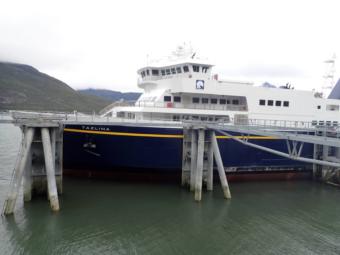
The M/V Tazlina ties up in Haines during its maiden voyage on May 7, 2019. (Photo by Jacob Resneck/CoastAlaska)
The Alaska Department of Transportation recently signed contracts with at least two vendors to run catamarans to Southeast villages. But officials in coastal communities aren’t sure the passenger-only vessels will be able to meet residents’ immediate needs.
In Gustavus, City Manager Tom Williams says the community doesn’t have a ferry scheduled until the third week in March and has been requesting a state ferry in coming weeks.
“We’ve had a really difficult winter, lots of snow, heavy snow loads on roofs, buildings that have collapsed,” Williams said last week.
He said right now residents rely on the marine highway’s ferries to shuttle their vehicles back and forth from Juneau for lumber and other essentials for repairs.
“Without the ferry, they’re not going to be able to do that,” he said.
On Wednesday, transportation officials confirmed that Juneau’s for-profit Native corporation Goldbelt, Inc. will be paid about $5,400 for a round trip circuit between Juneau, Hoonah and Gustavus. Williams said his city wasn’t notified.
“That’s news to me,” he said of the contracted ferries. “I appreciate the effort. But I don’t know that that’s going to be workable for us.”
He said he’s concerned that a passenger-only service would have limited ability to bring in freight like building supplies and groceries that Gustavus residents will need to get through the winter.
DOT spokeswoman Shannon McCarthy said private vendors were not the agency’s first choice. But that the ferry LeConte has to enter the Ketchikan shipyard for its annual overhaul to be ready for the busier summer months.
“We would prefer to sail with our vessels and with our crews,” she said. “That’s our first and foremost, that’s how we prefer to do it.”
Recently, the agency said some of the Tazlina’s certificates had lapsed delaying its ability to sail. Now it said it’s having trouble finding enough mariners for the 14-person crew.
“We actually don’t have people sitting around at all,” McCarthy said. “In fact, everyone who wants to work is working right now.”
Ferry unions say $60m Tazlina should’ve been floated sooner
That’s brought skepticism from union representatives, who point out that most of the fleet is tied up or being overhauled.
Shannon Adamson heads the local branch of Masters, Mates & Pilots, which represents the marine highway’s deck officers.
“If AMHS says that they don’t have enough crew to operate the Tazlina, then their crew shortage is much more severe than they’ve led anyone else to believe,” she said last week.
The three ferry unions recently signed an agreement to allow private ferries to call into Haines and Skagway at least until the end of January while the state readies the Tazlina. In a rare joint statement, the three unions blasted AMHS management for not having the Tazlina ready to take up the slack sooner.
“Repeatedly we have been told the Tazlina is the ready reserve ship, so why was she not prepared to take up this emergency service?“ wrote Ben Goldrich of the Marine Engineers Beneficial Association in a Jan. 9 statement. “We believe these vessels should be better prepared in the future.”
Adamson told CoastAlaska in a phone interview that the ferry’s winter gaps are the product of poor planning at the top.
“The fact that contracting out is something that has become more and more common — in the three unions’ opinion — it generally can be traced back to deferred maintenance and poor management decisions,” she said.
DOT reveals details of contracts
CoastAlaska had requested details of the tenders signed or being finalized for supplemental service.
On Jan. 11, DOT finalized a contract with Goldbelt for a scheduled circuit between Juneau, Hoonah and Gustavus for $5,390 per trip. It will also sail between Juneau, Tenakee Springs and Angoon for $6,860 per trip.
Earlier this month DOT finalized a contract with Sitka-based Allen Marine Tours to run a passenger vessel between Juneau, Hoonah and Pelican for $7,999 per trip.
In a statement, the agency says it’s finalizing contracts for on-call passenger service with the same two vendors as well.
Goldbelt would be paid $6,305 for a round trip between Juneau, Haines and Skagway. Allen Marine would be paid $9,999 for a round trip between Juneau and Sitka. A third circuit calling inKetchikan, Wrangell and Petersburg would cost the state $11,499.
The chartered passenger service has been designed with apparently little coordination with destination communities. Norm Carson sits on tiny Pelican’s chamber of commerce and serves on the state’s newly formed marine highway operations board.
He’s long been the point-man for the small village’s ferry service. He said Pelican officials agreed to forego ferry service in January and February altogether to save the state money.
“Rather than bring a $27,000 ferry out there ferry run,” Carson told CoastAlaska. “We said, ‘We’ll go without and save the AMHS some money.’”
The Tazlina isn’t an option for that village because its design is incompatible with Pelican’s dock.
Carson says passenger service in the winter would be welcome as an affordable alternative to air travel. But he said the real needs for Pelican are a vehicle-capable ferry in March and then regular service in the summertime when the fish processor is running and for people to move vehicles and freight.
“It would help to a point,” Carson said of the private catamarans this winter. “But it’s not going to be the answer in the long run.”
Sen. Jesse Kiehl, D-Juneau, has been pushing for the Tazlina ferry’s return to timely service for weeks now. He said the private contracts appear to be fair market value prices. But his panhandle constituents say they need the ability to move people and freight.
“It’s not one or the other,” Kiehl said Wednesday. “And so we really have to get the Tazlina or some other vessel that can move a vehicle full of freight, as well as a bunch of school kids or a family to medical appointments.”
Marine Highway officials say they anticipate the Tazlina ferry should be in action by the first week in February. But as of Thursday afternoon, none of the sailings — whether by private catamaran or state ferry — have appeared on the state’s reservations system.
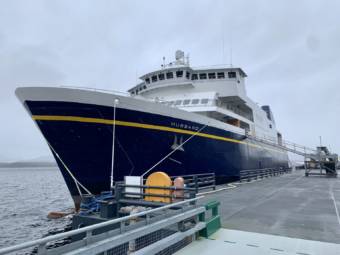
The 280-foot Hubbard is an Alaska Class Ferry tied up in Ketchikan on January 29, 2021. It was built for $60 million by Vigor Alaska and completed last year. It and its sister ship recently received new side doors at a cost of about $4.4 million. It has not been put into service. (Photo by Eric Stone/KRBD)
One Alaska state ferry collided with another while docking in Ketchikan early on Jan. 14, causing some damage but no reported injuries. The collision happened around 4:25 a.m. Friday morning.
That’s according to a statement from the Department of Transportation, which reported that the 382-foot Kennicott ferry hit the smaller Hubbard. The Kennicott has just finished up service in Southeast and is heading in for a scheduled overhaul.
The 280-foot Hubbard is an Alaska Class ferry that’s in Ketchikan for a $15 million upgrade. The work by Vigor Alaska would add crew quarters to extend the ship’s operational range and versatility before it enters service later this year.
The Kennicott fared worse than the Hubbard in the collision, with damage to its starboard side and to one window. Damage to the Hubbard was described as “minimal.”
“AMHS does not anticipate the damage from today’s incident will impact project timelines or return to service dates for either vessel,” the agency said in a statement.
Earlier in the day, the DOT had announced that Vigor Alaska had signed a contract for upgrading the Hubbard. The agency also said it had awarded a $9.4 million contract to JAG at the Seward shipyard on Dec. 28 for improvements to the ferry Tustumena, the second oldest vessel in the fleet.
“This work will contribute toward extending the ship’s service life until the Tustumena Replacement Vessel (TRV) can be put into service in approximately five to six years,” the agency said.
Close
Update notification options
Subscribe to notifications
Subscribe
Get notifications about news related to the topics you care about. You can unsubscribe anytime.