Jacob Resneck, CoastAlaska

Jacob Resneck is CoastAlaska's regional news director based in Juneau. CoastAlaska is our partner in Southeast Alaska. KTOO collaborates with partners across the state to cover important news and to share stories with our audiences.
Keeping the Malaspina idled costs nearly twice what the state has disclosed, emails show

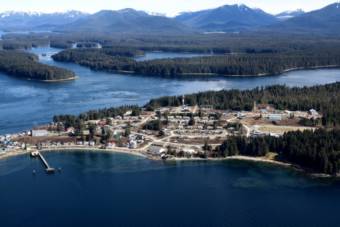
The Malaspina ferry, tied to a dock.
The state ferry Malaspina sits in layup in Ward Cove near Ketchikan on May 10, 2020. DOT says it costs around $75,000 a month in moorage, utilities and insurance. (Eric Stone/KRBD)

The cost of keeping an idled Alaska ferry at the dock is nearly twice as much as publicly reported to the public and state lawmakers. That’s according to internal emails obtained by CoastAlaska in October, more than three months after they were first requested under state public records law.

First, the back story: The nearly 60-year-old ferry Malaspina was built the year JFK was assassinated.  It’s one of the marine highway’s original three sister ships designed to connect coastal communities with each other and the Lower 48. But the blue and gold mainline ferry hasn’t carried passengers in almost two years.

Governor Mike Dunleavy’s administration didn’t want to invest in the overhaul of its original engines from 1963. Estimates of fixing the ship run upwards of $70 million for steel work, new engines and restoring its Coast Guard certificate, which lapsed while the ship’s been laid up at Ward Cove, a private dock north of Ketchikan. But officials have apparently been unable to decide whether it would be best to scuttle, sell or donate the ship.

As recently as Aug. 31, the marine highway’s general manager told CoastAlaska that plans to offload the vessel remain “on a hold.”

It could have been a floating barracks on the Horn of Africa

There’s been talk of commercial interest. But for the first time, email records show the nature of the inquiries. One firm says it wants the Malaspina for anti-piracy operations off the coast of Somalia.

“We would be using it as a platform for housing personnel over in the Middle East,” wrote Jonathan McConnell, president of Meridian Global Consulting, a security firm based in Mobile, Alabama.

The Malaspina has staterooms with more than 230 passenger bunks that McConnell says could be outfitted as sleeping quarters for security contractors that patrol shipping lanes to deter attacks from pirates off coast of Somalia, he said.

He provided recent email chains between his firm and state officials showing that more than a year has gone by since he first expressed interest. He last reached out in July 29, with no answer.

“We felt largely stonewalled by them,” McConnell told CoastAlaska this week.  He says his firm is willing to pay fair market value — close to $1 million.

“Our claims were not even entertained, it seemed like,” he said.

Another prospective buyer in the United Arab Emirates had made a cash offer via email for $625,000 for the Malaspina as-is, emails show.

Several prospective buyers have said the 408-foot ship has cash value. It could be sailed or towed on a temporary Coast Guard certificate to be repurposed or sold as scrap.

“There’s ample opportunities for use for that vessel,” McConnell said. “Laying it up and spending $40 grand a month for a layup is astronomical, frankly.”

Internal emails show surprise at high cost of mooring and insurance

That was the view of many inside DOT as well. Internal emails — some of them completely redacted — show officials were surprised and frustrated with the expense of keeping the ship.

One email from Mary Siroky, a recently retired deputy commissioner, brought to light that the price of insuring the vessel made the true monthly cost of keeping the Malaspina was closer to $75,000.

That was nearly twice the figure cited by the agency as the cost of mooring the ship at Ward Cove.

“Its (sic) seems clear to me, even if we give the Mal away, we’re coming out ahead very quickly,” DOT’s deputy commissioner Rob Carpenter wrote in an August 2020 email.

That was the apparent view of inside the Dunleavy administration, which earlier this year tried to gift the ship to the Philippines.

A May 20 letter to the consul general in San Francisco made it clear it could go either to the foreign government or a private operator in the country.

But talks between Alaska and the Philippines apparently had been going on for some time. Internal emails show that a month before the official offer bearing the governor’s signature was sent, an email from DOT’s Rob Carpenter had inquired whether that deal with Manilla was still on.

Gov. Mike Dunleavy’s acting Chief of Staff Randy Ruaro replied the same day, directing DOT to hold off.

“Do not do anything with the Malaspina,” Ruaro wrote in an email. “The Philippine Consul is interested and working on it on their end. The boat is 60 years old. We don’t need to rush to do something with it this month or possibly next. Please stand down from issuing anything that would dispose of the vessel until you hear from us to go forward. We will let you know.”

Ruaro told CoastAlaska this week that the deal fell through when the Philippine government learned it would cost more than $50 million to rehab as a passenger ship.

They said that would be out of their price range for wanting the boat,” he said in a phone interview.

Malaspina stored long-term in $400,000 sole-source contract

But even afterward, the emails up to June 23 showed no evidence that efforts to dispose of the ship resumed. Or that further direction was offered from above. And by that time, the state had signed a contract with the Ward Cove Group to store the ship.

“With only a single interested party, the state processed a Single Source Procurement to authorize the award of a new contract to Ward Cove Group for $402,084 annually,” DOT wrote in an email to CoastAlaska in June.

The Dunleavy administration earlier this year sold the fleet’s newest ships — two fast ferries — to a Spanish firm for service in the Mediterranean. Selling surplus ships had been a key recommendation of the governor’s task force giving advice on the future of the fleet.

Tom Barrett, the retired Coast Guard admiral tasked with chairing the working group, says it’s apparent the Malaspina remains a drain on state coffers.

“Sell it or scrap it,” Barrett said in an interview. “But you just don’t want to keep holding it there indefinitely. Also you’ve got insurance, but it’s a risk factor, it’s an old ship and it’s tied up at a dock.”

DOT confirmed to CoastAlaska that the cost of insuring the Malaspina ferry was approximately $420,000 a year in fiscal year 2021 and says that figure would go up “slightly” in fiscal year 2022. Add the roughly $450,000 the state is paying in mooring fees and electricity, and the cost is nearly double than it has previously admitted.

Lawmakers tasked with oversight are concerned

Those tasked with oversight of the ferry system say that’s a lot more than DOT even disclosed to lawmakers — which Sen. Jesse Kiehl, D-Juneau, says is surprising given the marine highway system’s extremely tight budget, which is regularly a target of line-item vetoes.

“I’m very surprised to learn that the marine highway system is able to allocate this, this insurance cost across each vessel, and that they never bothered to mention it to the legislature,” Kiehl said. He’d been on the Senate Transportation Committee that had quizzed transportation officials on the carrying cost of idled vessels.

An April 21, 2021 email from DOT officials seeking guidance from Gov. Mike Dunleavy’s staff on how to proceed with the Malaspina. The governor’s office directed them to stand by while a deal to give away the ship to the Philippines was being worked out.

“We either need to get a federally funded project going and rehab this vessel to get it moving,” Kiehl said, “or we need to make a decision about disposing of the vessel as Alaskans.”

“If the department’s not coming forward with all the facts, that ties the legislators’ hands of doing the job Alaskans sent us here to do,” Kiehl said.

Ruaro, the governor’s chief of staff and a former senate aide to Sitka Republican Senator Bert Stedman, says he’s taken an interest in the Malaspina. He says he’ll be visiting Ketchikan to personally inspect the ship’s condition at Ward Cove.

He says he couldn’t immediately explain why there had been no answer to prospective buyers.

“I will step in and talk to DOT and we’ll make sure that any offers or expressions of interest are all reviewed and vetted for options,” Ruaro said.

Several emails from a DOT contractor reiterates there were several serious commercial offers for the Malaspina on the table, one from a Fiji ferry operator who had purchased similar vessels from B.C. Ferries.

Rob Carpenter, the deputy commissioner, underlined the scrutiny the agency was under as it faced tough decisions over the future of the ship.

“There is significant sentimental value for the vessel, so a public process and an evaluation of alternatives will likely be the best publicly perceived approach,” he wrote on April 21.

Since that email was sent, the idle and vacant Malaspina has cost the state of Alaska more than $400,000 in mooring fees, electricity and insurance to keep.

Correction: The original headline used the term “dry dock” to describe how the Malaspina is stored. It’s not in dry dock — it’s docked in Ward Cove, near Ketchikan.

Subsistence council calls for tighter hunting rules in rural Southeast Alaska

Aerial view of Angoon in 2017. The Southeast Alaska Subsistence Regional Advisory Council is recommending making lower Admiralty Island off-limits to sport hunters during deer season. (Emily Russell/KCAW)

Hunters in Juneau are pushing back on proposals that could restrict their deer hunting rights in parts of Southeast Alaska. The Southeast Alaska Subsistence Regional Advisory Council says its proposals are responding to food security concerns from villages.
Pelican deer hunter Terry Wirta testified this month to the regional subsistence council from the tiny hamlet on Chichagof Island. He says it’s been difficult for guys like him to fill his freezer.

I don’t know, things seem to have slowed down around here, and all I hear nowadays is a lot a lot of hunters want to be coming here.” he told the council on Oct. 6. “I think the residents in Pelican should have the priority on hunting around here, I’ll tell you that much.”

He was supporting a proposal to restrict hunters coming from urban areas to hunt along Lisianski Inlet. It was one of a handful of proposals that would restrict deer hunting in areas popular with state-licensed hunters from bigger towns.

The strongest measure would be an outright closure of the southern portion of Admiralty Island to urban hunters, to give more opportunity to subsistence hunters living in nearby Angoon.

That’s where council member Albert Howard lives. He says hunters coming from Juneau have access to cheaper fuel to run their skiffs. And if they need affordable meat, there are supermarkets like Fred Meyer and Costco.

“If an Angoon resident fails at hunting, heh, I don’t know how else to say it. But they’re S-O-L,” he said last week. “And we’re people that don’t like to depend on anybody, and I don’t want to go ask anybody for help.”

These rules would apply to federal lands. Much of Southeast Alaska is in Tongass National Forest. And federal law gives priority to subsistence hunting for those living outside of the urban areas of Juneau and Ketchikan. Everywhere else in Southeast, from tiny Pelican to larger Sitka and Petersburg, is considered rural.

State and federal wildlife agencies opposed added restrictions on non-rural hunters. That’s because data shows the deer population appears healthy.

The federal Office of Subsistence Management also argued that many hunters originally from Southeast villages move to larger towns like Juneau or Anchorage. They’d be restricted when they come home to hunt with friends and family.

Juneau-based hunting group organizes opposition

More than 50 letters came in against the measures.

Territorial Sportsmen, a Juneau-based hunting and fishing organization, has lobbied hard against the proposals and encouraged its membership to chime in.

Ryan Beason is an accountant and commercial fisherman living in Juneau and the group’s president.

“We want to promote the rights to all hunters and Southeast and not limit each other,” he told CoastAlaska in an interview. “I think what these proposals are doing is creating conflict between user groups.”

The proposed restrictions on non-rural deer hunters were recommended by the council in amended form. They included urban hunters being allowed to hunt for bucks only with a reduced bag limit on areas of Chichagof Island near Hoonah and Pelican.

State tidelands would be exempt, meaning state-licensed hunters could still cruise the shorelines in their skiffs.

“The mean high-tide line is all state land,” Beason said. “So beach hunting would still be allowed.”

Regional Advisory Council Chair Don Hernandez, who lives on the northern tip of Prince of Wales Island, told CoastAlaska the council has been hearing from villagers concerned about rising costs of fuel and aging rural populations.

There’s worry about the ability of people in these villages to get the food that they require add at a cost that they can afford,” he said.

He says he understands the wildlife agencies’ opposition. After all, on paper the deer herds are relatively healthy. But he says the regional advisory councils were set up to consider more than population surveys and the number of animals taken.

The agencies, they rely on data. And the council, we listen to people,” he said. “You might call that traditional ecological knowledge. But it’s basically the stories of what people are telling us about what the actual conditions are. So we weigh that more heavily, I think, than the agencies do.”

Details still to come on proposals

Final details of the recommendations approved earlier this month remain unclear but will be published in coming weeks after the minutes of the multi-day meeting are finalized.

That’s because the federal Office of Subsistence Management says the precise language won’t be available until a court reporter prepares a transcript of the meeting and minutes.

But those recommendations are not final. They’ll be forwarded to the Federal Subsistence Board, which in mid-April will consider  whether to incorporate these in the federal hunting regulations as early as next year.

If they are adopted, it could limit deer hunting opportunities over large swathes of Southeast Alaska that had long been popular with sport hunters from larger towns.

New Juneau-based medevac jet has more room for patients and families

side view of a lear jet sitting on a runway
Airlift Northwest recently added a 58-foot Lear Jet 45XR to its medevac fleet in Southeast Alaska. Pictured on Sept. 28, 2021, it is based at Juneau International Airport. (Jacob Resneck/CoastAlaska)

Medevac pilot Sam Steensland’s office is a Lear Jet 45XR, with two engines generating a combined 7,000 pounds of thrust.

“It’s just as fast as our old jet but it carries a lot more fuel,” he said during a recent demonstration at Juneau International Airport. “The nurses have a lot more room in the back to work. The avionics up front are a lot nicer. So I’d say just about everything about it’s a lot nicer.”

Airlift Northwest’s newest aircraft replaces a slightly smaller Lear Jet 31. Small business jets like these were developed to convey jet-set types between countries. But in Southeast Alaska, working folk also use them to catch a rides to larger hospitals, usually in Anchorage or Seattle.

From its Juneau base it plies the skies of Southeast Alaska

The new plane, based in Juneau, can transport passengers from most communities that have long enough runways.

We can get into just about all of them in Southeast,” he said. “Except we can’t do Skagway or Hoonah in the jet. And that’s why we have our turboprop can do those.”

Airlift Northwest has a Pilatus PC-12. Other carriers fly the Beechcraft King Air 200. Both can fly lower and slower but are more susceptible to the elements.

There are also some situations where planes can’t land at all: Angoon on Admiralty Island doesn’t have an airport.

In some cases — like a patient on a fishing boat or a hunter in the wilderness — a Coast Guard rescue helicopter may be dispatched from Sitka or Kodiak for a “wing-to-wing” transfer to the medevac plane.

The Coast Guard helicopter will actually land right beside our plane,” Steensland said. “We’ll transport the patient onto our plane and off we go to wherever they need to get to.”

A woman inside a medevac lear jet, next to a stretcher
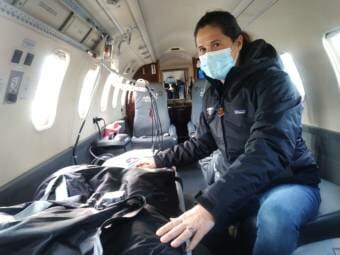
Juneau Base Manager Elise Blasco demonstrates the medical capabilities of Airlift Northwest’s Lear Jet 45XR that’s outfitted as a flying ICU. (Jacob Resneck/CoastAlaska)

Inside the Lear Jet’s cabin, there’s a long stretcher where an injured or ill patient is secured.

There are seats for the two flight nurses and even extra space for up to three family members, says Elise Blasco, the Juneau Base Manager for Airlift Northwest.

We are a flying ICU, so everything that you’re going to find in an ICU, we’re going to have the capabilities to initiate or continue in this aircraft as well,” she said.

The aircraft is equipped with medications, plasma units for patients that need blood and monitors designed for intensive care use.

There are a number of protocols for flying patients that have COVID-19. She says the pandemic has made it challenging at times for patients to be transported because of dwindling space in hospital critical care units.

“There is very limited availability for — especially ICU beds — right now in the state of Alaska,” she said.

A more comfortable cabin in a crisis

Stabilizing patients is essential because a flight between Juneau and Seattle can take more than two hours while cruising at around 500 mph.

a view of the learjet's cockpit
Airlift Northwest pilots Robert Wells and Sam Steensland, right, demonstrate their preflight checklist from the cockpit of a Lear Jet 45XR. (Jacob Resneck/CoastAlaska)

Diana Paul is a flight nurse who says the newest jet is an upgrade for everyone on board compared to the smaller jet.

“Before it was pretty tight, and they’d feel a little claustrophobic,” she said. “So this is really a lot more comfortable for the patients.”

Insurance may not cover the full cost of a medevac

Airlift Northwest charges by the mile, and a flight to Seattle can cost around $100,000. An 80-minute trip up to Anchorage is at least $70,000.

Providers bill insurance companies first. But patients sometimes find their insurer won’t pay the full amount, says Shelly Deering, the regional manager who oversees billing.

I cannot emphasize enough that it’s really important for Alaskans, to look at what their insurance covers for medevac to make sure that they are covered,” Deering said.

Airlift Northwest is a nonprofit that’s an arm of the University of Washington. But it still charges competitive rates in line with the other two medevac providers that are for-profit enterprises.

All three medevac providers offer an annual membership plans, which are not reciprocated. That means a household would need to buy all three to be guaranteed that they won’t receive a bill.

Deering says people sometimes sign up for Airlift Northwest’s membership plan from a hospital bed while waiting to fly out.

“But you have to be awake or have someone as an advocate who can do that for you,” she said.

Costco contractor agrees to pay $50K to Juneau employee who was denied extra bathroom breaks

Sun shines on Costco in Juneau on March 26, 2019. (Photo by Jeremy Hsieh/KTOO)

About a year after she was hired to work inside Juneau’s Costco in 2016, Terry Baker was told she could not use the bathroom except during her regular shift’s two scheduled breaks.

That’s despite producing evidence she had a medical condition that could require a trip to the bathroom more often than twice over a 6 and 1/2-hour period, a federal lawsuit said.

In 2019, the Equal Employment Opportunity Commission stepped in based on a discrimination complaint she’d filed with the watchdog.

“We saw here an employee who really suffered unnecessarily,” EEOC attorney Amos Blackman told CoastAlaska.  “This refusal to accommodate additional bathroom breaks had the likelihood of impacting any number of workers.”

Commission says employees with medical conditions have legal protections

The more than two years of legal wrangling didn’t directly involve Costco. The retail chain doesn’t hire the people that offer the product samples in its aisles. They are employees of Club Demonstration Services, a subsidiary of a larger firm with global reach, which has tens of thousands of people on its payroll.

Many of those employees Blackman says are older and might have underlying medical conditions that employers are in many cases obligated to accommodate under the Americans with Disabilities Act.

“It employs many employees with physical disabilities and older workers — and that is great, right?” Blackman said. “But that doesn’t give any employer the right to say, ‘Well, because we’ve hired you in the first place, we can easily replace you.’”

CDS was represented by Littler, a global law firm with an office in Anchorage. Attorney Renae Saade did not return calls and emails requesting comment. Nor did Costco, which has contracted with the sample-dispensing firm for decades.

Club Demonstrations Services, Inc. to pay $50,000 in back pay and damages

settlement approved by a federal judge Tuesday also puts the company under what’s called a consent decree. Regional managers will have to be trained on the company’s legal obligations under federal anti-discrimination laws.

The consent decree also requires regular reporting to the EEOC, which will be monitoring the company’s treatment of its Alaska workforce over the next two years.

“And if there are complaints, that they get handled in a more rigorous manner,” Blackman said. “So we can see if they’re holding up their end of the bargain.”

The lawsuit asked for Baker to get her job back. Instead, the company agreed to pay her $50,000 in back wages and other compensation.

Baker, who still lives and works in Juneau, declined to comment.

In court filings, the company didn’t dispute many of the central allegations in the lawsuit. But it did deny that Baker was fired, saying she resigned instead.

To pay oil tax credits, Alaska eyes selling carbon offsets on state forests

Cook Inlet oil platforms are visible from shore near Kenai, Alaska. The state of Alaska owes about $600 million in oil and gas tax credits to small producers and their creditors. (Rashah McChesney/Alaska’s Energy Desk)

The Dunleavy administration is eyeing a carbon credit program on state forestlands. It’s requested proposals from prospective consultants “to investigate the potential for a carbon offset credit program based on carbon sequestration on state lands,” according to a document that went up this month on a state website.

Alaska Native corporations have publicly vaunted windfalls worth tens of millions as some pivot from commercial logging to being paid to keep trees on their lands standing. Sealaska is one example: it and others went into partnership with oil giant BP in 2019. But state Revenue Commissioner Lucinda Mahoney told CoastAlaska in an interview that’s not where the idea came from.

“What we are looking for is to establish a program that enables the state of Alaska to communicate to the public that responsible development and management of our lands exists,” she said this week. “And we expect that we especially want to communicate this to many of the banks on Wall Street that prohibit investment in the Alaska Arctic oil and gas projects.”

She’s referring to pressure by major lenders that have effectively ruled out investments in new Arctic fossil fuel projects over concerns about impacts on the environment, Indigenous peoples and climate change.

Efforts to turn Alaska’s oil patch green

But where do carbon credits come in? Mahoney says corporations have carbon bills to pay. That is, they make pledges to offset their environmental impacts. And they do this by purchasing credits listed by the state of Alaska on one of the global carbon registries.

Mahoney says the state could use the profits to pay off some of the $600 million it owes in tax credits to Alaska’s small oil and gas producers and their creditors.

“For example, if we owe a bank $100 million in tax certificates, the bank could then say, instead of the cash, I would prefer that I receive a carbon offset value that is the equivalent — or maybe there’s a premium markup on it — of the tax certificate,” she said.

There is precedent for a state setting aside forestland for carbon credits, says Morgan Higman, a fellow with the Center for Strategic and International Studies in Washington, D.C. studying energy security and climate change. She pointed to Michigan’s state government, which recently made a deal with its largest energy utility, DTE Energy, that sets aside 100,000 acres of state forestland in exchange for $10 million in carbon credits.

“My initial reaction is it could work,” she said of Alaska’s framework.

But in general she says there are broader questions of whether carbon credits accomplish their stated goal of mitigating carbon emissions and slowing climate change.

“There’s a lot of concern about program integrity with these kind of things,” she said.

Two types of carbon offset markets

Those working on carbon offset credits in Alaska say there are basically two markets the state could tap into, voluntary markets and regulatory markets.

Nathan Lowejski, forestry manager for Chugachmiut, a Native nonprofit that serves communities on the Kenai Peninsula and Prince William Sound, says voluntary markers are the type consumers often see.

“I know there’s some websites where if you buy an airplane ticket, you can go buy some carbon offsets to offset your carbon footprint from your flight,” he said.

But there’s also the lucrative regulatory market like California’s cap-and-trade program, which requires polluters to purchase carbon offsets if they exceed a certain threshold of carbon production.

“The most simple way of looking at this is forest land owners can be paid by someone in California for an offset, and in return, they agree not to cut those trees for 100 years,” he said. “It’s not quite that simple. But that’s the simplest way of looking at it.”

From timber sales to long-term carbon offsets

Pivoting to carbon credits on Alaska’s state forests would be a departure from the government’s usual approach: timber sales. But the state’s holdings are small compared to the Tongass and Chugach national forests. There’s nearly 290,000 acres outside of Haines. There’s around 47,000 acres in Southeast and the largest would be the million-plus acres in the Tanana River Valley.

The Dunleavy administration is now shopping for a consultant to estimate the potential for carbon credits on state lands. The contract is worth up to $500,000 with the first report due by the end of the year.

Mahoney, the revenue commissioner, confirmed the state gets around that much from its proceeds from logging on state land. Carbon offsets could potentially offer more to state coffers than timber sales.

“It may be that we stopped doing that,” Mahoney said of commercial forestry. “We allow the trees to grow so that they can help continue to produce the carbon offset.”

What do Nestlé and NASCAR have in common?

It’s not clear what industry’s position would be on a policy that could restrict intensive logging on some state forestlands for a minimum of 30-40 years.

The Alaska Forest Association declined to comment. And nobody from the Resource Development Council offered any comments either. But conservationists, who have sometimes challenged state timber sales in court, welcomed the news.

“I see tremendous potential of carbon credits,” said forest ecologist John Schoen, a former habitat biologist with the Alaska Department of Fish and Game and now board chair with Audubon Alaska. He says Alaska’s old growth stands of trees are worth more in the long term, standing as carbon storage as the planet continues to heat up.

“This is one of the best natural opportunities to mitigate climate change that there is,” he added.

policy summary finalized this week and provided to CoastAlaska says the Dunleavy administration projects carbon credits could earn the state anywhere from $500,000 to $20 million in new revenue. It offered a “diverse, small list of entities and individuals who have purchased carbon offsets” including Amazon, Nestlé, NASCAR, Canadian Prime Minister Justin Trudeau, the country of Norway and the Dave Matthews Band.

Ex-lobbyist enlists former Fish & Game official to fight charges of illegal seining

Robert Thorstenson Jr. was among a group of seiners cited on Sept. 2 during a 12-hour opener in Sitka’s Silver Bay Terminal Harvest Area. The commercial fishermen were targeting chum released by the local hatchery in a special harvest area that he says was unfamiliar to the group.

The 12-hour purse seining opener began at 7 a.m. on September 2, 2021 in Silver Bay. Alaska Wildlife Troopers cited five people on four vessels for allegedly fishing in closed water. (Graphic courtesy of ADF&G).

It was a big, weird shaped triangle that I’ve never seen before that we’ve never fished before,” Thorstenson told CoastAlaska.

The hatchery had forecast as many as 90,000 chum salmon in the area. But state fisheries biologists drew lines to keep gear away from freshwater streams where wild salmon would be headed to spawn.

Mindful of when he was charged in 2019 with fishing over the line in Crawfish Inlet on western Baranof Island, Thorstenson says he was being cautious.

“The last thing I wanted was a ticket,” the Juneau-based fisherman said. “So I call the trooper to me and I asked him where I could legally fish, and he told me where I could legally fish. So I went over there and set there, and then he came over and wrote me a ticket.”

Wildlife Troopers: It’s up to skippers and permit holders to understand the rules

Both the Alaska Department of Fish and Game and Alaska Wildlife Troopers declined to comment on specifics citing the open court case. But the Department of Public Safety said in a statement it’s the responsibility of the permit holder and vessel captain to follow all rules and regulations.

Austin McDaniel, a spokesman for the agency, wrote in an email that a wildlife trooper was patrolling the seine opening on Sept. 2.

“As part of his patrol the Wildlife Trooper contacted multiple vessels before the opening to make sure that they were aware of the boundary lines that had been established by the Alaska Department of Fish and Game,” McDaniels wrote. “After the fishery opened, the wildlife trooper cited four vessels for fishing in waters closed to commercial seining. The ultimate responsibility of following the regulations, emergency orders, and statutes of Alaska is the duty of the permit holder and vessel captain.”

Court documents show that law enforcement officials confiscated 5,170 pounds of chum salmon from the fishing vessel Vigilant, of which Thorstenson was the captain. The permit holder was also cited, records show.

A big fish in the small world of Alaska fishing

Until 2018, Thorstenson was one of the state’s preeminent lobbyists in the commercial fisheries world. He’s also a former executive director of the Southeast Alaska Seiners Association and was part of the state’s delegation to help negotiate the Pacific Salmon Treaty.

The charges are similar to Thorstenson’s 2019 alleged violation, also on the west side of Baranof Island. There, he was accused of fishing for hatchery-released chum too close to a freshwater salmon stream.

He says the terminal harvest areas set up to catch hatchery-released fish are purposefully separated from where wild stocks are strong and downplayed any threat to other species like pink salmon.

“If there was any wild salmon stocks that were even meaningful enough to make a freakin’ sandwich out of, we wouldn’t let them put a hatchery there,” he said.

And he disputes that the Crawfish Inlet stream — which is classified in the state’s anadromous waters catalog — had wild fish in it.

It’s not an anadromous stream. It’s a mountain stream that has never had a fish in it,” he said.

A former Fish & Game deputy commissioner for the defense

That point was backed up by a former top Alaska Department of Fish and Game official who visited the area with Thorstenson about a week later in September 2019.

I looked around, there was not a sign of — actually to tell you the truth — I didn’t find a single fish of any species in that stream,” former deputy commissioner Charlie Swanton told CoastAlaska.

He explained his decision to get involved on his friend’s behalf.

Bobby, at that point in time was … I guess, you could say, upset about the whole thing,” said Swanton, who had retired from the agency at the end of 2018 after nearly 40 years at the agency. Thorstenson goes by “Bobby.”

The two realized after walking the stream they they couldn’t find any salmon in the freshwater, which had been closed off for 200 yards as a buffer for returning wild stocks, Swanton said.

Bobby turns around and goes, ‘Well, I think I just found my expert witness,’” Swanton recalled. “That’s how I got involved in it.”

To bolster this claim, Swanton filed a 12-page affidavit with the court, calling into question the agency’s rationale for continuing to list it as a salmon-producing stream. He says the nominations from these streams are from legacy data dating back to the 1970s that cannot be readily verified.

“It’s easy enough to prove to get it listed,” Swanton said in a recent interview. “But it’s very difficult to — or more difficult — to have it removed.”

In his affidavit, he also vouched for Thorstenson’s character.

“It is without comprehension that Mr. Thorstenson would knowingly violate a closed water boundary that protects wild salmon stocks,” Swanton wrote to the court.

Prosecutors have already downgraded the 2019 misdemeanor to a violation. And half of the $50,000 value of the 41-ton catch seized has been returned by authorities to allow Thorstenson to apply for more grant funding.

Thorstenson says he’s still committed to clearing his name rather than accepting the fine.

“It’s just a violation — but it’s still a violation,” he said. “Isn’t that a bad thing?”

The 2019 case is scheduled to go to trial in December. The second charges likely won’t be heard in court until 2022.

Site notifications
Update notification options
Subscribe to notifications