Jacob Resneck is CoastAlaska's regional news director based in Juneau. CoastAlaska is our partner in Southeast Alaska. KTOO collaborates with partners across the state to cover important news and to share stories with our audiences.

Geologists gathered soil samples on Chichagof Island mining claims being worked by Millrock Resources northwest of Pelican on Lisianski Inlet in August 2021. (Courtesy of Kyle Negri/Millrock Resources)
A Canadian mining company is exploring claims near the small town of Pelican on Chichagof Island.
Millrock Resources CEO Gregory Beischer in Anchorage says claims around the historic mines produced precious metals in the early 20th century. Some exploration resumed in the 1980s.
“But it really has been dormant since the mining activity took place in the ’20s and ’30s,” Beischer told CoastAlaska.
Subsequent permits for drilling were pulled as recently as 2018, but the exploration never happened. Beischer says they weren’t able to secure financing.
The subsidiary of Coeur Mining invested about $200,000 for a small team of geologists based in Pelican. They regularly crossed the inlet to take soil samples northwest of town. Taking soil samples doesn’t require permits, state and federal regulators say.
Beischer says soil sample results are pending. But he says geologists hope they will show that the gold-bearing quartz veins continue down the mountain.
“And it will hopefully be encouraging enough for our partner to finance drilling,” he said, “to test the quartz veins at lower elevations to see if the gold continues.”
If they do, the company could apply for renewed permission to drill next year. This exploration is only one of his company’s roughly half-dozen projects in Alaska. He says it’s important to keep this in perspective.
“Many hundreds — if not thousands — of exploration projects like this start,” Beischer said. “But the cold, hard reality for us exploration geologists is that not many of the projects actually result in the discovery of a deposit — especially a deposit that can be mined to the profit.”
Some of the public land claims were staked by Millrock. But the bulk of the area is on claims held by Apex El Nido Gold Mines, an Alaska company whose primary shareholder is Anchorage attorney Joseph Henri, a former state Commissioner of Administration.
Editor’s Note: This article has been corrected to reflect that Apex El Nido Gold Mines holds some of the claims but does not own any of the land.
Sgwaayaans Young leans against a wasgo, or sea wolf pole, he carved in the community carving shed in Hydaburg. Photo courtesy Bethany Goodrich/Sustainable Southeast Partnership)
Its work will be coordinated by Southeast Sustainable Partnership, a decade-old effort that runs projects in towns and villages across Southeast Alaska. That partnership will run the programs funded by the new trust.
Sealaska CEO Anthony Mallott told reporters that some projects are already running across Southeast. But the growth of the new fund could help them expand in new places and on a larger scale.
“This just gives us the pathway to increase the number of projects and bring on more partners and more communities,” he said.
“Our people watched the Tongass grow,” Tlingit & Haida President Richard Peterson said Thursday. “And this forest has taken care of us for generations. And who better than us to lead efforts to care for our forests and our resources.”
The Keex’Kwaan Community Forest Partnership (pictured) and the Hoonah Native Forest Partnership are collaborative land management programs that were catalyzed by the Sustainable Southeast Partnership and are helping to define what community land management can look like for Southeast Alaska. (Courtesy Bethany Goodrich/SSP)
Fran Ulmer, a former Alaska lieutenant governor and Juneau mayor who now works for The Nature Conservancy, says her conservation group is pleased to offer $7 million towards getting the Seacoast Trust off the ground.
“It is an exciting opportunity to really make something happen that has durability and sustainability,” she said. “And that recognizes how important it is that collaborative land and resource management with Indigenous people leading the way is what really makes sense in Alaska and in many other places in the world.”
Financial oversight of the Seacoast Trust will be done by Spruceroot, a nonprofit originally founded by Sealaska that is now organizationally independent. The Juneau-based nonprofit offers seed money and expertise for new businesses.
That didn’t pan out and the ferry link was suspended.
The marine highway’s general manager John Falvey says state officials were working with federal officials in both countries to find a workaround after one of the last Canada-bound ferries sailed.
“And that stopped with COVID,” Falvey told CoastAlaska in a recent interview. “And the Canadians closed their border. And of course, we couldn’t get in for the last year and a half.”
Land, Rail, Marine, and Air Transport Preclearance Agreement now in force
The passage of a bilateral agreement signed in 2015 is now in force allowing U.S. agents to be armed on Canadian soil.
“U.S. pre-clearance officers are authorized to carry the same regulated items, defensive equipment, and restraint devices in Canada that (Canadian customs) officers are permitted to carry in the same operating environment,” Public Safety Canada spokesperson Tim Warrington said in a statement to CoastAlaska.
Once the Prince Rupert ferry terminal has been designated as a certified “pre-clearance” facility U.S. agents will have the same rights to carry weapons as their Canadian counterparts, officials in both countries say.
“CBP officers will be armed at Prince Rupert when operations are expected to resume May 2022 pending any delays or changes,” U.S. Customs and Border Protection spokesperson Rhonda M. Lawson wrote in a statement to CoastAlaska.
Falvey says there’s likely enough time to get the Prince Rupert terminal area to meet the standards of pre-clearance in time for weekly sailings between Ketchikan and Prince Rupert.
“We’re open to get going again — on May 1,” he said.
The 280-foot Hubbard is an Alaska Class Ferry tied up in Ketchikan on January 29, 2021. It was built for $60 million by Vigor Alaska and completed last year. It and its sister ship recently received new side doors at a cost of about $4.4 million. It has not been put into service. (Photo by Eric Stone/KRBD)
Alaska Class Ferry to get crew quarters
Falvey’s comments were part of a recent wide-ranging interview in which he gave updates on the marine highway. He also confirmed that one of the Alaska Class Ferries, the Hubbard, built with $60 million in state funds, would be modified to extend its range at the end of the year.
The Hubbard was completed two years ago but has yet to enter service. The state Department of Transportation plans to open bidding for the installation of crew quarters, which would allow the ship to run for longer than 12 hours at a stretch.
This time, Falvey says federal highway dollars would pay for the work which he says would go to bid.
State officials say they hope to have construction underway in November. That would put the Hubbard on track to enter service in early 2023.
But where in the system it would be deployed isn’t set, Falvey said.
“Quite honestly, we’re still not sure yet,” he said. “It could stay in some capacity in Southeast. It could go to Prince William Sound to replace the Aurora.”
Both Alaska Class Ferries have also had side doors installed since they were completed which allows them to tie up at more docks.
Tazlina moored in Auke Bay as a reserve ship
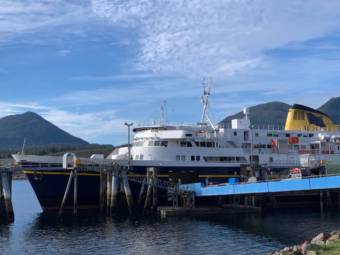
The Hubbard’s sister ship the Tazlina remains tied up at Juneau’s Auke Bay terminal.
“She’s on a hold — she’s ready to go,” he said. “But she could be used if we needed it.”
The $60 million Alaska-built ferry ran briefly for a few months in 2019 and 2020 but has been sidelined for much of the time as it has limited range. He says it could be reactivated with a week’s notice to get a crew on board to run point-to-point between Southeast ports.
“That ship can get into all the village locations except Pelican,” he said.
The Dunleavy administration has been negotiating with Goldbelt, Inc. — Juneau’s Native corporation — about building a ferry terminal at Cascade Point which could shorten the voyage between Juneau’s road system and Haines and Skagway.
The reasoning is that the Tazlina could complete a round-trip to upper Lynn Canal communities within the 12-hour window without crew quarters.
But Falvey says those discussions have been happening at a higher level.
“The commissioner’s office is handling that,” Falvey said. “I’m not privy to what’s happening with Cascade Point at this point.”
The Commissioner’s Office said in response to inquiries that DOT and Goldbelt would “continue to discuss the potential details and terms of a new terminal at Cascade Point” but didn’t have any further details to release.
The state ferry Malaspina sits in layup in Ward Cove near Ketchikan on May 10, 2020. (Eric Stone/KRBD)
Department of Transportation paying $38,500 a month to keep Malaspina tied up at Ward Cove
Gov. Mike Dunleavy offered the ship up for free to the Philippines as an apparent goodwill gesture. But except for a phone conversation between the governor’s staff and consular officials in San Francisco the offer apparently didn’t go anywhere.
The marine highway system’s general manager told lawmakers this spring there had been some interested parties. And he told CoastAlaska recently that it’s out of his hands.
“There’s a lot of interest, but we’re still on a hold,” Falvey said. “That’s guidance comes that comes from above me as to what to do with that ship. So, we’re in Ward Cove. Awaiting guidance. I guess that’s what I can say right now.”
CoastAlaska filed a public records request on June 23 seeking the commissioner’s office’s emails and internal discussions outlining commercial interest in the Malaspina. But as of September 16 the agency says those records remain under legal review.
In the meantime, agency officials confirm that the Malaspina remains tied up at the private Ward Cove facility near Ketchikan at a cost of $38,500 a month. The expense of keeping ferries tied to the docks has been a contentious issue with state lawmakers.
Alaska Marine Highway System offering better employment terms, general manager says
There are some bright spots for the state-run ferry system. Due to federal funding for marine highway operations, the state has been able to budget 18-months ahead. That’s given DOT the ability to guarantee hours to crew year-round which he says should boost hiring.
“With the budget that we’ve got, we’re able to offer full-time employment,” Falvey said. “And we’re making that a key part of our pitch (to attract new hires).”
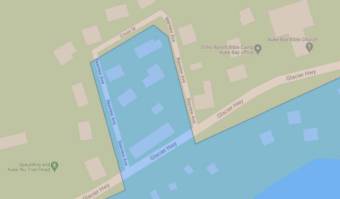
Rep. Andi Story, D-Juneau, lives on Cross Street in Juneau’s Mendenhall Valley. Under current redistricting plans, her side of the street would join a neighboring legislative district. (Source: Alaska Redistricting Board)
The last time political boundaries were redrawn, Southeast lost a senator and a House member which diminished its voice in the legislature.
U.S. Census data shows Southeast communities have either had very modest growth or lost population while other parts of the state grew relatively quickly.
Rep. Andi Story is a Democrat now in her second term representing Juneau’s Mendenhall Valley. But the new maps released late Friday show her four-bedroom home on Auke Bay would be in a neighboring district that’s held by a party ally. But only by a few hundred yards — her neighbors across the street would be unaffected.
“It is really suspect that they chose to break up my current street this way,” she said.
It’s normal for political boundaries to be redrawn every 10 years to follow trends with population shifts. But Rep. Sara Hannan, also a Juneau Democrat, says the new lines on the map look politically motivated.
“It’s a funny little carve-out because the neighborhood that her house is in has two sides of the street, and they took only one side of the street,” Hannan said.
The draft maps also divide Ketchikan in a novel way. A zig-zag line excludes Ketchikan independent Dan Ortiz’s three-bedroom home on South Tongass Highway. That would land him in a sprawling 630-mile-long outer coastal district that would run from the Canadian border all the way up to Yakutat, in territory that’s largely represented by Sikta Democratic Rep. Jonathan Kreiss-Tomkins.
Rep. Dan Ortiz, I-Ketchikan, lives on South Tongass Highway, which under current plans would be joined with an outer coastal district that would be more than 600 miles to the northwest. (Source: Alaska Redistricting Board)
The Alaska Redistricting Board put out a statement saying there had been some errors in the mapping of the Ketchikan Gateway Borough that would be addressed when it reconvenes later this week.
“This was due to a software glitch and does not align with the board’s stated intentions,” the written statement said.
Rep. Dan Ortiz, a Ketchikan independent who caucuses with the bipartisan House majority, says that gives him hope.
“It’s my understanding — and I take it on good faith — that that specific issue will be corrected,” Ortiz said Monday.
Alaska’s Constitution is fairly specific on how legislative districts should be drawn. But Ortiz says carving out the predominantly Alaska Native city of Saxman and the outskirts south of Ketchikan could lump these voters with a representative that might be hundreds of miles away.
“It puts part of South Tongass and part of Saxman as a part of the west coast district that goes all the way up to Yakutat,” Ortiz said. “That’s just not in the best interest of the people who live on Revillagigedo Island.”
Veteran Republicans involved in the redistricting process say shifting demographics made the new districts inevitable. Former state Republican chairman Randy Ruederich fronts a group calling itself Alaskans for Fair and Equitable Redistricting.
“There just wasn’t enough population — south of Juneau — to build two districts under any shape,” he told CoastAlaska. “So we had to do to create the map that I was working on, we had to arrange to import the Yakutat’s population from the north.”
He says there wasn’t any deliberate effort to exclude incumbents. But Ruedrich says it made sense to carve out the city of Saxman from the Ketchikan district and include it with other Alaska Native communities to the northwest.
“I haven’t even thought about who lives where,” Ruedrich said. “But we did carve out — if you’re using that term — we did select Saxman to be in the coastal district since it has most of the other Alaska Native villages. And it has Sitka, which is the center of many other services. I thought it was justified to include it in the maritime district.”
These maps are only drafts, and the courts often get involved following legal challenges.
The Alaska Redistricting Board released its final draft of maps on Sept. 9, 2021. (Alaska Redistricting Board)
But it’s shaping up to be the opening of a high stakes political exercise that will play out through the Nov. 10 deadline to settle political boundaries.

Alaskans for Fair Redistricting — a coalition tied to organized labor and public interest advocates — says that it would be offering viable alternatives.
“Our coalition believes that the board’s pairings ‘speak for themselves’ but would offer that while Southeast Alaska has challenges, AFFR will offer an alternative solution to those challenges that does not involve those pairings,” the group’s chair, Joelle Hall, wrote in a statement.
Democrats accuse redistricting board of partisanship
Rep. Andi Story, the Juneau Democrat, says this process is too political. Three of the five members on the redistricting board are registered Republicans.
“It’s probably a good reason for why we should have a nonpartisan redistricting board,” Stori said.
If the current maps are allowed to stand, it would shake up the political landscape in Southeast by forcing political allies to either contest each other in the 2022 election or uproot themselves.
Rep. Sara Hannan says that’s a tall order for part-time legislators. She notes she’s lived in her home for more than 25 years.
“I am not a politically committed enough public servant to move to continue to represent a district,” she said.
Which, cynics might say, could be exactly the point.
The Alaska Redistricting Board will be soliciting public comment. It next meets on Friday, Sept. 17.
Correction: A previous version of this story said Rep. Andi Story’s house is on Auke Lake. It is in Auke Bay.
The Alaska Redistricting Board released its final draft of maps on Sept. 9, 2021. There’s not a lot of detail, but questions will be answered in coming weeks as the public grapples with the implications. (Alaska Redistricting Board)
Under the first draft of a state redistricting plan released late Thursday, Southeast Alaska keeps all four of its current House seats despite losing population in all but one of those constituencies since 2010.
A decade ago, Southeast lost a Senate and a House seat when the districts were redrawn due to population shifts. That was largely due to faster growth in the Rail Belt, which can shift political clout to the road system.

“There’s always a concern that Southeast as a region is not able to grow economically, and especially at the rate that the Mat-Su area is,” Robert Venables of Southeast Conference, a nonpartisan civic and business organization told CoastAlaska. “So even if we didn’t lose population, which we are, we can’t keep up with the pace that they are increasing.”
Yakutat brought back into Southeast’s legislative orbit
There would be some major reshuffling in 2022. The new legislative maps would create a largely rural coastal House district from Yakutat south along the outer coast, to Sitka, Prince of Wales Island and all the way to Hyder on the Canadian border.
Ketchikan’s House district would be split, with areas south of the city limits joined up with this 600-odd mile long coastal district largely represented now by Sitka Democrat Jonathan Kreiss-Tomkins.
From the level of detail provided, it’s not clear which district Ketchikan independent Rep. Dan Ortiz’s residence would land in, or whether he’d be competing with the Sitka Democrat in the 2022 legislative election.
But redistricting sometimes affects sitting lawmakers.
“We’ve seen the lines drawn where the incumbent is now in a different district and has to run against that incumbent or actually move addresses,” Venables said.
Southeast Alaska’s current legislative districts since 2013. (Alaska Division of Elections)
The areas lost by Ketchikan’s current district include parts of Prince of Wales and Metlakatla, which would be linked with the outer coast.
Capital seats reshuffled with Haines and Skagway
Juneau keeps its two Democratic-held House seats with a reshuffling that would remove Haines and Skagway from Juneau’s Democratic-leaning downtown areas. Instead, the upper Lynn Canal would be joined with Juneau’s Republican-leaning Mendenhall Valley.
Southeast’s two incumbent senators, Bert Stedman and Jesse Kiehl, would be largely unaffected, and their residences would still remain within the new boundaries.
Now that the maps have been released, the Alaska Redistricting Board will take public input before beginning a series of statewide meetings.
The redistricting board, which is appointed by all three branches of government, is working against a Nov. 10 deadline to finalize the maps. That may not be the end of the line. Redistricting carries implications for political clout, and the final boundaries often end up decided in court.
An Alaska Department of Fish and Game wildlife biologist came upon this Alexander Archipelago wolf on Prince of Wales Island in the summer of 2018. It had been sleeping. It woke up and moved away. (Kris Larson/ ADF&G)
A coalition of conservationists warn they’re preparing to sue for federal protections of Southeast Alaska’s wolves if the Biden administration doesn’t take concrete action soon.
Last year, the U.S. Fish and Wildlife Service accepted a petition filed by Alaska- and national-based environmental groups calling for the Alexander Archipelago wolf to be listed as threatened or endangered. But the federal agency has yet to act.
Now, groups including the Alaska Rainforest Defenders, the Center for Biological Diversity and the Defenders of Wildlife have followed up with a notice saying that the U.S. Department of the Interior missed a one-year deadline to take action on the petition.
The three-page letter is required by law before filing a lawsuit that could compel the federal agencies reviewing the petition to protect Southeast’s wolves.
The coalition of conservation organizations argues that Alexander Archipelago wolves are threatened by clear-cut logging, aggressive hunting and trapping, and by climate change. A similar petition to list the wolves was rejected in 2016 but Fish and Wildlife says the threats identified have only worsened since the last time it reviewed the species.
“An unprecedented 165 wolves were killed during the 2019-2020 trapping season,” Camila Cossío, a Portland, Oregon-based staff attorney with the Center for Biological Diversity wrote in the Sept. 8 letter. “This occurred after state and federal wildlife managers ignored the recommendations of their wolf management program and eliminated limits on the number of wolves that could be trapped or hunted.”
State game managers have argued that Southeast’s wolf population is resilient and have opened the population up to hunting and trapping on Prince of Wales Island where residents complain the wolves prey on the island’s deer.
State officials have said they’ll resist federal protections which would affect permitting for development and resource extraction across the region.
Close
Update notification options
Subscribe to notifications
Subscribe
Get notifications about news related to the topics you care about. You can unsubscribe anytime.