Jacob Resneck is CoastAlaska's regional news director based in Juneau. CoastAlaska is our partner in Southeast Alaska. KTOO collaborates with partners across the state to cover important news and to share stories with our audiences.
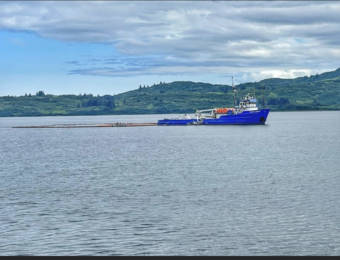
Ships deploy a boom in Women’s Bay to contain a 300-foot sheen believed to be from shipwreck disturbed by July 28’s massive earthquake some 260 miles away. (Photo by Judy Heller via KMXT)
“We know that this is a vessel that sank in 1989 in Women’s Bay and it’s been resting there since,” Jade Gamble, the state’s on-scene spill coordinator, told CoastAlaska on Friday. “It started leaking after the earthquake.”
She says it’s not clear how much diesel and other contaminants are on the former fishing vessel Saint Patrick.
“They’ve been able to minimize the leak,” she added. “But right now we’re going at it — now that it’s minimized — our main goal is to ensure we don’t have some type of catastrophic release.”
The crippled 138-foot vessel was adrift in rocky seas for several days before being towed to shore and anchored in Women’s Bay. The tragedy was the subject of lawsuits filed by survivors and families of the victims.
A shipwreck from decades ago has begun leaking diesel fuel off Kodiak Island
Authorities say the first reports of a sheen were first received less than a week after the earthquake.
The Coast Guard flew over Aug. 6 and confirmed what appeared to be a spill in about 30 feet of water.
But whether the 8.2 earthquake — the state’s largest in more than a half-century — could have been the cause isn’t clear, seismologists who have modeled the areas affected by the Perryville earthquake say.
Its epicenter was about 260 miles southwest of the Saint Patrick’s resting place in Kodiak’s Women’s Bay.
“Kodiak didn’t experience anything significant,” Alaska Earthquake Center seismologist Natalia Ruppert told Coast Alaska. “And this shipwreck being even farther away from the earthquake source, I guess it’s possible.”
Kodiak Island has also experienced major earthquakes that were much closer to Women’s Bay which would’ve produced stronger ground shaking, the most recent one in 2018, she added.
“I don’t know if this most recent 8.2 earthquake was the final straw that could have caused this shipwreck to move significantly,” Ruppert said. “Maybe it was a cumulative effect of these multiple earthquakes that over the years kind of reached a critical stage — it’s just hard to tell.”
A contractor is on scene helping with the containment, the Coast Guard said.
“Boom is in place and is being replaced as necessary along with absorbents to contain the sheening,” Coast Guard Petty Officer Ali Blackburn, a Kodiak-based spokeswoman wrote in an email.
The Coast Guard says it’s not clear who the responsible party would be as the vessel doesn’t appear to have an owner. It has activated the Oil Spill Liability Trust Fund and continues to monitor the situation.
This story has been updated with comments from the Alaska Earthquake Center.
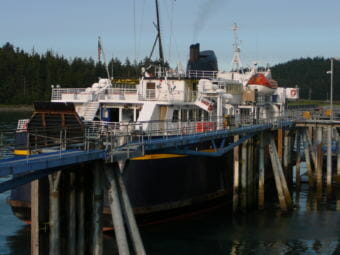
The ferry LeConte docks at Juneau’s Auke Bay terminal. (Ed Schoenfeld/CoastAlaska News)
A dishwasher and chief steward on a state ferry reported feeling ill and left the ship a few hours before it was to depart Juneau. That left the ferry LeConte — which sails with 24 crew members — shorthanded early Wednesday morning.
“The ship’s captain evaluated the shortage and made a decision to cancel the sailing based on their emergency response readiness,” Alaska Marine Highway System spokesman Sam Dapcevich told CoastAlaska.
In a follow up statement, the Department of Transportation says the two sick crew members didn’t have COVID-like symptoms, so they weren’t tested.
In the past, a couple crew members dropping out – for whatever reason – wasn’t a big deal. Others could be called up on relatively short notice.
This service notice went up on August 11, 2021 hours after the loss of two crew members prevented the vessel from sailing. The notice was removed the following day from the state website. (Screenshot by Jacob Resneck/CoastAlaska)
But not these days. It canceled the trip.
“I think all three unions are in the same boat here — we’re all short on personnel,” said, Ben Goldrich, a regional head of Marine Engineers’ Beneficial Association, the union that represents marine engineers on state ferries.
“We’re talking about a problem that the state has been aware of for some time and has not done much to remedy it — and here we are,” he added.
For the LeConte’s 84 passengers stranded at the Auke Bay terminal, that left few options. Most canceled their reservations and were refunded. But not Deb Boettcher. She had come down from Skagway to bring her sick dog to the vet in Juneau and still needs to get home with her vehicle.
She says foggy weather had kept planes flying between Skagway and Juneau grounded. So she’d put her car on the ferry on Tuesday and was trying to get back home when her return voyage was canceled the next day.
“I thought it was a mechanical problem, because that’s usually what cancels a ferry,” she said by telephone in Juneau. Or stormy winter weather, which can generate hazardous seas.
“But this is summer. They don’t get canceled in the summer,” she said.
Unless there’s not enough crew for the ship. It’s yet another hazard that complicates travel on the marine highway, a system that already struggles with reliability due to aging vessels.
Unfilled vacancies leave little slack in system
DOT says there are at least 125 unfilled vacancies on the marine highway, system-wide. And that means there’s not much slack in the system.
“We’re sailing short — fleetwide — and we’re having holdovers — fleetwide — and vacations aren’t being approved,” said Earling Walli, regional director of the Inlandboatmen’s Union of the Pacific, the largest of the three ferry unions.
Crews from the Lower 48 have been offered a comped ferry ride up from Bellingham. But the travel time is unpaid for a job with starting wages between about $16.40 to $18 an hour, he said.
“And then they’re still required to get themselves home out of their own pocket after a two-week assignment,” Walli added.
Crews spread thinly around the fleet
State officials say they’ve already recruited about 50 new crew members who are waiting for federal licensing. But more disruptions are possible.
“Given our overall fleet wide crew shortage, we do see the possibility of more no sailings or sailings being canceled due to this shortage,” Dapcevich said. “But considering the high number of vacancies that we have, our employees are doing a great job keeping the system operating.”
Unions have complained that leaner ferry schedules have made it harder to keep their members from leaving for the private sector. The deck officers, engineers and other licensed crews have guaranteed hours.
Not so for unlicensed crew members like stewards, pursers and cooks in the galley, who often are laid-off in the winter months when there are few ships running.
“It’s just — they don’t want to come back,” Walli said. “They’re like, ‘Why go work for a company where I have no job protection?’”
The LeConte’s next scheduled sailing is Friday.
Deb Boettcher, the passenger from Skagway, says there wasn’t space for her vehicle. So she rebooked on the larger Matanuska. She says she’d rather take a sick dog on the boat rather than wait for fog to lift so she can fly.
“He doesn’t have to fly home on a plane which might not fly tomorrow or the next day,” she said.
That means if all goes to plan, she and her chihuahua should be back in Skagway by Sunday morning.
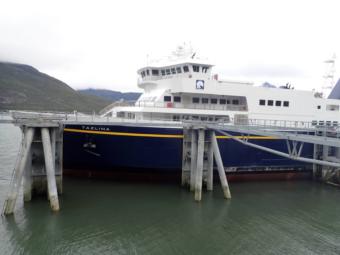
The M/V Tazlina ties up in Haines during its maiden voyage on May 7, 2019. In his interview with CoastAlaska, Gov. Dunleavy’s chief of staff Randy Rauro says a Cascade Point route might be the best fit for the Tazlina. (Jacob Resneck/CoastAlaska)
There’s language in the U.S. Senate’s $1 trillion infrastructure bill that could throw a life ring to Alaska’s beleaguered ferry system. CoastAlaska’s Jacob Resneck spoke with Randy Ruaro, the governor’s chief of staff, during his visit to Ketchikan last week.
Rauro, who’s served as the governor’s chief of staff since Ben Stevens resigned in February, discussed a potential windfall of federal dollars and gave a general update on the executive’s plans for the Alaska Marine Highway System.
Listen:
This interview has been edited for clarity.
Jacob Resneck: Sen. Lisa Murkowski is working on steering hundreds of millions of federal dollars to ferry systems. The language in the bill appears to heavily favor the Alaska Marine Highway System. What’s been the level of coordination from the governor’s office with Alaska’s delegation on this infrastructure bill?
Randy Ruaro: We’ve been talking about language changes and other statutory changes that would help the marine highway system for quite a few weeks now. And I think there is a very significant amount coming to Alaska for its ferries, just by the language in the bill. For example, if you look at Section 71103, it’s ferry service for rural communities. And I think that’s funding for a five-year period. And that’s going to produce a very significant amount of funding for Alaska’s ferry system. We just don’t know exactly how much will come out of that formula yet. But it will be substantial. And so we’re already making plans on our end on how to best get the highest and best use of the funds for the system.
Jacob Resneck: Gov. Mike Dunleavy signed House Bill 63 last month, which creates an oversight board for the ferry system. Where are we on appointing members of that board from the executive for when it goes into effect in October?
Randy Ruaro: We are taking applications now. And I hope to have people seated fairly soon. If I’m aware of folks that I that would be interested, I’ll be forwarding those names in, but anyone with, hopefully, some a marine experience can apply. And if someone’s interested they can apply. They can contact Courtney Enright [editor’s note: 907-269-0006] in the Anchorage office.
Jacob Resneck: Could you give us an update on the Tustumena replacement? Because in order to harness the federal highway dollars, the money’s got to be programmed into the states for more requests to the federal government.
Randy Ruaro: I think the design is very close to being completed. For that boat, there’s a section in the infrastructure bill that caught our attention that may have some relevance to that project or not. It’s Section 71102, which provides funds for an electric or low emitting ferry program. And so that’s a ferry that’s built to use alternative fuels. And there’s some funding that’s tied to that new type of ferry, I guess, in this program. It may be possible to use some of the funds that are appropriated through this program for a low emissions ferry that could tie into the design of the Tustumena? I’m just not not 100% sure yet, but we’re looking at it.
Jacob Resneck: That’s interesting, because I thought that that request had come more from the Skagway working group looking for kind of a short range ferry in upper Lynn Canal. I didn’t know that that there was proven that electric ferries or even hybrids could do the kind of range out to Southwest Alaska.
Randy Ruaro: Technically, I’m not sure if that type of a ferry would work for a long range run. But I guess, legally within the terms of the infrastructure bill, it looks like there’s nothing that eliminates a long range ferry from being eligible under the program. So we’re still, you know, taking it apart the language and then we’ll see technically, you know whether anything fits.
Jacob Resneck: And the Alaska Class ferries, they have not seen much action. But we read that the crew quarters would be added to the Hubbard, which hasn’t hasn’t been in service yet. But that would extend its range and allow it to do a lot more routes. What’s the state’s plan for the other ferry, the Tazlina?
Randy Ruaro: The crew quarters will give the Hubbard a lot of flexibility, and we’ll get it into service and moving. The Tazlina, the other vessel, you know, we’re looking at also building some capital projects like Cascade Point that would allow a run from Juneau up Lynn Canal and back, and not necessarily need crew quarters for an overnight overnight crew. So we’re working with Goldbelt on Cascade Point. And then that would probably be the best fit for that ferry.
Jacob Resneck: How far along is that? Because, my understanding, with that conceptual project, that would only operate in the summer in the warmer months.
Randy Ruaro: It would be a seasonal terminal, and I’d have to check. I know that Goldbelt’s working on the design and the the lease offer and some other terms that aren’t final yet, but we were hoping that can move along pretty fast.
Correction: The original post described the Senate bill as a “$1 billion infrastructure bill” instead of a $1 trillion bill.
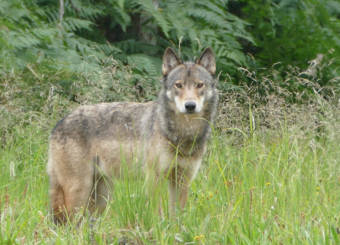
An Alaska Department of Fish and Game wildlife biologist came upon this Alexander Archipelago wolf on Prince of Wales Island in the summer of 2018. It had been sleeping. It woke up and moved away. (Photo by Kris Larson/ ADF&G)
A notice in the federal register published on Tuesday found merit to a conservationist coalition’s 111-page petition that says logging and road development, illegal and legal trapping and hunting, the effects of climate change and loss of genetic diversity were factors threatening Southeast Alaska’s Alexander Archipelago wolf population.
U.S. Fish and Wildlife spokeswoman Andrea Medeiros says fact-finding by her agency isn’t likely to affect game management in the near-term.
“It had substantial information to warrant us looking further at the species and whether it is warranted for listing or not,” she told CoastAlaska.
But the federal agency says that threats to regional wolf populations from clear-cuts, aggressive hunting and trapping harvests and climate change, alleged in last year’s petition, have worsened since the previous petition was filed a decade ago.
“Many of the threats identified in the 2020 petition aresimilar tothreats presented in the 2011 petition; however, the magnitude of the threats has increased,” the agency said in a statement.
The federal government’s action will reignite a long-running controversy among Prince of Wales Island’s resident hunters and trappers who complain of a steep drop-off on the island’s deer population that’s commonly blamed on predation by wolves.
Sitka conservationist Larry Edwards of Alaska Rainforest Defenders, one of the co-authors of the petition, says the legacy of clear-cuts is to blame for loss of deer herds, not predators.
“The difficulty with deer on Prince of Wales Island, at heart, goes back to habitat loss,” he said, “which is cumulative over time from the logging of old growth forest and just the huge loss of that on that island.”
He says common sightings of wolves on Prince of Wales Island isn’t sound science and shouldn’t be used to prevent protections.
“That’s anecdotal information,” he said. “There are definitely threats to this population.”
Some 68 wolves were taken last year. The year before a record 165 wolves were taken by hunters and trappers after state and federal managers lifted quotas for hunters and trappers on and around Prince of Wales Island.
Alaska Department of Fish and Game Commissioner Doug Vincent-Lang says Prince of Wales Island’s wolf population is far from threatened.
“We don’t think that harvest represents a threat to this population now or in the immediate future,” he said in a phone interview. “We think we have enough controls in place to be able to manage that population for sustainability.”
He echoed concerns from island residents that federal protections for wolves would allow unchecked predation on deer, which are a key food source.
“Many local communities really depend upon deer to get them through the winter,” Vincent-Lang said. “If wolves are listed by the US Fish and Wildlife Service, the taking of wolves in directed hunting would be prohibited.”
Federal wildlife scientists are expected to release additional findings later this year. The annual hunting and trapping season traditionally runs in the winter.
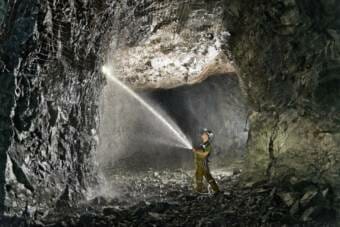
A Kensington Mine worker underground. (Photo courtesy of Coeur Alaska)
Coeur Alaska reported its Kensington Mine produced around 125,000 ounces of gold in 2020. And its most recent report suggests it’s on track for a similar yield this year. At current prices, that’s around $225 million worth each year.
“Gold prices have been excellent,” said Coeur Alaska’s general manager Mark Kiessling. “They came up quite a bit in 2019 and 2020. They’ve come down a little bit and 2021. But it’s still been very promising.”
The mine is on a patchwork of leased private land and Tongass National Forest in an area between Juneau and Haines east of Lynn Canal.
It’s one of the region’s largest private sector employers with around 360 employees. But in order to stay open through 2033, the mine needs to expand its footprint.
Future of mine depends on storage space
The mine produces gold concentrate, so all that leftover rock has to go somewhere. And the mining company says it’ll be out of space in a few years.
The way Kensington disposes its mine waste makes it somewhat unique in this country. Thanks to a favorable decision in 2009 by the U.S. Supreme Court, the Chicago-based mine company was allowed to convert a natural lake into a tailings pond, which has run into challenges.
There’s an 88-foot dam in place now to hold back about 4 million tons of liquid mine waste that contains heavy metals from the ore. This tailing treatment facility, formerly known as Lower Slate Lake, lies upstream from Berners Bay which makes conservationists — and some federal regulators — nervous should it ever fail.
“When you raise the dam by 36 feet, and add another 4 million cubic yards of material, the chance of that dam failing increases,” Eagan said. “And should it increase, the tailings will spill out more broadly into Berners Bay.”
Forest Service OKs nearly doubling tailings pond
The U.S. Forest Service has reviewed and tentatively green-lit the mine’s expansion. That would increase the tailing treatment facility’s capacity to 8.5 million tons of mine waste.
It’s working through the environmental review to get its permits. Federal law required the Forest Service to consult with NOAA Fisheries scientists.
Senior Forest Service officials in Alaska and Washington D.C. declined to answer questions or make anyone available for an interview request.
“The agency works closely with the state and other federal agencies with regulatory authority to ensure that measures are in place and followed to protect water quality, other resources, and nearby aquatic habitats,” the agency wrote to CoastAlaska. “When mineral extraction is proposed, the plan of operations is reviewed to ensure the protection of communities and natural resources. The plan of operations must include steps taken to protect water quality and aquatic habitats by minimizing erosion and preventing tailings or waste from contaminating water bodies or other areas.”
NOAA Fisheries’ role is advisory. But it’s asked the Forest Service to consider alternatives. It says Kensington should instead filter out the water from its tailings so they’d be stored in a more solid form.
Feds urge Kensington to consider ‘dry stacking’ tailings
NOAA Fisheries scientist Molly Zaleski says filtered tailings are already being done in the region’s other major mine on Admiralty Island.
“That’s something that we already have at Greens Creek Mine. So we knew that that’s something that can be done in Southeast Alaska,” she said.
Kensington’s engineers and consultants looked into it but the company says it’s not feasible.
“Just because it works at one operation and one area in Southeast Alaska doesn’t mean it’s going to work in another,” Kiessling said.
He says there’s the high rainfall on Lynn Canal could make it a “muddy, soupy mess.”
“The whole concept behind filtered tailings is you remove the water from the tailings, and that allows you to stack it up,” he continued. “And if you add the water back in and precipitation, it makes it almost impossible to stack it up.”
It’s not a direction the Forest Service is pushing for either. That was laid out in its July record of decision which gave provisional approval to raising the dam to a total height of 124 feet — easily the largest tailings dam in Southeast Alaska.
The Forest Service’s own analysis has suggested that whether Kensington’s mine waste is liquid or solid it presents an equal danger, which it characterized as “very low risk.”
Tailings dam would have ‘indefinite service life’ after mine’s closure
The Alaska Department of Natural Resources has been broadly supportive of the expansion.
But Alaska’s head dam safety engineer, Charlie Cobb, found fault with some of the Forest Service reasoning when it assessed relative risks.
“Effectively stating that the dam safety and geotechnical stability of all alternatives are essentially the same and all are subjectively considered as ‘very low risk’ prevents an effective and defensible comparison,” Cobb wrote in more than 80 pages of technical comments submitted on behalf of state permitting agencies.
“The failure mechanisms on those structures would be different. So the probabilities of those failures would be different,” Cobb said in an interview. “And the consequences of those failures would be different. So rather than being subjective about it, it would be better at least if they had some relative comparison that said, one might be higher or lower, or the consequences might be different.”
But any final dam would have to be approved and inspected by the state’s dam safety office. And Cobb says as long as the dam is built to standard, raising its height shouldn’t increase its risk of failing.
Kensington Mine’s “tailings treatment facility” was formerly Lower Slate Lake until the mine began operating in 2010 following a landmark ruling by the U.S. Supreme Court.
No immediate threat to ecosystem
To be clear, none of the federal agencies are suggesting Kensington Mine’s dam is an immediate threat to Lynn Canal.
“We do not feel that this dam is likely to fail in the next 10 years while the mine is operating,” said Eagan, the NOAA scientist. “We’re not even suggesting the next 20 years or 30 years. It’s more a process of the dam will be there for a very, very long time.”
Cobb says a dam’s service life depends on its maintenance and care.
“It’s not that you can’t design for something for a very long time frame,” he added. “But you do have to provide for the resources necessary to inspect and monitor that dam and do maintenance on it for an indefinite period of time.”
The expansion plan has generated a lot of interest — more than 400 comment letters from Alaskans and organizations expressing a mixture of support as an economic engine or as an ecological threat.
A formal objection period expires Aug. 23. But barring a major challenge the Forest Service’s decision becomes binding and Kensington will be able to expand its operations and stay in business through at least 2033.
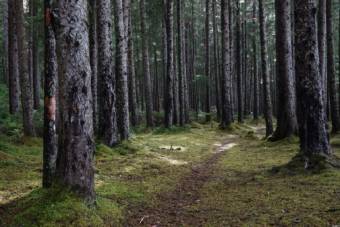
The Tongass National Forest is the largest temperate rainforest in the country. (Erin McKinstry/KCAW)
The Biden administration announced Thursday it’s freezing any remaining old growth timber sales in Tongass National Forest and will pivot to investing in other sectors of Southeast Alaska’s economy.
A statement from the U.S. Department of Agriculture said the federal government will invest $25 million and work with tribes, communities and Alaska Native corporations to provide technical assistance for projects and employment programs in the region.
“This approach will help us chart the path to long-term economic opportunities that are sustainable and reflect Southeast Alaska’s rich cultural heritage and magnificent natural resources,” Secretary of Agriculture Tom Vilsack said.
Thursday’s statement follows a recent announcement that the agency will start a lengthy process to reinstate the Roadless Rule in the Tongass, which restricts road building on federal forest lands.
That reverses the Trump administration’s decision to exempt the nation’s largest national forest from the Clinton-era rule that’s been fought by successive Alaska governors.
Dunleavy administration lambasts USDA
In a statement, Alaska Gov. Mike Dunleavy called out what he called President Biden’s “efforts to put Alaska workers permanently into unemployment lines and wipe out small businesses” with Thursday’s announcement.
“Narrow election results and political donations from environmental groups do not justify this federal agency’s policy flip-flop,” the governor said.
But the pivot away from forest products and toward other sectors was met with applause from the visitor industry.
“As we’ve been saying for a long time there’s so much else going on in Southeast Alaska that needs the Forest Service’s attention,” said Dan Kirkwood, a guide and general manager of Alaska Seaplane Adventures in Juneau. “We’re finally seeing some recognition that Southeast Alaska is really diverse in its economy and its cultures and the Forest Service’s trying to work on that. So that’s interesting.”
There have been few details released on the USDA’s $25 million “Southeast Alaska Sustainability Strategy,” but Southeast Conference’s executive director says meetings have been set up to discuss mariculture opportunities on and around Prince of Wales Island.
“The Tongass needs to be a multi-use forest. And unfortunately it’s still very much a political football that goes back and forth,” said Robert Venables. “So my hope is that we can work with the Forest Service’s stakeholders to really create more stability and at least many of the economic sectors and provide a longer term blueprint and map to go forward.”
Freeze on old growth logging announced
The practical effect of Thursday’s announcement would be to freeze any remaining old growth timber sales except for those used in small scale salvage projects for cultural use by Alaska Native tribes and others.
“The announcement that large scale, old growth logging is going to be ceased is very positive for that because those mass clear cuts are not going to occur here anymore,” said Marina Anderson, tribal administrator for the Organized Village of Kasaan on Prince of Wales Island.
“We hear commonly that we’re doing this for the next seven generations, or the seventh generation down the line,” she said. “However, we’ve been here for over 10,000 years, and we plan on being here for well over 10,000 years — we don’t have an expiration date on ourselves because we are part of this ecosystem.”
The announcement also didn’t mention amending the 2016 forest plan, which laid out a 15-year transition from old growth to second-growth logging. That would require a formal rulemaking process to ensure protections would last another political transition.
Proponents of ending old growth logging say they hope the shift in policy represents a long-term move away from Southeast Alaska’s federal forestland as primarily a supply for forest products.
“Any future administration is going to have the opportunity to pick its own policies and implement its own direction,” said Austin Williams, Trout Unlimited’s Anchorage-based legal director. “But I think what we’re seeing is that, as time goes on, the value of fish and wildlife, the cultural assets in the forest, the value of scenic beauty and climate resiliency — those values are becoming more and more important.”
The USDA notes that the Tongass has global significance as the largest intact temperate rainforest in the world. It also captures more carbon than any other national forest in the country.
Fate of lawsuits uncertain
There have been lawsuits filed on both sides of the Roadless Rule exemption issue. A coalition of tribes and conservationists has sued to overturn the Trump administration’s decision. And a separate lawsuit is defending the Roadless Rule exemption backed by local governments and industries.
Juneau attorney Jim Clark has been coordinating that effort to defend the Trump administration’s action. He says it’s not clear how the Biden administration plans to carry out its goals.
“We know where they’re headed and where they’re trying to go,” said Clark, who served as chief of staff for Republican Gov. Frank Murkowski. “And what we’re going to need to see is how they move to achieve those things.”
Close
Update notification options
Subscribe to notifications
Subscribe
Get notifications about news related to the topics you care about. You can unsubscribe anytime.