Jacob Resneck, CoastAlaska

Jacob Resneck is CoastAlaska's regional news director based in Juneau. CoastAlaska is our partner in Southeast Alaska. KTOO collaborates with partners across the state to cover important news and to share stories with our audiences.
Some shareholders wary as Sealaska proposes trust to handle future payouts

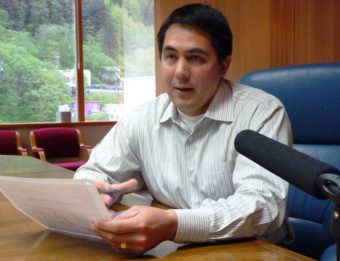
Sealaska CEO Anthony Mallott discusses the regional Native corporation's finances May 2, 2016, (Photo by Ed Schoenfeld/CoastAlaska News)
Sealaska CEO Anthony Mallott discusses the regional Native corporation’s finances May 2, 2016, (Photo by Ed Schoenfeld/CoastAlaska News)

The leadership of Sealaska, the Native corporation for Southeast Alaska, is asking its shareholders to approve the creation of a type of tax shelter called a trust. Sealaska says it wants to take advantage of the 2017 tax overhaul passed by Congress that allows corporations to offer tax-free payments to shareholders.

“Sealaska’s philosophy around investments has always been one based on our Native values,” Sealaska’s chief executive Anthony Mallott says during a two-minute video produced by the corporation. “You will get the same dividend you otherwise would have gotten from Sealaska from the settlement trust, and that dividend will be non-taxable.”

But some shareholders say they see red flags in Sealaska’s 14-page proposal. That’s because it would give the board — acting as the trustees — unconstrained authority to decide the amount of future payouts, as well as who would receive them.

Settlement trusts are a tool used by big companies, and in this case, Sealaska’s board of directors would also serve as the trustees who would control how any money transferred into the trust would be shared and spent.

More than 20,000 Sealaska shareholders receive regular dividend payments based on the corporation’s financial performance. Those same shareholders have final say over this plan, which is being put to a vote as a resolution in June.

Shareholder Resolution #1 as it appears on the official Sealaska proxy statement.

Sealaska shareholder Joan Dangeli notes that section 3.1 of the proposal says “The trustees may distribute some, all, or none of the net income, accumulated net income or principal of the trust to the beneficiaries.” Dangeli has been outspoken in her skepticism of the settlement trust.

The same section, she notes, explicitly states that no distributions are required, nor would payments for one year have any bearing on future years — the trustees would have maximum flexibility to pay out as much or as little as they choose.

“This is a really big issue,” Dangeli told CoastAlaska. “The language not is matching the kind words about what’s going to continue.”

Shareholder Vicki Soboleff worked for Sealaska as a financial officer for more than a decade. Now she’s running for the board of directors as an independent candidate. She says she’s on the fence about whether she’ll vote in favor of the resolution.

“I feel that there are a lot of positive aspects, potentially with passage of the trust,” she told CoastAlaska. “Also, there are many questions related to the trust.”

She added: “And I don’t feel, after speaking with shareholders, that they are comfortable voting ‘Yes.’”

Sealaska notes that other Alaska Native corporations have established settlement trusts “using similar structures,” including Goldbelt, Inc. a Juneau-based Native corporation.

Goldbelt’s settlement trust — established in 2019 — defines specific programs like scholarships that are paid out by its trust. But Sealaska’s proposal leaves the trustees to decide how that would be worked out in the future. And that lack of detail worries Dangeli, who says future boards would be unconstrained to follow through on the corporation’s assurances.

I couldn’t find consistent language matching what they’re verbally telling us,” Dangeli said.

Nor is Soboleff fully convinced by the corporation’s arguments. She says she’s still doing her homework on what the full implications would be for individual shareholders.

“Again, I feel there are a lot of positive aspects possible with the trust,” she said. “But the information provided has been limited.”

Sealaska has tightly managed its information flow to shareholders for the upcoming election. Its management declined interview requests and has only fielded questions from shareholders that are typed into a chat window during virtual meetings with senior executives and financial advisors.

“Every decision Sealaska makes is with our shareholders in mind,” the Juneau-based Native corporation wrote in a statement to CoastAlaska. “This is good for our shareholders as the Sealaska Settlement Trust will allow shareholders to keep more money from their dividends. Currently, shareholders are required to pay appropriate taxes on dividends. The settlement trust would ease that burden. This decision is in the hands of shareholders, and our board believes it will serve to benefit shareholders both now and into the future.”

Shareholders are already voting, with the final tally to be calculated at their June 26 annual meeting. The corporation says it will only require a simple majority of those voting for the resolution to pass. That’s a lower bar than two shareholder resolutions the board opposes that would reform how elections are run.

Sealaska is a significant economic player in Southeast Alaska. The Native-owned corporation is a major landowner with a portfolio invested in real estate, fisheries and services. It reported nearly $700 million in annual revenue with more than $55 million in net profits last year, according to its most recent annual report.

It’s one of the original 13 regional Native corporations established nearly 50 years ago by the Alaska Native Claims Settlement Act. The landmark legislation distributed corporate shares to Alaska’s indigenous people based on ties to their traditional homelands.

Alaska, B.C. regulators discuss concerns over transboundary mining

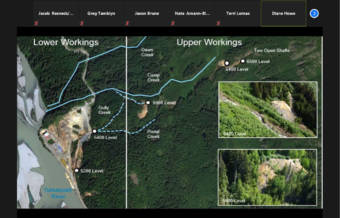
British Columbia regulators offered an update on May 19, 2021 on the progress towards cleaning up the Tulsequah Chief legacy mine about 10 miles upstream from Alaska’s boundary with B.C. (Screenshot by Jacob Resneck/CoastAlaska)

Alaska’s top environmental regulators held a cross-border Zoom session May 19 with British Columbia officials in charge of permitting mines in the shared transboundary watershed that flows into Southeast Alaska.

“This area is called the Golden Triangle for a reason,” said Peter Robb, a deputy minister with B.C.’s mining ministry, pointing out a sparsely populated area in the province’s northwest that faces the Alaska’s panhandle.

“There is lots of exploration and lots of potential in these rocks,” he added. “And we will continue to see that exploration and development, and we want to work with our Indigenous partners to build what that future looks like.”

More than a dozen working and legacy mine sites are located in watersheds shared between British Columbia and Southeast Alaska. (Image courtesy of B.C. Ministry of Energy, Mines and Petroleum Resources).

Beyond holding promising mining prospects, the Golden Triangle is also on the headwaters of major salmon-producing rivers in Southeast Alaska, like the Stikine, Unuk and Taku.

Officials from both sides presented findings from a joint water monitoring study on three transboundary rivers. The study grew out of the landmark 2015 agreement inked by Gov. Bill Walker and his B.C. counterpart.

Tribes and others have criticized the joint-decision to wrap up their work after just two years.

But Alaska Department of Environmental Conservation’s Terri Lomax says the water quality standards on Alaska’s side of the boundary were within regulatory limits. And there’s already monitoring being done by Alaska tribes, Canadian First Nations, the U.S. government and mining companies themselves.

There was no need for additional monitoring from the state of Alaska and British Columbia,” she said.

Canadians give report on Tulsequah Chief Mine cleanup

Efforts are continuing to finally clean up the long shuttered Tulsequah Chief Mine. B.C.’s deputy chief of abandoned mines Diane Howe described a year-old remediation plan.

She spoke of eventually using water to fill the mine’s underground complex.

By flooding this area, we are going to cut off the oxygen to this area which is the main culprit for causing the (acid rock drainage),” she said.

A Tulsequah Chief Mine settling pond overflows at the site about 40 miles northeast of Juneau Sept. 26, 2016. (Photo Courtesy of British Columbia Ministry of Energy and Mines)
A Tulsequah Chief Mine settling pond overflows at the site about 40 miles northeast of Juneau Sept. 26, 2016. (Courtesy of British Columbia Ministry of Energy and Mines)

For decades, acid rock drainage has been visible as a red and orange acidic sludge leaching into a tributary of the Taku River about 10 miles upstream from the border.

Provincial officials have been prepping a $37 million plan for the former mine, which the owners have not cleaned up.

Alaska officials applauded the preparatory work so far.

I know this has been a sore spot between the US and Canada for years,” Alaska Department of Fish and Game Commissioner Doug Vincent-Lang said. “But we’re very pleased with the effort that you have been making towards towards identifying the issues at the site, identifying a path forward to clean up and this presentation highlights that you have a pathway identified moving forward.”

The Tulsequah Chief Mine hasn’t been active since 1957. But there have been attempts by various firms to restart mining. Its current owner is a capital investment firm that’s been trying to find a new buyer. A Canadian bankruptcy court last year ruled it has until August 2022 to find a new buyer.

That was echoed by DEC Commissioner Jason Brune, who told his provincial counterparts that responsible mining is important to his boss.

I know on behalf of Gov. Dunleavy, this is a very large priority for us,” Brune said. “And it’s one that we take very seriously and have a number of meetings with with our colleagues from B.C. and we appreciate that relationship.”

Absent from the call were any representatives from Southeast Alaska’s tribes or Canada’s First Nations. Both have been critical of the pace of cleaning up abandoned mines and ongoing permitting of new ones they say could foul salmon habitat that’s both a critical source of food and income.

Tribes, conservationists underwhelmed by summit

Conservationists and tribes released a joint statement less than an hour after the meeting, criticizing the lack of commitments offered by either side.

“Why is this the first public meeting by Alaska/British Columbia since the Walker-Mallott Administration?” Southeast Alaska Indigenous Transboundary Commission Chair Rob Sanderson, Jr. wrote in a statement.

Others said they they failed to see the point of the publicity surrounding the meeting as officials routinely discuss these issues as part of the transboundary bilateral working group between the state and province.

“We didn’t learn anything new whatsoever,” said Chris Zimmer of Rivers Without Borders, an advocacy group in Juneau. He told CoastAlaska there was a lot of technical discussion from reports that had been released months ago.

“That’s all we heard,” he added. “We wanted to hear about next steps and commitments and not essentially a rehash of what we already know.”

The meeting comes just weeks after the Inter-American Commission on Human Rights agreed to hear a petition from Southeast Alaska tribes asking it to investigate Canadian mines in transboundary watersheds. But that won’t be a swift process — the Canadian government isn’t expected to reply to the petition until later this summer.

Judge hands down split decision in Native corporation free speech case

The cover design of Goldbelt Inc.'s 2016 annual report was inspired by the late Clarissa Rizal, a Goldbelt shareholder and weaver. (Photo by Jeremy Hsieh/KTOO)
The cover design of Goldbelt Inc.’s 2016 annual report was inspired by the late Clarissa Rizal, a Goldbelt shareholder and weaver. (Photo by Jeremy Hsieh/KTOO)

An administrative law judge recently found Goldbelt shareholder Ray Austin innocent on charges of making misleading or false statements on Facebook that were critical of the elected leadership of Juneau’s Native corporation.

The state’s Division of Banking & Securities cited Austin last year and ordered him to pay $1,000 for dozens of Facebook posts that criticized sitting Goldbelt directors.
“I speak up for what I think is right,” Austin told CoastAlaska.

But the judge did find him guilty for not filling out the required paperwork before making his comments in a public forum. Free speech is not a defense in these types of cases, she ruled.

A screenshot of one of Goldbelt shareholder Ray Austin’s Facebook posts.

“Mr. Austin’s constitutional rights were not violated by the requirement he provide the (regulators) concurrent copies of his Facebook postings, including his own re-submitted candidate posts,” Administrative Law Judge Carmen Clark wrote in her 31-page decision.

The Alaska Native Claims Settlement Act — known as ANCSA — created dozens of regional, urban and village Native corporations with shares allocated to Alaska Natives based on their ties to ancestral homelands.

The law was passed by the U.S. Congress in 1971, but it gives the state — not the federal government — authority to regulate Native corporate governance and board elections.

That’s set up a tension between the rights of shareholders to be critical of their corporation’s leaders, and the need to police false or misleading statements that could dupe shareholders voting in an election.

Austin’s critical Facebook posts came under scrutiny after a Goldbelt director complained to state regulators. Agency officials took notice and said Austin’s writings went to the very heart of why they regulate shareholder speech.

Speaking at Austin’s September hearing, Leif Haugen, chief of enforcement at the state Division of Banking & Securities, called Austin’s writings “egregious” and said the rules exist for a reason.

“And that’s to promote transparency in corporate board elections,” Haugen said. “These are alluding to incumbent directors, and they’re talking about these directors engaging in illegal activity.”

But even though regulators say they disregarded Austin’s complaints because they had accepted the Goldbelt Corporation’s timeline of events, the judge disagreed his post was false or misleading.

The judge did, however, let a $500 fine stand because Austin hadn’t filed financial disclosures required by the state before making public statements about a Native corporation’s board election. She took her cues from this year’s Alaska Supreme Court decision that affirmed state regulators’ power to do so.

The American Civil Liberties Union of Alaska took the state to court over a shareholder being fined because of a letter to the editor in a Nome newspaper. The state’s highest court ruled in favor of the shareholder, but did not weigh in on the broader constitutional concerns of policing free speech.

Anchorage attorney Susan Orlansky argued the case on behalf of the ACLU. She pointed out there are no truth police regulating conventional political races.

“People get to sort out what’s true and not true, and who they want to believe,” Orlansky told CoastAlaska in a recent interview. “But Alaska is tightly regulating this when there are shareholders — almost exclusively Alaska Native people — speaking their opinions about an upcoming board of directors election for the corporation. And I find that troubling.”

ANCSA complaints are lion’s share of Alaska financial regulator’s workload

The Division of Banking & Securities is the state’s primary financial regulator. It’s charged with enforcing the rules for payday lenders, mortgage companies, consumer finance and more. But state officials conceded during Austin’s hearing the majority of its investigations are focused on Native corporations.

“The majority of investigations are related to ANCSA,” Adam Marks, the state financial examiner charged with Native corporation cases, testified during Austin’s hearing in September 2020.

Since at least 2016, the agency has used fees levied on those cases to pay for a dedicated investigator. The division said most of its work is complaint-driven, and it opens about a half-dozen enforcement actions a year.

Austin, who’s from Southeast Alaska, said Alaska Natives aren’t like conventional shareholders who choose to buy or sell shares to protect a financial investment.

“We had no choice to be put in this corporate world,” he said of the landmark ANCSA legislation passed nearly 50 years ago. “But at the same time, we have no choice. We have to work with it or try to make it as best as we can.”

Judge notes there’s “an imbalance of power” at play in ANCSA disputes

The state’s financial regulations were modeled after the federal Securities and Exchange Commission, which regulates all public corporations in the U.S. But the SEC loosened its regulations in the early 90s to allow reasonable criticism of corporate governance.

Alaska has not followed suit.

And in her decision in Austin’s case, Judge Clark remarked on the state’s sanctioning of individual shareholders under the same legal standard they would apply to corporate directors with sophisticated legal experience and resources.

“There is an imbalance of power between (Alaska Native corporations) and its shareholders that should not be ignored,” she wrote. “It is important to prevent statutes and regulations designed to protect shareholders from being weaponized against them.”

Both Goldbelt and the state’s Division of Banking & Securities declined to comment on the outcome of the case.

The headline for this story has been updated to reflect that the decision wasn’t made by a court, but an administrative law judge.

Legislature sends Alaska ferry reform bill to governor

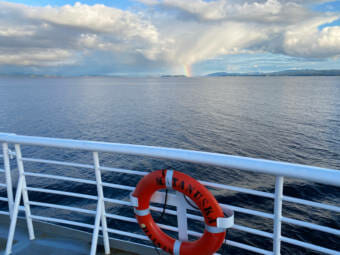
A rainbow over Keku Strair near Kake is seen on May 6, 2021 from the deck of the ferry Matanuska. (Joe Viechnicki/KFSK)

Alaska lawmakers passed a bill to Republican Gov. Mike Dunleavy on Wednesday that boosters say would ensure better long-term planning for the state-run ferry system.

The Alaska Marine Highway System has been struggling with deep spending cuts, an aging fleet and declining ridership as it runs fewer ships to coastal communities.

But it’s also come under fire for poor planning decisions that have kept its brand new Alaska-class ferries tied to the dock.

Sen. Gary Stevens, R-Kodiak, says that House Bill 63 would replace an existing advisory panel with a nine-member Alaska Marine Highway Operations Board tasked with crafting a short- and long-term vision.

Their job is to assess and suggest marine business and procurement practices, enhance revenue and reduce costs,” Stevens said during the Senate’s floor debate Tuesday.

The bill, written by Kodiak Republican House Speaker Louise Stutes, unanimously passed both the House and Senate. Sen. Mike Shower, R-Wasilla, says he’s concerned the ferry reform bill doesn’t go far enough to change a business-as-usual culture at the state Department of Transportation.

“We have an empire at DOT and we have got to break away from this mold of kind of doing things the way we have always done it,” Showers said. “And while this is a step in that direction, I’m still not convinced it does what we need it to do per our discussions and we’re going to continue to work on a greater plan.”

Four of the nine members of the board would be appointed by legislative leadership. That’s in stark contrast with a separate legislative proposal by Gov. Dunleavy that failed to gain traction in either the House or Senate.

The governor’s office earlier this month suggested that lawmakers appointing members to an executive board would violate the state constitution’s separation of powers.

But on Wednesday, Gov. Dunleavy’s spokesman Jeff Turner walked back that opposition, without saying whether the governor would sign or veto the bill.

“When the bill is transmitted to the governor’s office he will consider the legislation,” Turner told CoastAlaska via email.

Sealaska shareholders consider election reforms

A Sealaska corporate logo adorns the roof of the Southeast Alaska Native corportation's headquarters in Juneau on May 2, 2018.
A Sealaska corporate logo adorns the roof of the Southeast Alaska Native corportation’s headquarters in Juneau on May 2, 2018. The logo has representations of the Eagle and Raven moieties of the Tlingit, Haida and Tsimshian. (Photo by Jeremy Hsieh/KTOO)

At Sealaska Corporation’s upcoming annual meeting, five seats are in play on its 13-member board, and candidates are seeking support from the more than 22,000 people holding shares. But one of the biggest contests will be how elections will be carried out in the future.

Former Sealaska board member Ed Thomas says about a fifth of shareholders don’t have a particular candidate in mind, “but they still want to be supportive of Sealaska; there’s an opportunity to give their votes to the proxy holders to vote as they wish.”

That creates a bloc of votes that are called “discretionary” because they can be used at the discretion of the board majority. And it’s basically like handing over an unmarked ballot for a corporation’s leadership to ink in the bubbles.

Critics like Thomas say this perpetuates the majority members’ ability to retain control. Now, he’s gathered enough signatures to force the issue this spring.

Former Sealaska board member Ed Thomas made a two-minute pitch for his resolution that would heavily restrict discretionary voting. He says other ANCSA corporations have done away with the practice. (YouTube screenshot)

The former board member says any director that’s out-of-step with the majority risks losing their endorsement and with that — access to the pool of discretionary votes controlled by the majority.

And what that does is sends a message to any new member,” Thomas told CoastAlaska from his retirement home in Washington state. “That you got to go along with their thinking otherwise — you can’t think independently — otherwise, you’re out.”

A former president of Central Council of Tlingit and Haida Indian Tribes of Alaska, who grew up in Craig on Prince of Wales Island, was first elected to Sealaska’s board in 1993 as an independent. In subsequent years, he was re-elected as part of the board slate up until 2019 when he says he apparently fell out of favor and was dropped from the slate of endorsed candidates.

Shareholder resolutions would amend Sealaska’s bylaws

His proposed resolution would restrict the use of discretionary votes in Sealaska’s elections. It would require candidates to be elected on the strength of shareholders checking off their names.

But Sealaska’s board majority opposes the measure. Board and executive leaders declined an interview request but have released statements pointing out that past efforts to stamp out discretionary voting have failed.

Sealaska’s board of directors has urged shareholders to reject a resolution that would limit discretionary voting in elections. (YouTube screenshot)

Thomas says it’s understandable that the board’s leadership wants to keep the status quo.

“Because it does really pretty much ensures that when election time comes, so you can shift around the votes to make sure their candidates get put back on,” he said.

It’s not the only election reform resolution put on the ballot by shareholders. Anchorage shareholder Lisa-Marie Ikonomov is pushing a separate measure that would require more detailed reporting of the final vote count. That means a candidate’s election returns would have the number of directed votes cast by individual shareholders and the discretionary votes controlled by the majority on the board in separate columns.

“This resolution does not say that they can’t use discretionary voting,” she said in a recent interview. “What it says is they just need to be honest and truthful and report those full totals to shareholders. They shouldn’t be able to hide any vote count from any shareholder.”

Simmering tensions from shareholders concerned about executive compensation

Sealaska is a major economic player in Southeast Alaska. Its business portfolio includes seafood, real estate and until recently timber across more than 360,000 acres. The Native-owned corporation reported nearly $700 million in annual revenue with more than $55 million in net profits last year, according to its most recent annual report. And it pays out cash dividends each year to its shareholders and funds educational work through its cultural arm, Sealaska Heritage Institute and others.

Yet there have long been competing factions vying for control of the organization. In recent years, critical shareholders have decried the take-home pay of Sealaska’s leadership which tops more than $2.2 million for its chief operating officer and more than a quarter million dollars for its full-time board chairman.

Anchorage public relations professional Lisa-Marie Ikonomov recorded a two-minute pitch to fellow Sealaska shareholders to support a resolution requiring more transparency in vote tallies. (YouTube screenshot)

Sealaska is one of the 13 original corporations established by the Alaska Native Claims Settlement Act. The legislation was a sea change for Alaska’s indigenous people who received shares in regional, village and urban corporations based on ties to their traditional homelands.

But Ikonomov says ANCSA corporations like Sealaska have in the past half-century become a lot more than just profit-driven corporations.

“They’re our voice in politics, they’re our voice in the community,” she said. “We look at those positions as not just having that business component, but also in a lot of ways, the representation component of us as shareholders as tribal citizens, as Alaska Native people.”

Sealaska leadership quiet over opposition to shareholder resolutions

Sealaska’s board of directors opposes both shareholder resolutions. But its opposition has so far been fairly low-key. At a May 11 informational meeting for shareholders, aside from a pair of video messages, none of the board members or executives directly addressed the shareholder resolutions.

The board has released statements that say roughly one-fifth of people vote discretionary because they are consciously showing their support for the corporation. It notes that six similar proposals have been voted down since 1992.

Sealaska’s board of directors has urged shareholders to reject a resolution that would require vote tallies to be separated between shareholders’ directed votes to individual candidates and the discretionary vote block controlled by the majority. (YouTube screenshot)

The resolutions still face tough odds. Under Sealaska’s bylaws, a shareholder resolution requires support from the majority of all shareholders to pass. That’s challenging because 20% to 30% of shareholders don’t vote, meaning that two-thirds of those that do would need to vote yes.

The Sealaska Corporation also told shareholders that its current bylaws encourage a “team-based” approach, where the endorsed nominees work together and support each other.

In election materials distributed to shareholders, it says the proposed changes could make, “some nominees look weak if they did not seek directed votes, and instead sought discretionary votes in support of the team.”

Ed Thomas, the former Sealaska board member, says he feels the corporation will be stronger if it has fairer elections.

“I personally feel that it is not anti-Sealaska,” Thomas added. “You look at some of the folks that are young, up and comers, we really have positive people. And then they get a fair chance to go forth in their elections without having the cloud of having to bow to a leader in order to get elected.”

Sealaska shareholders have until June 25 to vote by returning their proxies. Resolutions and the board of directors elections will be made at Sealaska’s annual meeting.

Guardian Flight settles over deadly 2019 medevac crash

Signs remember Guardian Flight crew members Patrick Coyle and Margaret Langston during a memorial service on Friday, June 7, 2019. (Photo by Adelyn Baxter/KTOO)

A Utah-based medevac company has settled a wrongful death lawsuit over a 2019 air ambulance crash in Southeast Alaska that killed three crew members from Juneau.

Dylan Listberger of Juneau sued Guardian Flight over the death of his 30-year-old fiancée Stacie Rae Morse, a flight nurse who was 27 weeks pregnant at the time, according to the lawsuit filed earlier this year.

“The parties are happy to have the lawsuit concluded,” Sheldon Winters, the Juneau attorney who filed the suit on behalf of Listberger, wrote in an email to CoastAlaska. “The settlement terms are confidential.”

The twin-engine King Air turboprop was en route to the village of Kake to pick up a patient the evening of January 29, 2019. But federal investigators say during its approach it inexplicably veered to the right and dropped more than 2,500 feet in just 14 seconds.

It hit the water at high speed destroying the aircraft.

The bodies of 63-year-old pilot Patrick Coyle; 43-year-old paramedic Margaret Langston and Morse were never found. And investigators never established a cause for the crash.

The original lawsuit sought more than $100,000 for gross negligence against the company. But court filings on Wednesday indicate that the parties have settled for an undisclosed sum.

A spokesperson for Guardian Flight declined to comment “due to legal and confidentiality reasons.”

Site notifications
Update notification options
Subscribe to notifications