Jacob Resneck, CoastAlaska

Jacob Resneck is CoastAlaska's regional news director based in Juneau. CoastAlaska is our partner in Southeast Alaska. KTOO collaborates with partners across the state to cover important news and to share stories with our audiences.
Alaska Supreme Court upholds legality of fish landing tax

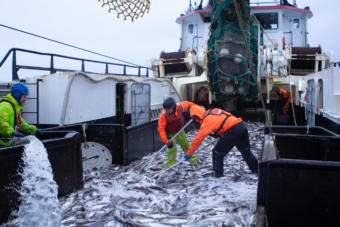
Crew members Brian Hagen, left, and Derrick Justice shovel pollock on the deck of the Commodore on Thursday, January 24, 2019. (Photo by Nathaniel Herz / Alaska’s Energy Desk)

A raw fish tax that has pumped tens of millions of dollars into coastal communities over the past decade has survived a legal challenge before Alaska’s highest court.

The state can tax seafood caught beyond the 3-mile line in federal waters, then loaded on a bulk carrier at the dock for foreign export, without violating provisions of the U.S. Constitution.

That’s according to the Alaska Supreme Court, which released its 31-page ruling Friday.

Fishermen’s Finest, a Washington state seafood company that operates factory trawlers and exports most of its product overseas, had challenged the state’s tax in court. It argued that there are protections against state taxation on shipping in coastal state waters, and a lower state superior court agreed.

But the justices, writing in a unanimous opinion, found that the fees assessed on Fishermen’s Finest’s products are not unconstitutional

“The landing tax is not opportunistic taxation of vessels ‘merely transiting’ adjacent waters without landing or benefitting from any local services,” the justices wrote.

At stake was about $47 million dollars in revenue collected since 2017 — half of which goes to the state, and the other half goes to coastal communities. In the Aleutians, the case was watched with interest, as taxes on the lucrative pollock fishery is a major economic driver in the port of Dutch Harbor and its neighbors

Unalaska’s Vice Mayor Dennis Robinson says the raw fish tax is a major source of the city’s municipal revenue, and local officials had been anxious about the impact of a decision against them.

“I’m pretty relieved of that,” he told CoastAlaska on Monday. “Because that is roughly 17% of our budget, and it would be devastating to this community.”

The Fisheries Resource Landing Tax has existed since the 1990s and is designed to capture revenue for raw seafood that’s landed on Alaska port docks before it’s transshipped on cargo vessels and sold overseas.

Unanimous ferry reform bill prompts constitutional challenge from Alaska’s governor

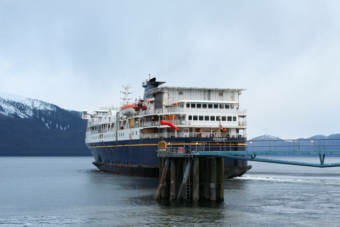
The M/V Kennicott leaving Wrangell on Jan. 8, 2021 (Sage Smiley / KSTK)

A ferry reform bill passed the Alaska House of Representatives 37-0 on Wednesday, with no objections from the floor. But Gov. Mike Dunleavy believes the bill violates the separation of powers clause in the Alaska Constitution.

House Bill 63 would create an Alaska Marine Highway Operations Board, which would craft short- and long-term planning for Alaska’s ferry fleet. The bill would also bind the Alaska Department of Transportation to incorporate the board’s directions into daily operations.

The Alaska Marine Highway System has been struggling with deep funding cuts, an aging fleet and steep declines in ridership during the COVID-19 pandemic.

“My hometown of Sitka is getting less ferry service than any point since the 1960s,” Rep. Jonathan Kreiss-Tomkins (D-Sitka) said on the House floor Wednesday. “That sort of puts things into context that we are definitely going backwards and not forwards. And it really affects people’s lives.”

Rep. Jonathan Kreiss-Tomkins, D – Sitka, speaks during a House floor session in the Capitol in Juneau on March 16, 2020. (Skip Gray/KTOO)

He relayed his experience as a coastal resident left in the lurch: At the end of last year’s legislative session, there were no state ferries between the capital and his hometown, so he used a private carrier.

“It took me four weeks on Alaska Marine Lines to barge my car, from Juneau to Sitka,” Kreiss-Tomkins said. “This is simply not tenable for quality of life or commerce.”

Reforming the Alaska Marine Highway System has been a priority of coastal legislators who want more autonomy for the state ferry system. And House Bill 63 found bipartisan support with Railbelt lawmakers like Rep. James Kauffman (R-Anchorage), who worked to refine the legislation.
Coming from South Anchorage, I didn’t think I would be getting all busy on a bill about the ferries,” the freshman legislator told fellow lawmakers. “But it turned out it was an enjoyable process, even though it was hard work.”

Gov. Mike Dunleavy floated a similar initiative earlier in the year that’s stalled in a House committee.

But this bill differs by requiring four of the board’s nine members be appointed by legislative leadership. That could be a sticking point with the executive branch, which released a statement questioning the House bill’s constitutionality just hours after its passage.

The governor’s office says allowing lawmakers to appoint members to an executive board violates the separation of powers.

“The Governor and Speaker (Louise) Stutes both share the belief that the advisory board needs to be reformed,” Governor’s Office spokesman Jeff Turner told CoastAlaska by email. “However, the board appointment process contained in HB 63 is considered to be unconstitutional by the administration because it permits the presiding officers of the legislature to appoint members to an executive board.”

That wrinkle was raised in an April 6 legal memo to lawmakers. But legislative counsel said since the operations board would be largely advisory, a court may find no legal issues exist.

The bill now heads to the state Senate for consideration, where its first hearing is set for May 11.

The bill comes as lawmakers announce they’ve reached a consensus on a plan that would forward fund the ferry system by 18 months, rather than a year. The ferry system is also in line to receive nearly $77 million in federal pandemic relief.

But the final ferry budget remains to be worked out by both legislative houses and signed by the governor.

Coast Guard scuttles Juneau’s troublesome tugboat Lumberman

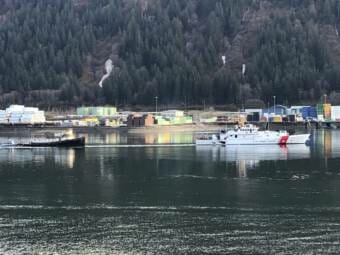
The tugboat Lumberman sitting in Gastineau Channel at low tide on June 15, 2018 (David Purdy/KTOO)

It was a foggy Sunday morning when the 80-year-old tugboat left Gastineau Channel. A Coast Guard cutter towed the Lumberman out for her last trip to sea.

The black-and-yellow tugboat had long been a familiar sight in Juneau’s inland waters. She arrived in the late 1990s from Puget Sound and changed hands several times, decaying over the years to become a rustic liveaboard that skirted local laws.
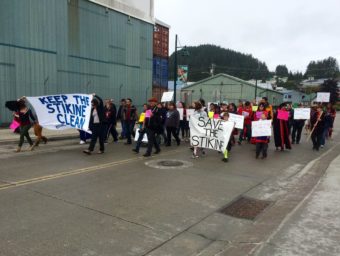
“We had a dispute with the owner at the time that he couldn’t be there. He claimed that he was on state lands and had the right to be there,” Juneau’s Port Director Carl Uchytil told CoastAlaska.

Anchored on city-owned tidelands outside the harbor, the Lumberman sat in a jurisdictional no man’s land that was out of reach of local officials.

The M/V Lumberman in 2017, with various vessels attached. (Courtesy of Dave Borg/Juneau Docks & Harbors)

The vintage tug could often be seen from Juneau’s main highway with a collection of skiffs moored to her rusting hull. It became a magnet for people unable to find shelter in a community that’s long struggled with a lack of affordable housing.

Of course, there was that unfortunate accident where two people perished going out to the Lumberman,” Uchytil said, referring to a December 2017 accident when a skiff carrying five people and a dog overturned while heading out to the tugboat. Two men were never found.

The city later moved to condemn the 192-ton vessel after she broke her anchor chain and drifted off state-owned tidelands.

But then came the question of whose responsibility it was. The owner was long out of the picture. The state didn’t want her. The Coast Guard didn’t consider her a navigation hazard. And scrapping her would have cost too much, so she sat for more than a year — abandoned — tied to a city dock.

“This is just the typical poster child of what a derelict vessel is,” Uchytil said, “where people aren’t responsible with their vessels, passing them from one person down to another.”

To date, the city’s Docks and Harbors spent about $160,000 to clean and prep and ultimately scuttle the ship. The Coast Guard spent close to $70,000 to remove hazardous materials.

Still, nobody really wanted to sink her. Juneau’s Docks & Harbors even appealed to the public for ideas for what could be done with the hulking beauty.

Uchytil says the community had a range of pie-in-the-sky ideas, from converting it into a beachfront fish-and-chips stand to a community flower garden.

“There was never an organization that said, ‘I’ll take it over, I have some funding, I will do this,’” he said.

That was three years ago. In all that time it would remain the city’s problem. Then last fall, federal regulators issued a permit green-lighting sinking the ship in about 8,400 feet of water.

The plan called for her to be towed about 55 miles west of Cross Sound. Uchytil worked with a salvage firm to rig the tugboat with remotely opening valves that could flood the 107-foot tug at a flick of a switch.

We had consulted with a naval architect to make sure that the vessel would indeed flood and sink in that proposed spot,” he said.


The derelict tugboat Lumberman is towed by a crew aboard the Coast Guard Cutter John McCormick, a 154-foot Sentinel–class vessel, to a position 54 miles west of Cross Sound, Alaska, on May 2, 2021. (courtesy U.S. Coast Guard)

A salvage crew headed out early on Sunday. At first, everything went according to plan. But Coast Guard Chief Petty Officer Kip Wadlow says that the flooded vessel didn’t completely sink. Her bow continued to bob up and down, protruding from the water’s surface.

And then the John McCormick, a 154-foot fast response Coast Guard cutter, used its 25 mm deck gun to complete the sinking,” Wadlow said.

Within 15 seconds, the waters of the Pacific closed over the ship as she sank to the ocean floor — an inglorious end to the saga of the Lumberman.

In recent years, Juneau’s Assembly has since tightened up its anchoring rules on city-owned tidelands. And the Legislature passed a legislation requiring boats to be titled to tighten up the chain of ownership.

All in the name of cracking down on derelicts and sparing them the notoriety of becoming a public nuisance, like the 80-year-old Lumberman tug boat.

Human rights panel to weigh transboundary mining concerns

A 2015 protest in Wrangell marked the one-year anniversary of the Mount Polley mining disaster. (Katarina Sostaric/KSTK)

A booming Canadian mining area known as the Golden Triangle is key to northwest British Columbia’s economy. But Southeast Alaska tribes, fishermen and other concerned citizens say that the Canadian mining sector enjoys all of the economic benefits, while those downstream bear most of the ecological risks.

Efforts to elevate the issue to the international level have had some success. And recently, the Inter-American Commission on Human Rights informed a coalition of 15 tribes that it had agreed to take up the matter.

The Southeast Alaska Indigenous Transboundary Commission’s Tis Peterman told lawmakers at an April 27 meeting of the Alaska House Fisheries Committee that its most recent petition was submitted which basically stated that the transboundary mining will have devastating effects on our way of life and downstream communities.”

The Washington D.C.-based IACHR is an arm of the 35-member Organization of American States, which Canada joined in 1990.

Formal cross-border efforts at the state and provincial level have been in place since 2015, when both sides signed an agreement pledging cooperation on transboundary resources.

But tribes have complained that progress has slowed, and there’s been little to no consultation with tribes since the state’s political transition following the election of Gov. Mike Dunleavy.

Ray Paddock of the Central Council of Tlingit & Haida Indian Tribes of Alaska told lawmakers that tribes on both sides of the border have taken to doing their own environmental work, independent of state and provincial regulators.

Our way of life depends upon our health of the transboundary waters, and it’s important for Alaska tribes and B.C. First Nations to be fully engaged for to collaboration to exist,” he said.

Commercial fishing groups have raised concerns about poor salmon returns in transboundary rivers like Taku and Stikine, which are some of the largest salmon-producing systems in the region.

More than a dozen working and legacy mine sites are located in watersheds that are shared between British Columbia and Southeast Alaska. (Image courtesy of B.C. Ministry of Energy, Mines and Petroleum Resources).

United Fishermen of Alaska Executive Director Frances Leach says salmon runs — particularly chinook — have been falling off in transboundary watersheds.

“UFA is increasingly concerned with the potential impacts to fish habitat and water resources from at least 12 large-scale, open pit and underground metal mines in British Columbia that are abandoned, permitted or operating in the headwaters of transboundary rivers,” Leach said.

But there was skepticism from at least one member of the House Fisheries Committee.

I grew up in northern Minnesota, and I used to swim in the tailings ponds — and look at me,” said Mat-Su Republican Rep. Kevin McCabe.

“So my point is, I think there’s all sorts of different tailings and tailings ponds, and some of them are toxic. Some of them are not, we’ve had six years now to study Mount Polley, and I’m interested, really interested, to see how it’s affected us in the the lake and the fish and that sort of stuff,” McCabe said.

He also asked why mining interests weren’t more represented in transboundary discussions during the House Fisheries Committee meeting.

“It seems like we’ve heard from a whole bunch of fish people here today. I’m concerned that there’s no balance in this hearing today,” he added.

The Dunleavy administration recently announced it had wrapped up its joint monitoring with B.C. after collecting two years of data. Both sides argued that in-stream surveys by the federal governments as well as samples being collected by tribes made the state and provincial project duplicative.

Chris Sergeant of the Flathead Lake Biological Station has been tracking efforts to date. The university researcher told the House Fisheries Committee that key questions remain: are the overall conditions of transboundary rivers changing over time? And how are polluting legacy mines such as the long-closed Tulsequah Chief affecting the environment downstream?

“To date, no monitoring efforts in transboundary watersheds have been designed to answer both of these questions,” Sergeant said.

Congress appropriated more than $3 million last year for renewed stream monitoring at border stream gauges operated by the U.S. Geological Survey. And a cross-border group of resource agency officials from both Alaska and B.C. continues to meet at least twice a year on transboundary issues.

The tribes’ human rights petition says upstream mine pollution from British Columbia could harm salmon and hooligan runs on the Taku, Stikine and Unuk watersheds.

It asks the Inter-American Commission on Human Rights to hold a hearing and investigate these concerns. The Canadian government has three to four months to respond.

Could rising timber prices aid the Tongass transition to second-growth logging?

A 70-year old stand of young-growth timber photographed in 2013. The tightly-packed trees are growing among the stumps of their much larger predecessors. (United States Department of Agriculture)

Soaring lumber prices could be a boon for Southeast Alaska’s struggling timber industry. The pandemic has fueled the demand for both renovations and the new home construction market, and supply has not kept up.
But industry experts are divided over how to best seize the opportunity in the region: By cutting what’s left of Tongass old-growth or by retooling to cut younger, second-growth trees.

In March, the National Association of Home Builders blamed rising materials prices for adding an average $24,000 to the cost of a new home.

Most of that cost is due to the skyrocketing price of lumber which is in high demand and “soaring to just absolutely record highs,” said resource economist Brett Watson with the Institute for Social and Economic Research at the University of Alaska Anchorage.

There are a number of explanations: low-interest rates have spurred home-buying, people doing more do-it-yourself projects and renovations, and also a bottleneck in the supply caused by the pandemic.

But could this be an opportunity for Southeast’s struggling timber sector?

“What I imagine that timber mills are looking at now during this recent run-up is thinking about whether or not these prices are here to stay,” Watson added.

Opponents of old-growth logging push second-growth solutions

Catherine Mater is an Oregon-based forestry consultant who’s worked both for timber outfits and for environmental groups opposed to old-growth logging. She’s been advocating for retooling Southeast’s timber economy to use second-growth trees instead of logging old-growth forests.

What we have in Southeast Alaska is literally a wall of wood that’s going to happen whether the industry is ready for it or not,” she told CoastAlaska during a visit to Juneau in September 2019.

And the real question is, can we do a good transition so that you’ve got an industry that could reinvent itself?”

Two years later, Mater says she still believes the focus on old-growth logging is a fight that no one can win.

Alaska really is the last state in the nation that harvests old-growth material — no one else is doing it,” she said in a recent telephone interview from Corvallis. “Everyone has transitioned to young growth harvesting. And the industry is not just surviving, but it’s thriving right now.”

Second- or young-growth trees cover a Tongass National Forest hillside in southern Southeast Alaska in 2012. (CoastAlaska)

The industry says Tongass second-growth is decades from viability

But Alaska’s timber industry remains focused on old-growth supply. That’s despite the Tongass National Forest’s 2016 plan to transition away from logging ancient forests.

The Forest Service prepped one of the largest timber sales in recent history on Prince of Wales Island. But environmentalists sued in 2019 — after objecting to clear-cutting old-growth forests — and a federal judge agreed that the agency’s review process was flawed.

It sent the Forest Service back to the drawing board to revive a portion of the old-growth logging plan. But in the meantime, it’s taken tens of thousands of acres of forest off the table — including second-growth lumber — and that means there’s little supply available on federal lands, says those who work in the industry.

There are no young growth sales scheduled in the Forest Service,” Eric Nichols of Alcan Lumber in Ketchikan told CoastAlaska. “So people can talk about all this stuff. But until you see these timber sales actually come up, you can’t count on them.”

He’s skeptical that second-growth trees are the answer. His company exports old-growth logs to Asia where he says there’s a strong market for their clear, knot-free timber. And he says it’s more economical to export overseas than transporting logs to mills in Alaska or down south.

By the time we build the roads and harvest the timber, truck them from a small island, put them in the water and transport them to a mill in Washington,” Nichols said, “our cost to do that is higher than what we can generate from the log.”

Others who make their living in this industry agree: Second-growth timber sales don’t pencil out. Especially as the costs of doing business rise.

Wes Tyler operates Icy Straits Lumber and Milling on Chichagof Island, west of Juneau. Most of his work is old-growth logs he agrees are prized for their clear, knot-free wood.

He doesn’t dismiss the potential for second-growth harvest but he says that is further south and out of range of his small mill near Hoonah.

The region’s industry now employs just a few hundred people at most, compared to the thousands when Alaska Pulp Corporation in Sitka and the Ketchikan Pulp Company operated their mills.

“It’s going to be difficult because the whole system of things — the whole infrastructure that used to be there in the old days — is gone,” Tyler said.

The last major sawmill in the region is Viking Lumber in Klawock. The company didn’t respond to calls for comment about the potential for second-growth trees. Nor did the Alaska Forest Association returns calls or emails.

Tyler says that it would take major investment to get Southeast’s timber manufacturing sector running again.

And so, somebody is going to have to spend a lot of money to set up for a volume-type infrastructure that’ll handle that,” he added.

The timber business is a long game. Tyler says in the northern reaches of the Tongass National Forest there could one day be potential for second-growth harvests in future decades.

“Most likely it would be another 30 to 40 years of growth before it is actually viable,” he added in a follow-up email.

Political winds shift the direction of Tongass management

Politics play a role as much as economics, leaving Eric Nichols of Alcan Timber deeply skeptical of his industry’s future. Chinese tariffs on timber exports imposed during the Trump administration’s trade war hurt the industry. Clinton-era Roadless Rule policies were supported under Obama but rolled back by Trump.

“Every four years, we keep changing the direction of the Tongass is going we’re going through that right now again,” Nichols said, “and you cannot make the investments needed either on the harvesting side, or on the manufacturing side, based upon an unsteady supply from the Forest Service.”

The political transition means the feds aren’t ready to show their cards of how management might change.

“We are evaluating the implications of the new administration changes and will provide updates as they become available,” Tongass spokesman Paul Robbins Jr. wrote in an emailed statement.

On top of it all,  Sealaska, the regional Alaska Native corporation, and largest private landowner exited the timber business — destabilizing the sector even further.

Yet Catherine Mater, the forestry consultant, says the pieces to revitalize the industry are in place — and have been for a long time. Working from the Forest Service’s own data and as well as her firm’s in-field surveys, she’s prepared a report that shows tens of millions of board feet of marketable stands of trees that are at least 60 years old.

Had Southeast been on track to transition to young-growth starting this year, you would have had competitive material flowing in not only to Alaska markets but in my opinion, in the Lower 48 markets,” she said. “The pricing has been so good.”

Of course, nobody can know for sure whether these higher prices are here to say. But both Mater and Nichols do agree on one point: second-growth timber isn’t being offered on the Tongass. That is hasn’t been the focus of the Forest Service.

The current timber sales in the works are about 1,850 acres of old-growth forest being prepped for sale on the north end of Prince of Wales Island. And a second project east of Ketchikan could offer about 6,040 acres of the national forest for logging.

Of that only about 1,000 acres of that timber sale would be second-growth forest as the emphasis continues to feed the demand for centuries-old trees, something conservationists have already raised their objections to.


Engine trouble, COVID-19 cases delay Matanuska ferry in Ketchikan

The Matanuska docked in February 2020 at the Auke Bay ferry terminal in Juneau. Engine trouble and COVID-19 cases among crew have delayed its April 25, 2021 departure from Ketchikan. (Photo by Rashah McChesney/KTOO)

The Alaska Marine Highway’s Matanuska mainline ferry remains tied up in Ketchikan on Monday with 34 passengers on board as transportation officials grapple with at least two newly discovered COVID-19 infections among the crew and a mechanical failure that has shut down one of the ship’s engines.

The Matanuska ferry arrived in Ketchikan from Bellingham on Sunday. It was scheduled to depart that day for ports north but was delayed after tests from the previous week showed at least one crew member had the coronavirus.

“Out of an abundance of caution, Matanuska was held in Ketchikan while the entire crew was tested, and one additional positive case among the crew was identified,” state Department of Transportation spokesman Sam Dapcevich said by email.

State officials have linked the two new cases to close contacts of the two engineering crew members that were infected last week.

Additionally, the ship’s starboard engine failed with an unspecified problem.

“The Matanuska is still in Ketchikan due to a mechanical issue with the starboard main engine, which will require technical support,” reads a service notice issued Monday morning. “Engineering staff is in contact with technicians, there is not an estimated time of departure at this point.”

The Matanuska is a mainline ferry. It was scheduled to sail north to major Southeast ports including Wrangell, Petersburg, Juneau, Haines and Skagway. A second leg to Petersburg and Sitka is also scheduled this week.

Officials haven’t said when they expect the ship would be ready to sail.

This story has been updated.

Editor’s Note: A previous version of this story incorrectly stated the Matanuska was the sole operating mainline ferry in the fleet.

Site notifications
Update notification options
Subscribe to notifications