Jacob Resneck, CoastAlaska

Jacob Resneck is CoastAlaska's regional news director based in Juneau. CoastAlaska is our partner in Southeast Alaska. KTOO collaborates with partners across the state to cover important news and to share stories with our audiences.
Proposed winter schedule leaves long gaps in Southeast ferry service

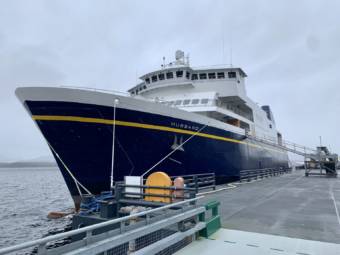
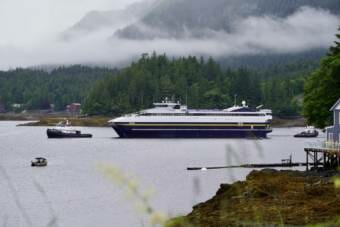
The 280-foot Hubbard tied up in Ketchikan on January 29, 2021. The Hubbard is slated for a $20 million modification to add crew quarters, which will increase its range. (Eric Stone/KRBD)

The Alaska Marine Highway System’s proposed winter schedule, released late on Tuesday, projects long gaps between ferries over a seven-month period.  Southeast towns like Sitka, Wrangell and Petersburg would see ships infrequently, while Kodiak Island and some Southcentral communities could see improved service.

From October through the end of April, the state-run ferry system will have at most five ships running at any one time. And one of those vessels shuttles between Ketchikan and Metlakatla leaving at most four ships to provide regional service across coastal Alaska.

“It’s disappointing to see such gaps still, for so many communities,” said Robert Venables, executive director of Southeast Conference, a regional civic and business organization. “There’s apparently no service to a number of the village communities for a great length of time. “

Alaska Department of Transportation spokesman Andy Mills says the draft winter schedule reflects the best the state can do given the available funding and the maintenance needs of the ships being overhauled.

We do our best to juggle all of the considerations when it comes to formulating the schedule,” Mills said Wednesday.

Gov. Dunleavy reduced ferry operating budget

The ferry system will have around $54 million in state funding to operate over the next 18 months. Add a one-time infusion of about $72 million in federal relief dollars, and transportation officials say that’s allowed the system to be forward funded through the end of 2022.

But it’s still not as much as the Legislature would have liked. Gov. Mike Dunleavy vetoed nearly $8.5 million of the state appropriation which trimmed the marine highway’s operating budget.

But House Speaker Louise Stutes, R-Kodiak, says the final amount of state funding isn’t set in stone as lawmakers will be meeting next month in a special session to consider their options.

We’re still working with the governor and there were a lot of vetoes that need to be addressed,” House Speaker Louise Stutes told CoastAlaska in a phone interview. “And so, you know, I’m an optimist.”

It takes a three-quarters vote to override a veto but with the fate of the Permanent Fund dividend check and other considerations in play, a lot will be on the table when lawmakers return to Juneau.

But overall she says she’s pleased with the schedule. That’s because Kodiak Island and Prince William Sound communities have shorter service gaps compared to last year.

“We went long periods with no ferries,” Stutes said Wednesday. “And so I think that they’re just trying to make it a little more spread out. And some communities are getting a little more and some are getting a little less.”

Ketchikan-built Hubbard to be equipped with crew quarters

Another bright spot is that one of the Alaska Class Ferries will be modified to extend its service range. The $60 million Hubbard has yet to enter service since being completed last year. It’s going in for crew quarters on November 1.

It’s a roughly $20 million modification passed by lawmakers but axed by Gov. Dunleavy during last year’s round of line-item vetoes.

Coast Guard regulations limit a crew member’s working hours to no more than 12 hours. That’ll extend its service range by allowing space for relief crew members on board the vessel.

But as was the case last year, neither of the two Alaska Class Ferries will be on the board. The Tazlina and Hubbard will both either be in layup, undergoing modifications or being overhauled. And the largest ship in the marine highway’s fleet, the Columbia, continues to be idled as a cost-savings measure.

A public teleconference to hear additional comments and consider adjustments is scheduled for 10 a.m. Thursday, July 29 for Southeast schedules. A teleconference for Southwest and Southcentral routes will follow at 1:30 p.m. The meetings will be held at the Alaska Marine Highway System’s Ketchikan headquarters at 7559 North Tongass Highway, for participants wishing to attend in person. The toll-free number for joining both teleconferences is: 1-515-604-9000, access code 279613.

Written comments are being accepted through July 27 via email at dot.amhs.comments@alaska.gov.

Dunleavy’s veto erases $8.5 million from Alaska ferry budget

Two Amak Towing tugs pull the former state ferry Chenega — adorned with a banner with the name of its new Spanish owner, Trasmapi — out of Ward Cove. (Eric Stone/KRBD)

Gov. Mike Dunleavy vetoed around 12% of the ferry operating budget on Thursday. That leaves the Alaska Marine Highway System with nearly $8.5 million less to run its ferries over the next 18 months.
Dunleavy told reporters that the vetoes were in response to extra funding added by lawmakers.

“The money that we discussed, the money that we agreed upon to put in the budget — is in the budget,” he told reporters on Thursday. “There was just more money on top. That was the money that we took off and put aside.”

The governor and lawmakers have agreed to forward fund the ferry system for a year and a half to give the Department of Transportation more leeway for planning and operations.

A $250,000 study commissioned by his administration and the recommendations of a nine-member working group were delivered in late 2020, but to date there have been few initiatives aside from the recent sale of the marine highway’s two fast ferries.

Dunleavy says oversight board could help steer fleet’s direction

The governor has yet to sign a near-unanimous bill to create an oversight board for the ferry system. But he says if that bill is enacted, the operations board could get to work on long-term goals for the fleet.

“I think we’re on track to put together the pieces that we said we were going to put together and get some input from folks that will be on this group,” Dunleavy said in response to a question about the fleet’s future.

Coastal lawmakers unimpressed

It’s the third time in as many years that Gov. Dunleavy has used his veto pen to cut ferry funding. Last year he erased more than $15 million from the marine highway’s budget, which has struggled with long service gaps for coastal communities.

“The governor’s cut to the ferry system is just kicking the system while it’s down,” Sen. Jesse Kiehl, D-Juneau, told CoastAlaska shortly after the announcement. “After three years of this, we can tell what the governor’s agenda is for the marine highway system.”

Lawmakers will be returning to Juneau in August to take up unfinished business on the budget. It requires a three-quarters vote by the legislature to override a veto.

Sealaska shareholders reject election reforms, support settlement trust

Sealaska shareholders have elected two new directors to the Alaska Native corporation’s board. The Juneau-based regional Native corporation announced on Saturday the addition of Liz Medicine Crow and Vicki Soboleff among the five seats that were up for grabs.

Medicine Crow was among the four board-endorsed candidates to be elected. Longtime chair Joe Nelson who has been on the board since 2003 was also reelected.

The other returning incumbents are Barbara Cadiente-Nelson and Nicole Hallingstad, who was elected as an independent in 2018 but added to the board slate this year.

A screenshot of a report showing 2021 Sealaska election results for the corporation’s board. (Sealaska)

Medicine Crow is chief executive of First Alaskans Institute, a nonprofit whose aim is to advance the interests of Alaska’s Indigenous peoples. She did not respond to requests for comment on Monday.

Independent candidate elected

Soboleff, an independent, won the second-highest number of votes, according to a tally released by the corporation. She’s a grants coordinator for a Washington state tribal government. Both she and Medicine Crow grew up in and have deep ties to Southeast Alaska.  She declined to be interviewed but released a short statement to CoastAlaska.

“I will not forget the support I have received,” Soboleff wrote, “and I will continue my work for our people.”

Board-endorsed resolution wins, shareholder resolutions fail

A screenshot of a report showing 2021 Sealaska election results for resolutions 1-3. (Sealaska)

The precise count of direct shareholder votes wasn’t publicly released. A shareholder resolution to require more in-depth reporting of results failed, as did a second resolution that would have restricted the practice of allowing the board majority to steer proxy votes toward favored candidates that critics say perpetuates the status quo.
But a board-proposed resolution passed by a majority of votes. It establishes a tax shelter allowing the corporation to pay its dividends. That measure was controversial as some shareholders say its language is too vague; there’s nothing to guarantee that payments to shareholders would be equitable.

“We have an excellent combination of fresh perspectives and institutional knowledge on our board, and I am confident the settlement trust will be a great benefit to shareholders,” Sealaska chief executive Anthony Mallott wrote in a statement.

Only one candidate endorsed by the board majority wasn’t elected. Sarah Dybdahl of Juneau came in sixth place, according to the vote count released, which reported a turnout of around 64% of shareholders.

Sealaska is a significant economic player in Alaska. It’s one of the original 13 established the Alaska Native Claims Settlement Act and has more than 20,000 shareholders whose ancestors have ties to traditional homelands across Southeast Alaska.

Nearly 50 years old, it’s become a major player in real estate, fisheries and commercial services. It reported nearly $700 million in annual revenue with more than $55 million in net profits last year, according to its most recent annual report.

Alaska’s budget impasse won’t interrupt ferry service, DOT says

The Alaska Marine Highway System ferry Columbia passes through Wrangell Narrows headed south from Petersburg in Southeast Alaska, June 15. 2012. (Photo by Skip Gray/KTOO)
The Alaska Marine Highway System ferry Columbia passes through Wrangell. (Photo by Skip Gray/KTOO)

State officials say ferries would continue to sail even if a political impasse over the budget isn’t resolved by the end of the month.

“Should a government shutdown take place on July 1, 2021, the Alaska Marine Highway System will continue to provide service and remain fully operational,” reads a notice that’s appeared on the state-run ferry system’s website.

The Department of Transportation has referred all questions about a potential shutdown to the governor’s office. But DOT Commissioner John MacKinnon wrote in an email to agency employees that confirmed that sailings would continue regardless of what happens inside the Capitol in Juneau.
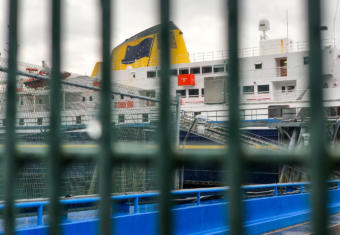
All scheduled vessels will provide passenger services without interruption, MacKinnon wrote in an all-staff memo Wednesday evening.

That’s in line with a 10-page document also released late Wednesday by Gov. Mike Dunleavy’s administration outlining which state functions would operate, which would be scaled back and which would grind to a halt.

Lawmakers are in Juneau for a special session to resolve the dispute. But time is running short.

MacKinnon wrote that there’s still time for the political impasse to be resolved but that the agency has to be prepared if it is not and state government functions are largely curtailed.

“Beyond that, only my assurance that every effort will be made to minimize the impact of this partial government shutdown to you, the lifeblood of this department, and the public whom we serve,” he wrote.

The governor’s office said Thursday afternoon ferry crew members would continue to be paid.

“Staffing would remain the same for the vessels in operation and shoreside crew will still be necessary,” Kate Sheehan, division director for the state’s Division of Personnel and Labor Relations, wrote in an email to CoastAlaska. “The money exists — it is only that the authority to spend it does not.”

Summer is the busiest season for the marine highway. In July, there are six vessels scheduled to sail seven days a week across coastal Alaska.

The Inter-Island Ferry Authority which runs vessels between Ketchikan and Prince of Wales Island also won’t be affected, “unless a shutdown is protracted,” Ron Curtis, IFA’s general manager wrote in an email to CoastAlaska.

Editor’s note: This article has been updated with more information about payroll for ferry crew members.

Free to good home: Gov. Mike Dunleavy offers Alaska ferry to the Philippines

The Malaspina moored in Juneau during a strike by the Inlandboatmen’s Union of the Pacific on July 25, 2019 (Photo by David Purdy/KTOO)

Gov. Mike Dunleavy wrote to the Philippines consul general in San Francisco a little over a month ago offering up the Malaspina ferry.

“This vessel is surplus to our fleet, is in need of some repairs, but does have some service life left,” the Republican governor’s one-page letter reads. “We would be willing to provide the vessel to the Philippine government or to a private ferry company in the Philippines free of charge.”

The May 20 letter included a pamphlet on the 408-foot ship and a link to an 11.5-minute YouTube video of a 2015 walk through posted on a ferry vessel fan page.

Dunleavy’s apparently unsolicited offer was included as part of a routine records request for the governor’s correspondence filed by Alaska Public Media.

The Malaspina was built in 1963 and has had several overhauls over the decades. Its last sailing was in late 2019 when the state put the ship in layup rather than invest at least $16 million in needed steelwork.
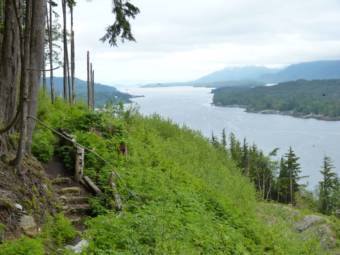
The decision to do a cold layup went against the advice of union engineers who said without a regular maintenance crew the ship would deteriorate. Freezing temperatures led to some minor flooding in staterooms and a fact-finding tour by coastal lawmakers and aides reported it was clear there was no intention of the ship being used again.

A skyrocketing price tag to return mainline ferry to service

Recent estimates have put the price tag upwards of $45 million for complete overhaul including new engines, according to the Department of Transportation.

DOT solicited bids on storing the vessel last month. It says only one offer came in from the Ward Cove Group where it’s been sitting for about a year and a half. It’s contracted to pay about $400,000 a year. Add the monthly power bill to heat the ship, and it’s paying roughly $447,000 a year to tie it up.

With such a high price for a ship on the sidelines, the Dunleavy administration has said it’s looking at deep-sixing the vessel to cut its losses.

“We are actively looking at working with the EPA to scuttle the ship and potentially salvage some of the steel or resale value,” Alaska Marine Highway System General Manager John Falvey told the House Transportation Committee on March 20.

He says there has been only tepid interest in buying it. And as its fleet has diminished in recent years, the state has also struggled to offload other ferries: one went to a scrap yard in India, and two more sold to a Spanish ferry company for a tiny fraction of what the state originally paid.

But at the time, Falvey said there would still be a public process.

“If we were to sell it, we would have to, of course, per state requirements, put it out to a sealed bid, just like we’ve done the two fast ferries,” Falvey told lawmakers.

Unusual offer gets mixed reviews from ex-procurement officials

So that’s the backstory for when Gov. Mike Dunleavy penned a letter to the Philippines consulate in San Francisco offering the ship up for free.

“I would be stunned — I am stunned — in reading the letter that it wasn’t advertised and put out for auction or something similar,” said Barry Jackson, a former senior state procurement official of 30 years. He says it’s understandable that a state asset could be a liability, but that there’s a process for disposing of public property.

“If you want to get away from the bills that this ferry is costing, advertise that you want to give it away — and see what happens,” he added.

Other veterans of the procurement are more charitable. Jason Soza was hired as the state’s top procurement official during the administration of Gov. Sean Parnell; his six-year term was allowed to expire in 2019.

“It may look at first blush like we’re just giving away something that’s worth a lot of money,” Soza told CoastAlaska. “But when you start digging into it, you might find that there are a lot of costs associated with it.”

He says state law waives normal procurement rules for giving things to other governments. But he recognizes the governor’s letter also floated “a private ferry company” as a possible receiver which isn’t normally allowed.

Sitka lawmaker: Alaska Marine Highway System operations board should be given a chance to work

Dunleavy’s offer comes at a time of transition for the ferry system’s governance. One of the few pieces of legislation to pass this session was a bipartisan bill that created an oversight board for the marine highway. House Bill 63 passed unanimously but still awaits the signature of the governor who has given mixed signals over his support.

Rep. Jonathan Kreiss-Tomkins, D-Sitka, was one of HB63’s co-sponsors.

“We passed this bill, to sort of write a new chapter for governance and management of the ferry system,” Kreiss-Tomkins said Monday. “And then concurrent to that, the governor sort of, on a lark, offers up one of the core assets of the ferry system: the Malaspina to the Philippines for the cost of $0.”

He says the new ferry operations board should be seated before the state starts offering to give away ships.

The governor’s spokesperson Jeff Turner said Monday there hadn’t been any response from the letter. The governor’s office declined to comment further.

The Consul General of the Philippines in San Francisco says its chief diplomat will visit Juneau in July. But a spokesperson said in a follow up email that it’s part of the consul general’s normal outreach for Filipino citizens in Alaska — not a ferry fact-finding mission.

Alaska recruits former California official as top forester

Alaska’s new state forester, Helge Eng, grew up in Oslo, Norway, at nearly the same latitude as Anchorage.

I’ve always considered Alaska kind of home in the sense that I was born and raised in a similar climate,” he told CoastAlaska in a recent interview from Anchorage.

Helge Eng joined the Department of Natural Resources on June 2 as director of the Division of Forestry and Alaska state forester, after a 21-year career at California’s forest management and wildlife firefighting agency. (Photo courtesy of Department of Natural Resources)

Eng just finished a 21-year career in California where, despite making his home in the foothills of the Sierra Nevada mountains, he said the dry heat spells were hard to escape.

“That wall of heat of 105 degrees is not something you really get used to,” Eng said. “So, coming up here, it’s a welcome change. And it’s like coming home for me.”

Eng spent more than 20 years working for the California Department of Forestry and Fire Protection — known as Cal Fire. He was in charge of resource management, which researched different timber practices on state lands.

As Alaska’s state forester, he oversees the roughly 260-strong Division of Forestry, which is in charge of fire protection and regulating logging on state and private lands. His division is attached to the Alaska Department of Natural Resources and is charged with preparing timber sales on state lands to supply local industry.

He’s preparing to meet with U.S. Forest Service officials next month to discuss the impacts from the Biden administration’s recent announcement that it plans to reinstate the Roadless Rule for Tongass National Forest, which could curtail old growth logging on federal lands.

We are continuing to work actively, as my predecessor did, to re-reinvigorate a timber industry in Southeast,” Eng said.

Clear-cut logging of old growth forests is controversial. And there’s been increasing scrutiny of projects on Prince of Wales Island and other parts of Southeast.

Eng says it’s his job to make sure all voices are heard before making critical land use decisions.

“There are several points of view on forest management and timber harvesting,” he said. “And I do think it’s important that all of those uses are represented and all the voices are heard. So, rest assured, there will be ample opportunity for public inputs into all of the state’s harvest decisions.”

As in California, which has been devastated by wildfires, his job here will also include wildland fire protection. That was a point underscored by his boss, DNR Commissioner Corri Feige, who released a statement earlier this month announcing his recruitment.

“State foresters in Alaska and California share similar challenges in fighting wildfire to protect lives and property, and similar opportunities in managing vast forest resources to benefit industry, wildlife and recreation,” Feige said in a June 2 statement. “We are fortunate to have Helge Eng bring his experience north to Alaska to lead our Division of Forestry in its continued success in achieving these goals on behalf of Alaskans.”

Eng replaces outgoing state forester Chris Maisch, who served for 21 years before retiring in February.

Site notifications
Update notification options
Subscribe to notifications