Jacob Resneck, CoastAlaska

Jacob Resneck is CoastAlaska's regional news director based in Juneau. CoastAlaska is our partner in Southeast Alaska. KTOO collaborates with partners across the state to cover important news and to share stories with our audiences.
Dunleavy pushes bill for long-range planning for Alaska’s ferry system

Gov. Mike Dunleavy on June 30, 2020 (Photo from the Office of the Governor)

Gov. Mike Dunleavy has proposed a new bill to boost independent oversight and planning for the Alaska Marine Highway System.

In a statement Wednesday, the governor said the legislation would improve the reliability and efficiency of the fleet.

“As we continue efforts to restructure and modernize the Alaska Marine Highway System, it is imperative the long-term operations and finances are addressed,” the statement said. “Our goal remains the same, to create a more reliable and efficient marine highway system to serve coastal Alaska for years to come.”

Dunleavy, a Republican, has targeted the ferry system for deep budget cuts during his two years as governor. But the new bill is aimed at sharpening the marine highway’s strategy.

The legislation would also replace an existing marine transportation advisory board with a new panel required to draft regular short- and long-range plans for the fleet. Its key responsibilities would be to prepare an annual report while also thinking long-term.

Robert Venables, chair of the existing Marine Transportation Advisory Board, said those types of plans are sorely needed and were a key recommendation of a marine highway working group convened last year by the governor.

“In spite of the fact that the state has a Southeast transportation plan, which is woefully out of date, there’s never really been a long-term plan specific to the marine highway system,” he told CoastAlaska on Wednesday.

The 10-member operations and planning board’s members would be appointed and removed by the governor.

Rep. Jonathan Kreiss-Tomkins, D-Sitka, called Dunleavy’s bill an “incremental improvement.” He wants the ferry system’s leaders to be fully insulated from shifting political winds, and he said the governor’s legislation wouldn’t accomplish that.

“All we’re talking about talking about is advisory, advisory, advisory,” Kreiss-Tomkins said in an interview. “I don’t think anything is going to change unless the management power and governance fundamentally is depoliticized … and this bill doesn’t do that.”

Kreiss-Tomkins is a co-sponsor of a separate bill introduced by House Speaker Louise Stutes, R-Kodiak, that would revamp the existing marine transportation board to give it greater authority. A key difference is that legislators would appoint four of its nine members to help balance out influence from the executive branch.

But Kreiss-Tomkins, a Democrat from Sitka, concedes that even his favored legislation still wouldn’t grant as much autonomy to the ferry system as he’d like. Nor does it have a companion bill in the state Senate.

The existing advisory board originated with a 2003 administrative order from Gov. Frank Murkowski.

Venables, the board’s current chair, said he’s concerned state lawmakers won’t have time to pass either bill before their session ends. He said he’d hoped Dunleavy would’ve used his authority as governor to make it happen sooner.

“My first hope was that the governor might with his executive powers just appoint such a body and allow the legislature to see it in action,” Venables said, “and that it may be more readily adopted.”

The governor’s office released a follow-up statement on Thursday saying its reading of the law requires legislative action to make “substantive changes” to the workings of the Alaska Marine Transportation Advisory Board.

Lawmakers said that before the legislative session ends, they’ll be taking a hard look at the ferry system, which has struggled from declining subsidies and reduced ridership from lower service levels and COVID-19. But that work still hasn’t progressed much nearly two months after the session started.

The ferry budget was contentious last year with the governor vetoing much of the extra money added by lawmakers.

Transportation officials told legislators this week that the ferry system is entering a new year with a $6.6 million deficit.

Editor’s note: This story has been updated with a statement from the governor’s office.

Alaska senators skeptical over Dunleavy administration’s plan to privatize rural DMVs

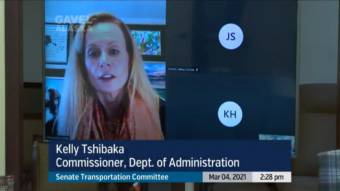
Department of Administration Commissioner Kelly Tshibaka told the Senate Transportation Committee on March 4 that private partnerships would reduce leasing and overhead expenses and also give more back to state coffers. (Screenshot by Jacob Resneck/CoastAlaska)

The state-run Division of Motor Vehicle offices in Haines, Homer, Valdez, Tok, Delta Junction and Eagle River would be eliminated under a plan presented Thursday by Department of Administration Commissioner Kelly Tshibaka.
We’re all in this really challenging time of having to span a $2 billion budget gap,” Tshibaka told members of the Senate Transportation Committee. “And so this is a creative proposal from our department to try to do that without significantly changing services to Alaskans.”

The agency pledged to avoid layoffs, and Tshibaka said the state would still collect its normal fees but allow a private vendor to charge extra.

“They offer the DMV services but they offer a service charge on top of them,” she said. “That’s how they stay in business as a private business.”

But members of the Senate Transportation Committee had a lot of questions on how that would work in practice — even those who campaigned on cutting the state budget.

Fairbanks Republican Sen. Robert Myers — the committee’s chair — said that under the current law, professional truck drivers like him wouldn’t be able to use the private contractors.

“I have a [commercial driver’s license] and I can’t renew that online, nor can I renew it through one of the private companies such as UMV.” Myers said. “So it’s a little bit more concerning for me, personally. I know I’m not the only one.”

Tshibaka suggested the Legislature could change the law and allow more services to be offered online.

And while closing DMVs might save the state some overhead, Alaskans in those specific communities could end up paying more.

Private vendors would add their fees on top of what the state already charges, under a proposal presented March 4 to the Senate Transportation Committee. (Screenshot by Jacob Resneck/CoastAlaska)

According to examples provided to the committee, the $20 cost of renewing a driver’s license would increase to $45. The $40 cost for a REAL ID-compliant license would double to $80. A vendor would charge $10 for a practice test that’s freely given at a state-run DMV.

The closure of Tok’s DMV would mean Alaskans would need to drive 138 miles to the nearest DMV office in Glennallen. (Image from Google Maps)

Sen. Mike Shower, R-Wasilla, said he’s in favor of private partnerships that reduce state bureaucracy. But he said he’s concerned about higher costs for Alaskans.

That is some fairly significant cost increases over what they pay for a state-run service,” Shower said.

Sen. Jesse Kiehl, D-Juneau, said he doesn’t follow the logic of rolling out public-private partnerships in relatively small communities.

“Help me understand the reasoning that we’ve gone to six in the middle, instead of the biggest cities if this is really no great inconvenience to regular Alaskans,” Kiehl said.

The commissioner replied that this modestly scaled plan had received push back which would likely be more intense if larger cities were involved.

This has been a pretty controversial proposal just in the magnitude that it is,” she said. “If you’d like us to come back and consider something larger, we’d be happy to introduce that too.”

Legislators say they’ve heard from constituents concerned that closures in their community would force them to drive more than a hundred miles to the nearest DMV. But residents of Haines won’t have that option. The closest DMV is in Juneau, which is only accessible by plane or ferry.

Tribes, fishermen criticize Alaska and British Columbia decision to end transboundary monitoring

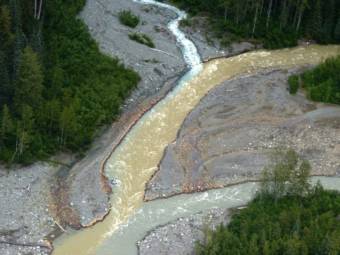
Sulphurets Creek, which drains naturally occurring rusty water from the KSM mine prospect, enters Mitchell Creek upstream from Southeast Alaska in 2014. Tribal officials worry mining will send polluted water into British Columbia rivers that flow into Alaska. (Ed Schoenfeld/CoastAlaska)

A 22-page final report released on Thursday culminates two years of data collected from water, sediment and fish tissue in three transboundary watersheds that straddle the frontier. And now, Alaska and British Columbia governments said their work is done.

“Given the existence of other sampling programs planned by state, federal or provincial agencies throughout the transboundary region, there is no need to continue the joint program,” the state and province said in a joint statement.

Congress appropriated more than $3 million for renewed stream monitoring at border stream gauges operated by the U.S. Geological Survey.

“With all the resources didn’t feel like it was necessary for multiple agencies to be collecting the same thing,” said Terri Lomax, a program manager with the state Department of Environmental Conservation.

She’s been part of the cross-border effort ever since Gov. Bill Walker signed a landmark agreement in 2015 with B.C. to set up joint water quality monitoring for a shared watershed. It hosts a booming Canadian mining sector upstream and drains into Southeast Alaska waters downstream.

“We’ve developed a lot of partnerships and a lot of relationships over the last couple of years,” she said. “We didn’t have these relationships with British Columbia.”

Provincial officials agree the program has run its course. Greg Tamblyn works in the regional water quality section at B.C.’s Ministry of Environment and Climate Change.

“Because of these established sampling programs in the region, continuation of the joint sampling program would really be redundant,” he said.

Transboundary watersheds as critical salmon habitat

But not everyone is convinced. Those who pushed for monitoring in the first place said they feel the state and province are letting themselves off the hook.

United Fishermen of Alaska said the state isn’t taking its responsibility seriously. The Taku and Stikine are significant salmon-producing rivers that have struggled in recent years. The fisheries are a key subsistence food source for Southeast Alaskans. And they generate significant economic value for commercial and charter fleets which have struggled in recent years.

“We have made every attempt possible to engage the State of Alaska on this issue, and the fact that they arrived at these premature conclusions is a disservice to Alaskans and the fishing communities of Southeast Alaska,” UFA’s Executive Director Frances Leach said in a statement Friday. “We need our federal delegation to elevate this issue to the highest levels.”

The final report said that two years of data found water quality standards weren’t exceeded on Alaska’s side of the border. There were times when certain heavy metals were over limits in sediment, but the report noted there are a lot of natural occurring minerals in the region.

Scientists who study these watersheds said a couple of years is a blink of an eye for dynamic river systems.

“You can’t measure a given site once or twice a year for two years and claim that you know the baseline watershed health of that area,” Chris Sergeant, a freshwater ecologist University of Montana’s Flathead Lake Biological Station.

The final report noted there was little evidence of contamination and aquatic life appeared healthy. But Sergeant said many of the mines Alaskans downstream are worried about haven’t been built yet.

“We have a lot of potential mines coming down the pike that are very large projects such as KSM, or Shaft Creek or Galore Creek,” Sergeant told CoastAlaska by phone from Seattle. “And so I’m looking at like, ‘Well, do we know what these metal patterns look like right now, and these rivers, in case those big projects are built and things change?’ And I just don’t think we’re set up for success to answer that question yet.”

The stream gauges such as those on the Unuk River operated by the U.S. Geological Survey are important, Sergeant said, but they’re only on Alaska’s side of the border. They don’t gather baseline data upstream, which could be used as an early warning signal for contaminants entering the watershed.

“The salmon swim right past that border, they go way up in those streams,” he said. “And there’s a lot of other, less catastrophic contaminants that can harm fish, and we’re just not measuring those things.”

Indigenous tribes push for more monitoring

Southeast Alaska tribes spurred the Walker administration to engage B.C. over transboundary mining. They said the commitment hasn’t survived the political transition following the election of Republican Gov. Mike Dunleavy.

“You know, we need, we definitely need, water quality sampling,” said Fred Olsen Jr., executive director of the 15-tribe Southeast Alaska Indigenous Transboundary Commission. “But we need ongoing, seasonal, sustainable sampling, we don’t need a couple years of hit and miss cherry picking the data, and then saying everything’s OK.”

The joint report cited a “well-established” monitoring program to collect data in the region run by tribes, including the Central Council of the Tlingit and Haida Indian Tribes of Alaska.

The tribe released a statement the following day and said it hadn’t been involved in the joint monitoring project since 2018. It urged the state and province to continue efforts even after the release of two years of data.

Tlingit & Haida vice president Will Micklin said the state and province’s two years of sampling is far from comprehensive.

“It is one step forward, it is not the end of the journey,” Micklin said. “This should not indicate to anyone that the testing is complete and more actions need not be pursued.”

Alaska and B.C. will remain in close contact: Greg Tamblyn of the environment ministry office in Smithers, B.C. said the existing cooperation pact remains standing, even after the joint-monitoring work ends.

“So that’ll help ensure a collaboration between the two parties and the long-term protection of the transboundary waters,” he said.

The cross-border workgroup established during Gov. Walker’s administration will continue to meet twice a year.

Feds approve $50M in pandemic relief for Alaska’s fishing sector

Fishing boats wait for an opener in Chignik’s city harbor in 2019. (Photo by Alex Hager / KDLG)

Alaska’s plan to pay out nearly $50 million to the fishing industry for pandemic relief has been approved by the federal government. That’s after two major revisions and more than 200 public comments from every industry sector.

It really was a balance between getting the funds out quickly and developing a spending plan with the input of affected fishery participants,” Alaska Department of Fish and Game Deputy Commissioner Rachel Baker told CoastAlaska.

Final details were released on Thursday. Commercial applicants will need to show that the COVID-19 pandemic caused them at least a 35% loss in revenue last year. Applications will be accepted during a two-month window that opens March 1. Payments could come as early as June.

Baker says a major change to the final plan now excludes commercial permit holders who live in other Pacific states like Washington and Oregon.

Non-Alaska resident commercial harvesters who fish up here but live in a state that received a CARES Act allocation must apply to their state of residence,” she said. “They’re not eligible to apply to the state of Alaska for a funds.”

Non-resident charter guides are eligible if they have an Alaska business license.

The plan notes that the Department of Fish and Game saw a 54% reduction in non-resident sport fishing license sales last season compared to 2019 — but that this was “only one indication of impacts to the charter sector.”

The money comes from the original CARES Act that Congress passed last year. More than $17.2 million will go to commercial fishermen, about $13.3 million to sport and charter guides and around $493,000 to Alaska’s aquaculture businesses.

Another $2.4 million is reserved for rural households that had pandemic-related problems accessing subsistence fisheries, with extra available for households below the federal poverty line.

The allocation plan was developed by the state, but it’s being administered by the Pacific States Marine Fisheries Commission. NOAA Fisheries approved the plan this week.

Earlier drafts had set aside more money for the charter sector and less money for processors, and it disqualified out-of-state commercial fishermen. But hundreds of comments and push back from industry led to several revisions.

The money comes from $300 million set aside for the nationwide fishing industry announced last May. A little more than 1 percent of Alaska’s share — about $628,000 — will be paid to the Pacific States Marine Fisheries Commission, NOAA Fisheries and Alaska Department of Fish and Game to administer the program.

Applications will be accepted online from March 1 to April 30. More information on how to apply is available by calling 1-888-517-7262. Or emailing AKCares@psmfc.org.

State working to close sale of its fast ferries

FVF Fairweather
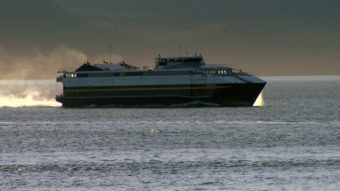
Alaska Marine Highway System’s fast ferry Fairweather. (Skip Gray/KTOO)

The Alaska Marine Highway System is working to finalize the sale of its fast ferries to an overseas bidder.

Trasmapi, a Mediterranean-based catamaran operator, offered about $4.6 million for the Fairweather and Chenega ferries. But that was less than half the $10 million reserve price set by the state.

When bids were opened on Jan. 13, a state procurement officer noted that a lower price could still be negotiated.

We do have a responsive bidder and we are continuing — as we speak today — to work through the process to close the sale, ” John Falvey, the state-run ferry system’s general manager, told the Senate Transportation Committee on Tuesday.

Trasmapi runs ferries between the Spanish mainland and the island of Ibiza. The Spanish company had also offered about $411,000 for a pair of diesel engines, which cost about $3 million new.

“The two swing engines which are in our warehouse and hermetically sealed containers, unused, they were also part of the sale,” Falvey said.

The state of Alaska commissioned the fast ferries in the mid-2000s. And they were popular, completing a voyage in about half the time as a conventional ship. But they were taken out of service in 2015 and 2019.

At the time, the marine highway cited rising fuel costs and poor performance in rough seas. It’s not clear how much the state is now asking for them. The two 235-foot catamarans cost $68 million new.

‘Frustrating’ investigation into fatal 2019 medevac crash ends with no clear answers

Sitkans held a vigil on February 19, 2019 for those lost in the crash. An event was also held in Juneau where the three crew members lived. (Photo by Katherine Rose/KCAW)

Federal aviation safety investigators have closed the book on the Guardian Flight fatal crash that killed three crew members.

The twin-engine medevac plane was en route to the Southeast village of Kake to pick up a patient the evening of Jan. 29, 2019. During its approach over Frederick Sound, the turboprop veered to the right and plummeted 2,575 feet in just 14 seconds.

A final report released Jan. 28 by the National Transportation Safety Board says there isn’t enough evidence to explain how or why.

“A loss of control for reasons that could not be determined based on the available information,” the 13-page report said.

Most of the wreckage of the King Air 200 was recovered in about 500 feet of water. The bodies of the Juneau-based crew members were never found despite extensive effort by the U.S. Coast Guard and private contractors.

This one was a little bit frustrating for us,” NTSB’s lead investigator Clint Johnson told CoastAlaska. “It’s not for the lack of trying, but unfortunately, it didn’t give us any definitive answers of exactly what happened.”

He says there was initial hope after the cockpit voice recorder was found. But a forensics lab determined the recorder hadn’t worked since 2015.

We were definitely hoping that we were going to be able to glean some information as far as what happened in those last final moments,” Johnson said on Friday. “Unfortunately, it did not help us at all.”

A radar track of the Guardian Flight and its communications with air traffic communications during its final approach clearance. (Graphic courtesy of NTSB)

All but one of the crew seats were recovered with the harnesses unbuckled. But the NTSB says that because none of the crew members were found, it couldn’t conduct autopsies or toxicology tests on any of the crew members. The pilot had cleared an FAA medical exam about four months before the crash.

The three killed were 63-year-old pilot Patrick Coyle; 43-year-old paramedic Margaret Langston and 30-year-old nurse Stacie Rae Morse. Morse was more than six months pregnant at the time.

Her fiancé, Dylan Listberger, filed a wrongful death suit against the Utah-based medevac company and plane manufacturer last month, shortly before the crash’s two-year anniversary.

But Listberger’s Juneau attorney Sheldon Winters says it’s unclear whether the civil suit will proceed.

“Mr. Listberger filed suit to preserve potential claims in light of a possible two-year statute of limitations, while we waited for the NTSB probable cause report,” Winters wrote in a statement. “We are currently evaluating the recently issued NTSB report.”

A Guardian Flight representative says it’s aware of the lawsuit — which has been moved to federal court — but had no further comment.

Site notifications
Update notification options
Subscribe to notifications