Jacob Resneck, CoastAlaska

Jacob Resneck is CoastAlaska's regional news director based in Juneau. CoastAlaska is our partner in Southeast Alaska. KTOO collaborates with partners across the state to cover important news and to share stories with our audiences.
NTSB: Cessna ran out of fuel between Ketchikan and Port Angeles in fatal crash

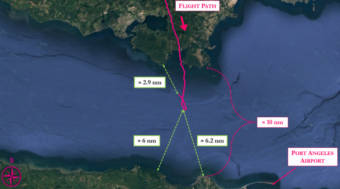
The NTSB says a review of the radar data revealed that the plan was on a southerly track, reaching the edge of the northly land mass at 4:34 p.m. local time. The radar hits continued south at an altitude of about 1,200 ft. About four minutes later, the plane reversed course and heading north-northeast. (Image courtesy of NTSB)

The Kodiak man killed while trying to pilot his small plane from Ketchikan to the Lower 48 apparently ran out of fuel a few miles from an airport. That’s according to federal aviation investigators who on Thursday released preliminary findings of the fatal January 26 crash near Port Angeles, Washington.

Authorities haven’t named the pilot of the Cessna 170A. But the aircraft’s registration and family speaking to the Kodiak Daily Mirror identified the plane’s owner and pilot as 38-year-old Sean M. Hayes of Kodiak.

The National Transportation Safety Board says the pilot had taken off from Kodiak the day before and had stopped in Ketchikan to refuel.

It says he’d sent multiple text messages to his mother indicating strong headwinds and dense cloud cover over the Inside Passage. Those were slowing his progress, and he was worried that the plane did not have enough fuel.

“The pilot stated that his estimated time of arrival kept changing on his GPS because of the fluctuating wind, turbulence and cloud avoidance,” the four-page report said.

The report says the pilot reversed course and started to slowly descend around 1,200 feet. He broadcast a mayday call around 4:40 p.m., saying he was “ditching” the aircraft and could see a boat towing a barge. The NTSB says he’d texted a photo to his mother of the area which radar records indicated was less than three miles from the closest land.

Coast Guard vessels from the U.S. and Canada used infrared cameras and radar to search for the lost plane over two days. By the end, searchers had scoured nearly 1,200 square miles before calling off their effort without finding the plane.

The NTSB says the pilot’s intended destination was Lake Havasu, Arizona.

Dunleavy taps real estate executive for fisheries commission

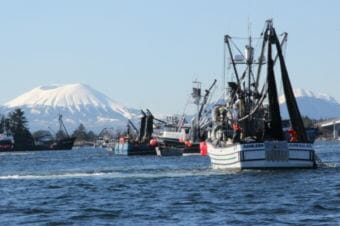
Purse seiners fish a commercial herring opening in Sitka Sound in 2014. (Photo by Rachel Waldholz/KCAW)

The Commercial Fisheries Entry Commission is obscure to many Alaskans. But for those whose livelihoods are tied to fish, it’s a household name.

The agency was created in the 1970s after Alaska voters amended the state constitution to allow limits on the number of people allowed to fish — all for the sake of conservation. Fishermen had to show a history of their catch in a particular area to get rights to fish.

“The commission spent many, many years going through those applications, sorting through the permits,” said Juneau attorney and former lobbyist Vance Fate Putman, who former Gov. Bill Walker appointed to the two-person commission in 2017.

Vance Fate Putman was appointed by Gov. Walker to service on the Commercial Fisheries Entry Commission in 2017. The attorney and former lobbyist’s term expires in March 2021. (File photo from Governor’s Office)

That work of documenting who did and didn’t get fishing rights took decades, but it’s finally done. Over the past few years, the commission has resolved all but one dispute: an excess of eligible permit holders for a single shrimp pot fishery in Southeast.

The commission hasn’t created a new limited entry fishery since 2004. But Putman says there’s still work to be done: namely facing what he calls “the optimal number question.” And that’s because the number of permits was largely based on historic participation.

But that isn’t necessarily the optimum number,” Putman said. “That’s the maximum number. The optimum number may be lower or higher than that.”

His term expires in March. And so his successor Melvin Smith will likely take up that question. Until recently Smith worked for the Anchorage real estate office of a regional Native corporation.

He’s a low-key appointment — industry representatives say they don’t know him. He didn’t respond to requests for comments sent through the governor’s advisors.

Records show Smith has lived in False Pass, Wasilla and most recently Anchorage. His most recent commercial fishing permit was active in 2004. He’s also held permits for land-based set nets in the Alaska Peninsula, purse seining and some longlining. His work email at Aleut Corporation bounced back saying he’d left the Native corporation last Friday.

The Governor’s office didn’t announce the appointment. Nor was the vacancy advertised. His name only surfaced after it was transmitted on February 3 to the state Senate for consideration. Appointments to the commission require a confirmation vote by lawmakers.
Asked about his qualifications, the governor’s spokesman released a one-sentence statement.

“Gov. Dunleavy selected Mr. Smith because he believes he is the best candidate for the seat on the CFEC,” wrote spokesman Jeff Turner in an email.

Fish politicos like former fisheries lobbyist Bob Thorstenson say it’s longtime practice for someone close or loyal to the governor’s inner circle to be tapped for the commissioner jobs, which come with six-figure salaries.

“Whoever gets that job is usually a pretty good friend of the governor’s people,” Thorstenson told CoastAlaska. “Because it’s a choice job.”

Thorstenson agrees with Putman that the commission’s next task is to right-size the number of permits in limited entry fisheries. And create new ones.

“There’s going to be a lot of buybacks and a lot of different types of moves,” Thorstenson said. “And there’s moves that need to be made for commercial fisheries.”

CFEC has been under pressure since a scathing 2015 audit that found inefficiencies, and Thorstenson says he takes exception to critics who argue that the commission has worked itself out of a job.

“Those people just don’t have a lot of breadth or vision or depth,” he said, “because CFEC’s job is far from done.”

Lawmakers proposed a bill in 2015 to merge the commission into the Department of Fish and Game. An executive compromise reduced the number of commissioners and cut salaries.

Melvin Smith may be unknown in fishing circles. But industry figures will soon be putting a face to the name. He’ll be addressing the United Fishermen of Alaska during this week’s annual meeting.

8 months later, family of Kodiak man killed at naval base is still seeking answers

Jayson Vinberg with his wife Becky and sons Eaen and Duncan in September 2018. (Photo by Tony Furio)

Kodiak resident Jayson Vinberg was fatally shot last summer by a naval special forces guard at the Naval Special Warfare Detachment Kodiak. It’s known locally as the “SEAL base” because it trains the U.S. Navy’s elite commandos.

The facility is at the end of a wooded peninsula just outside of town. In the 1990s, before the facility was gated off, local kids used to ride their bikes there to buy sodas from the base’s vending machine.

“That’s before it became top secret,” said Tony Furio, Vinberg’s father.

Vinberg, 30, entered the base after 10 p.m. on June 30, 2020. His family says they still don’t know why he went there.

All that’s officially known comes from two short statements — one from the military and one from the state. The statement from the military says Vinberg tried to enter one of the compound buildings before he was confronted by a naval special forces member and “events led to the service member using deadly force.”

Alaska State Troopers offered a few more details. They said Vinberg had been tapping on the building’s windows with a knife. His stepmother, Esther Furio, says troopers told them their son had challenged the guard before he was fatally shot.

“That’s kind of the short version, but it is all on film,” she said.

Nobody from the family has seen the video — if it exists. The Naval Criminal Investigative Service is leading the investigation and won’t comment until it’s completed. A spokesperson says its findings could be released under the Freedom of Information Act.

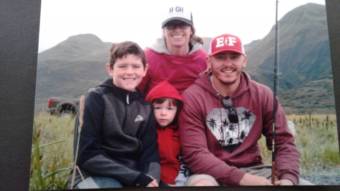
Jayson Vinberg on a fishing trip on Kodiak Island in 2018. (Photo by Tony Furio)

Family members say they’re confused by what they’ve been told. Vinberg spent much of that day painting his aunt’s deck and nobody knows why he would have been prowling around with a knife about an hour before sundown.

“He was very non-violent,” his stepmother said. “He’s never been aggressive or anything like that. It just totally sounds out of character for Jayson.”

The family says they never received any of his personal effects — including the knife he reportedly brandished.

Esther Furio says he wasn’t carrying a wallet or any identification. They learned of his death nearly 24 hours later. The call came from Vinberg’s wife in Utah, mother of his two sons — who were 5 and 11 at the time.

“He has his son’s name tattooed on his forearm, and that’s how they finally identified him,” she said.

Vinberg’s death certificate says he was shot an unspecified number of times in the arms and torso. That piece of paper, along with their son’s cremated remains, are the only things the family has received. The state medical examiner’s report, which includes details from the autopsy, remains sealed pending the outcome of the investigation.

Vinberg’s next of kin is his wife of 12 years. Through the family, she declined to speak about her husband’s death.

His stepmother recalls that when naval investigators visited Kodiak, they asked questions about a possible a motive for their son’s trespassing. They asked if their son had problems with the military or authority in general.

“And I said, ‘No, I have a son that’s in the Army. Tony was a Marine, he’s never had any issues with authority or anything like that,’” she said. “We’re very supportive of the military.”

Like many long-time Kodiak residents, Esther Furio has fond memories of the now sealed-off area. Kodiak Island has a lot of steep cliffs. But Spruce Cape has easy access to the water. She was a grade school teacher in Kodiak for 27 years and used to take classes there to go tide pooling. But after 9/11 it was fortified and made off-limits to civilians. The school field trips ceased.

His father says he wonders whether his son’s Alaska Native appearance could’ve been a factor in the guard’s decision to open fire. Jayson Vinberg’s mother is Alutiiq.

“He’s Native, he has curly hair and stuff,” he said. “He looked like a minority.”

It’s hard to answer the broader question of whether Vinberg’s Native appearance played a role.

University of Alaska Anchorage criminologist Troy Payne told CoastAlaska that “Alaska Natives are generally over-represented in all stages of the criminal justice system, including victimization.”

That means Alaska Natives are disproportionately killed by law enforcement.

The state university’s Alaska Justice Information Center is studying lethal force used by police in Alaska. He says its report would be published later this year.

“I think that Jayson’s family is asking fair questions about how their son was killed, why deadly force was used,” said Alex Cleghorn, legal and policy director of the Alaska Native Justice Center in Anchorage.

Cleghorn has cultural ties to Kodiak and was asked by the family to look into the case. He says the fact that the shooting occurred on a federal military base may be slowing things down.

“I think that what is challenging is how long it takes for families to get answers,” Cleghorn added.

A cursory look into Jayson Vinberg’s past shows some small stuff from his teens. But it’s kid stuff: driving off the road, a count for underaged drinking, buying tobacco. His father says his son spent a year at McLaughlin Youth Center, a state facility for at-risk youth in Anchorage. And the young man had bouts of drug addiction. In his 20s, Vinberg was arrested for property crimes in Utah.

“Everybody has their struggles, and we’re not saying our son is perfect,” his stepmother said.

But she and her husband say nothing in his past pointed to violence or threats. He was a devoted husband and father who she said hoped to bring his family to live on Kodiak Island.

“He loved the ocean, that’s one of the reasons he wanted to come back and just to have that feeling around him,” she said.

Jayson Vinberg with his father and stepmother Tony and Esther Furio in 2018. (Photo courtesy of Furio family)

The family is willing to accept the truth — however unpleasant. But they want to know what happened that night.

“We’ve always said that the truth will set you free,” she said. “We have prayed that at one time, the truth about what really happened to Jayson will come out — there’s so many questions.”

CoastAlaska contacted the federal prosecutors with a list of questions. Later that same afternoon, Tony and Esther Furio got a phone call from the U.S. Attorney’s office in Anchorage. The family says that federal prosecutors want to meet early next month to discuss the case. They’re tentatively set to sit down inside the Kodiak police station.

The U.S. Attorney’s Office declined to comment.

Emergency VHF radio channel unreliable across Southeast Alaska, Coast Guard says

A map showing VHF signal coverage areas in Southeast Alaska.
U.S. Coast Guard Sector Juneau operates a system of VHF relays designed to ensure distress calls over Channel 16 are heard by watchstanders. (Graphic by U.S. Coast Guard District 17)

A network failure on Monday evening has rendered the Coast Guard’s emergency VHF radio channel unreliable across much of Southeast Alaska.

Coast Guard Commander Lyle Kessler said mariners calling on Channel 16 may have trouble getting through to watchstanders. That’s because the region’s VHF repeaters are either inoperable or are unreliable due to a network failure in a swathe from Yakutat to south of Ketchikan.

The Coast Guard operates a system of VHF repeaters that allow radio broadcasts to be relayed across Southeast Alaska’s narrow inlets and around tall peaks.

“If the tower’s down and you try to call us on [Channel] 16 it makes the tower not relay the message back to us,” Commander Lyle Kessler, a Coast Guard spokesman in Juneau, told CoastAlaska.

Several VHF repeaters have been down for more than a year. But the situation had been improving after a new contractor was hired to service the system.

But a new issue with AT&T’s microwave network developed this week. Kessler said even VHF towers that are functioning are only broadcasting intermittently.

“They’ll go down for anywhere from a few seconds to a few minutes, then come back up,” Kessler said. “And then we also have the towers that have been down for some time due to the previous issues.”

The Coast Guard is advising mariners to carry an alternative means for sending distress calls. That ranges from an Emergency Position Indicating Radio Beacon, satellite phone or even a conventional cell phone.

As of Wednesday, Kessler said nine VHF repeaters — Althorp, Cape Fanshaw, Duke, Gravina, Mt. Robert Barron, Mud Bay, Mt. Ripinski, Yakutat and Zarembo — are working only intermittently due to the microwave interference issue.

VHF towers on Deception Hills, Mt. McArthur and Duffield are already down and awaiting parts from the contractor. A VHF tower on Sukkwan Island is also not broadcasting and bad weather has kept contractors from investigating the cause.

Those on the water are asked to monitor Channel 16 and relay any unanswered calls for assistance to the Coast Guard. Sector Juneau command center’s number is 907-463-2980.

Alaska tribes apply for broadband licenses to improve internet access

A new plan will extend high-speed broadband and cell service in rural areas. (Photo by Ed Schoenfeld)

Alaska Native tribes are awaiting word on scores of wireless broadband licenses offered at no charge by the Federal Communications Commission. It’s part of a federal push to improve internet access in traditionally underserved communities.

A startup called Alaska Tribal Spectrum received a $100,000 grant from the Denali Commission to register as many Alaska Native tribes during the final months of last year’s application period. The initiative has signed up nearly 70 tribes.
“We created a website and an application process to make it very, very simple to join a consortium application and get as many people, as many tribes to grab a hold of for this free asset before, before the window closed,” said Jim Berlin who heads the Kenai-based nonprofit.

Because when it does close, any unclaimed broadband licenses will go to auction to private carriers. Berlin said it was a big push to get rural tribes with poor internet to enroll on their website. Some faxed applications, others mailed in handwritten submissions.

And the struggles they had were some of the craziest stories you’d ever want to hear,” he said. “I mean, it’s so challenging for them to do even a simple email, let alone fill out something online.”

Douglas Indian Association was among the tribes that said it was welcomed the help negotiating the FCC application process.

We had no clue,” said DIA’s Environmental & Transportation Director Kamal Lindoff. “No clue on how we would manage it or even get started.”

Some of the applications already overlap. The Douglas tribe’s application is for coverage in an area also claimed by Central Council of Tlingit & Haida Indian Tribes of Alaska. That’s a Juneau-based regional tribal government working to improve broadband across Southeast Alaska.

Individual tribes are now negotiating overlapping claims. Once that process is complete and the FCC issues licenses for 4G wireless networks, tribes will be able to offer the so-called “last mile” to improve internet connectivity in their traditional homelands.

Tribes will still need to pay for the infrastructure to extend broadband internet into their license area. The CARES Act created a $1 billion broadband fund that tribes can apply to for that.

If any members of the consortium have second thoughts, the agreement allows tribes to part ways and still retain the rights to their FCC broadband license.

“You can take your ball and go home whenever you want,” Berlin said.

Alaska Tribal Spectrum has applied separately for a federal Community Connect Grant to bring broadband service to five villages in the Bristol Bay region.

Bomb scare in Juneau postpones state ferry sailing to Pelican

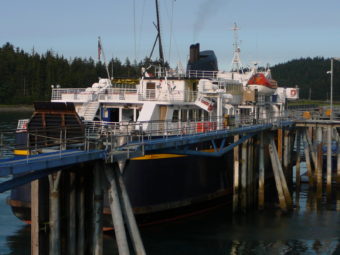
The ferry LeConte docks at Juneau’s Auke Bay terminal. (Photo by Ed Schoenfeld/CoastAlaska News)

An Alaska ferry in Juneau was evacuated early Wednesday after a man drove aboard the vessel claiming he had a bomb.

The LeConte was loading around 6:15 a.m. at the Auke Bay terminal for a round-trip sailing to Pelican. That’s when a man drove around the line of cars and boarded the vessel and told crew members he was armed and mentioned a bomb.

“The truck bypassed the purser without checking in and at high speeds, nearly colliding with another vehicle and container,” the state Department of Transportation said in a statement. It added the man began “muttering about bombs and firearms” while trying to climb back into his truck that he had seemingly locked.

“The comment was not a direct threat, nor did the man say he had a bomb, but it created a lot of concern with everyone on the vessel,” the Juneau Police Department said in a statement. “The man then stated that if the ferry employees didn’t back away, he would pull a gun on them. The man then reached into his jacket as though to grab a firearm.”

Coast Guard Lt. Chad Coppin said a 45-foot rescue boat was dispatched to set up a thousand-yard perimeter around the ferry as a precaution. But he said Juneau police searched the vehicle and arrested the man.

“It was a security breach — he shouldn’t have been on the vessel,” Coppin said. “JPD was notified and they came and dealt with it … I believe their bomb squad whoever that was came out and took a look. Our Coast Guard members actually swept the vessel and found no further credible threat. And so they secured the rest of the vessel.”

Juneau police said no bomb was found and the man claimed the whole thing had been a joke. He was identified as 39-year-old Adam Jason Bahr of Juneau. Court records show he faces a single misdemeanor charge of allegedly making threats.

The Alaska Department of Transportation said there were less than 10 ticketed passengers on board at the time. The LeConte’s sailing to Pelican — a village of less than 100 people on Chichagof — was canceled. It’s now scheduled to depart on Saturday, Feb. 13.

Editor’s note: This story has been updated with more information. The headline has been updated to clarify the sailing from Juneau to Pelican has been postponed.

Site notifications
Update notification options
Subscribe to notifications