Jacob Resneck, CoastAlaska

Jacob Resneck is CoastAlaska's regional news director based in Juneau. CoastAlaska is our partner in Southeast Alaska. KTOO collaborates with partners across the state to cover important news and to share stories with our audiences.

A journalist live-tweeted a legislator’s false statements about the vaccine. Twitter suspended him.

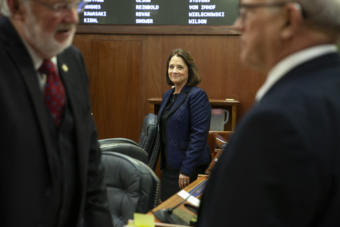
Sen. Lora Reinbold, R-Eagle River, smiles before taking her seat on the Senate floor on Tuesday, Jan. 21, 2020 in Juneau. (Photo by Rashah McChesney/KTOO)

Alaska journalist Matt Buxton has covered state politics for nearly a decade. Five years as a newspaper reporter in Fairbanks. And more recently as the editor of The Midnight Sun, a left-leaning political blog that covers the Alaska state legislature on Twitter.

“I am kind of a prolific live-tweeter, I cover meetings in as much detail as I can,” he said Friday from his home office in Anchorage. “And so, during this hearing, I thought some very interesting stuff was that Sen. Lora Reinbold from Eagle River was asking about hydroxychloroquine and sort of other debunked things.”

She was quizzing Department of Health and Social Services Commissioner Adam Crum on the availability of ivermectin, hydroxychloroquine, Vitamin D and zinc to treat COVID-19.

It’s important to note here that the National Institute of Health “recommends against the use of ivermectin for the treatment of COVID-19, except in a clinical trial.” The same goes for hydroxychloroquine — an anti-malarial drug touted last year by President Trump as a treatment for the coronavirus.

“And so towards the end of the meeting, she’s talking about how it’s important because the vaccine is causing deaths and paralysis and people are dying,” Buxton said.

It was among a number of points she was insistent be read into the record while the committee chair, Sen. David Wilson (R-Wasilla) tried to hurry things along.

“There could be people dying, paralyzed — deaths,” Reinbold told the committee.

After that exchange Buxton tweeted: “(Sen. David) Wilson is trying to cut her off but not before Reinbold can throw in something about people being paralyzed by the vaccine.”

And that was flagged as as vaccine disinformation, Buxton said.

He didn’t know about that right away. In fact, he spent the rest of the afternoon using Twitter normally. But he later found an email from Twitter that had come in just after midnight saying his account had been suspended. He appealed early that morning.

“I wrote in, ‘Look, I’m a reporter, and was reporting on what a state senator was saying, I think this is pretty relevant…’ And my appeal was denied right away.”

He deleted the tweet which started his 12-hour suspension, which expires shortly after 6 p.m. Thursday.

Reporter silenced as lawmaker doubles down

But while Buxton sat in Twitter jail, Reinbold used another senate committee hearing to raise questions about the safety of COVID-19 vaccines.

“I am not an anti vaxxer,” she said on Thursday afternoon. “But I’m concerned about this new type of vaccine that is out there that they are only strictly under emergency use authorization. So I have the constitutional responsibility to help, as all of us senators do for the health and public health of the Alaskans.”

Then she pressed Alaska’s Chief Medical Officer Dr. Anne Zink about now-debunked rumors that Alaskans had died from the COVID-19 vaccine.

“There are no deaths associated with the COVID-19 vaccine, Moderna or Pfizer, in the United States,” Zink told the committee.

“Wow, that that that is amazing, because I’m certainly following COVID reactions online,” Reinbold replied. “And I tell you, I think that definitely contradicts things that I’ve definitely been following online.”

Buxton says he’d like to know what got him in trouble with the social media platform. Was it artificial intelligence? Were there complaints directed at his tweets? He’s not sure, and Twitter isn’t saying.

But in the meantime, he’s more concerned about misinformation going unchallenged. He cites the Anchorage Daily News article debunking misinformation about how five people were killed by the vaccine that was published as he was sitting out his Twitter suspension.

“This is a thing that is going on,” Buxton said. “We need to really meet it headfirst and I think it’s important to call out elected officials when they are spreading clearly dangerous information.”

Twitter’s mea culpa

Twitter said late Friday that the company had erred in suspending Buxton’s account.

“We made a mistake with this enforcement action,” a spokesperson wrote in a one-sentence statement.

The representative added the company would follow up with more information.

By then Buxton was already back at it, live-tweeting a Senate Judiciary Committee meeting chaired by Sen. Lora Reinbold. But he says the experience has had a chilling effect. He’s being extra careful how he frames his tweets.

Reinbold’s office didn’t respond to requests for comment.

Correction: A previous version of this story misspelled Sen. Reinbold’s first name.

Alaska’s regional subsistence councils hamstrung by stalled appointments

Two caribou hides hanging on a rack behind a house on the east side of Shishmaref (Zachariah Hughes/Alaska Public Media)

A large number of unfilled seats on the councils that manage Alaska’s subsistence hunting and fishing has left advocates worried their voices won’t be heard and confused about the process of filling those seats.
The decisions for opening and closing hunting grounds and setting harvest limits are decided by the more than 100 Alaskans who sit on 10 regional advisory councils that inform the Federal Subsistence Board.

“They’re the ones that are on the ground and making these observations based upon a lifetime of experience,” said Jim Fall, who until recently was the state’s head of subsistence research.

He recently retired from the Alaska Department of Fish & Game after 39 years of service. And he’s been to a lot of these council meetings where a wide-ranging group from across a region have frank and full discussions about the state of wildlife populations, fish stocks and observations about what’s happening in their communities.

“The broader representation you have at a regional council, the better those ideas are,” Fall said.

But this year there are going to be fewer voices at the table. That’s because more than half of the seats are now unfilled.

It’s not due to a lack of interest. The federal Office of Subsistence Management said it dutifully forwarded enough names last fall to the U.S. Secretary of the Interior.

“We still have 35 open seats on all RACs, which means that 56% of 2020 open seats were not filled,” wrote Office of Subsistence Management Acting Policy Coordinator Katya Wessels in a recent briefing to the Federal Subsistence Board. “Some RACs now have as many as eight open seats.”

The Southeast Regional Advisory Council has eight vacancies ahead of its meeting on March 16-18.

Many of those whose appointments were stalled are long-serving members.

Until the end of last year, Don Hernandez has chaired the Southeast Regional Advisory Council. His reappointment has been inexplicably held up and he’s gotten no explanation.

“Either they’re not telling us or they don’t know,” Hernandez said from his home in Point Baker on the northern tip of Prince of Wales Island. “So we don’t even know who to call.”

That leaves the Southeast’s 13-seat regional advisory council with five members.

“That’s just not a real good representation for all of the different issues that we have here in Southeast Alaska,” he said. “So it’s going to be really tough to get anything done at this next meeting, I’m afraid.”

It’s not just Southeast that’s struggling to fill seats. The Western Interior regional council stretches across a large chunk of landlocked territory from Aniak on the Kuskokwim River to the Brooks Range.

“It’s a huge area, it’s like multiple states,” said Jack Reakoff, who lives in remote Wiseman, a former mining camp roughly halfway between Fairbanks and Prudhoe Bay. He was on the board from its inception in 1993. But not anymore; his reappointment was inexplicably held up on the eve of the spring meeting later this month.

“They’re going to be completely overwhelmed for this meeting,” he said.

It’s not clear who or what is responsible for the breakdown in appointments. A Trump administration executive order signed in mid-2019 directed federal agencies to reduce or eliminate advisory boards considered obsolete, duplicative or expensive.

But what is clear is that the Trump administration’s Interior Secretary chose not to fill 35 seats late last year. The recent change in presidential administrations has added yet another layer of uncertainty with people in the federal agencies scrambling for answers.

The Interior Department headquarters in Washington D.C. declined to comment.

The Office of Subsistence Management is soliciting nominations now, but it’s a year-long process. And applicants who file by the February 15 deadline likely won’t be seated until 2022.

There have long been tensions between the rights of rural subsistence hunters and the state over priority for rural subsistence users. Some of those conflicts have recently wound up in court.

Reakoff said there are political actors who have long been hostile to subsistence rights that would cheer the dismantling of the regional advisory councils.

“Rural subsistence priorities have never been palatable to the state of Alaska,” he said.

Rick Green, an assistant in the Alaska Department of Fish & Game Commissioner’s Office, said the state is neutral on the stalled nomination process.

“That is their process to carry out,” Green wrote in a statement to CoastAlaska. “As for their public meetings, yes, there is value to state managers as they bring parties interested in conservation of our resources together for public comments and suggestions and any group that brings the public together for the shared goal of conservation of our trust properties is useful.”

Subsistence priorities are enshrined by the Alaska National Interest Lands Conservation Act. The landmark legislation signed into law by President Jimmy Carter in 1980 expanded national parks and monuments in Alaska but also guaranteed Alaskans have some decision making authority over subsistence rights on federal lands.

“The regional advisory councils are kind of the linchpin of the whole system,” Hernandez said. “Having good functioning, well-qualified advisory councils is the key to make the whole subsistence system work in Alaska.”

But whether the lack of appointments is due to bureaucratic inefficiencies or political wrangling, the outcome will be the same — less input on federal wildlife management decisions by the people whose lifestyle and livelihood depend on it.

Prices expected to rise for Alaskans as barge rates increase

Alaska Marine Lines containers wait for loading on Yakutat’s dock in 2013. AML is part of Lynden Inc. (Ed Schoenfeld/CoastAlaska)

Alaska’s largest barge operator raised prices at the end of January. Economists say it could lead to higher prices for groceries and other local consumer goods next year.
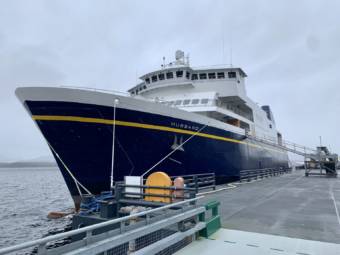
Alaska Marine Lines, a subsidiary of global shipping giant Lynden, announced in November that prices would rise 5% on all its routes including Southeast Alaska, the Aleutian Islands and Prince William Sound.

“This increase will become effective on January 31, 2021,” wrote AML pricing director Margretta Grace in a notice to customers.

The McDowell Group studied the economic impact of freight costs to Juneau in 2017. A portion of increased shipping costs is absorbed by wholesalers, but they often translate into higher retail prices especially in coastal communities.

“More than 95% of all the freight that moves into Southeast Alaska communities is on a barge,” said Jim Calvin, senior vice president of McKinley Research Group, the McDowell Group’s successor. “So, the cost of moving that material is certainly important to the prices that businesses pay, and ultimately the prices that consumers pay for the products that they purchase.”

Samson Tug & Barge in Sitka also serves Southeast Alaska. Its published rates expired in late January, too.

In November, Vice President Cory Baggen said Samson was also in the process of reviewing its general rates.

“We should be making an announcement soon,” she wrote by email.

In Alaska, freight prices are overseen by the federal Surface Transportation Board. But the board doesn’t directly regulate how much shippers charge: It only reviews the reasonableness of rates if a consumer files a formal complaint.

Representatives from AML’s parent company Lynden in Seattle didn’t return calls or messages.

This story was originally published on November 20, 2020.

Alaska Marine Highway proposes lean summer schedule; new ferries to stay tied to the dock

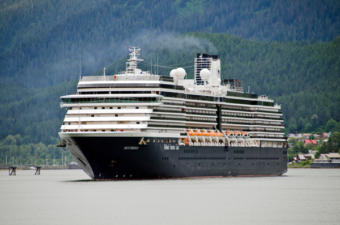
The 280-foot Hubbard is an Alaska Class Ferry tied up in Ketchikan on January 29, 2021. It was built for $60 million by Vigor Alaska and completed last year. It and its sister ship recently received new side doors at a cost of about $4.4 million. It has not been put into service. (Photo by Eric Stone/KRBD)

Summer is peak time for the Alaska Marine Highway System, and the proposed five-month summer schedule just came out. Many communities will get only limited service and coastal lawmakers aren’t happy.

“We need to get more ships in the water,” said Sen. Bert Stedman (R-Sitka). He’s concerned about long gaps despite lawmakers’ efforts to fully fund the marine highway system.
Stedman co-chairs the powerful Senate Finance Committee. Last year he worked with coastal allies in the state House of Representative to funnel more money into the ferries. But much of the extra funding was vetoed by Gov. Mike Dunleavy.

The schedule also leaves no slack in the system if and when one of the aging ferries breaks down.

“With all the deferred maintenance that has been going on over the years, it would be good to have a vessel on just for backup,” said Earling Walli, a former ferry boatswain and now regional head of the Inlandboatmen’s Union, the largest of the three ferry unions.

Veteran ferry crew members have made similar warnings in years past. When the Matanuska ferry broke down a year ago, there was no immediate replacement. That effectively shut down the marine highway’s regional service for more than two months.

That’s not to say the state isn’t spending money on upgrading its ships.

The Department of Transportation confirmed to CoastAlaska that it recently spent about $4.4 million to have side doors installed on the two Alaska Class Ferries.

“The total cost for both vessels’ doors, including installation, is $4,440,906,” the state agency wrote in a statement in response to CoastAlaska’s questions. “The doors and the installation contract are funded entirely by state dollars.”

The work was done at the Vigor Alaska shipyard in Ketchikan. That’s the same facility that built the two ships for $120 million in a sole-source contract using state money.

The Tazlina entered service in 2019 and did a few runs last year. But since then, it has been almost completely idle. And its sister ship Hubbard hasn’t spent a day in service. Both are slated to remain tied up in Ketchikan despite the recent upgrades.

So why are the two newest boats in the fleet staying tied up while the ferry puts out fewer and fewer sailings on its older vessels?

For one, DOT says the Alaska Class Ferries aren’t suitable to the fleet’s immediate needs. They were built as day boats, so they don’t have crew quarters, and that means they can’t run for more than 12 hours at a time.

They were designed to complement the Juneau Access Project, which would’ve extended the capital city’s road system nearly 50 miles north and shorten the ferry ride to Haines and Skagway.

“And of course, that road and that construction never happened and so therefore, those vessels are pretty much non-usable,” Rep. Dan Ortiz (I-Ketchikan) said in an interview.

And those new side doors? Well, that would allow them to tie up in communities with smaller docks, if they had the range to get there.

The legislature added funding for crew quarters, but that was part of the ferry package that was mostly erased by Dunleavy’s vetoes.

And there are two other modern ferries that have been tied up — a pair of catamarans, Fairweather and Chenega, that the state is trying to sell.

But at a recent auction they received one low-ball bid that was less than half the minimum price.

Meanwhile, Stedman says the state is paying a lot of money to moor mothballed ships.

“We need to cut some of our losses,” he said. “If we’re not going to sail those ships ever again, we need to get rid of them.”

In the meantime, Southeast Alaska and Prince William Sound communities will be mostly served by ships built in the 1970s. And the monthly Aleutian run will be done by the Tustumena, which entered service five years before Neil Armstrong walked on the moon.

“We need to get a replacement plan for these ships,” Stedman said. “And we need to get them funded.”

There’s no long range plan or state savings to replace the aging fleet.

“There’s nothing and that is alarming,” Stedman added.

A lot of these issues were addressed in last year’s marine highway report that was commissioned by the governor.

Stedman served on that working group and says its recommendations will be presented in detail to the legislature.

“I think this winter is going to be very telling if we can make some forward progress and trying to stabilize the marine highway,” he said. “In my opinion, right now, it’s still going backwards a little bit. I am concerned about the schedule that’s been presented for consideration by the public I hope the public encouraging the call in.”

He’s referring to an upcoming February 8 public hearing.

Already some communities have concerns. Kake, a village on Kupreanof Island, recently learned that it isn’t on the skeletal summer schedule at all.

“For some reason, we’re the black sheep of Southeast, I guess,” said Joel Jackson, president of Kake’s tribal government.

He says the village of 500 people was off the schedule last summer too. “We don’t very much appreciate it,” he added.

In a follow up email, a state transportation spokesman says Kake’s lack of ferry service was an oversight. It would be getting two ferries a month after all.

Proposed Vessel Deployment (May 1-September 30):

  • Kennicott to operate Bellingham/Juneau cross the Gulf to Southwest, twice per month.
  • Matanuska to operate on the Wednesday Bellingham Route.
  • LeConte to sail Northern Panhandle.
  • Lituya to sail 5 days per week between Annette Bay and Ketchikan
  • Tustumena to sail the Southwest Route with one Aleutian chain trip per month.
  • Aurora to sail Prince William Sound.

The state Department of Transportation is hearing public testimony on the draft summer schedule on Monday, February 8. Southeast communities will be heard from 10 a.m. And Southwest communities — including Kodiak Island and the Aleutians — will be heard at 1:30 p.m. Written comments can be emailed to dot.amhs.comments@alaska.gov through February 7.

State proposes early-season cruise ship inspections to replace Ocean Ranger program

The Holland America Cruise Ship Westerdam prepares to dock in Juneau July 16, 2012. The ship was fined $250 by the National Park Service for illegally discharging grey water last year in Glacier Bay National Park. (Photo by Heather Bryant/KTOO)

The state Department of Environmental Conservation is looking to hire environmental monitors to inspect cruise ships over a six-week period in May and June. It comes via a recent contract proposal to field marine engineers on commercial passenger vessels during the early part of the cruise season.

“We’re going to get onboard 100% of the cruise vessels that are coming in the state,” DEC water division director Randy Bates told CoastAlaska on Tuesday.

The proposal would include the megaships with thousands of passengers and crew. But unlike the Ocean Ranger program, it would also cover smaller, high-end 60-person cruises operated by boutique lines like National Geographic Expeditions and UnCruise.

“DEC is committed to environmental oversight of cruise ships, and we expect the cruise ships to comply with our existing laws while they’re in Alaska waters,” Bates said.

The agency is offering up to $400,000 annually for marine engineers to inspect 30 to 40 ships. The money would come from a head tax paid by cruise ship passengers.

But it’s a fraction of the $3.4 million Ocean Ranger program that was funded out of that same head tax money. That program had marine engineers on more than half of all voyages by large cruise ships.

Gov. Mike Dunleavy has twice defunded the Ocean Rangers through line item vetoes over the objections of state lawmakers. His administration’s legislative proposal to repeal and replace the program has stalled in the legislature.

Rep. Zack Fields (D-Anchorage) says blocking that program goes against the will of voters who approved the Ocean Rangers program in 2006.

“What I’ve heard is very strong support for the Ocean Ranger program, both from the public and for members of the legislature,” Fields said Tuesday. “Because the cruise industry is an important part of our economy. And it’s important that the public have confidence that there aren’t going to be illegal discharges.”

Fields says lawmakers support modernizing the Ocean Rangers program but want to see widespread coverage on large ships.

“We were actually working on legislation to update the Ocean Ranger program to include the capacity for remote monitoring, that is electronic monitoring, complementing in-person inspections,” Fields said. “So I would like to return to that legislation when we get organized.”

The DEC contract also makes allowances for monitors to ride along but prevents them from booking berths on what are often overnight trips.

One of the authors of the original 2006 ballot measure says that violates the spirit of the original law which seeks to maximize coverage of cruise ships.

“This seems to be yet another example of the Department of Environmental Conservation’s lackadaisical approach towards enforcement of Alaska’s laws designed to protect the water,” Juneau attorney Joe Geldhof said.

Cruise Lines International Association Alaska‘s Mike Tibbles released a brief statement on the proposal.

“The industry is committed to meet or exceed environmental regulations and is continuously investing in new technology to further reduce environmental impacts,” Tibbles wrote late Tuesday. “As new technology and compliance systems evolve, we appreciate the state’s effort to consider more effective and modern ways to monitor and ensure compliance with state environmental laws.”

Industry veterans say a mix of qualified engineers and electronic monitoring could probably be an efficient way to police cruise ship pollution.

“I was in the Coast Guard when we first came up with the oversight when they discovered they were doing overboard discharges,” Ed Page, executive director of the Marine Exchange of Alaska. He’s referring to the 1990s when cruise lines were accused of illegally dumping in Alaska waters.

“I look at it 20 years later, I’m going, ‘There’s some pretty good technology that could be coming into play,’” he said. “I still think you need a human, though.”

Ed White helped develop and run the Ocean Rangers program as head of DEC’s cruise ship program. He left the agency in 2019 after more than a decade.

“The proposal in some ways reminds me of 2007 when there was a partial Ocean Ranger program immediately after the ballot measure when there wasn’t much time to prepare the contract or to hire,” he wrote in an email to CoastAlaska. “It was difficult to hire, train, and transport Ocean Rangers each year, but a lot of hard work by contractors and staff made the program possible.”

It remains unclear how many cruise ships will return to Alaska in 2021. The pandemic erased last year’s season and so far cruise lines have announced early cancellations suggesting that if cruises do resume they’ll be later in the season.

Prince of Wales trappers report 68 wolves taken in 2020

An Alexander Archipelago wolf in Southeast Alaska. (Robin Silver/Center for Biological Diversity)

State wildlife officials have reported that 68 wolves were taken by trappers on and around Prince of Wales Island.

Conservationists had unsuccessfully sued to block the 21-day trapping season. They argued that the state and federal officials are allowing wolves to be killed unsustainably.

But regional wildlife supervisor Tom Schumacher says the Alaska Department of Fish and Game’s managers are confident the island’s Alexander Archipelago wolf population is healthy.

If you can catch 68 wolves in three weeks,” Schumacher told CoastAlaska, “I think that means you still have a pretty robust population of wolves.”

The state agency estimated around 316 wolves in the fall of 2019. But that number doesn’t include the record 165 wolves  reportedly killed by hunters and trappers over four weeks later that year.

State biologists won’t have the fall 2020 population estimate until later this year to assess the impact of the latest harvest.

“We’re pretty confident that we’ll have a fall population right within our population objective range of 150 to 200 wolves,” Schumacher said.

Conservationists argue that the wolf population is threatened and that some hunters and trappers don’t report their kills. The Center for Biological Diversity filed a petition with federal authorities to list the grey wolf subspecies.

“This level of carnage shows that wolves in Southeast Alaska desperately need the protections of the Endangered Species Act or they’ll become another statistic in the wildlife extinction crisis,” Shaye Wolfe, a staff scientist in Oakland, California wrote in a statement for the organization.

Prince of Wales residents have testified in hearings that the true wolf population is higher than official estimates. Many blame the canine predators for the deer population falling in a place where venison is an affordable alternative to expensive store-bought meat.

Conservationists counter that decades of commercial clear cuts on Prince of Wales Island forests are to blame for thin deer herds. A legal challenge  filed by the Anchorage-based Alaska Wildlife Alliance is headed for trial. A date is expected to be set in February.

Site notifications
Update notification options
Subscribe to notifications