Ed Schoenfeld, CoastAlaska

Glacier Highway extending 3 miles north

The road out of Juneau is getting a little longer this summer. Crews are extending Glacier Highway, the capital city’s northernmost land route. It’s a step in what officials hope will be an approximately 50-mile highway, to the north and west along Lynn Canal.

Transportation Commissioner Marc Luiken told the Juneau Chamber of Commerce on Thursday that construction is ongoing.

Transportation Commissioner Marc Luiken

“We are well on our way to being able to complete that about 3-mile extension this fall. It’ll be a gravel road out there initially; we’ll eventually get out there to probably put a chip seal on it. And then eventually we’ll improve it beyond that,” he said.

The work involves widening and upgrading an existing gravel road from Glacier Highway’s current end to Cascade Point, on Berners Bay. Miller Construction won the contract for the $2.5-million-dollar project.

Plans for the longer road, to the Katzehin River, are less clear. A new ferry terminal would be built, connecting drivers to Skagway and Haines.

Environmental groups sued to block the road. Two federal courts have ruled that planners should have considered improved ferry service as an alternative to laying down pavement. That’s blocked plans to begin construction.

Luiken says his staff, the governor’s office and the Federal Highway Administration are still considering what to do next.

“Really, it boils down to two options. We can either appeal to the Supreme Court. Or we can conduct a supplemental environmental impact statement that addresses the issues that the Ninth Circuit (Court) brought up in their ruling,” Luiken says.

He says either option would take up to two years. Both could take place at the same time.

2012 ferry schedule reactions mixed

JUNEAU, ALASKA (2011-08-16) Reactions to the proposed ferry schedule for next summer are mixed. In general, communities like more service and dislike reductions. But it’s not that simple.

The draft of 2012’s May-through-September sailing plan alters the fast ferry Fairweather’s routes.

One change has the ship stop in Angoon twice a week during its Juneau-Sitka roundtrip sailings. It would replace port calls by the small ferry LeConte, long the village’s marine highway mainstay.

(Link to proposed changes for the 2012 summer schedule.)

Angoon businesswoman Maxine Thompson serves on the state’s Marine Transportation Advisory Board. She says it’s the best of a limited field of choices.

“In order for Angoon to resume service to Sitka where we have the SEARHC hospital we need to have the Fairweather. Because the LeConte is a day boat, we no longer have the option to use her to transport to and from Sitka,” Thompson says.

Another fast ferry change would increase Juneau-Sitka sailings from five to six days a week. That would come at the expense of Petersburg, which would see runs cut from twice to once a week.

Petersburg Mayor Al Dwyer opposes that plan.

“I understand the ridership wasn’t what it should have been. But anything that limits access to Petersburg is not good for Petersburg,” Dwyer says.

The proposed summer 2012 schedule would keep the Malaspina sailing daily among Lynn Canal communities. But it would reverse direction, starting and ending in Juneau, instead of Skagway.

Robert Venables of Haines, another Marine Transportation Advisory Board, criticizes the plan.

“I do have concerns with the day boat change. I’ve long been a champion of homeporting that in the north and I think it works better for those communities. I did talk to the deputy commissioner who indicated that should this be implemented and not work out, that it could be revisited,” Venables says.

Gustavus picks up more sailings under the draft schedule. It would see four weekly LeConte stops next summer instead of the current two. The town near the entrance to Glacier Bay just began regular ferry service last fall.

Melanie Lesh, who works for the Gustavus Visitors Association, says the runs have been convenient.

“We could always take our own boats back and forth and there’s freight service to get our bulky goods out here. But being able to drive a car on and off the ferry and then do our shopping and even our vehicle maintenance has been just really helpful,” Lesh says.

She and others say more sailings will be good for tourism. But they acknowledge some residents worry about the changes increased access is bringing.

One city official says traffic has increased, meaning bike lanes may need to be added. And some people are concerned about ferry travelers camping on private land without adequate sanitation facilities.

Most of the summer 2012 schedule does not change. That includes the Bellingham-to-Whittier express, a twice-monthly Kennicott sailing that began this summer.

Advisory board chairman Mike Korsmo of Skagway says it’s been a good addition.

“It’s been very successful so far. And it takes a lot of pressure off of the Columbia run coming up out of Bellingham. And it satisfies a lot of people who were complaining that we only had one Bellingham run,” Korsmo says.

It stops in Ketchikan, Juneau and Yakutat. Officials say they’re working to make sure there’s room for Yakutat vehicles, since the car deck can be booked far in advance.

The schedule changes come after several years of a relatively static timetable. Officials promised stability after a period of frequent changes that brought calls for more predictable sailings.

Advisory board member Venables says the proposed schedule meets marine highway goals.

“The system is trying to be responsive as it moved forward, having enough long-term consistency to be predictable yet to be responsive enough to make changes as necessary. So I think overall it’s a healthy thing,” Venables says.

He says one proposed change could lead to more schedule flexibility. That’s a weekly overnight in Hoonah for the Juneau-based LeConte, which normally makes only day trips.

“It may just make sense to in the future go to a community, overnight in that community and then the crew goes into the community as they do for the airlines. And then you change crew or overnight and come back the next day,” Venables says.

The ferry system will hold a teleconference on the proposed schedule Monday, August 22nd. Testimony from Southeast starts at 10 a.m. and from Southcentral and Southwest at 1:30 p.m.

The teleconference number is 1-800-315-6338. The conference code is 3902#.

Comments can also be submitted to dot.amhs.comments@alaska.gov

Mine drilling OK’d in two roadless areas

The Forest Service today (Tuesday) OK’d exploratory drilling at two Southeast Alaska mine sites.

The work will be done in roadless areas of the Tongass National Forest. That means they needed approval from agency Chief Tom Tidwell.

The Greens Creek mine is allowed up to three drilling sites totaling less than an acre. The operating multi-metal mine is on Admiralty Island, about 20 miles southwest of Juneau.

The Niblack project is OK’d for eight drilling sites, also totaling less than an acre. It is a multi-metal project is on Prince of Wales Island, around 30 miles southwest of Ketchikan.

Alaska Regional Forester Beth Pendleton says helicopters will move equipment to and from the sites. She says no roads will be built and reclamation will follow drilling operations.

“They would be permitted then to go in and actually construct the drilling pad sites and proceed with geotechnical and exploration drilling at those sites,” she says.

Greens Creek and Niblack were part of a recent court agreement listing mine, hydropower and other projects that would be allowed in roadless areas of the Tongass. An earlier court ruling imposed the nationwide roadless rule in Alaska after years of exemptions.

Drilling will help determine the extent and makeup of mineral deposits. Pendleton says other exploration has taken place outside areas designated as roadless.

“We’re able to expedite this process, but just to insure that any kind of incidental cutting of trees is acknowledged. And we’ve moved forward now with the approvals so the operators will be able to continue their exploration and drilling,” she says.

The Forest Service earlier this month approved tree-clearing for two other Southeast exploration projects. One is on Woewodski Island, south of Petersburg. The other is at Bokan Mountain, on southern Prince of Wales Island.

Greens Creek is owned by Idaho-based Hecla Mining Company.

Niblack is a mineral prospect being developed by Vancouver, British Columbia, based Heatherdale Resources. Its size and employment potential has been compared to Greens Creek.

The mines’ operators could not be reached for immediate comment.

Bill would allow gull egg harvest in Glacier Bay

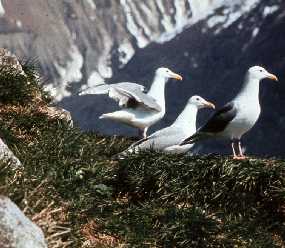
A bill just heard by a Congressional committee would allow Tlingits from Hoonah to harvest seagull eggs in Glacier Bay. It would resume a tradition that ended when the former Native homeland became a national park.

But it faces opposition from a nationwide environmental group.

Tlingits used to live, hunt and fish in Glacier Bay, about 50 miles west of what is now

Glaucous-winged gulls nest in Glacier Bay. (Photo by the National Park Service.)

Juneau. But centuries ago, the ice advanced and pushed them out. They settled across Icy Strait in Hoonah.

The glaciers later retreated from much of the bay, leaving large areas accessible. But since that time, it’s become a national park and preserve, where hunting and gathering are prohibited.

“Kind of a thing where you can’t just go into Glacier Bay and do as you please,” says Raino Hill, president of the Hoonah Indian Association, the community’s tribal government.

He says one of the traditions lost is gathering – and eating – sea gull eggs from nests in the bay.

“Through time, it’s died out. But there are still a few people in town who have the acquired taste for the seagull eggs,” he says.

Legislation proposed by Alaska Senator Lisa Murkowski would allow Hoonah Tlingits limited access to the seabirds. (Read the bill.)

Spokesman Robert Dillon says it would permit harvests at five nesting areas two days a year.

“They expect that at a maximum it might be 440 eggs that are harvested. But in exchange for that it would allow a large group of the tribe, elders and young people, to practice a traditional cultural activity and really reconnect with their Glacier Bay home,” Dillon says. (Read about Tlingit history in Glacier Bay.)

The national park has given its consent.

Cultural Anthropologist Mary Beth Moss says the harvest should, at most, reduce gull hatchling numbers by 6 percent. She says research also determined egg-gathering would not significantly damage other wildlife.

“We also looked, of course, at potential impacts on the sea lions that use some of the same areas where gulls are nesting. And we looked at potential impacts to other birds nesting in that area and determined that our management plan would preclude any impacts to those species,” Moss says.

The bill would only allow harvests of glaucous-winged gull eggs. Other gulls also live in the park.

Sierra Club Alaska Chapter Executive Committee member Jack Hession says the damage could be greater. He says the bill could set a precedent that could affect Katmai, Denali and Kenai Fjords national parks.

“There is a risk that if Glacier Bay is opened Alaska Native people living around these other parks might seek the same privilege. And who knows how far this could go,” Hession says.

He says the bill is not needed because Hoonah Tlingits can – and do – gather gull eggs outside the park.

“The Sierra Club totally supports Alaska Native subsistence. But in this case, not in a national park that’s been long closed to subsistence. Particularly when the folks have alternatives, and some of these sites, traditional sites, are closer to Hoonah than the ones they want to visit in Glacier Bay,” Hession says. (Read more about the group’s opposition in its newsletter. Go to Page 4.)

The legislation was introduced in May. It was heard July 28th by the National Parks Subcommittee of the Senate Energy and Natural Resources Committee. It’s cosponsored by Alaska Senator Mark Begich.

Murkowski spokesman Robert Dillon is optimistic about its chances.

“It was able to get through the committee pretty quickly and we believe we can probably attach it to something and get it passed pretty quickly. And that’s because it doesn’t cost anything,” Dillon says.

The Hoonah Indian Association would like to see the matter resolved soon. President Raino Hill says some members are anxious to return to the bay to gather the traditional food.

“This legislation will make it easier. And if it does come about I may take the trip up there and help gather for some of the elders, just to have done it once,” Hill says. (Read more about egg harvesting in the bay.)

Much of the interest is in nests on Marble Island, a traditional gathering spot in the lower area of the bay. Hill says his members will follow traditional rules, which prescribe how many eggs can be in a nest targeted for harvest.

Angoon, Gustavus, Petersburg ferry sailings could change

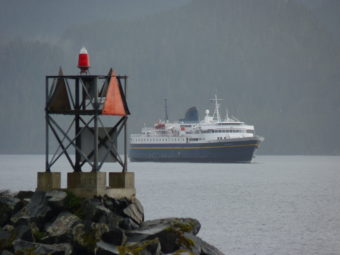
The ferry Malaspina sails near Sitka.
Alaska’s marine highway plans some schedule changes next summer. The fast ferry will begin port calls in Angoon but have fewer stops in Petersburg. The main Lynn Canal ship will reverse its route, and Gustavus will double its sailings to and from Juneau.

But most other routes will remain the same. That includes the new Bellingham-to-Whitter express, which has proved to be popular.

The draft schedule for summer of 2012 will take the fast ferry Fairweather to Angoon, a village about half way between Juneau and Sitka. Ferry Chief Mike Neussl says a rebuilt dock will reinstate a connection lost when the slower ship LeConte switched to shorter trips several years ago.

“So if folks were destined for Sitka to reach the hospital over there, they had to connect through Juneau, which was somewhat inconvenient. So we hope that will meet the needs of the community better. … We’re going to see how that works by running that service twice a week,” he says.

(Link to proposed changes for the 2012 summer schedule.)

It won’t be same-day service, as is now the case with the LeConte. The Fairweather will stop in Angoon on its way to Sitka on Thursdays, then make a port call on its way to Juneau on Saturdays.

The proposed change will free up the LeConte. Neussl says the small ferry will continue serving other small northern Southeast communities.

“It will be working the Gustavus-Tenakee-Hoonah route and one night of the week it will overnight in Hoonah,” he says.

Next summer’s schedule will double stops in Gustavus, the marine highway’s newest destination. Service began last fall and increased this summer.

A passenger views the scenery fron the Fairweather's back deck.

“That has been a pretty popular destination. And with the LeConte having not to go to Angoon it has a little more time available. And I think we can accommodate more frequent service into Gustavus,” he says.

The city near the mouth of Glacier Bay will see four weekly stops next summer.

The Malaspina, which sails a Skagway-Haines-Juneau route, will also change its schedule. It will overnight and start the day in the capital city, instead of its current home port of Skagway.

“It’s not running empty but it’s not spectacular. And the thought is that by reversing that route it will be more appealing to folks heading up to Haines and Skagway for day trips and to connect to the road system. And the timing will be more convenient to get there at a reasonable hour to make border crossings,” he says.

The fast ferry will see changes beyond the Angoon stop. Neussl says it’s scheduled to drop one of its two weekly Juneau-to-Petersburg sailings.

“The ridership on the Fairweather coming out of Petersburg has not been that high so we’re going to throttle that back to one time per week,” he says.

Instead, the fast ferry will sail six days a week to Sitka, one more day than this summer.

Most of the rest of the schedule remains unchanged.

That includes a long-distance sailing that began this summer. That’s a twice-monthly Kennicott roundtrip from Bellingham, Washington, to Whitter, the nearest ferry port to Anchorage, and on to Kodiak and Homer. It also stops in Ketchikan, Juneau and Yakutat.

“The Bellingham-to-Whitter portion of that run is consistently running pretty full. Not passenger full, because we hardly ever fill our vessels with walk-on passengers. But vehicle deck space is pretty well sold out on that run, both northbound and southbound,” he says.

That route allows the ferry Tustumena to make two monthly sailings to the system’s furthest west ports.

The marine highway system will hold a meeting on the proposed schedule Monday, August 22nd, in Ketchikan. It will be teleconferenced statewide, with comments on the Southeast schedule starting at 10 a.m. and Southcentral and Southwest starting at 1:30 p.m.

The teleconference number is 1-800-315-6338. The conference code is 3902#.

Ferry reservations staff could leave Juneau

State officials say they have no immediate plans to move the marine highway reservations office from Juneau to Ketchikan. But they confirm it is on a long-term list of possible system changes.

The office remained in the capital city when most other headquarters functions were relocated about seven years ago.

Ferry chief Mike Neussl says the Ketchikan headquarters does not have the space or bandwidth capacity needed for reservations.

“It’s not moving yet, or may be never moving. But it’s being studied based on looking at all different efficiencies and ways to make the marine highway system more efficient. We look at all avenues to do that,” he says.

The reservations office has 22 jobs. It’s in a relatively new building next to the state Transportation Department’s Southeast regional office near Juneau’s Glacier Highway.

Neussl says a move has been on a list of budget-review items for several years without action.

“It was in there again this year in that discussion as a potential efficiency for the marine highway system. It would take advantage of using that staff more than just for reservations, but making it more of a combined reservations and marketing staff. Right now our marketing staff is in Ketchikan and our reservations staff is in Juneau,” he says.

The marine highway system’s headquarters is in the old Ketchikan Pulp Company’s administration building in Ward Cove. Neussl is based in Juneau.

State officials are considering options for a new building at a nearby site. They’ve purchased land and have money for design.

Site notifications
Update notification options
Subscribe to notifications