Ed Schoenfeld, CoastAlaska

Marine highway doesn’t want Mat-Su ferry

Some legislators are suggesting the Alaska Marine Highway System take over the ferry Susitna. The $78-million vessel was built to connect Anchorage and the lower Matanuska-Susitna Borough. But there’s no place for it to dock and it’s unclear how it will be used.

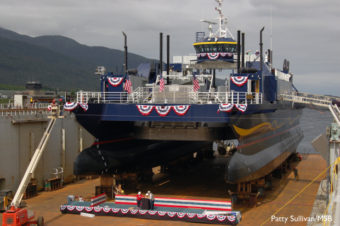
Ketchikan’s Alaska Ship and Drydock is finishing up work on the experimental ferry.

“Right now it’s undergoing sea trials. It needs to be outfitted with seats and the borough hasn’t even taken title yet of the ship,” says Mat-Su Borough spokeswoman Patty Sullivan.

She says it may not get legal ownership until spring.

The ferry Susitna near completion at Alaska Ship and Drydock. Photo by Patty Sullivan, Mat-Su Borough

Eventually, it hopes to sail the ship in northern Cook Inlet — connecting Anchorage and Point MacKenzie, and possibly Kenai and Tyonek.

But no ferry ramps have been built. So officials are looking for other options.

“The borough is interested in gathering any sort of idea on how to use the ferry while we work on the landings. If the Alaska Marine Highway is interested, we’re certainly are interested in speaking with them,” she says.

She says it’s too early to say how much the borough would charge. (Read more from the borough about the Susitna.)

Juneau Senator Dennis Egan recently toured the Susitna, and he was impressed.

“Every time I go into Ketchikan and see that doggone ship sitting there, it makes me ill. I mean $78 million and it’s just sitting there,” Egan says.

Egan wants the Alaska Marine Highway System to consider using the Susitna, as a fill-in vessel or for a regular route. He recently led a delegation of Juneau lawmakers to a meeting with ferry officials.

“I’m not talking about stealing it from the Mat-Su Borough. I’m talking about the state of Alaska reimbursing the Mat-Su Borough if we can use it,” he says.

State transportation officials have looked into the craft. Ferry chief Mike Neussl says adding it to the fleet would be difficult.

“The problem really comes in trying to operate a high-speed craft that is incompatible with all of our existing shore facilities is a difficult evolution. The training, the route manuals, the certifications, the maintenance and just the start-up operation to take on a vessel like that is labor-intensive, time-consuming and expensive,” Neussl says.

The Susitna is a first-of-a-kind vessel, developed and paid for by the Navy. It can adjust its height above the water, break through ice and land on a beach.

Marine Highway General Manager John Falvey says that makes it even harder to add to the fleet.

“It’s an eight to nine to ten month process of getting certified, getting trained, getting the Coast Guard to appove all the documentation. We would most likely be up against something like that, maybe something more difficult, because it’s so unusual,” Falvey said during a recent Marine Transportation Advisory Board meeting.

Its capacity is smaller than all but one state ferry: about 20 vehicles and 135 passengers. And Neussl says even if it could be used, it wouldn’t be for long.

“Theoretically, as far as I know, the Mat-Su Borough still intends to use that as a passenger ferry in upper Cook Inlet and it will eventually go to that service. So to do all the work to make it a marine highway vessel for some route some place only to have it taken back for its intended purpose sometime later doesn’t seem cost-effective in my view,” Neussl says..

Juneau Senator Egan says he’s not convinced that’s true. And he’ll keep pursing the idea.

If training is needed, he says it should be provided. And if there are no docks that can handle the vessel, it can land on the beach.

“I think there are a lot of beaches in Southeast Alaska so that we could figure it out,” Egan says.

Other ideas have also come up.

U.S. Senator Mark Begich sent a letter to Admiral Robert Papp, the Coast Guard’s commandant, suggesting it be used for expanded Arctic operations.

“One of the issues is it’s pretty shallow water. The good news about this ferry is that you can drop it down to about a 4-foot draft, which is pretty shallow. And you can make it in deep water. You can go with a variety of ways with it,” Begich says.

Mat-Su Borough spokeswoman Sullivan says other northern uses have been put forward.

“Shell is trying to endeavor Arctic exploration of oil and the ferry has come up in those discussions,” Sullivan says.

Docking the Susitna is expensive – about $1.3 million a year in Ketchikan and more in Cook Inlet. So the borough is motivated to see the ship used, once it takes possession.

State wants court to order fast ferry engine fix

Alaska’s Marine Highway System wants a court to order the fast-ferry builder to provide new engines for the ships.

State officials say engines on the Fairweather and Chenega are wearing out far faster than their warranties promised. Replacing the eight engines could cost in the range of $20 million.

The state filed a lawsuit last year, but continued talking to the manufacturer about a solution.

Captain Mike Neussl says the state is now asking the court for a preliminary injunction to force action before the engines wear out.

“If that happens, those vessels could be out of service before there’s an ultimate resolution. That would mean the state would lose use, and state residents and communities would lose use, of those vessels prior to the ultimate decision on that lawsuit,” he says.

He says quick action is needed because making new engines will take about a year.

The engines have already undergone repairs. Neussl says that has extended their operating life. But the repairs are not permanent.

The lawsuit and injunction motion are against Derecktor Shipyards, which build the ship, and subcontractors that built the engines. Derecktor officials could not be reached for immediate comment.

The injunction motion filed in Superior Court does not specify that new engines be built by the same manufacturer. But Neussl says that’s the likely solution.

“We have looked at alternatives, what other engines are out there that we could replace these engines with. And to be honest with you, there’s not any other diesel engines in the market place that meet the power-to-weight ratios that these engines have and would fit in the assigned space and have the correct weight to be used in these vessels,” he says.

The Fairweather, built in 2004, is based in Juneau and sails to Sitka and Petersburg. It’s scheduled to begin Angoon service next year. The Chenega, built in 2005, is based in Cordova and runs to Valdez and Whittier.

Thomas files for Sitka-based House district

A Haines Republican is the first candidate to file for Sitka’s new House seat. The district also includes more than a dozen smaller Southeast communities, such as Pelican, Kake, Angoon and Port Alexander.

Bill Thomas has put in his paperwork for the 2012 primary election. He’s spent the past seven years representing House District 5, which includes about 30 small Southeast Alaska cities and villages from Metlakatla to Cordova. Redistricting combines Sitka, which is now part of District 2, with much of Thomas’ current district. The new number is 34.

He says he knows it will be a difficult race, since Sitka will be the largest community in the district.

“It’s going to be a challenge but it’s nothing any different than going to 30-some community seeking election or re-election. I guess I get to make one stop instead of an additional five or six,” he says.

Sitka is currently represented by Wrangell Republican Peggy Wilson. Her hometown is in a new district that includes Ketchikan. If she runs for re-election, she could face Ketchikan Republican Kyle Johansen. He faces a recall effort organized by members of his own party.

Thomas is a commercial fisherman, former lobbyist, and a board member of the Sealaska regional Native corporation. He says he thinks he’ll do well in Sitka.

“I expect to get a challenger, so I have to work a little harder. But I believe with my background, leadership skills and leadership position that I have. Being a Vietnam veteran, with the Coast Guard base there, a fishermen, which is a huge community there. And there’s a good population of Alaska Natives there also,” he says.

Thomas is co-chairman of the House Finance Committee. That puts him in charge of assembling the state’s operating budget, and gives him influence on the capital projects budget.

He says he’ll be running on his record.

“I think we’re achieving a lot in the district as far as meeting the needs of rebuilding the infrastructure we have. And trying to meet the other goals of the communities. I don’t set an agenda. They tell me what they want and I believe I’m in a position to continue to help the district, whether it’s my old one or the new one,” he says.

Thomas filed paperwork for his old district as well as the new one. That’s because the redistricting plan faces challenges in court.

Ketchikan Republican House member Kyle Johansen has also filed for re-election.

The election is in 2012, with an August primary and a November general election. Other candidates have until next June to file.

Ferry engine problems continue

Time could be running out for the fast ferry Fairweather.

It’s been plagued with engine problems, which are the subject of a lawsuit against the ship’s builder.

Captain John Falvey told the Marine Transportation Advisory Board today (Friday) that approval to use the engines runs out this April. But he says that deadline could be extended after an off-season examination.
“We’re hoping that what we see is OK and we can get another extension. We’re kind of living year by year on extensions. We’re racing the clock against potentially getting new engines or solving the problem and keeping the fast ferries running,” he says.

The Juneau-based Fairweather was out of service for about two weeks recently due to an engine-system crack that leaked oil.

Approval for the Cordova-based Chenega, the state’s other fast ferry, will run out next July. But it’s a younger ship and Falvey expects it to easily win an extension.

The ferry Columbia is also having engine trouble.

The ship is almost 40 years old. Its return to service last May was delayed due to an engine problem.

Falvey says a long-term solution is needed.

“We had a mechanical problem with one of the (engine) cylinders. We lost quite a few days. We got it fixed. Boat’s been running OK since. We are in the designing process of new engines. That uses federal money we would hope to be able to obligate that sometime in spring or early summer,” he says.

Falvey also says an upgrade is planned for the ferry Kennicott’s lift, an elevator that carries cars and trucks down to its vehicle deck.

It will allow easier loading in Yakutat, where the ship has had problems.

“We plan to install the tie-downs during the Kennicott’s state overhaul this winter. So we will have a mechanism to secure cars up on that lift basically all the time, in any kind of weather conditions,” he says.

Several other ships will undergo repairs and maintenance this winter.

Metlakatla fisheries certified as sustainable

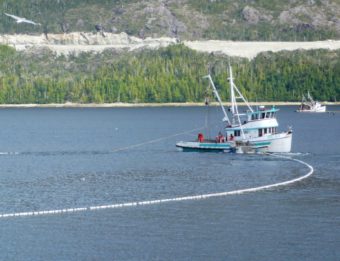
Commercial fishing in Metlakatla. Photo by MSC.

Metlakatla’s fisheries have been certified as sustainable by the Marine Stewardship Council.

That should help the southern Southeast community maintain salmon sales overseas. Officials say it’s the first tribal fishery to earn the certification.
Metlakatla is a Tsimshian community on Annette Island, about 15 miles southwest of Ketchikan. It’s an Indian reservation, and its tribal government controls fishing within 3,000 feet of its shores.

Its fisheries used to be included in the Marine Stewardship Council’s certification of Alaska waters. But a few years ago, that changed.

“The certifier examines the management of the fishery, as part of assessing to the standard,” says Kerry Coughlin, the council’s regional director.

“So when it became clear that the Metlakatla fishery was the only small part of the Alaska salmon fishery that’s not managed by the Alaska Department of Fish and Game, then it became clear they couldn’t be covered under the certificate because the management of the Metlakatla fishery had not been assessed,” she says.

So community leaders decided to pursue their own certification.

Jeff Moran runs Metlakatla’s Department of Fish and Wildlife. He says the move was motivated by economics – but that wasn’t all.

“We had certain markets that we had been selling to that came back and said we won’t be able to buy your fish unless you’re certified. That was one of the primary factors that drove us to seek certification. But the more we started looking into it, the more it became obvious that it seemed like the right thing to do,” Moran says.

Mayor Art Fawcett recieves a certificate from MSC's Kerry Coughlin. Photo by Marcella Brendible.

Metlakatla hired Scientific Certification Systems of California to handle the review process. Coughlin, of the London-based stewardship council, says it’s lengthy, and detailed.

“There are 31 different scoring indicators in the MSC standard under three different principles around sustainability of the stock, the impact on the marine ecosystem and the ongoing management of the fisheries,” Coughlin says.

Metlakatla’s Moran says it already followed many of the required practices. He says it’s been managing its fisheries for decades.

“It’s been pretty tried and true in our eyes. A lot of the issues we had to deal with were genetic
conflicts between hatchery fish and wild fish. And  
then, how our fishery impacts areas outside of the reserve,” Moran says.

The council certified Metlakatla’s pink, chum, coho and king salmon fisheries earlier this summer. That will maintain European markets that require proof of sustainability.

Moran says that’s important to the 50 to 70 gillnetters and 10 to 15 seiners working out of the community.

“A very, very significant percentage of the community relies very, very heavily on fisheries. And then on top of that we have our own processing plant, a packing company, which hires many people for processing the product,” he says.

Marine Stewardship Council staff traveled to Metlakatla to celebrate certification in late August. But that’s not all that has to be done.

Coughlin says the review process recommended some changes that will help make the fisheries even more sustainable.

“The rebuilding strategy, the sampling programs, monitoring and reporting, those would  be some areas where they passed, but the certifier flagged them as having room for improvement,” she says.

But she says overall, Metlakatla meets the standards. And that should help maintain – if not expand – its markets.

“What’s exciting to me is to see such a clear example of a community fishery that is going to see market benefit from demonstrating their sustainability. It’s not only a good example of how the MSC program is designed to work, but it’s just a wonderful thing to see that tribal community ensuring the continuation of their fishery,” she says.

Alaska salmon, as well as western flatfish and pollock, are among other in-state fisheries certified as sustainable by the council.

Bill signing expands Southeast State Forest

The state is setting aside more of its land for logging.

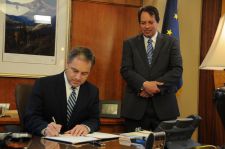
Governor Sean Parnell today (Sept. 7th) signed a bill adding 23,000 acres to the Southeast State Forest. The measure nearly doubles the size of the forest, which was created in 2010.

The forest is spread out, rather than in one concentrated area. The new acreage is in Southern Southeast and includes 23 parcels on Mitkof, Wrangell, Prince of Wales, Dall and some other islands, as well as the mainland. Click here to view a map of the forest additions.

Gov. Sean Parnell signs state forest bill as staffer Randy Ruaro watches.

Haines Representative Bill Thomas helped get the bill passed. He says a larger state forest should be of value to the region’s mills.

“There’s not very many around and they need all the help they can get. So I’m just hoping our efforts will be able to supply some volume of timber to them rather than having them litigated and shut down,” he says.

The land was already slated for eventual timber harvest. The state forest designation allows officials to manage it by enhancing tree growth with techniques such as thinning.

The Southeast State Forest, at about 50,000 acres, is the third and smallest such entity.

The quarter-million-acre Haines State Forest is in northern Southeast. The 1.8-million-acre Tanana Valley State Forest stretches from Manley to Tok in the Interior.

Thomas says the areas remain open to uses other than logging.

“We have a state forest in Haines too and it’s multi-purpose. It’s open to hunting, fishing trapping, subsistence, personal use, the whole thing,” he says.

Parnell sponsored the measure, House Bill 105. It passed the House and Senate last spring without objection.

The governor this year also created a timber task force to work on plans to rejuvenate Southeast’s depressed wood-products industry. It includes state and other logging supporters who left the Tongass Futures Roundtable. That group included environmental organizations, which the task force does not.


Site notifications
Update notification options
Subscribe to notifications