Ed Schoenfeld, CoastAlaska

Wood biomass heat growing in popularity

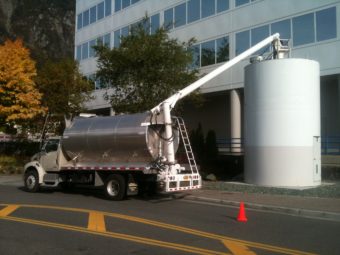
Wood pellets for a new boiler are unloaded at Sealaska's headquarters in Juneau. Casey Kelly photo.

More and more Southeast government buildings and businesses are turning to woody biomass for heat. Some experts say the region is close to having enough demand to justify building a pellet mill. But it won’t be easy.

Boilers heated by wood pellets or chips are being installed in Coast Guard and Forest Service buildings throughout Southeast. Sealaska and some other businesses have done or are looking at the same thing.

And Yakutat is among those considering wood-powered electrical generators.

But in most cases, the pellets have to be shipped from Canada or the Lower-48.

Tongass Forest Supervisor Forrest Cole says that could be about to change.

“There are a number of hurdles to cross, but I believe in the southern part of Southeast Alaska we’re pretty much getting close to a tipping point where we could supply the wood available off a roaded land base to a mill that could create a pellet that could be somewhat competitive in the market today,” Cole says.

Tongass Forest Supervisor Forrest Cole. Ed Schoenfeld photo.

One of those hurdles is land selections or trades that make part of the Tongass National Forest’s future uncertain. That includes Sealaska and University of Alaska land selections, trades with the Mental Health Trust and potential claims by landless Native corporations.

Speaking at a biomass workshop at the recent Rural Alaska Energy Conference in Juneau, Cole says they’re due their claims. But …

“I find it extremely difficult in order to invest a buck today and ensure it’s there 10 years from now, when there’s so many hands in the pot of who’s going to own the land,” Cole says.

He says logging to just supply a pellet plant is not profitable.

But he says there’s enough timber, even with reduced harvests, to provide the mill leftovers that can be turned into pellets. He says if low sales cause mills to shut down, there won’t be that waste wood.

“If we lose the current timber industry in Southeast Alaska, we’re going to miss a huge opportunity in order to take a product that’s being produced today and basically a burden on the mills, in order to make a pellet that could readily heat and get a lot of the communities in Southeast Alaska off of oil,” Cole says.

Read Smith, another energy conference speaker, says the Forest Service is unusual among government agencies. He says the Department of Defense is also bullish on alternative energy. But much of the rest of Washington, D.C., is slow to recognize wood-energy opportunities.

“The problem is they don’t get it. They don’t get what we’re trying to do here,” Smith says.

Smith works for the group 25-by-25, which is pushing to get a quarter of the nation’s energy produced from renewable resources by the year 2025. He expects Alaska to be a leader in wood energy.

“The bottom line is biomass is a huge, huge piece and I don’t think anybody, anywhere in the United States is positioned better to capitalize on some new technology that’s just going to be implemented here in the next five to ten years,” Smith says.

Wood boilers are most often used as a source of heat.

But Dave Sjoding of the Clean Energy Application Center in Pullman, Wash., says it can do more.

“When you’re putting in systems for pellets, think about layer-caking on top an organic rankine cycle (heat recovery) system as well and get some power out of the deal as well,” he says.

He says a heat-recovery system can add value to a wood-energy project.

It also can replace expensive diesel generators when connected to a power grid.

“So one of the ways to think this through is using the hydropower system as a great big storage battery. So as you do energy efficiency, or renewable energy, you’re preserving and stretching out that cheap hydropower,” Sjoding says.

Wood biomass energy faces other challenges beyond funding. Advocates acknowledge opposition due to pollution worries, though they say a well-built system generates few emissions.

They also know any industry linked to timber harvests will face opposition in some communities. But they say wood boilers would mostly use leftovers from mills.

David Dungate of ACT Bioenergy speaks at the energy conference. Ed Schoenfeld photo.

David Dungate of ACT Bioenergy, and others at the conference, say it’s worth serious consideration.

“When you look at what’s the best return per dollar invested in energy, if your target is reducing carbon, what’s the most cost-effective way to do that, and what’s the best way to create jobs per dollar invested, biomass comes out very well on all those,” Dungate says.

The Alaska Wood Energy Development Task Group is trying to spur development of wood-energy projects statewide. The group is accepting statements of interest from those exploring community heating projects.

The task group, a coalition of agencies, will hire consultants to visit project locations and craft reports that could help with funding. The deadline is November 4th.

SE votes on plastic bags, hydro, alcohol tax

Southeast Alaskans head to the polls on Tuesday, October 4th. They will choose city and borough leaders and voice opinions on a variety of ballot measures.

The more-than-a-dozen measures include taxing plastic bags, funding hydropower projects and dropping a senior-citizen exemption for a tax on booze and smokes.

One of the most controversial is in Juneau, where a local group put a 15-cent-per-plastic-bag tax before voters. It would only affect customers at larger retailers, such as Fred Meyer and Walmart. (See Juneau’s sample ballot.)

Supporter Dixie Belcher says the goal is to encourage people to give up plastics and instead bring reusable reusable bags.

“It’s something that is just a habit, and we can just as soon get into a habit of taking our own reusable bags. They do that in many other parts of the world. Because of their impact on the ocean they’re banned in 25 percent of the world, and they’re taxed in many other parts of the world. And generally the taxation lowers the use of plastic bags by about 90 percent in the first three months,” Belcher says.

The ballot measure faces strong opposition from many businesses and public officials. Resident Geri Swanson thinks the proposal won’t have the intended effect.

“Personally, I own several reusable bags and I always forget to bring them with me when I go shopping. I recycle those small shopping bags in my garbage in my bathrooms and some I even take to the recycle center. So, I think 15 cents is just a silly idea for the city,” Swanson says.

Juneau has four other ballot measures. One would continue a temporary 3 percent sales tax that funds police, fire and ambulance services, as well as road, water and sewer repairs. Another would pay for an energy-efficient ground-source heat pump at an elementary school. Yet another would replace artificial turf at a local ballfield.

One more would pull Juneau out of state-mandated campaign-disclosure rules and replace them with its own.

Mayor Bruce Botelho says changes made a few years ago have scared off potential candidates. That’s because they require too much information on earnings.

“The 2007 amendments require not only the disclosure of the source of the income in excess of $1,000, it does require you to state the amount,” Botelho says.

He says Juneau’s proposed rules only require the income source be reported. Critics say the current system works and keeps candidates honest. Many other communities have already pulled out of the state requirements in favor of their own.

Ketchikan voters face three measures in the October 4th election. (See the city of Ketchikan’s ballot information.)

The city ballot has a bond issue providing $15 million for the Whitman Lake hydropower project. The state already has chipped in $11 million and the ballot measure would bring the total near what’s needed.

Ketchikan City Mayor Lew Williams says it’s an important part of keeping the price of electricity low.

“Right now we pay only 9.5 cents a kilowatt and it’s really helped our growth down here, especially in some industries. And then we have a lot of homes switching over to hydro. It’s so much cheaper than fuel right now. So we’re just pushing for every little project we can and Whitman’s on the board,” Williams says.

Another city ballot measure would change the candidate filing period to match that of the Ketchikan Gateway Borough’s. (See the Ketchikan Gateway Borough’s sample ballot.)  The borough ballot has one measure, asking whether assembly members should continue to be elected at-large, rather than by district.

Petersburg voters face three measures. (See Petersburg’s election information.)
One would sell $1.5 million of bonds to fund a new library. Another would allow the city council to declare up to two sales-tax-free days each year.

A third would repeal a sales tax exemption on the sale of alcohol and tobacco to seniors.

Mayor Al Dwyer says passing the measure would lessen impacts on government services.

“Alcohol and tobacco are very expensive for municipalities to deal with, medically,” Dwyer says.

But some worry the measure will lead to removing other senior exemptions.

Councilor Dan Hickman says it should stay in place.

“My argument from the git-go is that by the time you get to 65, if you want to continue killing yourself you earned the right,” Hickman says.

Sitka has one ballot measure that would raise the property tax limit from 6 to 6.5 mills. The increased revenues would be used to fund improvements to municipal infrastructure, such as the hospital, and its maintenance. (See Sitka’s sample ballot.)

Haines has two ballot propositions. (Link to the Haines sample ballot.) They ask voters to recall a pair of assembly members. Backers claim they violated borough law by failing to appoint a new member to an open seat.

Skagway and Wrangell have no measures on this year’s municipal ballot.

Road, line work starts at Reynolds Creek hydroproject

Haida Energy is starting to build Prince of Wales Island’s next hydropower plant. But it still needs more funding.

The Reynolds Creek hydroproject has long been a dream of the Haida village Native corporation, based in Hydaburg.
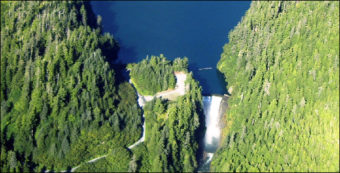
Reynolds Creek

Project manager Corry Hildenbrand says that dream is close to becoming reality.

“We are on the ground. Durrett Construction is moving in with their barge. We awarded early in September. And we’ve got 9 to 11 weeks of work, so hopefully the weather will cooperate and we’ll get this first phase of work done,” he says.

Reynolds Creek is about 10 miles from Hydaburg, which is about 25 miles southeast of Craig. It’s being developed by Haida Energy, a joint venture of the Haida Corporation, and APT, the Alaska Power and Telephone Company.

Its powerhouse and small dam will feed electricity into Prince of Wales Island’s grid, eliminating the use of high-cost diesel generators.

Corry Hildenbrand

Hildenbrand, speaking at the Rural Alaska Energy Conference in Juneau, says there’s a long list of projects for this fall.

“Repairing the roads, building a road into the powerhouse site, building a road into the dam site so we can do our geotech investigations confirming what we have for foundation conditions. APT is also starting construction of the transmission line from Hydaburg out toward Deer Bay. The turbine generation is very close to being on order. And then we’ll be moving into final design based on our geotech work this fall,” he says.

The project’s power is expected to cost 11 or 12 cents a kilowatt-hour.

Its overall cost is estimated at $28 million, paid for by a mix of grants, loans and backing from its developers.

Alvin Edenshaw of the Haida Corporation says that’s more than they have.

Alvin Edenshaw

“Along the way, since 2000 and 2006, the cost has gone up. So we’ve gone back to the state and we are in the process right now with the Alaska Energy Authority and AIDA to develop another $9 million loan to bring our project on line,” he says. (Read a letter about Reynolds Creek from Edenshaw to shareholders.)

Haida Energy is also looking for ways to save money.

One approach is to change its Fish and Game Department permit. It requires what’s called a rotating drum fish screen to keep grayling out of the turbine. Hildenbrand says the fish were stocked and are not native to the area.

“So we’re looking to mitigate the cost of that fish screen and the possible operation problems with some outside mitigation funds so they can go ahead and perhaps in Hydaburg enhance some of the fisheries streams that have been damaged over history,” he says.

He says the screen costs about three-quarters of a million dollars.

Developers hope to have the hydroproject complete and producing electricity in 2014.

Statewide energy conference held in Juneau

Alaska’s seventh annual Rural Energy Conference takes place this week in Juneau.

The three-day event includes technical workshops on newer technologies, such as wind, tidal, geothermal and biomass. Other sessions focus on funding, permitting and regulations relevant to energy projects. Still others are on hydropower, regional electric grids and efficiency.
Field trips to Juneau power projects are included. So is an Energy 101 session, providing

Sitka's Blue Lake hydroproject, which is slated for expansion.

an overview for people new to the topic.

The conference is sponsored by the Alaska Energy Authority and the Alaska Center for Energy and Power. Its theme is “Energy Pathways to Alaska’s Future”.

The event, Tuesday through Thursday at Juneau’s Centennial Hall, is expected to attract several hundred people from dozens of cities and villages.

Last year’s conference was in Fairbanks.

Transportation plan could change roads, ferries

Public meetings on Southeast Alaska transportation options begin Monday (Sept. 26). Some of the plans up for review would drastically change ferry service or increase road mileage in the region.

Imagine a ferry system with no service to the Lower-48 or across the Gulf of Alaska. How about where vessels operate until they wear out and aren’t replaced? Or one with an expanded highway system connected with shuttle ferries but no mainliners.

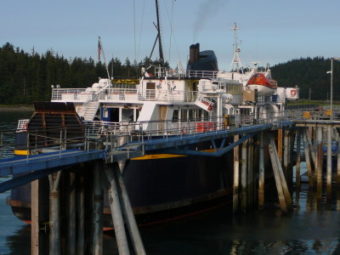
Ferry LeConte at Auke Bay. Photo by Ed Schoenfeld.

Those are among the six options proposed for the Southeast Alaska Transportation Plan. They will be presented and discussed in about a dozen public meetings over the next month in the region’s main cities. (A wrap-up of the options is posted at the bottom of this page.)

Transportation Department Southeast Planning Chief Andy Hughes says it’s an important part of preparing for the future.

“Some alternatives reduce existing excess vehicle deck capacity. Some increase reliance on roads over longer ferry routes. Some focus on comfort over service, and others service over comfort,” he says.

Hughes says ferries carry about 43 percent of traffic within the region, and planes carry the rest.

But only about 8 percent of travel to Seattle is via the ferry. And only about two percent of cross-gulf travelers use the marine highway.

“Looking at those figures we kind of have to ask ourselves how important is it to the residents of Southeast Alaska to improve and retain some of those ferry links versus improving the frequency of service between communities within the region,” he says.

So one of the options eliminates Bellingham and Whittier sailings. Another replaces several mainliners with smaller Alaska Class Ferries, which lack staterooms.

Another calls for no major changes or improvements, which would be an issue for older ships.

“As one of those vessels reaches a point of a failure, to the point where it’s too expensive for us to deal with it, that vessel ceases to be serviceable, the system contracts and the level of service we offer within and between regions declines,” he says.

The ferry Malaspina in Sitka Harbor. Ed Schoenfeld photo.

Another option maintains what’s there now, keeping ferries, roads and airports about the same. Yet another changes ferry schedules based on ridership history.

All, except the no-action alternative, cost a lot of money – from $1.5 billion to $2.2 billion – over the next 20 years.

That’s a problem, because the plan estimates the region will only have a third, to less than a quarter, of those totals for transportation projects over the same time period.

Hughes says it makes sense to plan beyond what’s affordable.

“We need to have a program that also exceeds what our target is just so we’re in line to compete successfully for the available funding opportunities as they arise,” he says.

But in reality, federal dollars – a large part of road-and-ferry funding – could shrink instead of grow for at least part of that time.

The first meeting is in Juneau. The last one is in Angoon. Details are on the Department of Transportation’s Southeast Region website.

SATP MEETING SCHEDULE

DATE, LOCATION, TIME: OPEN HOUSE ,TIME: PUBLIC MEETING

Sept 26 Juneau Centennial Hall, Hickel Room 5:30-6:30 pm 6:30-8:30 pm

Sept 28 Gustavus City Hall 5:30-6:30 pm 6:30-8:30 pm

Oct 4 Yakutat High School Auditorium 5:30-6:30 pm 6:30-8:30 pm

Oct 5 Skagway Assembly Chambers 5:30-6:30 pm 6:30-8:30 pm

Oct 6 Haines Assembly Chambers 5:30-6:30 pm 6:30-8:30 pm

Oct 6 Hoonah City Hall 5:30-6:30 pm 6:30-8:30 pm

Oct 11 Ketchikan Ted Ferry Civic Center 5:30-6:30 pm 6:30-8:30 pm

Oct 11 Kake Council Chambers 5:30-6:30 pm 6:30-8:30 pm

Oct 12 Craig City Hall 5:30-6:30 pm 6:30-8:30 pm

Oct 18 Wrangell Nolan Center 5:30-6:30 pm 6:30-8:30 pm

Oct 19 Sitka Centennial Hall, Maksoutoff Rm 5:30-6:30 pm 6:30-8:30 pm

Oct 20 Petersburg City Council Chambers 5:30-6:30 pm 6:30-8:30 pm

Oct 24 Angoon Senior Center 10:45-11:45 am 12:30-1:45 pm

THE SIX PRELIMINARY ALTERNATIVES

  1. Maintain the Existing System: Identifies the costs to maintain the existing ferry system. It is thus a “baseline” alternative against which other alternatives are compared.
  2. Fleet Capacity Management:  Identifies the costs, benefits, and impacts to manage fleet capacity in a way that more closely matches current and projected future traffic demand.
  3. Maximize Use of Existing Roads: Identifies the costs, benefits, and impacts of discontinuing ferry service to Bellingham and across the Gulf of Alaska, including Yakutat.
  4. Alaska Class Ferries: Identifies the costs, benefits and impacts to replace the three aged mainline ferries with three 350 foot “Alaska Class” ferries and a new mainline ferry.
  5. Highway Route 7: Identifies the costs, benefits, and impacts of replacing the existing mainline ferry system with a system based on road segments connected by shuttle ferries.
  6. No Action: Evaluates what happens to the transportation system if no action occurs to replace the three aged mainline ferries.

Juneau faces homeless chronic inebriate problem

An affordable-housing group is looking for ways to reduce the number of chronic inebriates downtown. The Juneau Homeless Coalition met Thursday to begin gathering information and planning for new programs.

Juneau Police Officer Tracy Murphy attended the meeting. His beat is downtown Juneau. He says he spends much of his time dealing with disruptive drunks.

“It’s a constant trucking for me. A stop here, a stop there, all the nooks and crannies, everybody goes where they go to drink and hang out. And now with the weather, you can see there’s a lot more loitering and trespassing inside of the businesses,” he says.

Stores and offices in the downtown core clean up after their trash, including human waste.

The library’s Mark Whitman says it’s a problem there too.

“I’m increasingly concerned because I saw this summer some extremely violent behavior in the library itself that caused injury to people. And I’m not sure what we can do. It’s not something that we’re trained to deal with,” he says.

Whitman and Murphy were among about 40 people at the Juneau Homeless Coalition’s meeting on chronic inebriates.

Substance abuse professionals, housing program managers, and representatives of government, social-service and business groups talked about the problem and possible solutions.

Juneau Economic Development Council Affordable Housing Coordinator Scott Ciambor  says comparing notes helps.

“A lot of times these agencies are dealing with the problem on their own. So what ended up happening today was a good information-sharing among those agencies that work most frequently with the homeless chronic inebriate population,” Ciambor says.

Those at the meeting said Juneau has around 30 homeless chronic inebriates, some from other Southeast communities. Many have mental health problems, Fetal Alcohol Spectrum Disorders, or other complicating issues.

They said to find solutions, they need more details about the depth of the problem.

“The take-away from this meeting was, a group of those agencies that deal with the same folks day in and day out to go ahead and start investigating the question of who exactly are these folks and what exactly are their needs so they can be addressed,” Ciambor says.

That information will be used to plan for new programs or facilities.

One approach discussed would be a “wet” shelter, a supervised hotel or center where drinking is tolerated.

Another model, called Housing First, provides efficiency apartments and ties residents to assistance programs. Yet another, called 100,000 Homes, identifies the most vulnerable homeless and applies a more intensive treatment system while getting them off the streets.

Some at the meeting also discussed stricter enforcement. That includes a focus on bars and liquor stores. City attorney John Hartle says it’s illegal to sell alcohol to an intoxicated person.

“It’s kind of addressing it from the supply side. In 18 years that I’ve been at the city, though, I’ve never seen an arrest,” Hartle says.

Another idea was to turn some alcohol-related citations into misdemeanors after a certain number of offenses. That would send people to jail, rather than charge fines that will never be paid.

But that’s what some inebriates want: time with food and shelter, even if it’s in jail. Some view treatment programs the same way.

Murphy, the downtown police officer, says he’s seen some people go sober. But on the streets, it’s hard to stay that way.

“I check with them every day. And we count the days together. And it’s saddening to come back after a month to see that they’ve fallen into the same group, the same pressures. It’s there, they just can’t get away from it,” Murphy says.

Some in Juneau’s coalition will attend a statewide homeless issues conference next month in Anchorage. There, they’ll find out more about new programs, including the 100,000 Homes campaign.

Site notifications
Update notification options
Subscribe to notifications