Ed Schoenfeld, CoastAlaska

Salmon virus fears voiced, caution advised

Scientists and fishermen are following news of a deadly fish virus found in British Columbia salmon. It’s a scary situation, but it may not be as bad as it sounds, at least for now. And it’s not a threat to people who eat salmon.

Infectious salmon anemia
has badly damaged populations of farmed Atlantic salmon. So when scientists found the virus in a pair of wild, Pacific sockeyes, they were worried.

Should they be?

“It’s not a time to panic or overreact. I think some folks have been a little bit overly concerned about it,” says Ted Meyers, chief pathologist for Alaska’s Department of Fish and Game.

If confirmed, he says the virus, found in two central British Columbia fish, needs to be watched, and understood. That’s because it is a deadly disease that affects the blood and internal organs of salmon.

“Basically, they develop an anemia and they hemorrhage. And it can kill market-size fish,” he says.

The virus has badly damaged captive Atlantic stocks in Chile, Norway, Scotland and eastern Canada.

Pacific salmon are different, and Meyers says several thousand earlier tests by the British Columbia government showed no presence in wild fish.

But he warns this disease adapts.

“It’s possible that some of these viruses could mutate to potentially affect Pacific salmon. But that would probably occur under situations where there’s a selective pressure, like a hatchery situation or a pen farming situation or something of that nature,” Meyers says.

That’s what happened
to farmed Pacific cohos in Chile in the late 1990s. Infectious salmon anemia spread quickly through cohos raised in net-pens along with Atlantic salmon and rainbow trout.

“We shouldn’t underestimate the power of viruses,” says Dale Kelley, who heads up the Alaska Trollers Association.

The Juneau-based group is among commercial fishing organizations that want action.

“It’s a pretty scary situation for us all and we want to put it into context. We would like to continue to urge the Canadians and other fisheries professionals to make sure that they’re doing as much as fast as they can,” she says.

Some politicians agree. Alaska Senators Lisa Murkowski and Mark Begich have joined Washington Senator Maria Cantwell to ask Congress to require U.S. agencies to become involved. They want an emergency research effort to calculate how much of a threat the virus may pose.

Canadian officials have stepped up their interest. But they say they will decide on an action plan after they confirm identification of the virus.

Kelley says the initial diagnosis came from a lab that specializes in infectious salmon anemia. So, she asks, why wait?

“What we’ve seen out of Canada is a press release that says, if our tests, a few weeks down the road, come up with a finding of ISA, then we’ll be bring people together and then we’ll talk about what to do,” Kelley says. “It seems like there’s probably some information they could be gathering up, before winter hardens everything up, to at least give them a boost on sorting out the extent of the problem.”

Those concerned assume the virus came from Atlantic salmon in British Columbia fish farms. It appears to be the same European strain found in Norway and Scotland.

The fear is close quarters could quickly spread the illness, which could further spread it to wild stocks. Those fish could then carry the disease up the coast into Southeast, and other Alaska waters.

Other pathogens attack Pacific salmon, and some are widespread.

One, known as the IHN virus, also causes hemorrhaging and organ failure.

State pathologist Ted Meyers says it’s common in Alaska sockeyes. It’s adapted to live in Chinook, chums and steelhead down south. But in this state, it hasn’t crossed those boundaries.

“We’re always concerned about this virus potentially mutating and being able to affect other species. But so far our hatcheries have been following a sockeye salmon culture procedure, which really mitigates or reduces the risk from this virus,” Meyers says.

He says the hatchery procedure has been in place for close to 30 years and it’s been successful.

The salmon viruses pose no threat to people. But some fisheries advocates worry consumers won’t understand that, and word of the latest problem could hurt salmon sales.

Omnibus lands bill could include Sealaska measure

It looks like the Sealaska land-selection legislation will become part of a larger bill that could be easier to pass. At least that’s the case in the U.S. Senate. Meanwhile, opponents continue lobbying against the measure.

There are a couple of ways to get a bill through Congress.

One is to push the measure through on its merits or its sponsor’s connections – or both. Another is to combine it with similar legislation.

That’s what Senator Lisa Murkowski is trying to do with the Sealaska legislation.

“Historically what the energy committee has done is taken a whole package of lands bill, roll them into what is called an omnibus public lands bill, and then advance them to the floor that way,” she says.

The Alaska Republican is working on such a bill with Natural Resources and Energy Committee Chairman Jeff Bingaman. Murkowski says the New Mexico Democrat expressed some concerns she’s trying to address.

She says the timber acreage to be selected is pretty much set. Sections addressing cultural and economic-development areas are more flexible.

“Still some questions remaining on the sacred sites and some of the futures sites. But I would suggest that after years of input from Alaskans and those that have an interest we have gotten to a point where we’ve got a final bill that we can put before the committee,” Murkowski says.

“The idea of the Sealaska land bill being part of an omnibus bill in the Senate has really always been our expectation,” says Rick Harris, executive vice president of Sealaska.

He says bill changes mostly have to do with the futures sites, which could be used for ecotourism or energy development.

“I think they just want to confirm that we’ve done as good a job as we can in the selections to avoid conflict, but to still craft a suitable solution,” he says.

But there’s still plenty of conflict.

“I think it’s a bad idea,” says Davey Lubin, who runs a sea-taxi and ecotourism business in Sitka. He’s opposed to the omnibus approach, or any version of the bill so far.

“There’s some sense that some of the senators from certain states who stand to gain small wilderness areas are willing to throw the Tongass under the bus,” he says.

Lubin traveled to Washington, D.C., last month to lobby against the legislation. He’s concerned about impacts on wildlife, tourism, subsistence, and the overall future of the Tongass National Forest, where the land would be selected.

He says he tells people in Washington that the legislation is a corporate land grab.

“I was giving them a frontline view of what the sentiment here is about privatizing some of the most significant, important, beautiful gems of the Tongass. Most of the time the response was ‘Wow, we didn’t realize that this was anything other than a Native rights bill,” he says.

He’s not alone. Some environmental, tribal and outdoors groups, plus small Southeast communities, have also come out against the measure.

One of the latest to join is the Alaska Outdoor Council. The Fairbanks-based group includes seven Southeast affiliates and is the official state association of the National Rifle Association.

“We’re still battling here in the Interior to try to keep the easements across corporation lands to public lands behind them. And we have not been that successful at keeping that access,” says Rod Arno, the council’s executive director.

He’s among those worried that hunters, hikers and fishermen will be limited by the corporation’s new land ownership.

“The main concern is having more federal Alaska lands legislation when there should be adequate lands in the original withdrawals from ANCSA to meet the needs of the Sealaska Corporation,” he says.

Sealaska could select land now from areas of the Tongass near Southeast communities. Officials say much of that acreage should be protected as fish and wildlife habitat, or community watersheds.

Instead, the corporation wants Congress’ permission to select other lands in the region, much of it valuable timber property. Officials say they will maintain access and be environmentally sensitive.

Murkowski points to support from timber industry, economic development and Native groups, and businesses. She says she hopes the omnibus bill, cosponsored by Alaska Democrat Mark Begich, will move soon.

Meanwhile, Alaska Republican Representative Don Young’s version has cleared its only committee. It could head directly to the House floor, or, like the Senate, also be wrapped into an omnibus lands measure.

Earlier reports:
Both sides prepare for Sealaska bill’s next stop
Murkowski, Young post new Sealaska bills
Sealaska lands bill passes House committee

Coast Guard charges helo crash survivor in crewmates’ deaths

The U.S. Coast Guard has brought criminal charges against the sole survivor of a 2010 helicopter crash in which three people from Air Station Sitka died. Lieutenant Lance Leone is facing possible court martial for negligence and the death of two of his crewmates — all violations of the Uniform Code of Military Justice, and all charges he intends to fight.

In July of 2010, a newly refit Jayhawk helicopter was flying to Sitka from Astoria, Oregon, when it ran into some power lines strung across a channel and crashed into the water off La Push, Washington.

Three of the four people on board were killed: the pilot, Lieutenant Sean Krueger, Petty Officer First Class Adam Hoke, and Petty Officer Second Class Brett Banks. Co-pilot Lance Leone was injured, and survived.

He’s now facing three charges from the Coast Guard: The first is that he negligently failed to navigate the helicopter away from charted hazards, and failed to make sure it was flying above 500 feet, in accordance with Coast Guard policy. The second charge is for the destruction of military property – the chopper – which was valued at $18.3 million dollars. Both of those charges are misdemeanors.

The third charge is a felony. The Coast Guard says Leone negligently caused the deaths of Hoke and Banks. There are two counts, each carrying a maximum of three years in jail. Leone is not facing charges in connection with the death of the helicopter’s commander, Sean Krueger.

The charging document amounts to what would be a criminal complaint in civilian courts. The Coast Guard intends to convene an Article 32 hearing – which is similar to a grand jury – to determine if Leone should be court martialed.

“The Article 32 hearings are not used to determine guilt or innocence,” says Chief Petty Officer Kip Wadlow, a Coast Guard spokesman. “It is a review of the evidence that’s been collected, along with the potential charges that are being faced by the member.”

Wadlow says an investigation began immediately following the crash of helicopter 6017. The details of that investigation have not been made public, and the Coast Guard says they won’t be released until after the proceedings regarding Leone are concluded.

But a former military lawyer says the damage might already have been done.

“Your career can end without being court martialed; it doesn’t take much. In the military, it doesn’t take much,” said Lt. Col. John Pharr (Ret.).

Pharr is in private practice in Anchorage. But he spent most of his career as a Judge Advocate General in the Army.

He says in cases like this, acquittals are common, but even charges are enough to do serious harm to a military career.

“You’re toast if you’re acquitted, you’re toast if you’re found guilty,” he said. “So as far as your military career, it ends upon the charges in this day and age.”

Leone’s attorneys have asked him not to speak to the media during this phase of the process. In addition to a military-appointed lawyer, Leone is represented by Anchorage attorney Phillip Weidner, who did not return calls for comment.

Efforts in Sitka are underway to establish a legal defense fund to help Leone with expenses.

Pharr says the charges against Leone are extraordinarily serious, but not unprecedented. Military accidents always involve an investigation, and often, officers connected to the incident face some sort of consequence.

“In addition to the tragedy of whatever happened, if a training accident happens on your watch, you know that it’s going to potentially impact your career,” Pharr said. “Not only your career, but the careers of everybody up the chain of command.”

But Pharr also says Leone’s intention to fight the charges is a good move, especially in light of the felony counts.

“Oh, you have to defend yourself,” he said. “If you’re convicted of a felony, there’s a lot of disabilities involved in being a felon. You can’t serve on a jury, you can’t vote, you can’t possess a firearm. There’s a lot of reasons to not be a felon. Because that’s the way our system works, he should fight it. He should definitely fight it all the way.”

Wadlow, the Coast Guard spokesman, says the officer who presides over Leone’s Article 32 hearing will release the findings to Rear Admiral Thomas Ostebo, who commands the Coast Guard district encompassing Alaska. It will be up to Ostebo whether the findings proceed to a court martial, whether the charges are dropped, or whether the matter is handled administratively. Leone’s hearing is tentatively scheduled for December.

Federal cuts could threaten ferry repairs

The ferry Lituya undergoes repairs at Ketchikan's shipyard. Photo by Ed Schoenfeld

The Alaska Marine Highway System could be another casualty of federal budget battles. Money used to repair and maintain the aging ferry fleet could become much tighter in the near future.
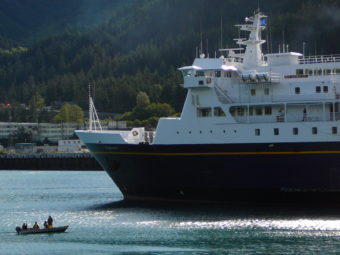
The small ferry LeConte needs renovated crew quarters, upgraded wiring and a new coat of paint – plus engine and other work. That’ll cost nearly $9 million.

The mainliner Columbia has to have new engines. That’s expected to run around $25 million. And the list goes on.

How does it get paid for? Alaska Marine Highway chief Mike Neussl says a lot of the money comes from the U.S. government.

“There is a real potential that our federal funding will decrease. And we will need to make that up somehow, either through state general funds or changing the amount of maintenance that we do or saving money someplace else,” he says.

Neussl says the state gets about $17.5 million each year from the Federal highway and transit agencies. A state match brings it up to about $22 million. Still other appropriations come our way from Washington, D.C.

Congress last month voted to extend highway funding, including marine highways, for another six months. And the program’s formulas, including ferry set-asides, will remain.

But that’s expected to change.

Alaska’s Congressional delegation is optimistic, but realistic.

“Anything that’s been subsidized by federal dollars is under a threat,” says Representative Don Young, a member of the House Committee on Transportation and Infrastructure.

He’s watching a ferry-funding bill being pushed by Washington state Congressman Rick Larsen. Young has cosponsored similar measures in the past.

“This time I didn’t because I want a better formula for Alaska. I’ve told him, ‘You put my formula in there that we had before, and I’ll be very supportive of it,’ ” Young says.

There’s also Senate ferry legislation.

Senators Lisa Murkowski and Mark Begich cosponsored the measure with Washington state’s Patty Murray.

“As one from the Pacific Northwest, she understands that ferries are not necessarily a luxury. This is not a cruise ship that you’re putting your car on. This is our transportation system,” Murkowski says.

Murray is in a good position to support ferry funding.

She chairs the transportation panel of the Senate Appropriations Committee, which assembles highway and ferry budgets. She also co-chairs Congress’ debt-reduction super-committee.

Begich says the ferry bill may not pass on its own. But it could advance marine transportation.

“Making sure we have a piece of legislation out there is critical so we create kind of a marker so when we get into the highway transportation bill, this is one of the items that needs to be discussed,” Begich says.

The Parnell administration is also watching for funding declines. But it’s not sounding the alarm.

“The boats will be safe and in good condition to run,” says Randy Ruaro, the governor’s deputy chief of staff. He says the state may have to chip in more. “In the last several years we’ve seen some supplemental requests for some maintenance and rehabilitation work. And I think the Legislature has approved those on each occasion.”

Less federal money would bring more legislative requests.

There’s about $16 million for ferry terminals in Kodiak and Prince Rupert, $4.5 million for emergency evacuation slides — and the list continues.

Advisory panel chimes in on transportation plan

The mainline ferry Kennicott pulls out of Whittier as fishermen watch. Ed Schoenfeld photo.

Alaska’s ferry advisory panel wants a few changes in Southeast’s transportation system.

The Marine Transportation Advisory Board met in Juneau Friday (Oct. 14,) to weigh in on the Southeast Alaska Transportation Plan. That document is being reworked, and options include dropping mainline vessels, ending cross-gulf and Bellingham service, and building more roads.

Panel members liked plans to continue developing a new line of short-distance ships. Robert Venables of Haines is the advisory board’s president.

“There seems to be good support for two Alaska Class vessels, with a third maybe on the far horizon, with one in upper Lynn Canal and one down in the Gateway concept, between Ketchikan and Prince Rupert,” Venables said.

New ships in northern and southern Southeast could leave other communities with less service. Board member Gerry Hope of Sitka called for continued use of long-distance, mainline vessels.

“There’s the Mal, the Mat, the Taku, as old as they are, and then the Tusty, that is in bad shape. We need to provide that class of ferries an opportunity to be replaced,” Hope said.

Marine Transportation Advisory Board
members backed replacing one mainliner. They also voiced support for continued sailings to Bellingham, Washington, and Southcentral Alaska.

They are also interested in roads that would shorten ferry routes. That includes one from Sitka across Baranof Island. But it does not specify a highway up Lynn Canal.

The advisory board wants to explore plans for a new terminal at the end of an existing road to Berners Bay, north of Juneau. That would shorten travel to Haines and Skagway.

But members worried about how walk-on passengers would get to the site, about 30 miles north of Juneau’s Auke Bay terminal.

City planner Ben Lyman said that would be difficult.

“There’s no way that we can have a fixed-route bus service that goes to the ferry terminal and turns around at every half-hour or every hour when the ferries are coming in at 2 in the morning or 6 in the morning and not when there’s any ferries there,” Lyman said.

The board’s official comments on the transportation plan will come in a letter drawn up based on discussion at the meeting.

Sealaska defaults on part of California casino land

Sealaska has lost some its California casino land to foreclosure. But the regional Native corporation says it won’t hinder the project.

Sealaska has been working for several years to build a hundred-million-dollar-plus hotel and casino project about 85 miles north of San Francisco. Its partner is the Cloverdale Rancheria, a Pomo Indian group.

It lost two acres to foreclosure this week. The corporation’s Rick Harris says it’s a small part of a 65-acre project. A recent study showed it was not needed.

“What we chose to do is try to negotiate a better price because the property wasn’t going to be used for casino property. The individual who owned it was not interested in any further discussion, so we felt that it was not necessary for the project. So we chose to let it go and it just goes through the normal structured foreclosure process,” Harris says.

Sealaska bought the two acres for $1.3 million, according to the Santa Rosa Press Democrat. The newspaper reports the corporation owed just under $1 million when it defaulted on the land and it reverted to the previous owner.

The Press Democrat, about 30 miles south of Cloverdale, has covered the casino extensively. Some residents strongly oppose the project, saying it would create too much traffic and change the town’s character.

Harris says any money lost in the foreclosure will ultimately be recovered.

” We did invest some initial purchase price on the property. But it’s included as part of the overall gaming project. And as Sealaska is repaid, we’ll cover our investment,” he says.

Sealaska’s 2010 financial report, issued earlier this year, shows gaming operations losing more than $7 million during the previous two years.

The same report also said the corporation moved to end some agreements with its tribal partners in Cloverdale. But Harris says the project continues.

“We have agreements with the tribe to go forward with how to secure the financing for the project. And based upon that financing, that will help chart the course for the future,” he says.

The corporation earlier invested about $15 million in a San Diego-area casino run by the San Pasqual Indian Band. It made a sizable profit from that investment.

13Foreclose AM/AM/AM/MID/PM

3-cut wrap, about 2:20 Schoenfeld, 10/13/11

Sealaska has lost some its California casino land to foreclosure. But the regional Native corporation says it won’t hinder the project.

Sealaska has been working for several years to build a hundred-million-dollar-plus hotel and casino project about 85 miles north of San Francisco. Its partner is the Cloverdale Rancheria (RANCH-ur-ee-ah), a Pomo (POE-moe) Indian group.

It lost two acres to foreclosure this (last) week. The corporation’s Rick Harris says it’s a small part of a 65-acre project. A recent study showed it was not needed.

13Foreclose, 22 seconds: What we chose to do is try to negotiate a better price because the property wasn’t going to be used for casino property. The individual who owned it was not interested in any further discussion, so we felt that it was not necessary for the project. So we chose to let it go and it just goes through the normal structured foreclosure process.

Sealaska bought the two acres for $1.3 million, according to the Santa Rosa Press Democrat. The newspaper reports the corporation owed just under $1 million when it defaulted on the land and it reverted to the previous owner.

The Press Democrat, about 30 miles south of Cloverdale, has covered the casino extensively. Some residents strongly oppose the project, saying it would create too much traffic and change the town’s character.

Harris says any money lost in the foreclosure will ultimately be recovered.

13Foreclose, 13 seconds: We did invest some initial purchase price on the property. But it’s included as part of the overall gaming project. And as Sealaska is repaid, we’ll cover our investment.

Sealaska’s 2010 financial report, issued earlier this year, shows gaming operations losing more than $7 million during the previous two years.

The same report also said the corporation moved to end some agreements with its tribal partners in Cloverdale. But Harris says the project continues.

13Foreclose, 10 seconds: We have agreements with the tribe to go forward with how to secure the financing for the project. And based upon that financing, that will help chart the course for the future.

The corporation earlier invested about $15 million in a San Diego-area casino run by the San Pasqual (PASS-kwall) Indian Band. It made a sizable profit from that investment.

###

Site notifications
Update notification options
Subscribe to notifications