Ed Schoenfeld, CoastAlaska

“Cluster” groups advance economic priorities

How do you improve Southeast Alaska’s economy? Business, government, and nonprofit group leaders met in Juneau this week to share and refine ideas at the Southeast Alaska Economic Development Cluster Summit.

The event brought together groups concentrating on forest, ocean and visitor products. It also included a group trying to develop a regional, renewable energy industry.

“The goal is to create viable economic activity in Southeast Alaska and in the Tongass,”

Rep. Beth Kerttula, Sen. Dennis Egan and USDA's Danny Consenstein listen to questions during the Southeast Economic Summit. Ed Schoenfeld photo.

says Ketchikan’s John Sund, who co-chairs the ocean products group.

“The measurement is creating new jobs and at least stopping the population drop in Southeast and creating more private sector investment and private sector business in Southeast Alaska,” he says.

Sund is one of more than 130 people involved in the four cluster groups since they began in 2011.

A cluster is sort of like a committee or task force. It brings together individuals, companies and agencies in the same business and geographic area. Members work on ways to collaborate, as well as develop new products or initiatives. Then they get together at events such as the summit to compare notes and see what they can work on together.

(Read a briefing paper listing economic-development priorities.)

The visitor-industry cluster, for example, has already worked with the Forest Service to increase tour access to Juneau’s Mendenhall Glacier area.

It also wants to spread tourism beyond cruise-line ports.

“There are some communities that are never going to see any ships,” says Juneau marketer Sharon Gaiptman, who co-chairs the visitor products group.

“And so between them and our hubs – Ketchikan and Juneau – it’s about developing itineraries to capture those more independent visitors,” she says.

The forest products group wants to simplify the government’s timber sale process, especially for small mills. It also wants to convince builders to use more regional timber products, and promote waste-wood energy.

Co-chair Wade Zammit, of Ketchikan-based Sealaska Timber Corporation, says it’s been trying to avoid duplication with another recent group.

“We also began making the necessary steps for a formal process of communication with the state Timber Task Force, to make sure that we’re working cooperatively on initiatives and not creating redundancy, but building on what each other is doing,” Zammit says.

The group also wants Alaska’s Congressional delegation to push through legislation designating lands for timber harvest in the region.

But Senators Lisa Murkowski and Mark Begich, speaking from Washington via

Sens. Lisa Murkowski and Mark Begich answer questions via videoconference during the economit summit.

videoconference, say that won’t happen anytime soon – or at all. They warned that the Tongass has become as controversial as ANWR, the Arctic National Wildlife Refuge.

“You all need to be pragmatic in your approach there. At this point in time the support, at least with this particular administration, to advance such legislation is probably pretty questionable,” Murkowski says.

The renewable energy group is just getting going, since there’s little industry so far.

Co-chair Brandon Smith, of Juneau’s Alaskan Brewing Company, says it’s looking at tidal, wind, geothermal, biomass and small hydro.

“Big hydroprojects kind of have a lot of their support structure already in place. So we decided to focus on some of the smaller ones that may need a little help in becoming part of this industry,” Smith says.

The renewable energy group asked Begich and Murkowski to find funds to help with research and development.

The senators like the idea of using Southeast as a testing ground. But both say the money won’t come easy.

“I think all of us understand that to be more energy independent in this country, we’re going to have a diverse portfolio. We see some great opportunities but it’s going to be tight because there are the budgets that people go after because they don’t see the results right away,” Begich says.

The ocean product group is focusing on sea otter management, education and training for fishermen and boat owners, and salmon habitat restoration, among other issues.

Wrangell’s Julie Decker co-chairs that group.

“The area where the United States has been strong has been innovation and that’s sort of our key area where we can still have a competitive advantage,” Decker says.

The summit was not the end of the cluster groups’ work. They will continue refining their ideas and choosing which ones to push the most.

The event, and the larger effort, were organized by the Juneau Economic Development Council. Funding has come from the U.S. Department of Agriculture, which just committed another $100,000 for continued work.

You can watch rebroadcasts of the Southeast Economic Summit on 360 North TV. They will air Saturday, December 17th, from 8 a.m. until 1 p.m., and Tuesday, December 20th, from 1 p.m. until 6 p.m.

Summit speaker: Cluster process can help economy

A Pacific Northwest industry leader says Southeast Alaska’s cluster initiative could create jobs and grow the economy.
Dave Klick of the Northwest Food Processors Association has been active in his region’s cluster efforts.

Cluster groups bring together industry members, government agencies and supporters to

Dave Klick of the Northwest Food Processors Association addresses the summit. Ed Schoenfeld photo.

come up with new ways of developing, manufacturing and marketing products. They’re a little like a task force.

Klick says Northwest efforts show cluster groups work.

“We’ve seen 600 jobs in the last four years that were created or saved, improved productivity of $13 million, over $100 million of cost avoidance. And political clout cannot be underscored,” he says.

Klick spoke at today’s Southeast Economic Summit at Juneau’s Centennial Hall, organized by the Juneau Economic Development Council.

The Southeast cluster effort is looking at the region’s visitor, forest and ocean products industries. It’s also looking at how to develop a renewable energy industry.

The summit gives cluster-group members a chance to compare notes and focus their lists of initiatives.

Popular beach may have high mercury levels

This time of year, the tidal flats of Sandy Beach are mostly used by dog owners trying to wear out their pooches. In warmer seasons, it’s a favorite place for castle-building kids, picnicking parents and the occasional pallet-powered bonfire.

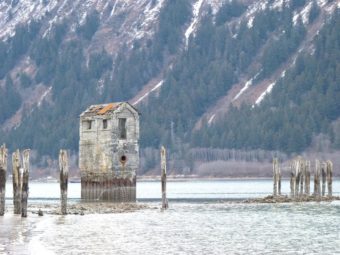
Mine ruins are surrounded by water as the tide comes in at Sandy Beach, a popular Southeast Alaska recreation area.

But for decades, it was a Tlingit village, at times reaching a population of 600.

The Douglas Indian Association, the area’s tribal government, has been concerned about hazardous substances in the sand. So last summer, high-schoolers in a tribal environmental program took samples and sent them off to a lab for analysis.

“Well, they called us right away and they wanted to make sure we disposed of our collection pails and our gloves, because they knew that there was some elevated mercury there,” says Eric Morrison, environmental planner at Douglas Indian Association.

Along with mercury, there’s arsenic and cyanide, once used in the nearby Treadwell Mine. Similar issues have been raised over plans to dredge a nearby harbor. The sand and mud removed was to be placed on the ocean floor.

The beach and low-tide zones are largely ground-up waste rock from the mine. And whatever is there could be getting into seafood collected for subsistence and personal use.

“Anyone from Juneau and Douglas knows that there’s a lot of crab pots in that area. One of the things we’re hoping to do is top test some of the crabs and clams for methyl mercury content,” Morrison says.

“Well, the indications are we need more information,” says Bruce Wanstall, of the state Department of Environmental Conservation’s Contaminated Sites Program. He’s met with the tribal government and the city of Juneau, which owns and manages the beach.

He understands some people might worry about what’s been found. But they really shouldn’t, in part because the samples were taken below the area most used by people.

“They don’t suggest there is an immediate threat to human health and the environment, at this time. But it does indicate we should conduct a more in-depth and wider set of sampling,” Wanstall says.

Before officials do more work, they have to find funding, and they’ll seek grants.

No one’s given the city a deadline, but Juneau Parks & Recreation Director Brent Fischer says it will get done.

“I want to do it. It’s timely. It’s our responsibility to make sure there isn’t a risk. So I look

Corgis and huskies cavort at low tide at Juneau's Sandy Beach.

at it as a priority on my table,” Fisher says.

So what about summer toddlers sitting down in the sand, playing with it and sometimes eating it? Or the dogs that catch sand-encrusted balls thrown by their owners?

“Nothing they’ve tested so far revealed there would be any risk as the public uses the park,” Fischer says.

He says areas that are most suspected are actually below the sandiest part of the beach.

Ship’s return pushes million-passenger mark

Norwegian Cruise Line says it will sail another ship in Alaska waters.

Company officials this week announced plans to return the Norwegian Sun to northern service two seasons from now. It last sailed here in 2009.

The Sun will sail from Vancouver to Whittier and back beginning in May of 2013.

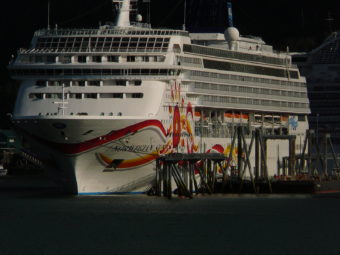
The Norwegian Sun, in an earlier port call in Juneau

Northbound cruises will stop at Ketchikan, Juneau, Skagway, Glacier Bay and the Hubbard Glacier near Yakutat. Southbound itineraries will be similar, adding Hoonah’s Icy Strait Point and Tracy Arm south of Juneau, and skipping Glacier Bay.

Crane Gladding of Norwegian Cruise Line says each week-long trip will carry about 2,000 passengers. That adds up to around 40,000 for the season.

“We really feel like the time is right. And it really feels like with the cooperation of the government and the folks in Alaska that we’ve really seen a lot of improvement in the demand for the overall product,” Gladding says.

He says better marketing and improvements in docks and shoreside facilities helped his company decide to return. So did a reduction in the voter-approved cruise ship passenger fee, which dropped from $50 to about $25 dollars this last season.

Governor Sean Parnell and the Legislature credit that change for bringing more ships to the state. So does Ron Peck, of the Alaska Travel Industry Association.

“By reducing the liability on the head tax, I absolutely believe that had an impact on cruise executives decisions and that’s great news for Alaska,” Peck says.

Industry critics disagree on the reason the Sun is leaving the Baltic Sea for Alaska.

Chip Thoma, of Responsible Cruising in Alaska, says international politics, not tax cuts, are bringing ships back to the state.

“A lot of these ships from Alaska and from the Caribbean went on to Europe thinking they would do well in the Mediterranean. And of course the Arab Spring came and that was just a debacle. So all those ships are coming back to this part of the world and that’s what I attribute all of the interest in Alaska again,” Thoma says.

Norwegian already sails two larger ships on roundtrips through the Inside Passage. The Sun sailed a similar route in 2009, its last Alaska season.

Its new itinerary is one way, dropping passengers off or picking them up in Whittier, the nearest cruise port to Anchorage.

John Binkley, of the Alaska Cruise Association, says that boosts passengers’ economic impact.

“Those people then will be getting on or off the ships in Southcentral Alaska. Many of them will travel then all the way up into the Interior and other parts of Alaska and be spending more money and more time in Alaska,” Binkley says.

Industry figures show cruise capacity peaked at just over a million passengers in 2007. It stayed about the same for two seasons, then dropped to about 880,000 for last and this year.

Next year, Princess will add a seventh ship to its Alaska fleet. And Holland-America is juggling vessels to carry more passengers. That will bring total cruise capacity up to about 950,000.

The Norwegian Sun’s 2013 addition raises passenger counts another 40,000, almost reaching the historic million-cruiser high of the last decade.
Binkley says other deployment announcements could come in the next few months.

“Most of the companies have them finalized now. And then it’s just a question of what their strategy is and when they release those to the public and when they start selling those,” he says.

Alaska cruises can run from the hundreds to the thousands of dollars, depending on the choice of cabin and other amenities.

Norwegian Cruise Line’s Gladding says the Sun’s fares also depend on timing.

“There’s also great opportunities to sail in May, early June and September that offer an affordable price. So I think prices will start at about $699 per person and kind of go up from there as you get into peak times,” Gladding says.

Capacity estimates are based on two people in each stateroom. Actual numbers can be higher or lower, depending on the number of children and others along for the ride.

Report says sea otters hitting dive fisheries hard

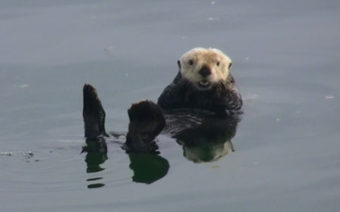
Sea otter in Glacier Bay. Photo by Riley Woodford.

The Allen Marine catamaran St. Tatiana heads along the outer coast south of Sitka near the end of this year’s tour season. It’s on one of the company’s Sea Otter Quests, and it’s having some success.

Several dozen cruise-ship tourists watch from an open deck as otters swim, dive, roll and float on their backs.

“You saw a few of them have their hind feet out of the water. That’s because there’s not so much fur around there so they don’t want to lose that heat through their body to the water because they don’t have a lot of fur around their feet,” says Naturalist Ryan Dunn.

He goes on to explain that otters have incredibly thick fur instead of blubber. Their pelts are valuable, and they were hunted to near-extinction by the early 1900s.

Otters were reintroduced to Southeast in the 1960s, and for decades, they were a rare sight. But recently, their population has boomed, mostly along the outer coast and in southern Southeast.

That means the voracious eaters are consuming more and more sea cucumbers, sea urchins and the giant clam called geoducks.

A resting sea otter. U.S. Fish and Wildlife Service digital archives.

A new report says Southeast Alaska’s sea otter boom has cost the region’s commercial divers and fishermen close to $30 million. Most is income lost as otters consume shellfish and crabs that otherwise would be harvested.

“We don’t know what’s going to happen with the dive fisheries in the long run. It doesn’t look very promising, though,” says Phil Doherty, executive director of the Ketchikan-based Southeast Alaska Regional Dive Fisheries Association.

The association recently released an economic report from the McDowell Group, a Juneau-based research firm.

The report estimates regional otter numbers will soon hit 20,000, more than double the population about eight years ago. And by 2015, it will more than triple.

“We don’t see a real management plan out there that would even slow down the growth, let alone trying to keep otters out of areas where they aren’t in yet,” Doherty says.

The report estimates otters have taken about $22.5 million dollars in the species divers harvest, plus Dungeness crab, using the wholesale value. Add in businesses that support the dive and crab industries and the figure grows to just over $28 million dollars.

That includes $9 million dollars of sea cucumbers, just over $4 million dollars in geoducks, almost $4 and a half million dollars in sea urchins, and around $5.3 million of Dungeness crab.

“That’s a very narrow way of looking at sea otters’ role in the ecosystem,” says California activist Jim Curland, who lobbies Congress to continue protecting sea otters.


He says their return to an area where they were virtually extinct is good for the marine ecosystem.

“When you have large colonies of sea urchins, which occurs when you don’t have sea otters, they can destroy kelp forests. And sea otter predation on sea urchins actually enhances the productivity of kelp forests. Scientists have documented this effect in Southeast Alaska and elsewhere over decades of studying this,” Curland says.

The Marine Mammal Protection Act bans most hunting. Alaska Natives can harvest otters for subsistence use. But they can only give or sell whole pelts to other tribal members. Other sales are allowed if the pelt is substantially altered, such as being turned into handicrafts or clothing.

Alaska’s Congressional delegation is pushing legislation that would allow Natives to sell whole pelts to anyone.

Doherty, of the dive fisheries association, says it’s unlikely to pass. But even if it does, it won’t solve the problem.

“If the Natives could sell them as a pelt, that would increase the harvest. But we feel it’s doubtful that even that new legislation would make a significant dent in the population and slow the growth down in the areas where they are most affecting our dive fishery,” he says.

A group of environmental organizations are campaigning against the legislation. Otter activist Curland says it could do a lot of damage to a species that’s recovering.

“You would open up a larger market outside of the Native subsistence hunters in Alaska. You’d start seeing pelts sold to China. They’d show up on Craigslist or eBay or whatever. And I think that demand would create a greater pressure on the hunting of sea otters,” he says.

Doherty says the dive fisheries association funded the recent report to share its concerns.

“We need to make sure everyone is fully aware of what’s going to happen with our shellfish fisheries in Southeast Alaska. And if at the end of the day, people still don’t want to react to it, and they will allow the sea otter population to wipe out the shellfish fisheries in Southeast Alaska, that’s the decision that our divers need to know so they can make a decision as to what their future is going to be,” he says.

A separate U.S. Fish and Wildlife service research effort is trying to determine the extent of sea otter population growth.

It’s shown a 13 percent boost in southern Southeast. Additional research, due out soon, will provide numbers for the northern part of the region.

Read a report from the U.S. Fish and wildlife service.

Hear a report on sea otter harvest legislation.

Ketchikan man faces APOC campaign fine

A Ketchikan House candidate faces a sizable penalty for campaigning without registering.

An Alaska Public Offices Commission attorney recommends fining David Scott $2,357. That’s because he sent out emails announcing his election plans without filing the proper paperwork with the state.

Scott is a former chief of staff for the incumbent in the seat, Representative Kyle Johansen. The Republican, now chief of staff for Nome Democratic Senator Donny Olson, announced his candidacy on Alaska Day.

He sent emails to the media, plus another Ketchikan Republican,

David Scott

who forwarded it to party members. At the time, he said he planned to work the upcoming legislative session, which meant he would not file until after the legislature adjourns. That’s because legislative staff have to quit before running for office.

In a report to the commission, APOC attorney Martha Tansik recommends he be charged a $700 fine, plus$1,657 in staff costs. That adds up to $2,357 in civil penalties.

Calls for comment were referred to APOC Executive Director Paul Dauphinais, who said staff concluded Scott violated state statute.

“For Mister Scott, it appears that he had an expenditure in announcing his campaign and did so before he filed either a letter of intent of candidate registration or put his name in nomination,” Dauphinais said.

Question: “Does the commission have a rule or the state have a rule that says sending an email is an expenditure?”

Dauphinais: “Yes, the commission has set a precedent where sending an email is considered an expenditure, even if it is de minimis (a legal term for minimal).”

The full commission will decide whether to levy the entire recommended fine.

Scott also could not be reached via phone and email. But in an earlier interview with KRBD, he said he did his best to follow the rules.

“I had no intent to try to skirt any ethical barriers or campaign laws, which is why I was in contact with the ethics committee before hand, before I did the press release. So I used my own private time. I did it after 5 o’clock. That’s why I used my own private computer. And I released the press release on a state holiday,” Scott said.

His written response to APOC’s complaint notes that he sent another email, rescinding his candidacy announcement, after agency staff told him he was in violation of campaign laws.

He also said he realizes he should have contacted APOC before sending out the first announcement.

The APOC report also questions whether Scott has actually ended his campaign. It cites a KRBD report where he indicates he still intends to run for the House.

Incumbent Johansen is seeking election to a reconfigured Ketchikan-based House district. Wrangell Representative Peggy Wilson and Ketchikan Visitors Bureau Director Patty Mackey have also filed for the Republican primary.

Ketchikan City Council Member Matt Olsen will run as a Democrat.

Site notifications
Update notification options
Subscribe to notifications