Ed Schoenfeld, CoastAlaska

IFA wants to sell spare ship to state ferry system

Should the Alaska Marine Highway buy a used ship from the independent Inter-Island Ferry Authority? Supporters of the idea say it could save money for both operations.

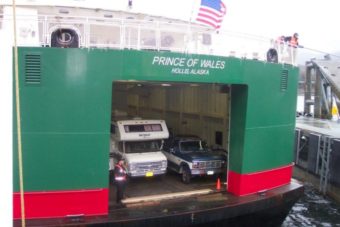
The ferry Stikine once sailed a summer route from Coffman Cove, on Prince of Wales Island, to Wrangell and Petersburg. Those runs were cancelled in 2009 because they weren’t much used. The Stikine took over Hollis-to-Ketchikan sailings from the older ferry, the Prince of Wales. That left their owner, the Inter-Island Ferry Authority, with an extra ship.

“And I’m hoping to convince some of my colleagues to maybe look at buying that and

The stern of the ferry Prince of Wales, which the IFA wants to sell to the state. Photo courtesy Inter-Island Ferry Authority.

helping the Inter-Island Ferry Authority out at the same time so they don’t have to carry the expense of maintaining that boat and not using it,” says state Senator Albert Kookesh, who represents much of Prince of Wales Island, where the ferry authority is based.

The Angoon Democrat is interested in using the spare IFA vessel to fill in for the state ferry system’s smaller ships.

“When the Aurora or LeConte break down or have to go in for service, they hire Allen Marine. And all they have is catamarans, and there’s many a time when those things can’t make it around Point Retreat, for instance, because of the weather, he says.

Kookesh says buying the ship could be far cheaper than building an Alaska Class Ferry, though he supports completing the first in that design.

The Inter-Island Ferry Authority says it spends about $300,000 a year storing, maintaining and providing security for its unused ship. That’s about 8 percent of its annual budget. The IFA is also paying off debt from vessel construction.

“We’re trying to trim costs and limit the amount of money that we require from the state for an annual subsidy,” says Bruce Jones of Petersburg, the IFA’s general manager.

He says the Prince of Wales is only used as a fill-in vessel when its sister ship is being repaired.

“So if we can get those two things taken care of, there’s a possibility that the IFA can stand on its own, unless of course the fuel prices continue to go through the roof,” Jones says.

There is a significant difference between the IFA’s vessels and Alaska Class Ferries.

The yet-to-be built state ships are expected to cost in the range of $120 million each. The Prince of Wales was built for a sixth of that amount, and a recent survey showed its value as far lower.

That’s in part because the Prince of Wales is smaller, carrying about a third as many passengers and half as many vehicles. Jones says it also has fewer amenities.

“It doesn’t have any cabins for crew quarters, but it could be used as a day boat by the Alaska Marine Highway System, similar to what we use it for,” he says.

State ferry chief Mike Neussl of Juneau says he hasn’t been contacted by lawmakers or the IFA, so he can’t comment on a possible purchase.

Marine Transportation Advisory Board Chairman Robert Venables of Haines also hasn’t been contacted. But if asked, he’s willing to take a look.

“On the surface, there does seem to be some benefit to having a newer vessel in the fleet,” Venables says.

He’d want to know more, such as whether it’s compatible with marine highway docks and ramps.

But he’s most interested in building Alaska Class Ferries. They’re being designed for the northern and southern ends of Southeast’s marine highway system.

“Generally, we’re seeing an increased need with a number of the mechanical situations and delays from the fleet that really I think highlights the need for an improved fleet. And the Alaska Class vessel is going to be one of the most important things we do at the marine highway system and MTAB this year,” he says.

IFA officials met recently with several Southeast lawmakers.

Senator Kookesh, who chairs his chamber’s Transportation Committee, says he’ll pursue the idea.

Ferry Taku breaks down again, sailings cancelled

The Taku loads in Sitka Sunday morning before sailing to Hoonah and Juneau. It was then tied up for repairs. Photo by Ed Schoenfeld.

The ferry Taku may be back in action on Thursday, after its second breakdown this month.

The 370-passenger ship was tied up in Juneau Sunday night due to a problem with its propeller control system. Officials then cancelled a roundtrip sailing to Prince Rupert.
Marine highway chief Mike Neussl says the Coast Guard determined the Taku was not safe to sail.

“There are two systems for the two different propellers so that there is redundancy. If one of them fails, the other could control both,” Neussl says. “But we will not be allowed to operate with one controlling both shafts. Because if it fails, then there is no control and a loss of propulsion, which is obviously a bad thing in the restricted waters of Southeast Alaska.”

The Taku stopped sailing about a week and a half ago after a hairline crack was found in its hull. It returned to service after being patched up. Neussl says the two problems are not connected.

He says repairs should allow the Taku to resume its route Thursday afternoon. But Petersburg, Wrangell and Ketchikan lost port calls. The ferry Matanuska filled in with a stop in Kake.

Officials also cancelled the ferry LeConte’s Juneau-Haines roundtrip today (Tuesday) for equipment maintenance and testing. They say it should resume sailing Wednesday.

The Taku’s controllable-pitch propeller system is a little like a hydraulic transmission.

“Instead of varying the revolutions per minute of the engine, or the speed of the engine, you change the pitch on the propeller blades to increase or decrease thrust or propulsion,” Neussl says. “So the hydraulic system had contamination, had a mechanical problem in it. That’s being taken apart, analyzed and assessed for repairs.”

The 350-foot-long Taku is almost 50 years old.

Kookesh pushes water, sewer, rescue projects

Senator Albert Kookesh continues his focus on rural problems this legislative session. That includes a continued push for more rescue boats and improved village water systems.
Kookesh represents his hometown of Angoon, and more than a hundred villages and small cities in Southeast, the Interior and Prince William Sound.

That’s led him to push for health, safety and infrastructure projects in rural Alaska.

In Southeast, that’s meant continued funding for village-based rescue boats. Several are already in place.

Sen. Albert Kookesh discusses issues at his Capitol office desk. Image by Ed Schoenfeld.

“The Angoon one recently was able to go out to the south end of Chatham (Strait) and rescue a couple of people this summer. And those were brought on by the Coast Guard’s requesting us to do that,” he says.

He hopes to keep funding rescue boats through the capital budget.

Kookesh also wants legislation creating a water and sewer task force to help rural parts of the state. Environmental Conservation Department figures show more than 6,0000 homes without clean drinking water and safe sanitation.

“It’s really amazing to me that at this time and place in Alaska that we have areas that don’t have sewer systems and don’t have running water,” he says.

Most are in Western Alaska, where Kookesh represents dozens of villages.

One of the biggest issues before the Legislature this session is Governor Sean Parnell’s call to lower oil taxes. The House passed a measure last year, but Kookesh’s chamber balked.

“The Senate has a lot of concerns and I share those concerns that we have to have the full story here before we take some action. You saw the outcry last year from people around the state saying, ‘Let’s not give a whole lot of money to the oil companies unless we absolutely have to’,” he says.

The Angoon Democrat has several of his own bills before the Legislature this year. He says one would put the state’s child support practices into law.

“The non-custodial parent’s support obligation is based solely on his or her income without regard to what the other parent makes. This bill will change that to an income shares model, which calculates support as to the share of each parent’s income allocated to the child as if the original household was still intact,” he says.

This is the last session Kookesh will represent his district. Reapportionment took away his northern communities, and shifted boundaries to include Sitka, Ketchikan and Wrangell.

That sets up an election battle with Sitka Republican Senator Bert Stedman. But Kookesh says that shouldn’t change capitol dynamics.

“Senator Stedman and I have a great working relationship. If the redistricting plan doesn’t change at all then I would have to run for that position against him. I don’t want to say anything negative about him. I have a lot of respect for him and I would hope we have a good clean campaign and I’m not worried about him at all,” he says.

In addition to the Transportation Committee, Kookesh serves on the Senate’s Community and Regional Affairs panel and its State Affairs Committee.

Hear Wrangell Rep. Peggy Wilson talk about her legislative priorities.

Hear Sitka Sen. Bert Stedman describe his legislative plans.

Hear Haines Rep. Bill Thomas discuss his session plans.

Thomas targets spending growth, village projects

Representative Bill Thomas wants to slow the growing cost of state government. And he has the influence to try to do it.

He co-chairs the House Finance Committee, where he oversees drafting the Legislature’s operating budget.

The Haines Republican says it’s increasing about 7 percent a year, more than the state can afford. It can’t stay level because of program guarantees and commitments already made.

He says he’ll work with the governor and other lawmakers to reduce that growth.

“Everybody has a need and a want. And we’re sitting here (wondering) at what point do they finally realize that we can’t continue to allow the budget to grow at this rate,” she says.

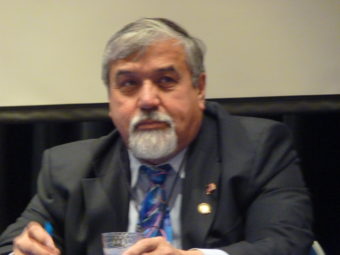
Haines Rep. Bill Thomas speaks at a 2011 Southeast Conference forum. Image by Ed Schoenfeld.

Thomas says he supports the governor’s plan to reduce spending by eliminating 284 funded, but unfilled, state jobs.

The Haines Republican doesn’t write the capital budget, which funds public-works projects around the state. But he has influence as a finance committee member.

Thomas plans to push for a powerline that could lower the price of electricity in one Southeast village.

“It’s been a project that we’ve been pushing for years. And for two years now it’s been vetoed. It’s for the intertie service for Kake. I think we’re going to try one more time and see. Maybe we’ll have to go for less money and build it over a two-year period, or something,” he says.

Other preferred projects include Angoon erosion repairs, statewide harbor improvements and village energy projects.

Thomas would consider additional funding for the first Alaska Class Ferry, if what’s budgeted now is not enough. But he questions the need for a whole new design.

“We’ve got now some of the finest boats running around and they’re 50 years old. Seems to me if it’s not broke, why fix it. These are working fine. I just don’t get it, I guess,” he says.

Thomas has authored or backed several veterans’ assistance bills. He’s also sponsoring a bill to help veterans to apply military experience to some occupational licensing requirements.

“Let’s say that you’re a captain in the Coast Guard and you come out and want to be a marine pilot or maybe a marine highway captain, this will allow you to use some of your sea hours, if you have six years or so of duty, you come in and we can help you waive some of that,” he says.

This is Thomas’ final session representing more than two dozen small communities from Metlakatla to Skagway to Cordova. Reapportionment will drop some of those towns, while adding Sitka to the district.

He says that will mean an extra push for his current constituents’ projects.

“The way we look at it now we’re going to be losing one representative and one senator. So we have to work together and anything anybody puts in hopefully we’ll be able to protect and work with each other. And we’re going to have to work with each other harder than we ever have before,” he says.

In addition to finance, Thomas serves on the Legislative Budget & Audit Committee.

Hear Angoon Sen. Albert Kookesh discuss his legislative plans.

Hear Wrangell Rep. Peggy Wilson talk about her legislative priorities.

Hear Sitka Sen. Bert Stedman describe his legislative plans.

Sealaska offers scholarship bonus

Descendents of Sealaska shareholders have until March to apply for corporate scholarships. But those submitting applications this month will receive an extra $50.

About 400 college, university and vocational school students receive the scholarships every year.

The money comes from Sealaska, the regional Native corporation for Southeast. It’s distributed by the Sealaska Heritage Institute, the businesses’ cultural arm.

Institute President Rosita Worl says the merit-based scholarships run from about $1,000 to $4,000 a year. The amount is based on each student’s year in school, as well as his or her grades.

“They have to be in good standing in their school. And we require a minimum of a 2.0 (grade-point average). If they fall below a 2.0, they go on probation for a semester and they have a semester to bring their grades up,” she says.

Applications must be filed online, through the institute’s website.

Forms, transcripts and letters of recommendation must be submitted by March 1st. Those completing paperwork by February 1st get the extra $50.

Students must attend an accredited institution full-time.

“One of the objectives is to train our future managers and employees of not only Sealaska, but our Native organizations. So in addition to the scholarship, we also have an intern program,” Worl says.

Students do not have to be Sealaska shareholders to receive scholarships. But they must prove they are a lineal descendent. The corporation has more than 20,000 shareholders, about half living in Alaska.

Site notifications
Update notification options
Subscribe to notifications