Ed Schoenfeld, CoastAlaska

Geologists find more volcanoes, lava, in Southeast

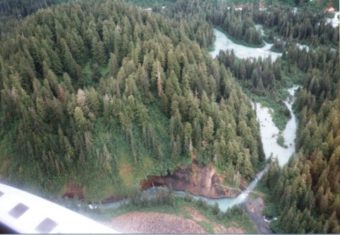
The Blue River cinder cone and lava flow, near the U.S.-Canada border northeast of Ketchikan. Photo by Jim Baichtal.

If you’ve spent any time in Sitka, you’ve probably seen Mount Edgecumbe. It’s one of Southeast Alaska’s most-viewed volcanoes, rising 3,000 feet from the ocean, only 10 miles from the former Russian capital.

It last erupted about 4,500 years ago, which is recent in the world of geology. But other volcanic sites in the region have seen more recent action. A dedicated group of geologists has spent several years searching for lava in the rainforest.
“So we are walking down the rec center road at UAS and on our right, or north side of the road, is a wondrous outcrop,” says Cathy Connor, as she approaches a rock face recently exposed by construction at the University of Alaska Southeast.

Geologist Cathy Connor points out quartz veins in a road cut near the University of Alaska Southeast Juneau campus. Photo by Ed Schoenfeld.

The Juneau geologist and geology professor points to an outcrop of asbestos, veins of quartz, and something else.

“Notice what’s happening now. What do you see up there? Do you see any change in color?” she asks as she points to a darker rock deposit.

“What I think we’re having here is just a little place where lava vented at the sea floor. And we’re getting some pillows of basalts where the magma rose, hit that cold sea floor and then gelled into a balloon or beach-ball sort of shape. And now that it’s all exposed it’s oxidizing, and making that rusty color,” Connor says.

The lava formed about a hundred million years ago, the quartz about 40 million. And that’s the same range as many similar rocks throughout the region.

But elsewhere in Southeast, volcanic activity is within the realm of human memory.

The Blue River cuts through a recent lava flow near the U.S.-Canada border. Photo by Jim Baichtal.

“The youngest basalts, the youngest eruptions that we know of, are about 110 years old,” says Susan Karl is a research geologist for the U.S. Geological Survey in Anchorage.

She says that lava, on the U.S.-Canada border northeast of Ketchikan, was dated by counting rings on trees caught in its path.

“Because they’re that young, they’re the youngest ones we know of right now, it’s certainly possible that more of these volcanoes could erupt at any time. We don’t see them as an imminent volcanic hazard. But they certainly are something we should be keeping track of,” Karl says.

“It’s quite surprising how many volcanics there are in Southeast,” says Jim Baichtal, a geologist for the U.S. Forest Service in Thorne Bay.

He, Connor and Karl have spent the past two or so years searching for new cinder cones, lava flows and other volcanic evidence.

Karl says they’ve found a dozen features, bringing the known regional total to about 50.

“Jim has given a number of talks around Southeast Alaska and shown people pictures. They’ll come back and tell us, ‘Oh, I’ve seen one like that over in this place or that place.’ And that’s actually how we’re found some of the new volcanic centers,” Karl says.

Some of what they’ve found appear to be eruptions beneath long-gone flows of ice. That interests Baichtal.

“If that‘s sub-glacial, it can actually blow a hole up through the ice, and it collapses back on itself. But as this thing continues to erupt, you may have an ice wall all the way around. And that’s what we believe Painted Peak, in behind Ketchikan, is,” Baichtal says.

Basalt columns on Suemez Island. Photo by Jim Baichtal.

So why are there volcanics in Southeast? It’s all tied into the region’s geological history. Basically, a series of tectonic plates – slow-moving chunks of land or ocean floor – crash into, and becoming part of, our mainland.


As they collide, rub against, or slide under each other, they heat up, or create cracks that release magma.

Karl, of the U.S. Geological Survey, says the region’s volcanic centers line up along major faults – or the intersections of two faults.

“So what the faults are doing is they’re providing a plumbing system, they’re providing an avenue for these little puddles of melt under the margin to come up,” Karl says.

Chemical analysis shows the recent arrivals are part of a much-larger volcanic system stretching into parts of British Columbia and the Yukon Territory.

Back at the university rock cut, geology professor Connor points out ribbons of quartz running through a crumbly, slate-like layer. They were formed as the Earth’s crust bent and flexed, which also brought a belt of gold-bearing rock into the ground beneath Juneau.

There’s evidence that the bending and flexing may have been a result of ice-age glaciers melting fast, allowing the land to rise. Could today’s climate change-caused shrinking icefields create a similar situation?

“I suppose it’s always a possibility. You just have to hold onto your socks, and see what comes,” she says, laughing.

Bill would expand geoduck farms to Gulf of Alaska

Alaska geoducks. Photo by Alaska Fish and Game Department.

Legislation allowing geoduck farming to expand north and west is moving in the state Senate.

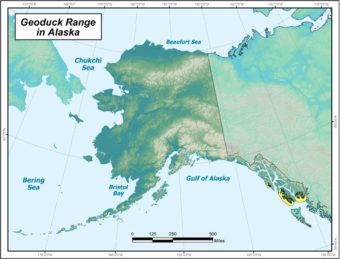
The measure would allow the large, valuable clams to be grown north of their natural realm. That ends around Juneau.

It would permit geoduck farms in Yakutat, Prince William Sound, Kodiak and other locations. Kachemak Bay is exempt because it’s been designated a critical habitat area.

House Bill 60 works on trying to promote economic development around the coast of Alaska,” said Homer Republican Representative Paul Seaton, the main sponsor.

He described the measure to the Senate Natural Resources Committee on Monday.

“It is very difficult to get a new economic base in many coastal towns, especially those that will not conflict in time with salmon and herring fishing,” he said.

A version of the bill introduced five years ago raised concerns among some biologists and lawmakers. They worried the large clams could become an invasive species, competing with other shellfish and ocean life.

But Seaton says geoducks will not spread outside farm areas.

The natural geoduck range in Alaska. Map by AK Department of Fish and Game.

“And the probability is that since the water has to be warmer before they will spawn, that they’ll be just like oysters up in Kachemak Bay where they never reach a temperature to spawn. And so we’re not talking about a proliferation of the species,” he said.

The stationary filter-feeders are farmed in subtidal areas. Larva, from a hatchery in Seward, are planted in the ocean floor and feed on their own. They need about seven years to mature, and could take longer in colder waters.

Southeast farmers recently began selling geoducks on the open market. They’re taking advantage of prices of more than $20 a pound. Larger farms raise and sell geoducks in British Columbia and Washington State.

Paul Fuhs of Sea Farms Alaska wants the same thing to happen along the Gulf of Alaska.

“If you pass this it’s not going to be a wasted effort. We would go immediately to a research permit, go in and get some in the ground and see how they grow, mortalities and things like that. We don’t have any experience with it yet, but they’re growing in Resurrection Bay water right now from the hatchery … so I don’t see any reason that shouldn’t work,” he said.

Seaton’s bill passed the House last year, but was not heard in the Senate until Monday’s hearing. After hearing about the bill, the resources panel moved it on to the chamber’s Finance Committee.

Behind the scenes of geoduck farming with Washington state’s Taylor Shellfish Farms, the biggest geoduck farmers in North America. Taylor’s farm is intertidal, while Alaska farms are subtidal.

Otter measure drops whole-pelt sales provision

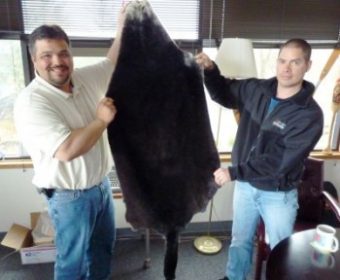
Will Ware, left, and Derek Lopez display the pelt of a sea otter at the Petersburg Indian Association office in 2011. Photo by Ed Schoenfeld.

The House Resources Committee has approved a scaled-back measure aimed at increasing sea otter harvests. It’s a significant change for the resolution authored by Wrangell Representative Peggy Wilson.

Aide Arthur Martin addressed the committee on Monday.

“A concern was raised with the ability of Native peoples to sell sea otter pelts to anyone. So we removed all mention of the sale of intact sea otter pelts and crafted the language and a few changes that clarified the issue,” Martin said.

Federal rules allow only coastal Alaska Natives to kill otters. And they can only sell pelts to non-Natives that are turned into traditional clothing or crafts.

The updated resolution calls for the state to work with federal officials to update otter harvest rules. That includes allowing Natives to turn pelts into modern handicrafts. The change could encourage more hunting by providing a larger market, but not as much as whole-pelt sales.

Fishermen and divers have seen shellfish numbers drop as the voracious marine mammals expand their numbers and range. That’s led some to ask the federal government to increase otter harvests.

Sea otters rest on their backs near Sitka Sound in 2011. Photo by Ed Schoenfeld.

Sitka’s Mike Miller, of the Indigenous People’s Council for Marine Mammals, told the committee it’s a serious threat.

“There’s definitely concern in the Native community about the impact the otters have. And we need to protect both the otters, but also the resources the community relies on like subsistence and commercial shellfish and things like that,” Miller said.

Others asked the committee to drop any effort to slow otter growth. They said such actions would upset the environmental balance and inspire national protection campaigns that could hurt tourism.

“Opening the door for predator control for sea otters also opens the door for predator control on other protected species such as Steller sea lions and humpback whales,” said Tina Brown of the Alaska Wildlife Alliance.

“And if you don’t think this is the case, haven’t been listening, because people are already talking about that,” she said.

But Petersburg Vessel Owners Association Executive Director Julianne Curry said many of her members want increased harvests.

“What we’d be looking for is for coastal Natives, who are allowed to harvest under current regulations, to be able to sell a sea otter pelt to a non-Native,” Curry said.

Sponsor Wilson says she will consider further changes to the resolution.

Tlingit clan conference set for this spring in Sitka


The late Andy Hope, conference organizer, during the 2006 event. Photo by Peter Metcalfe.


Anthropologists, linguists and elders will gather in Sitka this spring for a conference of Tlingit tribes and clans. It coincides with the 100-year anniversary of Alaska Native Brotherhood, the state’s oldest indigenous-rights association.

Organizers are meeting in person and by phone to assemble this year’s clan conference.

“The idea is that it’s sort of a combination of a down-home get-together and an academic conference,” says Richard Dauenhauer, a Juneau-based author, researcher and linguist, as well as one of the event organizers.

“So we encourage both academic participation, but also just folks in the community. Everybody has a chance to get together and we get different perspectives on things,” he says.

The event, called “Sharing Our Knowledge,” takes place March 29th through April 1st at Sitka’s Harrigan Centennial Hall.

Presenters include tradition-bearing elders, historians and anthropologists from Southeast, the Pacific Northwest, and as far away as Germany. (Read about the previous Clan Conference.)

“What’s unique about this is that for academics they get an opportunity to speak and kind of mix it up with people who are actually living the culture,” says Peter Metcalfe, an author, researcher, and one of the conference organizers.

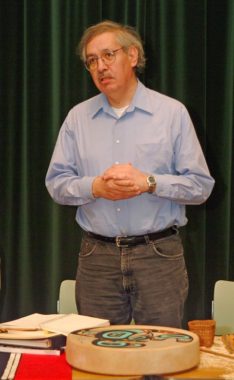
Nora and Richard Dauenhauer, Kathy Kolkhorst Ruddy, Peter Metcalfe and Ishmael Hope.

“The part I like about it is that it’s very accessible. There’s a lot of very intimidating concepts, linguistics and cultural anthropology and so on. But people aren’t really talking down, they’re speaking English – or Tlingit, as the case may be. There’s very little jargon and people are very respectful each other,” Metcalfe says.

He says the public is welcome, whatever their background or interest.

The Sitka clan conference will include sessions on the Alaska Native Brotherhood, which is celebrating a century of work, as well as the Alaska Native Sisterhood.

That’s a topic of interest to Kathy Kolkhorst Ruddy, another person helping with the event. She, Metcalfe and Dauenhauer researched and authored a study of the ANB’s role in protecting Native rights.

“And I learned a lot about the history of the success of the Alaska Native Brotherhood in preventing extinguishment of aboriginal title. It was very close. People don’t know the drama of that story. So I’m eager that that success of the Brotherhood and Sisterhood be highlighted,” Ruddy says.

Other sessions will focus on museums, access to digital collections, archeology training, traditional art and food, and other topics.

A Chilkat blanket is displayed at the 2007 Clan Conference. Photo by Peter Metcalfe.

Language expert and author Nora Marks Dauenhauer will present at the conference, as well as work behind the scenes. She’s been recording elders and transcribing their oratory since the late sixties.

“That’s part of the reason I’m glad that the conference is happening. I think there’s a lot of people who would like to have their stories told,” she says.

Clan conference sessions will be videotaped and made available to those who can’t attend.

See photos from the 2009 conference.

Southeast Native leader opposes oil tax cuts

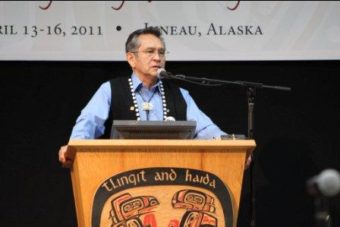
Tlingit-Haida Central Council President Ed Thomas.

A key Southeast Native leader is asking the Legislature to not lower oil taxes.

Tlingit-Haida Central Council President Ed Thomas says Alaska needs the revenue. He also says oil companies are already making huge profits.

“If there’s no incentive for them to get more oil under those conditions, I really don’t think a few dollars of taxes taken away from our education programs or rural energy programs is going to make a difference,” he says.

The Central Council is a regional tribal organization representing more than 28,000 Tlingit and Haida Indians in and outside Alaska. It runs health, job-training, business, public safety and other programs.

Governor Sean Parnell says lowering taxes would promote new development needed to keep oil revenues coming. The House has passed such a measure, but the Senate wants a different plan.

Thomas says even talking about tax cuts is a bad idea.

“If the oil companies are going to keep getting promised that they are going to get cutbacks in taxes, they’re not going to drill. You know that and I know that. Because they’re waiting for the better deal. They can afford to wait because they have barrels of money already,” he says.

Thomas spoke at Wednesday’s Native Issues Forum in Juneau. His comments followed statements from House Speaker Mike Chenault and Representative Reggie Joule.

Rural lawmaker pushes place-based education

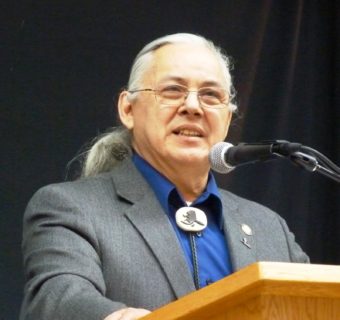
Rep. Reggie Joule addresses the Native Issues Forum. Photo by Ed Schoenfeld.

A Western Alaska lawmaker says place-based education is working.

Representative Reggie Joule, a Kotzebue Democrat, told Juneau’s Native Issues Forum today that the approach makes sense.

Theme- or place-based education teaches traditional subjects using students’ frames of reference.

Joule cited a math class he and other lawmakers visited last year at Barrow’s high school.

“The issue they were working around was height, distance and time. The problem that they were solving was in throwing a harpoon in which you hunt the whales with. What’s the time it takes to reach a certain point? What’s the time it takes to come down? What’s the distance? Those kids were into it big time,” he says.

Middle-schoolers compared the density of whale meat and blubber. And elementary students worked on kuspuk, or parka, designs.

Joule says those students were also very engaged in their classes.

“We put some money out there for a pilot project that’s taking place in the Iditarod Area School District. Because their board’s vision was to be, and to deliver to students, relevant education without losing the expectations and standards of what the education community needed to have,” he says.

Other Alaska schools use the technique. A legislative task force last year recommended more schools try place- or theme-based education.

Link to the final recommendations from the Alaska Legislative Task Force on Theme-Based Education.

Site notifications
Update notification options
Subscribe to notifications