A roadmap for Southeast Alaska energy development is meeting some resistance from the Southeast Conference.
The regional organization’s Energy Committee passed a resolution Tuesday supporting parts of the state-funded Southeast Alaska Integrated Resource Plan. But it called for continued work toward a regional electrical grid, which the draft plan calls too expensive.
Merrill Sanford chairs the Southeast Conference Energy Committee. Photo by Ed Schoenfeld.
Committee Chairman Merrill Sanford of Juneau said the Alaska Energy Authority plan lacks some important elements.
“This is not a fix-all by any means. But I think we’re at a crossroads here and we have to do something. We have to move forward with something,” Sandford said.
The resolution calls for construction of five hydropower plants – Sitka’s Blue Lake, Ketchikan’s Whitman Lake, Hydaburg’s Reynolds Creek, Angoon’s Thayer Lake and Hoonah’s Gartina Creek.
It also supports two new powerlines – one from Petersburg to Kake, the other from Metlakatla to Ketchikan.
But many at the meeting objected to its emphasis on wood-powered space heaters as a way to reduce electrical demand.
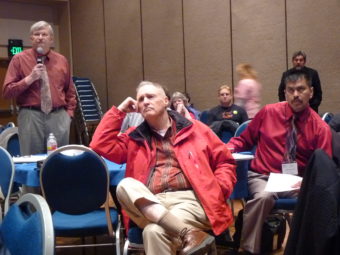
Wrangell's Paul Southland speaks as Juneau's Bill Corbus,center, and Angoon Mayor Albert Howard listen during debate over the Southest energy plan. Photo by Ed Schoenfeld.
Angoon Mayor Albert Howard said biomass energy should not replace long-planned, much-needed powerlines and plants.
“You talk about a Johnny-come-lately project, biomass is it. Where did that come from? Southeast Conference has talked about interties for years and all of a sudden, we’ve got biomass,” Howard said.
The resolution supports wood-powered energy, especially as part of Southeast’s timber industry.
But it makes other projects a higher priority.
It also calls for full funding for studies of other hydroprojects. And it emphasizes the need to build regionwide electrical interties, including a cross-border link to Canada’s power grid.
The Southeast Conference is holding its mid-session summit in Juneau. Its board of directors will take up the resolution before the plan’s March 19th comment deadline. The draft plan was developed by an Alaska Energy Authority contractor.
Government, business and tribal leaders gather in Juneau this week for the Southeast Conference’s Mid-Session Summit.
They’re discussing energy issues, resource development, tourism and plans for a regional landfill. Sessions will also cover job development in the mining, timber and maritime industries.
Congressman Don Young will address the summit Wednesday.
The 54-year-old organization holds its annual meeting every fall in a Southeast or nearby community. The late-winter mid-session summit updates members on regional issues and provides a chance to meet with lawmakers. It takes place Tuesday through Thursday at Juneau’s Centennial Hall.
Juneau's Jordan Creek watershed has undergone a stormwater impacts assessment. Photo courtesy Southeast Alaska Watershed Coalition.
Activists across Alaska are organizing to protect local watersheds. They met last week in Juneau to compare notes and make plans for future efforts.
They include a Haines group studying a hydropower dam’s possible impact on salmon and a Prince of Wales Island organization focusing on habitat restoration. Other groups and officials came from Juneau, the Kenai Peninsula and the lower Yukon River.
“And what the coalition works on specifically is trying to get resources in to community development professionals or natural resource professionals that are working locally,” she says. “So, we can make more informed decisions about where we should develop, where we should conserve or where we should restore lands.”
She says some of the groups work in relative isolation. That was much of the motivation for the three-day Juneau meeting, which was cosponsored by the National Forest Foundation.
Municipal leaders, resource agency staff, tribal governments, businesses, and environmental groups were among those attending the Community-Based Watershed Management Forum.
Kayser says the groups discussed a major wetlands initiative.
“Those systems deal with water quality, flood control, fish and habitat, tourism and recreation. In addition, we want to support sustainable, industrial enhancement projects. And how we can assess our watersheds to know best where those enhancement projects should be,” she says.
She says the coalition does not want to block development. But it hopes to make sure fish habitat, water system intakes, natural flood control and watershed ecosystems are protected.
“We have mines, but then there’s also harbor projects, there’s hydroprojects that are being looked at. And then on a smaller scale, there’s schools, fire halls, those type of things,” she says.
Kayser says those at the meeting agreed to collaborate more, sharing information, techniques and successes.
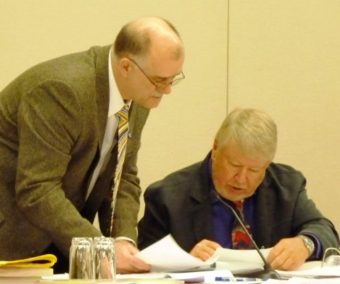
Fisheries Board member John Jensen, of Petersburg, and chairman Karl Johnstone, of Anchoage, review documents during their meeting in Ketchikan. Photo by Ed Schoenfeld.
Sport fishermen and chum trollers have reached a compromise in a salmon allocation battle in northern Southeast.
Chum salmon trolling is relatively new in Southeast.
“It’s only in the last 20 years, but particularly in the last four or five, the trollers have really been able to target hatchery chums,” said Eric Jordan, who represented the Chum Trollers Association at the Ketchikan Board of Fisheries meeting.
He said the Icy Strait and North Chatham Strait fisheries were worth $1 million to trollers last year.
They wanted the fishery to grow. So they put a pair of proposals, numbers 325 and 326, before the Fisheries Board.
One expanded spring harvest areas in Icy and Chatham straits. The other added a summer troll area in upper Stephens Passage, which is much closer to Juneau.
That didn’t go over well with capital city anglers. Larry Edfelt of Juneau-based Territorial Sportsmen says the plans encroached on popular fishing areas.
“We wanted to protect the king and coho access. And we were afraid that if you put 150 trollers into the north end of the Juneau area that a lot of juvenile kings and feeder kings and cohos would be caught in addition to a lot of chums,” Edfelt said.
Rather than butt heads before the board, they decided to work together on a compromise. The commercial group gave up much of what it wanted, while the sportsmen dropped objections to the remaining fishing grounds.
Jordan said it was a good deal for chum trollers.
“We ended up with less area and less time than we wanted in the new area on the Admiralty shore. But we figure we’ll have an even higher percentage of hatchery fish,” Jordan said.
He said the compromise allows trollers to target hatchery chums and hatchery kings, switching from one to the other as caps are reached.
Edfelt said the sportsmen are satisfied, because they were able to keep trollers out of popular fishing areas off the northern part of Juneau.
“They agreed to not only a reduced area but (also) a four-day fishery that did not include Friday, Saturday and Sunday,” Edfelt said.
The measure has a sunset clause, so the expansion will come back before the Fisheries Board in three years. And there’s more to the agreement.
“The chum trollers have agreed to not try to expand that fishery without gaining the consensus of the Juneau sport fishermen and charter fishermen, as well as the gillnetters,” he said.
The compromise is one of a number that developed during – or leading up to – the Fisheries Board meeting.
Jordan said that’s becoming more common. He says it’s good for Alaska’s fisheries.
“If the interest groups will get together and solve their own problems, as much as they have to compromise, they usually end up with a better deal than if the seven dark angels of the Board of Fisheries have to swoop in and decide it for you,” he said.
He credits the board, particularly Chairman Karl Johnstone, for encouraging negotiations.
Johnstone said he puts the proposals with the most impact before the whole board, rather than running them through a committee. He said that seems to quell some of the controversy.
“And the wind kind of goes out behttp://ktoo.sandbox.5mts.com/wp-admin/post.php?post=15264&action=edit&message=10cause everybody has pretty much decided one way or the other what’s happened. And the rest of the proposals are available and people seem to be more conciliatory,” the retired judge said.
Gillnetters, Fish and Game Department staff and a charter group joined the chum trollers and the sportsmen in drafting this particular compromise.
Their measure passed the board on a unanimous vote.
The braided channels of the lower Taku River, east of Juneau. Photo courtesy AK Department of Fish and Game.
Sport anglers will not get to fish for king salmon in the Taku River. And personal-use fishermen won’t be able to use dipnets or have a longer sockeye season.
The state Board of Fisheries rejected several requests to change Taku River fishing during its meeting in Ketchikan. The salmon-rich waterway, east of Juneau, runs from British Columbia to Taku Inlet.
The sport Chinook fishery was proposed by the Taku Users Group, representing riverbank cabin-owners. Fish and Game Department staff warned it could violate an international agreement governing fisheries from Oregon to Alaska.
Juneau board member Bill Brown spoke in opposition.
“It flies in the face of the history we have about fresh water salmon fishing,” Brown said. “Also, we have a problem with treaty fish. That’s an ugly nightmare we don’t want to open yet again.”
Some of the same objections came up with other proposals from the Taku Users Group.
One would have extended the personal-use fishery from mid-June through August to coincide with a gillnet opening. Another would have increased the household bag limit based on the number of family members.
Yet another would have allowed personal-use dip nets in the river, which Juneau residents access by boat.
Talkeetna board member Tom Kluberton said it would be popular.
“I think we would unleash a tremendous dip net fishery from boats down that way. That would offer much more opportunity to go and try for this harvest,” Kluberton said.
But other concerns, including salmon treaty implications, led the board to vote the proposal down.
It also rejected an Alaska Trollers Association plan to increase access to Taku River kings. Trollers proposed lengthening openings and changing how they are determined. Now, they’re tied to the gillnet fishery, which has a larger harvest.
Kodiak Board member Sue Jeffrey said she understands trollers want an equitable share. But she said the plan would create more conflicts.
“This is an area where we should just back off for now and let the rebuilding continue. So I’m leaning away from supporting this,” Jeffrey said.
Like other Taku River proposals, it failed on a unanimous vote.
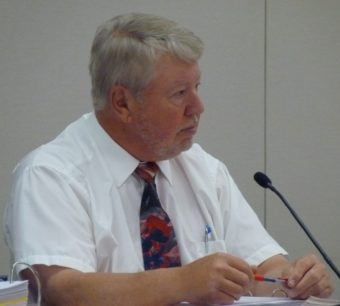
Board of Fisheries Chairman Karl Johnstone at the Ketchikan meeting. Photo by Ed Schoenfeld.
Board of Fisheries Chairman Karl Johnstone says he did nothing wrong when he charged the state for hotel and meal costs during a meeting in his hometown.
The Alaska Journal of Commerce reported Thursday that Johnstone was reimbursed $1,440 in hotel, per diem and transportation costs for the October meeting. It took place in Anchorage, where he and his wife own a home. They also have property in Arizona, where they spend winters.
Johnstone, interviewed Thursday at Ketchikan’s Board of Fisheries meeting, said he and other members work long hours.
“There’s a lot of reading to do and a lot of lobbying going on. And I thought rather than drive back and forth the 14 or 15 miles in the winter, I would better off if I was there and I could be available,” he said.
Johnstone, a retired judge, said he was given waivers for his meeting expenses. State rules require such waivers.
A later report on the Journal of Commerce website quoted Fish and Game officials, who said Johnstone followed proper procedures.
“I was told that was normal and I was given a waiver to do that. And in my opinion, I followed all the rules that I was supposed to follow. And it sounds like reading the second article, that the state agrees with me on that,” he said.
Johnstone was appointed to the Board of Fisheries about three years ago by then-Governor Sarah Palin.
Palin was criticized for charging the state expenses while staying at her Wasilla home when in office. Her predecessors, as well as her successor, live at the Governor’s Mansion in Juneau.