Ed Schoenfeld, CoastAlaska

Central Council addresses Southeast sea otter issue

Southeast Alaska’s largest tribal organization is pushing for changes in sea-otter management.

Tlingit-Haida Central Council delegates passed an otter resolution at their tribal assembly last week in Juneau.

Sea otter numbers are growing exponentially in Southeast. Council President Ed Thomas says that’s damaging stocks of some key species.

“They seem to be raising havoc around many of our communities. And not just subsistence, but also the divers who go after sea cucumbers and sea urchins,” he says.

Alaska Natives are allowed to hunt otters and give or sell them to other Natives. Proposed legislation would allow whole pelts to be sold to non-Natives.

Thomas says the council wants to do more to slow population growth. But its concerned expanded sales could compete with otter products in the handicraft market.

Tlingit-Haida Central Council President Ed Thomas.

“We don’t want to export anything that will undermine the local utilization. But where there is a potential for surplus we would like to still get some of those exported in the raw and to set up a system whereby they would be able to bring those back, competing with local artisans,” Thomas says.

He says the council is already trying to work with federal officials on otter management issues.

Council delegates also elected officers at the assembly.

Thomas outpolled former Sealaska CEO Bob Loescher to retain the president’s seat, which he’s held for most of the past 30 years. Loescher was named Citizen of the Year.

Six incumbent vice presidents were also re-elected. Thomas says it’s the first time the full Executive Council has gone unchanged.

Funding prospects are always a major topic at the tribal assembly. Thomas says they’re not looking good.

“It’s really very difficult to get into a growth scenario when we have cutbacks. I think there might be some opportunity in energy programs. But, boy, everything else is under fire,” he says.

Thomas expects federal-funding reductions that could lead to staff and program cuts. He says that would start with administrative spending, but likely move into other areas.

Other news from the tribal assembly:

  • Delegates also approved a resolution strongly opposing the exclusion of Alaska Native tribes from the Violence Against Women Act. The federal act is currently going through a re-authorization. The council says the current version of the VAWA (H.R.4154, H.R.4271 and S.1925) discriminates by singling out all Alaska Native tribes with the exception of the Metlakatla Indian Community, and removes the pre-existing authority of Alaska Native tribes to issue civil protective orders.
  • Delegates re-elected 1st Vice President William Micklin of San Francisco, 2nd Vice President Robert Sanderson Jr. of Ketchikan, 3rd Vice President Yodean Armour of Klawock, 4th Vice President Richard Peterson of Kasaan, 5th Vice President Harold Houston of Juneau, and 6th Vice President Lowell Halverson of Seattle.
  • Ed Thomas presented Mary Elizabeth Jones with the President’s Lifetime Achievement Award for her many contributions towards improving healthcare services for Tlingit and Haida people and strengthening Alaska Native women’s political positions within their communities.
  • The Doloresa Cadiente-Hardin Tribal Justice Award was presented to its first two recipients: Tribal Child Support Unit Attorney Jessie Archibald and Alaska Legal Services Corporation Attorney Holly Handler.

New director for Catholic Community Service

A major Southeast social-service agency has a new top official.

Jean Strafford will take over as executive director of Catholic Community Service on May 1st.

The Juneau-based nonprofit provides assistance to senior citizens and families, offering transportation, meals and child-care services to Southeast residents. It also runs the capital city’s hospice program.

Strafford has been Catholic Community Service’s finance director since last summer. She also held that post from 2001 to 2005. In addition, she worked for the Sealaska Corporation, the Juneau Economic Development Council, and Juneau’s municipal government.

Board Vice President John Greely says that experience made her the strongest finalist.

“She’s been our financial wizard there for quite a few years and knows the ins and outs of the agency and has the confidence of the employees. So she seemed to be the logical choice,” he says.

Strafford takes over from Rosemary Hagevig, who is retiring after 14 years on the job.

No significant changes are expected. Greeley says funding is a major challenge.

“We’re sort of waiting for the shoe to drop in Washington D.C. with some of the agencies that are our major grantees. We’re hoping that for the next year or so the funding will be stable enough that we don’t have to restructure a lot of our programs,” he says.

Catholic Community Service has 200 employees and 250 volunteers. It was founded in 1974.

Festival celebrates Buddy Tabor, Barb Kalen

Colette Costa and Hootenanny in Heaven choir sing "Just a closer walk with thee," one of Buddy Tabor's favorite hymns.
Southeast Alaska lost two well-known and much-loved acoustic musicians during the past year.

Juneau’s Buddy Tabor and Skagway’s Barb Kalen sang, strummed and put together musical events during their many years in the region.

Friends sing and play during a Barb Kalen tribute.

Both were celebrated at the Alaska Folk Festival, a seven-day series of concerts held last week in the Capital City. Here’s a taste of the sound of their tributes.


Southeast harbors targeted for upgrades

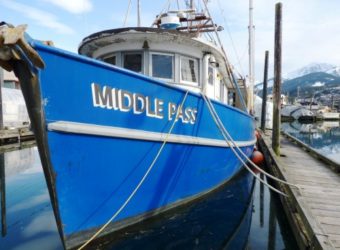
The Middle Pass is among the vessels docked at Aurora Basin, a Juneau harbor slated for repairs. The float it's tied up to is starting to sink. Ed Schoenfeld photo.

It looks like about 10 Southeast Alaska boat harbors will see repairs or construction soon. The capital budget moving through the Legislature provides millions for docks, ramps and associated facilities.


More than $33 million dollars is slated for harbors around the state, and more money covers cranes, ramps and other related work. About two-thirds of that amount is for work in Southeast.

Some of the harbors are just worn out.

“It’s to the point where the repairs aren’t really doing anything anymore. It just needs to be replaced,” says Juneau Port Engineer Gary Gillette.

He’s talking about Aurora Basin, a harbor not far from the capital city’s downtown.

Parts of it were built in the 1960s and part in the ‘70s.

A float lists at Aurora Basin harbor.

“We’re tried to maintain it as best as we can for safety reasons. But the wood and the float material has become so saturated that it’s slowly sinking. And there’s only so much you can do at some point,” he says.

It’s in the budget for $2 million, which the city will match. Gillette says that will fund phase one of an overall $20 million project.

Petersburg’s also due for some harbor improvements.

“It’s just wonderful. The whole waterfront will be alive. And I think it will benefit everybody in town,” says Harbormaster Glo Wollen.

She’s looking at $3.5 million toward replacement of North Harbor, near the center of town.

There’s also about $5 and a half million in the budget for a commercial drive-down dock. And $800,000 to upgrade the crane dock at South Harbor, closer to the town’s ferry terminal.

“We’re rocking and rolling on the design aspect of all of them. We really were looking for the funding to be able to get going on them,” Wollen says.

Haines, Hydaburg, Hoonah, Sitka and Skagway also have money in the budget for harbor replacement or repairs.

Saxman, next to Ketchikan, has a small amount of money that could lead to a major expansion. Officials say only a few slips are available elsewhere.

“It’s awfully congested in the Ketchikan area. So this is really an ideal location for another harbor,” says Leona Haffner, Saxman’s city administrator.

She says the planned new harbor could accommodate a couple hundred fishing, recreation and tour boats.

The $350,000 in the budget matches another grant supporting design work. She says the location, near the town’s city hall, is outside the area’s most crowded waterways.

“Right now, that small passage has tour ships going through on a daily basis during tour system. We have the Alaska Marine Highway vessels going through there, as well as the fishing fleet,” Haffner says.

Most of the harbor projects were proposed by the Parnell administration through a municipal grant program. Others were added in by legislators.

Site notifications
Update notification options
Subscribe to notifications