The regional Native corporation for Southeast Alaska holds its annual shareholders’ meeting Saturday, June 23.
Sealaska Corporation has about 21,000 shareholders, many living outside the state.
Saturday’s meeting is at Juneau’s Thunder Mountain High School. It begins at 10 a.m. with a shareholder’s fair and comments from board of directors’ candidates and both sides of a term-limits resolution.
The meeting also includes a business report and election results. It ends at about 5 p.m. with a question-and-answer session for shareholders.
Critics say the hour planned for that session is too short, and is an attempt to muzzle opponents. Corporate officials say it was just an estimate and will run longer if needed.
Sealaska’s annual meeting will be webcast live through the corporation’s website. Only shareholders can attend the meeting in person or on the internet.
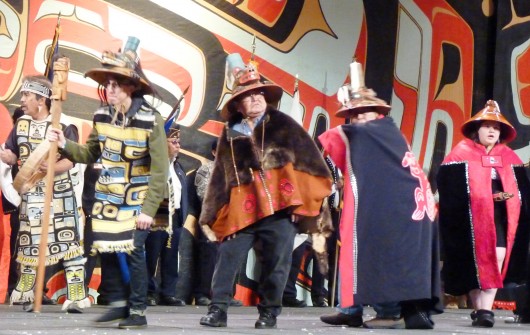
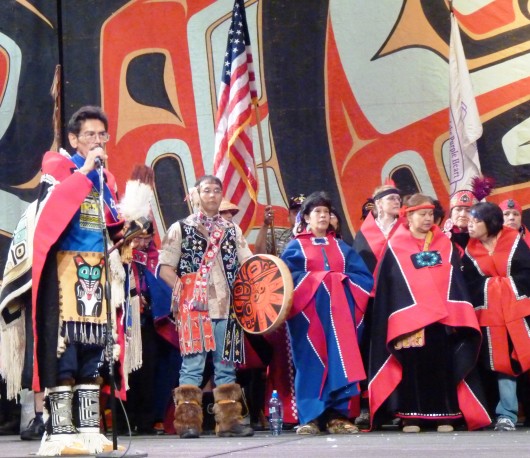
Xudzidaa Kwáan dance group leader Gilbert Fred takes the microphone near the start of Celebration 2012's Grand Entrance on Thursday, June 7, at Juneau's Centennial Hall. Photo by Ed Schoenfeld.
Celebration 2012 ended Saturday night with the Grand Exit, where more than 5o groups from Anchorage to Southeast to the Pacific Northwest made their final procession.
Xudzidaa Kwáan Dancers were at the lead. The Angoon group was also chosen to head up the Southeast Alaska Native cultural festival’s Grand Entrance, at the start of the three-day event.
If you were there, you would have seen dance leaders Gilbert Fred and his brother-in-law Alan Zuboff move back and forth across the stage, directing traffic as they sang and danced. From time to time, one would move toward the hall entrance, urging an arriving group to sync drumbeats with those on stage.
Fred says it was a great honor.
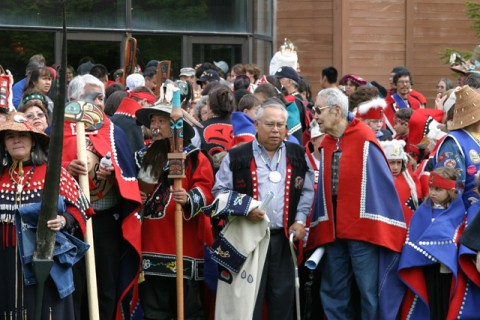
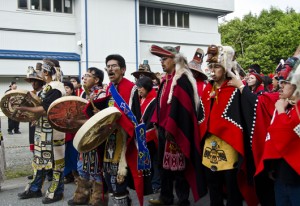
The Xudzidaa Kwáan Dancers of Angoon lead the Grand Entrance Parade down Juneau's Willoughby Aveue Thursday, June 7. Photo by Heather Bryant/KTOO.
“It was arduous and tiresome and it tested our fortitude and it was better than aerobics. But I think it was indeed a labor of love for our culture and for the fact that we had so many different nations coming together here and converging on Juneau to share our culture with one another,” Fred says.
The grand entrance continued for more than two hours, until everyone was in the hall.
Zuboff says the group’s strength comes from its experience, dating back generations.
“When it first began, it was just an elders’ group. But as time went on, the elders realized the young ones weren’t learning. So they did something that they had never done, and allowed (in) generations. They decided that the young ones, including the babies, should start dancing in order for them to learn,” he says.
Today’s group continues sharing those traditions. Members work with the Xootsnoowú Dachaxanx’i Yán dancers, formed through the Angoon school’s Indian Education Program.
Fred says the students are eager to learn, but have to get past their electronic distractions.
“One of the requirements in class, when they come to class, is to please turn their cell phones on silent and put them into your bag. We don’t want them dancing and then getting a ringtone and answering their phone while we’re supposed to be in character,” Fred says.
How does he keep them focused?
“We let them know that these songs and dances … carry a history connected with the people with the different clans. And it’s a part of who they are, and they have to know who they are and they will better succeed in life and they’ll better deal with peer pressure. It’s their culture that connects them to the community, to their parents and to their elders, and to one another.”
Like many traditional adult groups, the Xudzidaa Kwáan Dancers wear expertly-crafted regalia, adorned with images of their history and culture.
Zuboff wears a clan hat more than 300 years old. And he’s worn blankets handed down over three or four generations.
“It’s not just a common piece of thread or a piece of wood. It’s a bit of all the spirits of the older generation that made this and danced in them,” Zuboff says. “And sometimes you can maybe feel their energy in the dance group. Or sometimes you can hear them singing, to hear them saying, ‘Do this.’ ”
Every Celebration has a different lead dance group, chosen by a committee of the Sealaska Heritage Institute, which organizes the events.
Institute President Rosita Worl says members picked Xudzidaa Kwáan because of its strength, and its traditions.
Leaders Zuboff and Fred are thankful for the recognition. But they’re also glad they don’t have to direct such a massive group of dancers for a while.
“It’s almost like you feel your canoe get sucked into a tidal current, ” Fred says, getting a nod of agreement from Zuboff. “And we’re able to restabilize and readjust.”
Angoon dancers cross the stage during Celebration 2012's Grand Entrance. Photo by Ed Schoenfeld.
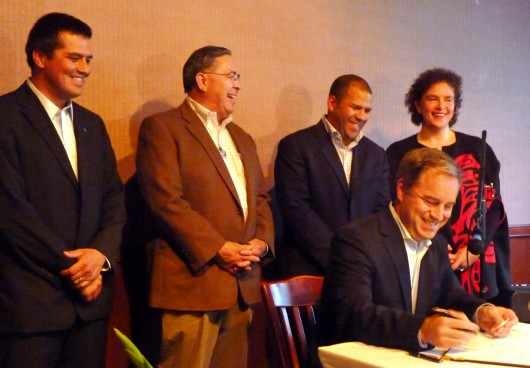
Gov. Sean Parnell signs a mariculture loan bill at Juneau’s Hangar Ballroom on Tuesday. Watching, from the left, are Haa Aani’ mariculture coordinator Anthony Lindoff, Sealaska CEO Chris McNeil, Haa Aani CEO Russell Dick and Commerce Commissioner Susan Bell.
The state is expanding its support for mariculture.
Governor Sean Parnell this week signed a bill creating a revolving loan fund for shellfish farms.
“The fund will be capitalized and if you want to engage in and begin operating a small business of that kind, you’ll now have greater access to capital in the state to do it,” Parnell said at the Juneau bill-signing. “You will also have an opportunity for a loan from the Alaska microloan revolving fund. This is a niche where the banks don’t offer it typically as a product. But (it’s) focused on access to capital for entrepreneurs of our state.”
The bill-signing was part of the kickoff reception for the Haa Aani OysterFest.
The event is connected to the Celebration 2012 Native culture festival. Haa Aani, part of the Sealaska regional Native Corporation, has helped start several oyster farms in rural Southeast.
The legislation also provides financial support for other business opportunities.
“There are two more revolving loan funds created in here related to communities being able to buy quota, something our communities have not had access to capital for, as well as the commercial charter revolving loan fund to allow individuals to get into the halibut charter business,” Parnell said.
OysterFest features cooks demonstrating recipes using Southeast-grown shellfish. It continues through Saturday across from the Sealaska parking lot in downtown Juneau.
An earlier DNA study sponsored by SHI took place at Celebration 2008. Photo by Brian Wallace/SHI.
A new genetic-testing effort could provide more information about the connections Tlingits and Haidas have with other tribal groups. A University of Pennsylvania expert is in Southeast to collect DNA samples. He’s hoping for cooperation from those attending this week’s Celebration 2012 cultural festival in Juneau.
The effort is part of a larger project analyzing the genetics of indigenous North American groups.
Principal Investigator Theodore Schurr says it could ultimately map out human migration routes, as well as link tribes.
“So we’re slowly being able to put together … data to see the more deeper history questions, the connections between communities here with those across all of North American on the broader and deeper scale. But also some of these more regional or even tribally based questions which I think are already understood or are being examined through linguistic studies, historical studies and also oral histories and the work being done by the tribes themselves,” Schurr says.
Schurr will be at Juneau’s Centennial Hall during Celebration 2012, which runs Thursday through Saturday. He’s working with the Sealaska Heritage Institute, which organizes the event.
No one is required to participate. Those interested will have the insides of their cheeks swabbed to provide DNA samples. Those will be analyzed, and what’s learned will be shared with the volunteer. The information will also contribute to the larger research project.
A similar genetic testing effort was conducted in 2008 by Washington State University. Schurr says this project will examine additional elements.
“We are taking, I think, the same approach as the earlier study, although analyzing perhaps a number more markers for the maternal lineages and the paternal lineages,” Schurr says.
DNA samples have already been collected in Yakutat and Hydaburg. The effort at Celebration will reach people from many other communities.
Schurr hopes to expand the effort to other villages. But he’s collecting more than cheek swabs.
“Ultimately DNA evidence will tell you a lot about genetic lineages. But why people bear certain genetic lineages has to have some sort of context for interpreting that,” he says.
Those providing DNA samples will also be interviewed about their genealogy. Schurr says that, and other information, will allow for a higher level of analysis.
“It makes a big difference to have geological evidence, oral history information, the archeology or so forth. Because that tells us something about the context in which people have come to live in a place sometime, who they’ve come into contact with, and how far and wide they might have dispersed because of environmental factors (such as) glaciers, or volcanoes, or things of this sort. And how in fact the diversity we see in certain places may be linked with the languages they speak,” he says.
Work done so far has shown some differences between members of the Eagle and Raven moieties.
Sealaska Heritage Institute President Rosita Worl, an anthropologist, has suggested the two groups were once members of different populations.
“I saw an earlier paper that he did where he begins to see that there is a difference and he was working with limited groups of people. But I think this will give him a larger population level to look at. I’m very hopeful,” Worl says.
She says the institute examined Schurr’s project carefully before agreeing to participate.
“I wanted to make sure that there would be no commercial use, that it would be for the specific purpose of this study. And if they were going to use it for other studies, they would have seek the permission of the donor and if the donor should die, that his or her heirs would make that decision,” she says.
Results should be available this year. Schurr says volunteers will find out about their individual data before group information is made public.
Dancers and leaders line up outside Juneau's Centenial Hall during Celebration 2006. Photo courtesy Ben Paul/Sealaska Heritage Institute.
Every Celebration, a different dance group leads the grand entrance parade into Juneau’s Centennial Hall. Dozens more follow in a procession that fills the street for several blocks and sets the stage for the every-other-year event, which began three decades ago.
Celebration 2012’s grand entrance will be led by the Xudzidaa Kwáan Dancers of Angoon. More than 50 other groups from Alaska, Canada and the Lower-48 will take the stage during the Thursday-through-Saturday event, which is Southeast Alaska’s largest Native cultural gathering.
It’s organized by the Sealaska Heritage Institute, the cultural arm of Southeast’s regional Native corporation.
“Celebration is a time when we come together as Tlingit, Haida and Tsimshian people to celebrate the survival of our cultures,” said institute president Rosita Worl, in a press release.
But it’s not all about song and dance.
There’s a Native Artists Market, showcasing Tlingit, Haida and Tsimshian traditions. The market will be held this year in a new, outdoor venue, with more space for a wider variety of art and contemporary goods.
“We want to be able to accommodate as many Native artists as we can because developing Juneau as a Native art center is one of our long-term goals,” Worl said.
Related events include a pre-celebration artists’ gathering and juried show, plus films, lectures and demonstrations. (See the schedule.)
Helen Abbot Watkins whips up soapberries during Celebration 2010's contest. Photo by Ed Schoenfeld.
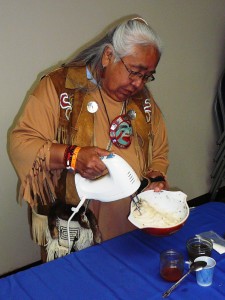
Then there are the traditional food events, such as the soapberry contest. Cooks from Alaska and the Yukon use hand- and electric-mixers to whip up the frothy treat.
There’s also a dried black seaweed contest, as well as an oyster festival focusing attention on Native-owned shellfish farms.
Other events include a toddler regalia revue, plus workshops on formline design and song-writing.
But for many, it’s all about the singing and dancing, which will bring about 2,000 people to the stage.
Celebration 2012’s theme is “Strengthen Yourself.” It’s spelled Ayanaltseenáa in Tlingit, Án hl is daguyáa in Haida and Lip sha gotgyednshm in Tsimshian.
Up to 7,000 thousand people are expected to attend. For those who can’t, the festivities will be broadcast on 360 North, the cable and internet channel that also broadcasts Gavel Alaska legislative TV coverage.
Schedules and other details are available through the sponsor’s website. There is an entrance fee.
Hear earlier reports and watch slideshows from other Celebrations:
More Alaskans are filing to run for the state Legislature as the deadline approaches.
As of this morning, only a quarter of the races remained without a challenger. That number was close to half earlier this week, and about a third Thursday.
The filing deadline for the August 28th primary is 5 p.m. today (June 1st).
All 40 House seats are on the ballot, as they always are. Nineteen of 20 Senate seats are also up for grabs.
Only 10 Senate seats are usually on the ballot. But redistricting changed boundaries enough to require all but one go before voters. That one is Juneau’s Senate district.
Retired University of Alaska political science professor Clive Thomas says those new boundaries may be a factor in unchallenged seats.
“It might have put off some people. I think that basically, the way redistricting works, it’s a political process, whatever people may say,” Thomas says.
Unopposed state Senators are Wasilla Republican Charlie Huggins, Eagle River Republican Fred Dyson, Anchorage Democrat Johnny Ellis, Kenai Republican Tom Wagoner, Bethel Democrat Lyman Hoffman, and Kodiak Republican Gary Stevens.
Unopposed Anchorage House candidates are Democrat Andy Josephson and Republicans Bob Lynn and Mike Hawker. Those from Juneau are Republican Cathy Muñoz and Democrat Beth Kerttula.
Also unopposed: Nikiski Republican Mike Chenault, Haines Republican Bill Thomas, Kodiak Republican Alan Austerman and Bethel Democrat Bob Herron.

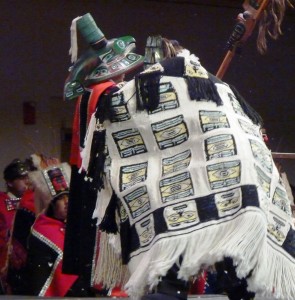 Zuboff wears a clan hat more than 300 years old. And he’s worn blankets handed down over three or four generations.