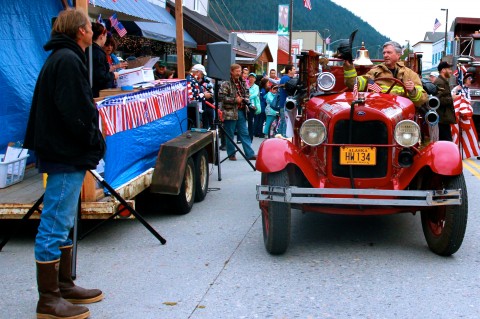
The ferry Malaspina sails by downtown Sitka during 2010 Alaska Day festivities. Ed Schoenfeld Photo.
New federal air-pollution restrictions will affect cruise and some other vessels sailing Alaska waters.
But they will not impact state ferries.
“It is a big issue for the state of Alaska, it is not necessarily a big issue for the Alaska Marine Highway System. All of our ships operating within 200 miles of the coastline already burn low-sulfur fuel,” says Captain Mike Neussl, the state’s deputy commissioner of marine transportation.
State ferries made the switch a number of years ago, before Neussl came on board.
The new air-emission limits come from the federal Environmental Protection Agency. They apply to what are called Emission Control Areas, or ECAs, within 200 miles of the coastline.
Officials say they’re part of an international effort to lower pollution that contributes to human illnesses and deaths.
Neussl says the required fuel is already available at ferry ports.
“The suppliers there already carry ultra-low sulfur diesel because that’s what they have and that’s what we use. So it wasn’t a big switch, and the switch that the marine highways made wasn’t in direct response to this upcoming implementation of the ECA,” he says.
The new rules go into effect Wednesday, August 1st
Organization General Manager Dave Owings says it’s funded by Princess Cruises, which sails into the bay.
“They approached us probably a year and a half or maybe two years ago now and asked what they could do to help increase the response capability in the Glacier Bay area,” Owings says.
The cache is a 20-foot container loaded with 2,000 feet of oil boom and related equipment. Owings says Princess’ donation is valued at just under $50,000.
He says the container is designed to be lifted and carried in a helicopter net.
“This was something we did several years ago and demonstrated it could work. It’s a very efficient and quick way to get equipment and, if needed, people to some of the remote places in and around Glacier Bay National Park,” he says.
The new gear adds to other spill-response equipment already staged in the area. That includes a response barge with a skimmer, a work boat, oil booms and other supplies and equipment.
Glacier Bay National Park and Preserve is about 50 miles west of Juneau, on the north shore of Icy Strait.
The petroleum resource organization, known as SEAPRO, has spill-response supplies and equipment stored in most Southeast communities.
Amos Wallace was a keeper. So his longtime home on Juneau’s Douglas Island held numerous documents from his nearly 70-year career.
Since he and his wife Dorothy passed away, their son, photographer Brian Wallace, has been going through the collection.
“I was in the basement in the earlier part of this year and I opened up some boxes of stuff and I saw some photos that I’ve never seen before, and unfortunately I found this,” Brian Wallace says.
“This” was a pair of black-and-white, historic photographs showing the elder Wallace with a totem pole he carved in Cincinnati, Ohio.
Both were badly damaged by water.
“I did not want this disaster to happen to the rest of the collection. So I immediately started putting everything together and organizing the archive and then I took it down to Sealaska Heritage [Institute]. And now it’s in a very safe place where it will be preserved for generations,” he says.
The Juneau-based heritage institute preserves and advances Tlingit, Haida and Tsimshian culture. It’s planning a new building, the Walter Soboleff Center, to house a growing physical collection, a digital library, classrooms and display space.
That will include the Wallace collection.
“In terms of going out and meeting the rest of the world, Amos was that ambassador for Tlingit people and for Tlingit art,” says Rosita Worl, the institute’s president.
She says Amos Wallace was an important artist and craftsman.
“He definitely brought attention to our art, nationally and internationally,” Worl says.
A drawing of a Frog image Amos Wallace created before carving. Image courtesy Brian Wallace and Sealaska Heritage Institute.
“And it certainly takes a person with character to do that,” says Zachary Jones, archivist and collections manager for the institute.
He says Wallace was enthusiastic about his culture and generous with his knowledge.
“He was there showcasing Alaska statehood, as sort of this Alaska Native representative to different people across the nation. [He was] on the Tonight Show, at museums, really sort of an individual teaching the Lower 48 about Alaska Native art,” Jones says.
Jones and Worl say the collection is comprehensive – something that’s not often seen. It includes notes, drawings, photographs and newspaper clippings in Tlingit art.
“You get to see the breadth of the artist’s life. You can see the evolution of his work from an early age to his later years. You can really see the beauty, the depth and aspects of his life that I think we really like to celebrate,” Jones says.
Amos Wallace began carving under the tutelage of his older brother, Lincoln, when he was seven years old. He went to boarding school at the old Wrangell Institute, and studied with respected carver Horace Marks.
He served in the Army in World War II, then spent more than a decade carving small totems with his brother for a Pacific Northwest wholesaler.
As the collection shows, he moved onto a larger stage.
A young Amos Wallace poses for a Fourth of July parade photo. Courtesy Brian Wallace.
“This is the totem pole that is now in the Brooklyn Children’s Museum,” says Brian Wallace, Amos’ son, as he pulls up a digitized photo from his father’s collection.
“He carved this totem pole in New York City in 1958 for a big department store in Brooklyn called Abraham and Strauss. Several local people in town grew up [there] and said, ‘Hey, yeh, I know that.’ They probably even went and saw my dad carving at one time when they were little kids,” Brian Wallace says.
The elder Wallace did more than carve when he was in New York. He talked to schoolchildren and others about his art, culture and traditions. That led to his “Tonight Show” appearance, back when it was hosted by Jack Paar.
The department store totem later moved to a new location, the Brooklyn Children’s Museum. Brian Wallace pulls up another photo, showing his dad wearing a traditional Chilkat blanket and a woven spruce-root hat.
“This photo was taken the day the totem pole was dedicated. He’s standing there with a little girl and [on cards] he has the Tlingit words for ‘new totem pole’ and words for ‘my country – Alaska’ in Tlingit here,” he says.
The Amos Wallace collection also documents totem carvings at Disneyland, the University of Alaska Fairbanks and museums in Cincinnati, Toronto and Boston.
In addition, the archive includes numerous drawings, such as clan crests, on graph paper. They’re images that became totems, or smaller wooden carvings, or metal jewelry.
“This killer whale here is a common motif he worked on throughout the years. You can see the finished carving of this in the Smithsonian Institution. I’ve seen it in pendants and I’ve seen it in bracelets that he’s made, so this is one of his favorite killer whale designs,” he says. (See more Wallace pieces in the Smithsonian collection.)
Parts of the archive are already digitized. Others wait to be scanned or otherwise preserved for future use.
Worl of the heritage institute says the drawings will be teaching tools. And the whole collection will attract artists and art historians.
“When I look at some of the pieces, I recognize them, as older pieces you don’t see any more. Nowadays the art has gotten more simple, it’s broader. But when you go back and look at the early pieces … I see it in his work,” Worl says.
Parts of the collection are more personal, showing Alaska Native Brotherhood events, or Orthodox Church services. There also are family events, including Amos taking his young son Brian to his first day of kindergarten.
Watch a video of Brian Wallace talking about his father, Amos Wallace, with more photos from his life. Watch below or at this link. It’s from Kathy Dye of the Sealaska Heritage Institute.
The Malaspina follows a roundtrip route connecting Juneau, Haines and Skagway Monday through Saturday. But on Sundays, it only sails north, and overnights in Skagway.
The ferry Malaspina will likely change its Lynn Canal schedule next summer. Photo by Ed Schoenfeld.
Ferry chief Mike Neussl says it’s a question of logistics.
“The reason we do that is because I need berth space for the Columbia to tie up early Monday morning in Juneau when it comes north out of Bellingham,” he says.
Neussl says no one objected last year when the schedule went out for public comment.
But since then, Haines and Skagway mayors have asked for a change.
“[There are] concerns from the communities up there that there’s not a roundtrip every day and there’s no southbound leg at the end of the weekend,” he says.
Neussl updated the state’s Marine Transportation Advisory Board about the situation at a recent meeting. He told members he’s committed to solving the problem.
“My scheduling staff and I are looking at next year’s schedule for some ways to try to avoid that and eliminate that from happening. I haven’t actually seen that plan yet. My scheduler is still coming up with options and ideas. And we will be looking at that shortly and that will go out for the next public comment period,” Neussl says.
Any changes would go into place with the summer 2013 schedule.
The ferry LeConte also overnights in Hoonah to make space for another ship at Juneau’s ferry terminal. No plans are in the works to change that schedule.
Sealaska Corporation shareholders have voted down a term-limits measure.
It called for limiting board of directors members to four, three-year terms, for a total of 12 years. It only attracted a little more than a quarter of the voting shares required to win.
Sealaska Corporate Secretary Nicole Hallingstad says shareholders also returned five incumbents.
“The Sealaska board slate was re-elected. Directors Albert Kookesh, Barbara Cadiente-Nelson, Bill Thomas, Joe Nelson and Tate London,” she says.
Three independent board candidates lost: William Micklin, Raymond Austin and Edward Sarabia Jr.
Sealaska is the regional Native corporation for Southeast Alaska. It has more than 21,000 shareholders, with fewer than half living in the region. Nicole Hallingstad, Sealaska corporate secretary and vice president.
Election results were announced at Saturday’s annual meeting, which was held in Juneau.
“Approximately 350 of our shareholders joined us at Thunder Mountain High School for our annual meeting. And 417 of our shareholder households viewed the webcast of our annual meeting,” she says.
Last year’s meeting, in Haines, attracted about a third as many people, but twice this year’s webcast count.
Those attending Saturday’s meeting heard from Hawaiian Native leader Nainoa Thompson, of the Polynesian Voyaging Society.
Hallingstad says he spoke about Alaska Natives as cultural leaders. He also talked about a major expedition he’s planning to several Polynesian Islands.
“It designed for those paddlers to navigate the way the old Hawaiians did merely by geography and the stars along the paths that their ancestors used to paddle. And he indicated it would be wonderful if some Alaska Natives could join those Hawaiians on the voyage,” she says.
The board also voted to retain Sealaska’s management team.
2012 Annual Meeting Election Results
Numbers indicate shares voted. Most shareholders have 100 shares.
CANDIDATE VOTES
Albert Kookesh – 1,004,184
Barbara Cadiente-Nelson – 901,138
Bill Thomas – 845,123
Joe Nelson – 802,338
Tate London – 778,126
William Micklin – 337,159
Raymond Austin – 294,618
Edward Sarabia, Jr. – 213,754
Term Limits resolution
Shall Sealaska Corporation amend Bylaw Section 3.1 to establish term limits for directors of four complete three-year terms, with permanent ineligibility thereafter?
Threshold to pass: 983,621 shares (50 percent of shares that could be voted, plus one.)
Shares voted in favor of the resolution: 499,147 or 25.37 percent of all possible shares.
\
Close
Update notification options
Subscribe to notifications
Subscribe
Get notifications about news related to the topics you care about. You can unsubscribe anytime.