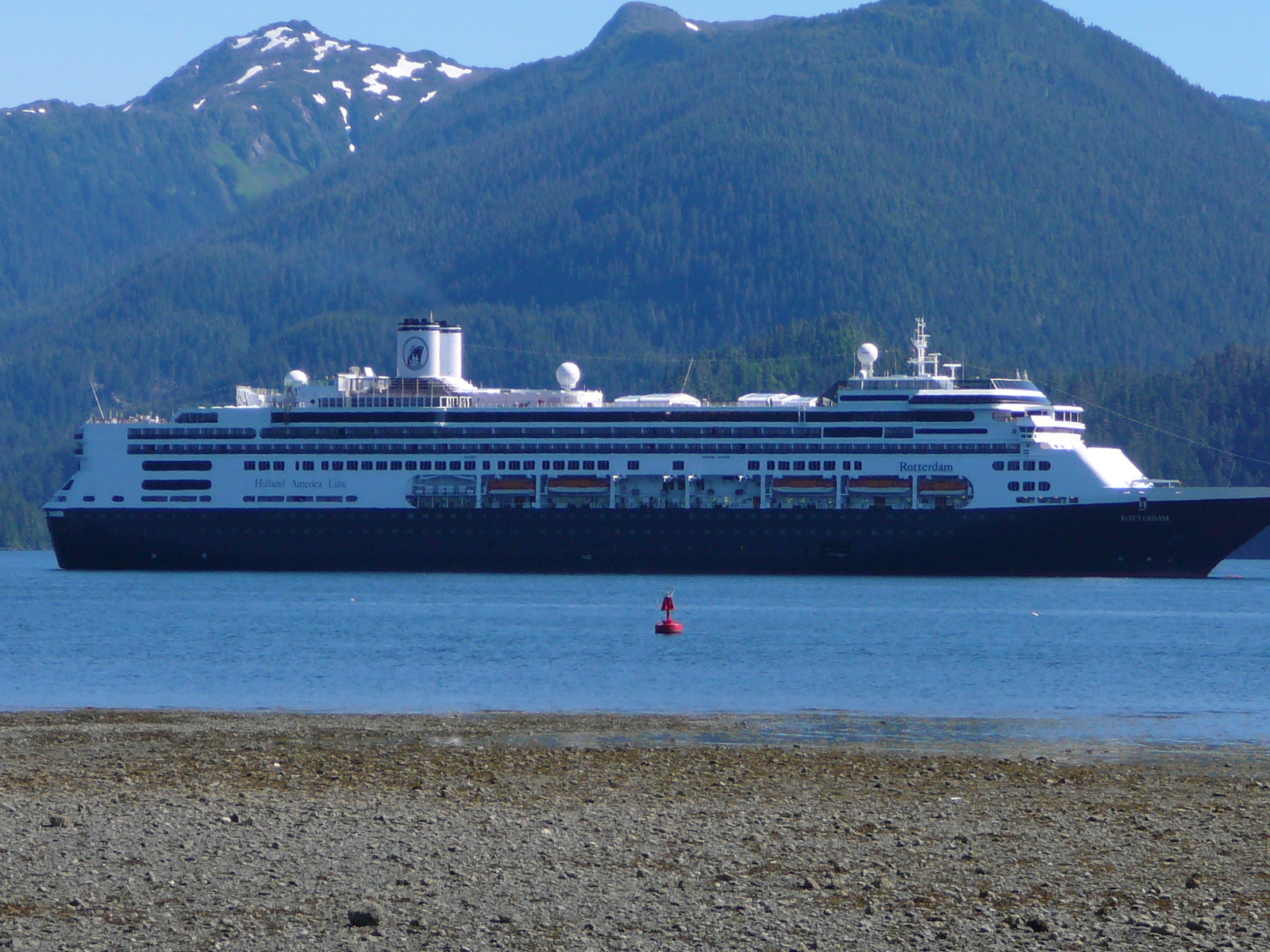
Fishermen pass the ferry Kennicott in Whittier’s harbor at the end of the 2011 season. Ferries and cruise ships deliver tourists to Southcentral at this port. Photo by Ed Schoenfeld.
About 500 people are in Anchorage this week for the Alaska Travel Industry Association’s convention and trade show.
They’ll hear from a variety of industry experts and advocates.
ATIA President Ron Peck says this year’s tour season was mixed, with more cruise passengers and fewer people driving the Alaska Highway.
He says the good news is a larger percentage of international tourists.
“We’re very encouraged by the fact that Korean Airlines and Japan Airlines both offered charters again this year. But the other great news, because I think folks see market opportunity, is the fact that Iceland Air has announced twice-weekly service starting in 2013,” Peck says.
Another airline, Condor, offers direct flights to and from Germany.
The cruise-passenger increase was about 6 percent. Similar growth is projected for next season, bringing the total up to about a million people.
There’s bad news as well. Peck says non-resident sport fishing license sales, once a third of a million, have trended downward. That means fewer people are coming to Alaska to fish.
The nearly 25 percent drop, over six years, is tied to stricter halibut catch limits and poor runs.
“Given the fact that fishermen talk, and given the fact that there’s still concerns about the overall sustainability of the halibut fishery and concerns that people are seeing in the Kenai and Mat-Su drainages, we as an industry are concerned about what’s happening with the fishery in Alaska,” Peck says.
The tourism industry convention runs Tuesday through Thursday at Anchorage’s Dena’ina Center. ( ATIA convention agenda.)
Peck says in-state marketing is also on the table.
“I think we’ll continue to see discussion about funding levels and the level of involvement from the state and the industry in terms of the actual tourism marketing program.
Those attending will also hear updated statistics and attend skill sessions such as Cultural Sensitivity and Social Media Techniques. Speakers include Daniel Halpern of Brand USA, which targets foreign visitors. U.S. Senator Mark Begich will also speak.
About a million and a half tourists come to Alaska during the summer season.
A banner announces Sitka’s celebration of the end of the cruise-ship season during a fun run, free food stands and gift-shop sales Sept. 29, 2012.
Suzan Hess is setting up a beer tent as part of the Sitka Chamber of Commerce season-end celebration.
She’s co-owner of the Baranof Island Brewing Company. The business began in 2010, so it’s still figuring out the tourism market. But Hess says it’s been great.
“We’ve had a really good year. Business is growing. More people who live in the community are bringing people out to the brewery when they come to visit. We’re getting more cruise ship passengers. We’re getting more independent travelers. And we definitely noticed a difference in the charter fishermen who are making their way out to the brewery as well,” Hess says.
Sitka expected up to see about 110,000 passengers this season, about 20 percent fewer than last summer and almost a third of the number about five years ago. Rough weather also cancelled its final two ships, shrinking the 2012 season even more.
***
But statewide, the passenger count grew. Industry officials say about 940,000 people sailed Alaska waters this year. That’s about a 6 percent increase from the previous season.
“There were more ships brought back to Alaska. Some had longer itineraries, maybe another sailing either in early spring or the late fall, and [there were] some bigger ships as well,” says John Binkley, president of the Alaska Cruise Association.
He says the industry’s uptick involves more than passenger numbers.
A cruise ship anchors in Sitka Sound near Totem Park. The big ships can’t tie up next to land because there is no deep-water dock.
“Different areas of Alaska are affected differently. But I would say just anecdotally, in talking to people around the state, that the spending was up as well. Not only more visitors to increase the overall amount of economic activity, but also the amount that each visitor spent I think was a little bit higher this year than last year,” he says.
Cruise ship traffic affects most of the state. Some ships sailing through Southeast go on to Southcentral, where tourists move to buses or trains that take them to railbelt and other locations. And a couple ships sail as far as Kodiak, Homer and Unalaska.
Additional passengers increase business on shore. But there are other factors.
In Southeast, the wet summer took its toll.
***
“Anytime somebody’s on vacation and it’s pouring rain, some people take that as the cue,” says Tyler Hickman, vice president of Icy Strait Point, a renovated cannery and cruise-ship attraction in Hoonah, west of Juneau.
“It certainly impacts retail, food and beverage, and tours. The walk-up sales you might normally get on that kind of day just don’t appear,” he says.
Icy Strait’s biggest show is a mile-long zipline ride over the rainforest. It lost some passengers to the weather this year. But Hickman says whale-watching excursions went well, with sightings of pods of up to 70 humpbacks.
The destination expanded its retail area this year, giving some stores more space and making room for others, such as a doughnut shop. Hickman says that helped make up for passengers reluctant to spend a lot of money.
“I would have to say that probably the real high-end stuff was down a bit. I think spending habits certainly changed, but we were quite successful with it,” he says.
Route changes cost Icy Strait about 5 percent of passenger capacity this year. But another cruise-ship shuffle will bring that back up next year, to about 130,000.
Cruise lines set their schedules far in advance. Industry spokesman Binkley says the 2013 calendar increases capacity.
Duct tape holds a Running of the Boots poster to a post near Sitka’s waterfront. The event is part of cruise-season’s-end celebration.
“For next year, it’s a combination of more ships, larger ships and more sailings for the ships that are coming. So the combination of all that should push us right over the million-passenger mark,” Binkley says.
That’s where it was about five years ago.
***
Back in Sitka, locals are checking out gift-shop sales and lining up for free burgers as the Season’s End celebration moves into high gear.
At the beer tent, Baranof Brewery’s Hess is looking forward to next summer.
“We are planning to work with another business in town to have the brewery tour be part of the tour they sell. And just continue to grow and increase production and distribution of beer. And maybe be more active to encourage tourists from downtown to take the shuttle out there,” she says.
As a relatively new attraction, she expects the brewery to do well. But she’s worried for other Sitka businesses.
“They’re our neighbors and friends who are supporting us that are losing out because of cruise ship tourism decreasing,” Hess says.
The 2013 season begins in April, when the Crystal Symphony sails from Japan to Dutch Harbor, Kodiak and Ketchikan. By May, other ships will be cruising north from Vancouver, Seattle and San Francisco.
Sitka, Alaska, celebrates the end of the cruise-ship season with this costumed fun run. Almost
Science panel member Michelle Ridgway and Juneau Rep. Cathy Muñoz discuss wastewater data during the Cruise Ship Science Panel’s technology open house Sept. 20 in Juneau.
A report that could change the way cruise ships handle wastewater is nearly done. A state science advisory panel met Sept. 19-21 in Juneau and shared some of its work with the public.
Alaska’s Cruise Ship Science Advisory Panel has spent about two years looking at options for cleaning up wastewater. That includes discharges of harmful bacteria, dissolved metals and other pollutants.
Some ships already use systems that can meet elevated standards. Some do not, while others only discharge outside state enforcement boundaries.
The 11-member group finished its work on a preliminary report during its Juneau meeting. But the document still must undergo review. Division of Water Deputy Director Andrew Sayers-Fay says he hopes it’s available to the public by November 1st.
State Cruise Ship Program Manager Rob Edwardson says it’s an important step in a process started by the Legislature in 2009.
“The science advisory panel is using the preliminary report as a tool to assist and advise the commissioner on his report to the Legislature that’s due Jan. 1st, 2013,” Edwardson says.
A technology open house that was part of the science panel meeting presented the history of cruise ships in Alaska and current water-quality issues.
An informational poster on display during the Sept. 20 science panel’s technology open house.
Edwardson says one is exploration of current cruise-ship systems.
“The second is the availability of additional methods that are economically feasible and technologically effective. And the third is the environmental cost and benefit of implementing any additional methods that they may find,” he says.
The feasibility issue is part of the Legislature’s charge to the panel. That led to examination of water-cleaning systems not yet used on the ships.
Sitka’s Steve Reifenstuhl represents the United Fishermen of Alaska on the science panel.
“We have looked at technology that is used in land-based facilities. There isn’t technology that has been used on cruise ships that can do that at this point. That’s not to say that it’s not feasible in the future – at a very high cost,” Reifenstuhl says.
Higher standards were called for in a 2006 Cruise Ship Initiative approved by voters, which also created a passenger head tax. (Hear a report on that initiative.) The panel was established as part of a compromise that delayed full enforcement.
Cruise lines argued the standards could be met by allowing discharges to be diluted through mixing zones. Basically, that means sampling water a distance from the ship, rather than from the discharge pipe itself.
Seattle environmental compliance analyst Lincoln Loehr represented the industry on the panel. He says water-cleaning systems in use now are about as good as it gets.
“I don’t see that there is convincing information on the effectiveness of these additional add-ons to consistently meet the water-quality criteria at the end of the pipe,” Loehr says.
Loehr’s specialty is permitting municipal and industrial wastewater systems. He says cruise ships can make better use of mixing zones than land-based treatment plants.
“The criteria may be met for a municipality within 20 minutes or so. For cruise ships, when underway, they’re going to be met within less than 10 seconds,” Loehr says.
Critics say that would only spread out, not reduce damage to the marine environment.
Representatives of several companies selling water-treatment systems were at the open house.
Erik Neuman of California-based Rochem Membrane Systems says dilution is a key issue that could set an international precedent.
“And that is really the big question that the panel has and that Alaska has is to set that dilution level at a proper level that will really be the basis for other states and other countries to utilize in the future,” Neuman says.
The science panel also includes a marine ecologist, a government inspector, a ship-builder and an environmental engineering professor. Some members declined to comment after state officials instructed them to avoid lengthy interviews with reporters.
Reifenstuhl, who holds the panel’s fishing industry seat, says he’s optimistic about the final results.
“The goal is to protect Alaska’s waters and I think the science panel is going to come out with a report that will do that,” Reifenstuhl says.
The panel’s report to the Legislature is formally a preliminary document. But it’s unclear what might change between its release and the deadline for a final report two years later.
An informational display shown during the Sept. 20, 2012, science panel meeting.
What’s the most effective and economically feasible method of curbing water pollution from large tour ships?
Alaska’s Cruise Ship Science Advisory Panel meets in Juneau this week to try to answer that question. Members will also review a preliminary report to the state Department of Environmental Conservation.
A membrane bioreactor wastewater treatment plant for installation on board a cruise ship. Courtesy Hamworthy Water Systems.
“The report will cover their analysis of the information that they’ve collected for existing and additional systems and methods,” he says.
Lawmakers delayed strict new wastewater discharge limits in 2009 while appointing the panel to consider developing and available technology. Its 11 members represent industry, government, fishing, coastal communities and other interests.
The panel will meet Wednesday and Friday at Juneau’s Goldbelt Hotel. Edwardson says a Thursday session at nearby Centennial Hall will present choices and issues.
“The technology workshop is for members of the public to be able to walk through and look at a number of different displays that detail the history of cruise ships in Alaska, the cruise ship wastewater issues and the panel’s work from the past two years,” Edwardson says.
The panel’s final report is due in 2015. Meanwhile, the Department of Environmental Conservation is developing a new permit for cruise ships that discharge wastewater within state maritime boundaries.
Sea otters rest in waters near Sitka. A new study says otters help kelp growth, which reduces carbon dioxide, which causes climate change. Photo by Ed Schoenfeld.
A new study is adding another dimension to the sea otter debate. The research shows the marine mammals help reduce carbon dioxide in the atmosphere, a major contributor to climate change.
Jim Estes remembers taking a look around the bottom of Sitka Sound about 20 years ago.
“When we were diving in that area back in the early 1990s, the sea floor was just covered with urchins and there was virtually no kelp,” Estes says.
“Two years ago, when we went back and looked at the same sites, there was not an urchin to be found and there was kelp everywhere.”
Estes is a professor of Ecology and Evolutionary Biology at the University of California campus in Santa Cruz.
His latest research takes a look at kelp forests, and how much carbon dioxide they absorb. The otter connection comes because they eat sea urchins, which in turn eat kelp.
Working with existing data and other researchers, Estes took a look at coastal waters with no sea otters and those with a full population.
“The effects of sea otters in that system on carbon dioxide concentrations would be significant. And by significant, I mean whether or not you have otters in the system would account for roughly, approximately 10 percent of the total carbon. That’s a lot,” he says.
And by cutting carbon dioxide, otters also reduce ocean acidification, which results from CO2 dissolving in water.
“That’s a whole other area of work that we and others have been looking at. And if, for example, you look at pH, which is a measure of acidification, and you measure it inside a kelp forest and then a couple hundred yards away, it’s always higher within the kelp forest, which means the acidification level is lower,” he says.
He says the CO2 changes would be in affected coastal areas, not worldwide.
Otter populations are booming in Southeast Alaska. And that’s brought a lot of attention from fishermen, economic analysts and biologists.
“I heard about this research a couple years ago when [preliminary] findings were presented at a scientific conference. And we do work with one of the authors of the study,” says Verena Gill, the U.S. Fish and Wildlife Service biologist who headed up Southeast population studies.
That research shows 12 percent annual growth in the southern part of the region, and 4 percent in the north. Other coastal areas, such as Kachemak Bay near Homer, have seen even larger increases.
“I just think it adds another piece to the puzzle of the many jobs that sea otters do in a healthy marine ecosystem,” Gill says.
The new study focuses on waters from southern British Columbia to the end of the Aleutian Islands. Southeast and most other areas lost their populations to Russian and American hunters about a century ago. Otters were reintroduced to the outer coast almost 50 years ago.
In an earlier interview, Phil Doherty of the Southeast Alaska Dive Fisheries Association said their rapid spread and voracious appetite hits his members hard.
“The areas that are most affected are the areas that have the largest food source. And those are the species that we harvest … sea urchins, sea cucumbers and geoduck clams,” Doherty says.
Sea otters are a protected species and only Alaska Natives can hunt them. There are also strict limits on how their pelts can be sold. Some commercial fishermen and Native groups have called for measures allowing more to be harvested.
Otter supporters have fought for continued protection in part because kelp forests offer shelter that boosts salmon, herring and rockfish populations.
The new research adds to those arguments. But Estes doesn’t want to exaggerate impacts on the planet’s overall carbon dioxide level.
“It’s going to be pretty small. We haven’t made that calculation, but this is just a teeny little part of the world. So I don’t think the story really is relevant on a global scale. It’s just demonstrates a process on a local scale,” Estes says.
Ester co-authored the study with Chris Wilmers, another U.C. Santa Cruz professor, as well as researchers from other schools, including the University of Alaska Fairbanks.
The study first appeared in the publication Frontiers in Ecology and the Environment.
The cruise ship Dawn Princess sails Tracy Arm fjord, between Juneau and Petersburg several years ago. It and Rhapsody of the Seas have had norovirus outbreaks in the past month. Photo by Cruiser1210.
Two cruise ships sailing Alaska waters have battled recent norovirus outbreaks. The highly-contagious illness causes vomiting, diarrhea and fevers, and can lead to dehydration.
The latest outbreak is on the Dawn Princess, which is wrapping up a three-week cruise including stops in Southeast and Southcentral Alaska.
The federal Centers for Disease Control reports 6.5 percent of its nearly 1,800 passengers suffered from norovirus at the same time during part of the cruise.
CDC staff boarded the Dawn Princess in Juneau on Friday to evaluate the outbreak. Staff also looked at crew members’ efforts to disinfect the ship to prevent further cases.
The CDC’s Jay Dempsey says the situation has improved.
“They are reporting a less than 2 percent number of passenger and crewmembers at this time. So it does seem to be that that outbreak was contained and they are sailing at a normal rate now,” Dempsey says.
The ship is due into San Francisco on Thursday (September 13th).
The earlier outbreak was on board Royal Caribbean Cruise Line’s Rhapsody of the Seas. Norovirus struck more than 7 percent of passengers during a late-August Inside Passage cruise.
Royal Caribbean’s Rhapsody of the Seas enters a Singapore shipyard for a major revitalization project. Photo courtesy Royal Caribbean.
The CDC’s Canadian counterpart sent inspectors to a port call in British Columbia and deemed the outbreak under control.
Dempsey says the illness is easily spread through contact with handrails, restroom fixtures, door handles and similar surfaces.
“It’s just like any other time that you have a lot of people sharing the same space. You just have a greater chance a norovirus-like illness might outbreak amongst that group of people. And it’s the same on land, whether you have people living in a nursing home or a dormitory or similar situation,” Dempsey says.
The Dawn Princess and the Rhapsody of the Seas are the only two Alaska cruise ships reporting outbreaks this season. That’s better than last year, when four ships reported high norovirus numbers, one on several cruises.
Close
Update notification options
Subscribe to notifications
Subscribe
Get notifications about news related to the topics you care about. You can unsubscribe anytime.