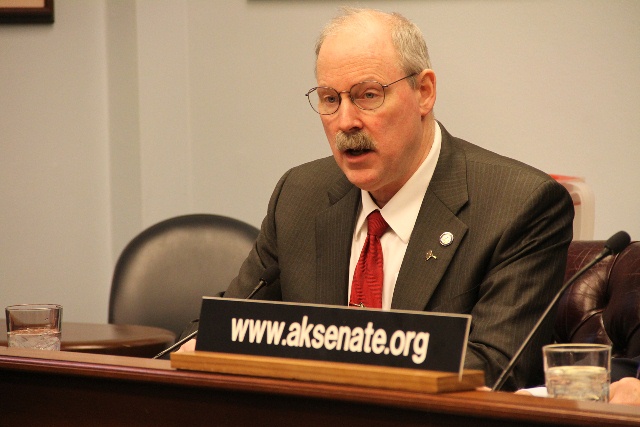
Ed Schoenfeld, CoastAlaska

Juneau’s unopposed candidates still raise campaign funds

Juneau has two House districts. Neither Democratic Rep. Beth Kerttula nor Republican Rep. Cathy Muñoz face opposition. But they’ve still gotten a lot of campaign contributions.

Juneau’s House district boundaries changed this year, adding new communities to one district and new neighborhoods to the other.

But both capital city incumbents face no opposition, and are virtually guaranteed re-election. (Scroll down to read recent finance reports.)

The latest Alaska Public Offices Commission reports show they’ve brought it a combined total of about $40,000. The question is, why?

Juneau Democratic Rep. Beth Kerttula

“I actually haven’t been asking to raise money. I have gotten some donations,” says Democrat Beth Kerttula, whose district includes downtown Juneau, Douglas Island, Petersburg, Skagway, Gustavus and Tenakee Springs.

Republican Cathy Muñoz tells a similar story. She represents Juneau’s populous Mendenhall Valley and neighborhoods to the north and south.

“The contribution I’ve received in 2012 were unsolicited. They were coming from organizations and individuals that supported my work in the Legislature,” Muñoz says.

She has raised the most, about $25,000.

A little more than half came from Political Action Committees. They included construction unions, state workers and teachers associations, realtors, seiners and a bank.

Four-fifths of her money came in last November and December.

“It’s very common to raise funds at the end of the year in anticipation of the election coming up. Fortunately, I haven’t had to raise additional funds this year,” Muñoz says.

Kerttula has brought in about $12,500, close to two-thirds of it during 2011.

About three-quarters of her funds came from PACs. They’re a mix of teachers, state workers and construction union groups. The hospitality industry and dentists’ PACS also chipped in.

“They just are sending it. It’s what the PACs themselves do. So I haven’t been asking, but they’ve been sending some money. And I will say, actually, I’m thankful, because of being able to travel,” Kerttula says.

And she has, to some of the communities added to her district.

Juneau Rep. Cathy Munoz, a Republican.

Muñoz has used a part of her campaign funds to travel outside the area she will represent.

“Southeast Conference had a candidate forum and I traveled to that. There were election night activities in Anchorage that I attended. So I was able to travel up and use some of my campaign funds to do that,” Muñoz says.

Along with travel, Kerttula’s campaign money goes to bookkeeping, office equipment and community outreach.

“I plan to do a mailing into the communities, and possibly an ad. Senator Egan and I during the primary did an ad reminding people to go vote. Things like that,” Kerttula says.

Both candidates expect to have money left over after the election. Campaign finance rules allow a limited amount to be used for legislative office funds. Some can also be given to a political party or held over ‘til the next campaign. And surplus money can go to non-profit groups.

Juneau Senator Dennis Egan is the only legislator not facing re-election this year. The Democrat represents Munoz’ and Kerttula’s House district.

Find out more:

Read Cathy Munoz’ latest APOC finance report.

Read Beth Kerttula’s latest APOC finance report.

Check other candidate campaign forms.

Read earlier Southeast campaign finance news reports:

Finance reports show Thomas far ahead of Kreiss-Tomkins

Parties back Wilson and Olsen, ignore Johansen

Stedman fund-raising twice Kookesh total



Parties back Wilson and Olsen, ignore Johansen

From the left, Democrat Matt Olsen, Republican Peggy Wilson and Independent Republican Kyle Johansen appear at an Oct. 23 Ketchikan radio forum. They are running to represent House District 33, including Wrangell, Ketchikan and northern Prince of Wales Island. Photo by Leila Kheiry/KRBD.

Kyle Johansen has represented Ketchikan in the state House since he was first elected in 2006. He’s been a Republican Party regular, working his way up to majority leader, a position with significance in the GOP’s House majority.

But about two years ago, he broke with his caucus over another lawmaker’s committee assignments. That left him out of favor, out of the majority, and on the outs with Ketchikan party officials, who attempted a recall.

This election, Johansen is running as an independent. And he’s doing it without his former party’s backing. In a recent interview at KRBD in Ketchikan, he said it’s one of the reasons he’s only brought in about $6,000.

“I didn’t ask the party for any money. I am basically registered as a Republican and the party is backing Wilson, and that’s as far as it goes,” Johansen says.

Wilson is Wrangell’s Peggy Wilson, who’s represented her hometown, Petersburg and Sitka in the state House for about 10 years. Redistricting moved Wrangell into Ketchikan’s district, setting up an incumbent-vs.-incumbent race.

Wilson has the largest bank account in this race, with a bit more than $37,000 raised. (Scroll down for links to all candidates’ finance reports.)

“I’ve had a fund-raiser since then and I did get some money. I think I’ll be getting some more in. Hopefully $38,000 $39,000 [or] $40,000. I hope that will be enough,” Wilson says.

That’s six times Johansen’s total, and close to double the amount raised by Democrat Matt Olsen, according to state finance reports.

Close to a fourth of Wilson’s money comes from Republican political action committees, GOP legislators and party notables. That includes former Governor Frank Murkowski and his wife Nancy.

The Democratic Party is also strongly backing its candidate, Ketchikan City Council member Olsen. It’s provided about a sixth of his approximately $20,000 in campaign funds.

House District 33 candidates speak at a recent Ketchikan Chamber of Commerce forum. Photo by Leila Kheiry/KRBD.

He says he would welcome additional contributions. But he thinks he has enough.

“More money in the campaign does always make you feel better, but I feel like the campaign that we’ve had and that we’ve run has been well-financed,” Olsen says.

Other political action committees play a significant role in both party-supported campaigns. (Hear a forum with the three candidates.)

About a quarter of Olsen’s funds come from government employee, teacher and construction unions. PACs, including Democratic groups, make up about 40 percent of his fund-raising total.

Almost all the PAC money is from outside House District 33.

“When you talk to Anchorage legislators, they raise their money pretty much in their district because of the high volume of highly-paid people. Ketchikan doesn’t have a lot of people who make a lot of money who can afford to give you that money. So, campaigns cost money and you have to reach out,” Olsen says.

Contractors, seiners, oil company employees and others contributed about another $4,000. That, plus the party money, makes up a bit more than a third of the Wrangell Republican’s campaign total.

“I didn’t turn to anybody for any support. That came voluntarily and I didn’t go asking for it,” Wilson says.

Ketchikan’s Johansen has only one political action committee contribution, from the construction industry group Alaska Build.

About half his approximately $6,000 raised comes from outside the district.

“I accept money from people who think I do a good job from all over the state and around the country if need be,” he says.

Overall, around $60,000 has been raised by House District 33 candidates, according recent finance reports.

That’s less than half the amount brought in for the House District 34 race. That district combines Sitka with Haines, Craig, Angoon and other small island communities. Haines Republican incumbent Bill Thomas and Sitka Democrat Jonathan Kreiss-Tomkins are seeking that seat. (Hear a report on the candidates’ campaign finances.)

It’s also about two-thirds of what Angoon Democrat Albert Kookesh and Sitka Republican Bert Stedman raised. Those incumbents are seeking election to Senate District Q, which includes House Districts 33 and 34. (Hear a report on the candidates’ campaign finances.)

Find out more:

Read Peggy Wilson’s most recent APOC finance report.

Read Matt Olsen’s most recent APOC finance report.

Read Kyle Johansen’s most recent APOC finance report.

Check other candidate campaign forms.

House District 33-Q is at the lower right-hand corner of this map. Courtesy Alaska Redistricting Board.


Finance reports: Thomas tops Kreiss-Tomkins

Candidates for state House District 34 Bill Thomas (l) and Jonathan Kreiss-Tomkins at a recent Sitka Chamber of Commerce forum. (KCAW photo/Robert Woolsey)

More money is going into the House District 34 campaign than any other race in Southeast.

Changing legislative boundaries combined Sitka with much of the old Southeast Islands House District to create District 34. The Islands District is the one that includes Haines, Craig, Metlakatla, Hoonah, Angoon, Kake and some other small cities.

State campaign finance reports show incumbent Haines Republican Representative Bill Thomas in the lead, with about $83,000 in contributions. That’s about 40 percent more than his Democratic opponent, Sitka’s Jonathan Kreiss-Tomkins.

Together, they’ve raised around $130,000, making this the most expensive Southeast race. (Scroll down for links to recent campaign finance reports.)

Thomas lost Yakutat, Skagway and Cordova from his old district. But he gained Sitka, where half the new area’s constituents live, including his opponent.

He says that means a more expensive advertising campaign.

“You know, we didn’t lose any newspapers. We ended up gaining more newspapers and bigger towns and other things that we haven’t done before. So, it’s going to be spendy,” he says.

This is Kreiss-Tomkins’ first legislative race. So he also needs to raise a significant amount of money to make his presence known.

His approximately $48,000 campaign war chest is far behind Thomas’. But he says it’s not as large a gap as it seems.

“What you’re really seeing is the advantages of incumbency. And you can raise $40,000 before you have an opponent. And that’s the reason why there’s this cash discrepancy. If it started from June 1st, which is when we filed, we’d be up a few thousand,” he says.

Democratic Party organizations gave Kreiss-Tomkins $8,000. State employee unions, teachers and other political action committees contributed another $4,000.

Together, they add up to about a quarter of his overall campaign contributions.

Kreiss-Tomkins’ acknowledges he has less to spend in the House District 34 race. But he says his cadre of volunteers is giving him more bang for his buck.

“We have a grassroots-oriented campaign. It’s basically people talking with people, which we feel is also the kind of politics we believe in,” he says.

Kreiss-Tomkins points to a higher percentage of district contributions than Thomas, many of them relatively small.

The Democrat’s gotten money from the Southeast Alaska Seiners and the United Fishermen of Alaska. And he’s claimed more from individual commercial fishermen, since he filed.

Republican Thomas — a gillnetter, longliner and shrimper — disagrees.

“He claims he has more fish money. But then you look [and] … it’s been raised since [his] general campaign. And I’ve raised almost 11 grand from the fishermen over two years. But it depends on when you report it. He’s playing words pretty good,” he says.

Campaign finance reports from the full fund-raising season show Thomas with more donations from individual fishermen.

The Haines incumbent attracted more than $17,000 from his party’s and other groups’ political action committees. About a fifth of that came from the GOP. The rest included labor organizations, oil PACs, dentists, contractors and the hospitality industry.

Overall, PACs and the party contributed about 20 percent of Thomas’ campaign funds. That’s a larger total, but a smaller percentage, than Kreiss-Tomkins.

Those figures do not include executives or other employees of those groups or companies, so they could be larger.

Despite his incumbency and higher campaign war chest, Thomas thinks of himself as the underdog in the race. Among other things, he has knee problems that limit one-on-one campaigning, a major part of Kreiss-Tomkins’ strategy.

“He was able to bang on all the doors this summer because I was fishing and I don’t think he was working. [That’s a] big difference in lifestyles,” he says.

Kreiss-Tomkins say he did work, though he wasn’t paid, managing a pair of nonprofit programs that bring college students to Sitka to volunteer and share their skills.

As the campaign wraps up, Thomas says his main job is to convince voters of the power of incumbency. That includes his budget-writing duties as co-chairman of the House Finance Committee and his record of funding community projects.

Kreiss-Tomkins says he’ll bring a new approach to representing the new district, and will take different stands on education and other parts of the budget. And, he’s close to his goal of meeting the majority of its population.

“To be representative, I think it’s really important you know who you’re going to represent . And this door-to-door component of the campaign in every community, knocking on every door that’s possible, has been a central component of the campaign,” he says.

Thomas says he’s met with his district’s leaders and other constituents during his four terms in office. And he’s reached out to Sitkans during this campaign.

The most recent campaign reports, released earlier this month, show a significant part of the $130,000 or so Kreiss-Tomkins and Thomas raised was spent on travel, including room and board.

That total is more than double the funds raised in the southern Southeast House race, between Republican Peggy Wilson, Democrat Matt Olsen and independent Kyle Johansen.

It’s also almost a third more than the Senate District Q race, between Republican Bert Stedman and Democrat Albert Kookesh.

Read Thomas’ most recent APOC finance report.

Read Kreiss-Tomkins’ most recent APOC finance report.

Hear a forum with Kreiss-Tomkins and Thomas.

House District 34 Communities:

• Sitka

• Haines

• Craig

• Hoonah

• Hydaburg

• Kake

• Kasaan

• Klawock

• Klukwan

• Metlakatla

• Pelican

• Angoon

• Covenant Life

• Elfin Cove

• Game Creek

• Lutak

• Mosquito Lake

• Mud Bay

• Port Alexander

• Whitestone Logging Camp

Stedman fund-raising twice Kookesh total
Bert Stedman and Albert Kookesh are running for Senate District Q. On the map, it's shown as House Districts 33-Q and 34-Q. Courtesy Alaska Redistricting Board.
Bert Stedman and Albert Kookesh are running for Senate District Q. On the map, it’s shown as House Districts 33-Q and 34-Q. Courtesy Alaska Redistricting Board.

Redistricting shoved Sitka’s Bert Stedman and Angoon’s Albert Kookesh into an incumbent-vs.-incumbent Senate race.

The most recent campaign finance reports from the Alaska Public Offices Commission show Republican Stedman with the most money. He brought in about $31,000 since the August Senate District Q primary. That’s about six times more than Democrat Kookesh’s $5,000.

Overall, Stedman leads with around $64,000 raised this and last year. That’s almost twice Kookesh’s $33,000.

Still, Stedman says he’s hoping for more.

Sen. Bert Stedman, a Sitka Republican.

“It would be nice to get that dollar amount up to about $80,000 to run a good Senate campaign. It’s just expensive to travel around. [With] advertising and stuff like that, it has a funny way of adding up,” he says.

The district includes Ketchikan, Haines, Wrangell, Sitka, Craig, Metlakatla, Hoonah and Klukwan, plus numerous smaller communities. It’s about three-quarters of Stedman’s old district and one-quarter of his competitor’s.

Kookesh continues raising funds. But unlike Stedman, he says he has what he needs. Still, it’s been hard.

“It’s really been hard to raise money because so many people are running this year. Every House seat and every Senate seat, except for one. I’ve even seen Anchorage legislators coming down here for fund-raisers in Juneau. So they must have dried Anchorage up pretty good,” he says.

Both are members of the state Senate’s bi-partisan majority, which blocked Governor Sean Parnell’s plan to lower oil taxes. Neither got money from Alaska’s major petroleum companies, or the political action committees they fund.

Here’s some of the campaign finance details (Scroll down for links to detailed APOC reports):

Stedman’s campaign did attract $1,000 from top officials at Armstrong, a Colorado-based, independent oil and gas company with Alaska investments. He also brought in $250 from the ConocoPhilllips Employee PAC.

But he’s not getting much help from his party.

“Each Senator can get up to $15,000 from the party. I’ve gotten $250 from the Sitka Republican Women, and that’s it. I expect no party support out of Anchorage at all,” Stedman says.

Kookesh got a little more party money, $500 from Juneau’s Democratic organization.

Sen. Albert Kookesh, an Angoon Democrat.

Both candidates have raised significant amounts from unions and their PACs.

Kookesh brought in $7,250 from six state employees’ and teacher’s groups, plus two constriction unions. All of Kookesh’s PAC money came from labor groups.
Stedman raised half as much as his opponent. He got $3,600, from three construction labor groups. (Hear a forum with both candidates.)

Five other PACS, including seiners, dentists and hospitality businesses, for a total of $6,600.

Kookesh did bring in about $3,000 from board members and employees of regional Native corporation Sealaska, where he’s board president.

“I got some money from individuals who work for Sealaska. But, no, they don’t have a PAC and they haven’t spent any money on a PAC. And if they had a PAC they certainly didn’t spend it on me,” Kookesh says.

Meanwhile, Stedman got $500 from the president of Sitka’s Native corporation.

The candidates have met with business, community and tribal leaders as they’ve traveled from Metlakatla to Pelican and points in between.

Kookesh says voters have asked about education funding and energy prices, among other issues.

“There’s a lot of talk about the ferry system and the need for replacing ferries. The road to resources has a lot of discussion because of the Prince of Wales mines that are going in down there,” Kookesh says.

Stedman says he’s hearing much of the same, from just about all communities.

“The issues haven’t changed or don’t change when you move from one island to the others. The major hurdles are energy and transportation,” Stedman says.

The candidates’ numbers have changed since their most recent finance reports, filed earlier this month.

At that time, Stedman had spent about $31,000 and still had around $26,000 left. Kookesh had spent around $11,000, with $22,000 remaining.

Want more details?


Can small wood-gas systems lower energy costs?

Wes Tyler, left, stands by a new wood gasifier at Icy Straits Lumber in Hoonah. John Hillman of the Hoonah Indian Association is on the right
Wes Tyler, left, stands by a new wood gasifier at Icy Straits Lumber in Hoonah. John Hillman of the Hoonah Indian Association is on the right. Photo courtesy Sealaska.

Wes and Sue Tyler run Icy Straits Lumber & Milling in Hoonah, about 40 miles west of Juneau. They make log cabin kits, siding, beams and other finished products out of Southeast Alaska wood.

But high energy prices have increased operating costs. A particular problem is equipment used to dry damp wood.

So Wes watched closely as a new system using wood chips to generate electricity was turned on earlier this month.

“All of a sudden the engine comes to life and we’re able to go in and turn on all the lights in the building and a fan that was pushing some warm air around in the dry kiln and with a few more KWs involved, why you could ultimately have the dry kiln running on that sort of fuel,” Tyler says.

The system is called wood gasification.

It’s part of an experiment to see if compact devices – this one is 4 by 4 by 8 feet high – are a viable alternative to oil-powered systems.

So far, the generator at the Tylers’ has been working fine.

Sealaska Executive Vice President Rick Harris, speaking at a press briefing in Juneau, says Icy Straits Lumber is the right place to try it out.

“He’s already got the wood supply there. He has the technical know-how to deal with these kinds of things. But based upon his experience then we can see if we can transfer this type of technology to other areas,” Harris says.

In fact, a second unit is also being tested at the mill, for eventual use at a Hoonah tourist attraction.

Wood gasification is not new technology. It’s been around, in one form or another, since the late 1800s. Small gasifiers were even used to power cars, trucks and trains in German-occupied territory during World War II fuel shortages.

How they work is not that complicated.

“So what we do in a gasifier is burn part of the wood and generate heat, which converts the solid to a gas,” says consultant Tom Miles of Portland. He worked with Sealaska’s Haa Aaní subsidiary and Icy Straits Lumber to select and install this particular system.

“And then the mixture of the gas with charcoal solids further reduces the fuel to a fuel gas. And the fuel gas is about half nitrogen, about 20 percent carbon monoxide, and about 20 percent hydrogen. And that will burn in an internal combustion engine,” Miles says.

Sealaska’s Rick Harris talks about wood gasifiers at a Thursday press briefing while consultant Tom Miles listens. Photo by Ed Schoenfeld.

It’s not as efficient as gasoline or propane. And it won’t replace hydropower. But if wood scraps or leftovers from milling or thinning trees are easily available, it can be cheaper.

Miles says it can take about a third off the cost of a diesel-powered generation. (Read more about wood gasifiers.)

“We will be not only generating electricity but we can capture waste heat from the engines so it’s micro-scale combined heat and power [system],” he says.

Sealaska’s Harris says a Hoonah lodge-owner has already shown interest in the system.

And the corporation is working with the Icy Strait Point tourist attraction, which is owned by Hoonah’s village Native corporation, to use gasification to power and heat a cultural center, and eventually, a greenhouse.

“It’s one of those things where in the summer they have a lot of visitors come in. So we can grow in the greenhouse certain plants and vegetables that they can use. And then in the winter when they’re not using it, we can move that stuff into the Juneau market or the local market,” Harris says.

Sealaska and its consultant have looked at a lot of gasification options. Harris says the Hoonah experiments will show whether they chose the right technology.

“In a month, Wes may tell us this just isn’t going to work. I think we’re fairly optimistic that it will work. But that’s why we’re doing it in a place where we have the ability to make the necessary adjustments and to prove it can work in a rural community environment,” he says.

Sealaska’s energy experiments have been funded in part by the federal Department of Energy and other sources.

It’s already heating its Juneau headquarters with a wood-pellet boiler, which is cheaper than diesel heat. It also considered building a waste-wood ethanol plant at Ketchikan’s Ward Cove, but concluded it wasn’t economically feasible.


Sitka is center of Alaska’s devil’s club business

Back Bay Botanicals products include devil’s club soothing rub and healing ointment.
Back Bay Botanicals products include devil’s club soothing rub and healing ointment. Photo by Ed Schoenfeld.

Listen to iFriendly audio.

Devil’s club is probably best known as a plant to avoid at all costs. But several small Southeast Alaska companies have a different take. They’re turning the roots, stems and bark of the plant into rubs and salves to treat sore joints and damaged skin.

Sitka is the center of the growing industry.

Sitka’s Ruth McMaster stands behind the counter at the store she runs with her husband Gary. The phone rings, and she’s soon taking an order for the company’s devil’s club salves.

Wintersong owners Ruth and Gary McMasters hold their devil’s club salve, lip balm and soap at their Sitka store.
Wintersong owners Ruth and Gary McMasters hold their devil’s club salve, lip balm and soap at their Sitka store. Photo by Ed Schoenfeld.

Wintersong makes a variety of handcrafted products, including lotions and soaps. But its devil’s club salve and soap are among the most popular – and demand is expanding, “Because it works.”

Devil’s club is a common shrub in the wet, cold forests of Alaska and the Pacific Northwest. Sometimes called Alaska ginseng, its bright red berries, tall stalks and large leaves make it easy to spot.

But it’s best known for its spiky spines, which cause great pain when they scratch or puncture skin. Jean Longstreth runs Back Bay Botanicals with her husband Dennis.

“Out in the woods, deer-hunting and such, collecting and harvesting other plants, you always saw that ominous-looking plant and you didn’t want to grab onto it,” Longstreth says.

The company, run out of the Longstreth’s home, makes devil’s club salves, balms and bath oil.

Back Bay and Wintersong are among at least 10 Alaska businesses making devil’s club products. (Scroll down for a list of other manufacturers and their websites.)

Those two, and a third, make Sitka a center of the industry.

“I have the Devil’s Club oil, the lip balm, the ointment and the menthol ointment,” says Pauline Duncan, a Tlingit author and one of the first Native teachers certified in Alaska.

She grew up knowing the plant is a traditional remedy. She followed her interests and built her skills through a class led by a fellow Sitka teacher.

Pauline Duncan displays her devil’s club products at the Celebration Native Artists’ Market in June of 2010 in Juneau.
Pauline Duncan displays her devil’s club products at the Celebration Native Artists’ Market in June of 2010 in Juneau. Photo by Ed Schoenfeld.

“From there I just started researching and started trying to bring back a lot of the old medicinal plants that were used and mix that in with the devil’s club,” Duncan says.

She and the others collect from their own property, or that of family and friends.

Wintersong’s Gary McMaster says it‘s careful work, because it’s so prickly and stingy.

His advice?: “Wear good gloves, you know, wear good gloves.”

Then it has to be processed. Back Bay’s Longstreth says she uses the same technique for devil’s club and other medicinal plants.

“We us an organic olive-oil base, and we simmer the devil’s club at a certain temperature for a number of days until we get as much of the medicine out of it as we can,” she says.

Each follow their own recipe, mixing in spruce pitch, tea tree oil, red clover, beeswax or other ingredients.

The resulting products are used to treat sore joints and muscles, and skin irritations such as diaper rash.

But none of those remedies have been evaluated by the Food and Drug Administration. So Duncan and Sitka’s other manufacturers are careful about what they say.

“I try to get as many of my buyers to give me a little blurb about how it has helped them or why they are ordering more. That’s basically how I advertise the product,” Duncan says.

Those testimonials are used on company websites or in brochures.

Back Bay Botanicals’ Dennis Longstreth enjoys hearing from the customers.

“Every so often there will be a little envelope in the mail, with a tight little handwritten address and we open it up and there’ll be a letter saying somebody gave her this product and it did wonders for her,” he says.

So why is Sitka a center of devil’s club products?

Wintersong’s Ruth McMaster says it’s all about attitudes.

“There’s a lot of independent people here who are seeking out ways to make money besides working for someone else. There’s a lot of entrepreneurs and crafters and artists. I think it goes along with the type of people who live here.”

A few years ago, some Tlingit leaders were concerned large-scale operations could lead to overharvesting of the traditional plant. So far, that doesn’t appear to have happened.

Access websites of some of Alaska devil’s club product producers:

Site notifications
Update notification options
Subscribe to notifications