Alaskans are celebrating the life today (Nov. 26) of a Juneau prison innovator, death-penalty opponent and author.
Charles Campbell, 88, died last month from pancreatic cancer at the Episcopal Church’s Goodwin House in Falls Church, Virginia. (Read his full obituary.)
He headed up Alaska’s Department of Corrections under Governor Jay Hammond, capping a nearly 50-year career in prison work. After retirement, he and his wife, Ellen, remained in Juneau until moving east in 2009.
Charles Campbell
Campbell was a World War II veteran who served as a paratrooper and gliderman with the Army’s 17th Airborne Division. He was at the Battle of the Bulge.
Later, he was active in the capital city’s chapter of Veterans for Peace. In a 2005 interview, he spoke against the Iraq war, and how he felt officials misrepresented the facts.
“I think we have a huge responsibility to try to make people understand the truth. I honestly think when people understand the facts, as hard as it may be to find the facts, I believe policies will come into place that will bring an end to this war,” he said when he was 80.
Campbell was active in a number of other causes in Alaska. He testified against the death penalty, based on his long career in corrections.
He was superintendent of the first coed federal prison, and wrote about the experience in “Serving Time Together: Men and Women in Prison.” He also wrote “The Intolerable Hulks,” about prison ships, and “Doing Easy Time,” a memoir.
Campbell was also an active member of downtown Juneau’s Holy Trinity Episcopal Church. That’s where tonight’s (Nov. 26’s) memorial service and celebration of life will be held at 7 p.m.
Mount Edgecumbe students work with a Science in the School volunteer during a class on octopus anatomy. All photos by Ed Schoenfeld.
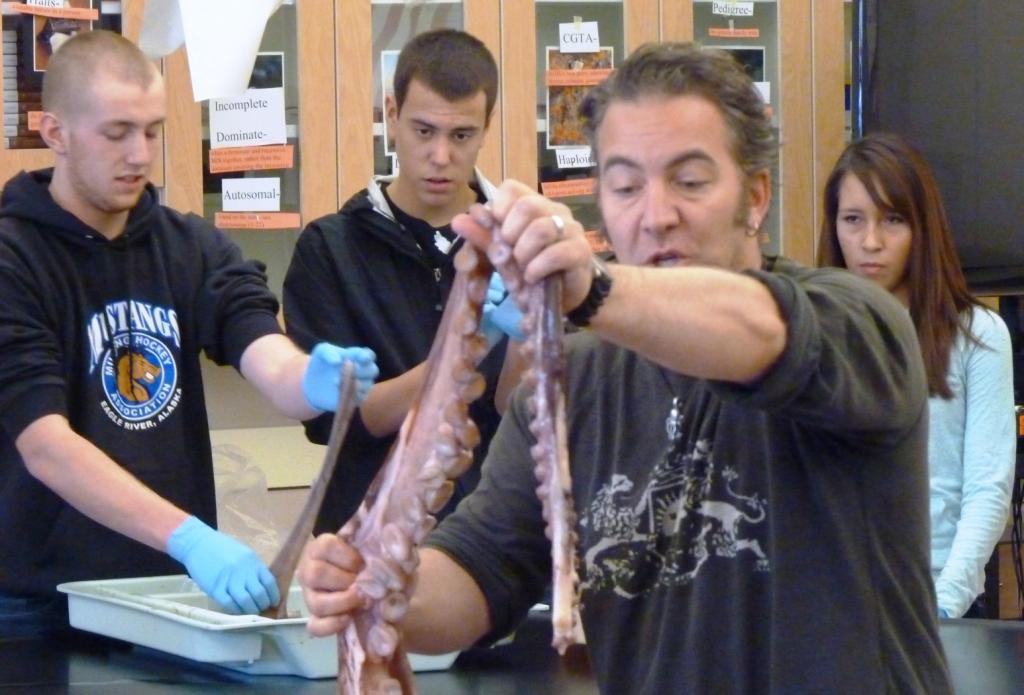
Marine biologist Reid Brewer stands at the front of a Mount Edgecumbe classroom, dangling an octopus from his hands
“So what we’re going to do is to pass out some of these octopus. We’ve got enough to do an octopus for every two or three people,” Brewer says.
The students, from mostly rural Alaska and attending the state-run boarding high school, are about to take them apart.
“For dissection etiquette, don’t touch people with slimy hands. I would recommend against fixing your hair after we’ve started,” Brewer says.
Biologist Reid Brewer describes octopus suckers to Mount Edgecumbe science students.
Some greet the mollusks’ arrival with disgust, then curiosity and a little giggling.
Brewer holds up an eight-armed pacific octopus and the interactive lesson begins.
“Each of the arms is covered with 230 to 280 suckered discs. This octopus could probably hold about 4,000 to 5,000 pounds using these suckered discs,” he says.
Brewer is usually based in Unalaska, working as an agent for the Alaska Marine Advisory Program.
But this particular week, he’s teaching students at Edgecumbe and other schools, as part of Sitka Whalefest’s Science in the Schools program.
“So I want you to look at the center part,” he tells the students. “Lift up the legs, where all the legs come together underneath it. And you should find a black, parrot-like beak. It’s right in the middle.” (Learn more about the giant pacific octopus.)
The students become focused as they locate, then remove, the beaks. With Brewer’s instructions, and program volunteers’ encouragement, they start searching for a variety of organs.
A few miles away, Sitka middle school students are learning how seals regulate body temperature – by dipping their faces into cold water. And high schoolers are being briefed about marine acoustics.
“We’re trying to bring in scientists who have cutting edge ideas and are good at working with students,” says Steve Lewis of Tenakee, Science in the Schools’ program coordinator.
“Part of my role is as an educator and a scientist to try to bridge that gap to help some of the scientists figure out some of the tricks to really integrating and making kids remember what they talked about and drawing them into the system,” he says.
Lewis says most students respond well, and it’s not hard to spot which ones are interested in marine biology.
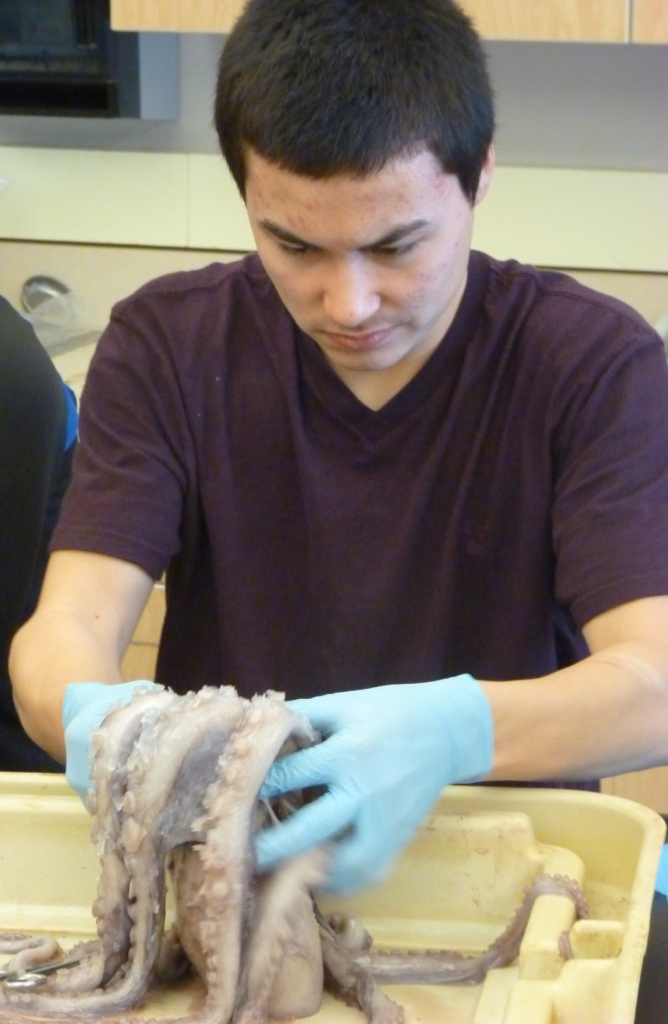
An Edgecumbe student gets ready to work on a small octopus.
He says Sitka students make a good audience, since many are from fishing families and have experience with ocean life. But he says Edgecumbe students seem the most interested in dissections.
“A lot of them are from Coastal communities around northern Alaska, and you can just see their eyes opening. They’ve done this before with hunting animals but they’re learning so much more about their physiology and what these organs that they were just pitching out as offal are doing for these animals and how it adapts them to their place in the ocean,” Lewis says.
Dissections – formally called necropsies – are difficult for some students. At least one lost her lunch during Brewer’s octopus class.
But Lewis says most get over it and do fine.
“Certainly you have some kids holding their noses. But usually once you get in there and things start to be interesting and you’re pulling lenses out of eyeballs and passing them around, all of a sudden they lose their fear,” he says.
Back in the classroom, Brewer instructs students as they cut into the octopus’ mantle, looking for internal organs.
“OK, so what I want you to do with the mantel is to turn it so the eyes are facing down and there’s a little slit back here and I want you to cut that slit,” he says.
Brewer circles the classroom, offering advice where it’s needed. He stops to help three students from Southeast and the Interior.
“You guys get it? Yeh. So once you that I want you to cut this way all the way and what we want to do is to peel the mantle back from the organs. Just use your fingers,” he says.
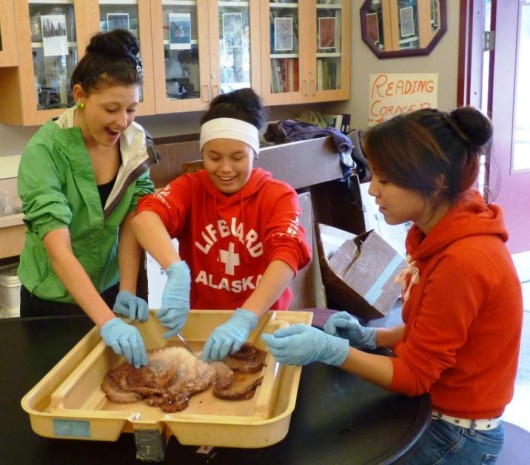
This is the fourth necropsy for Katie Wilmarth from Red Devil, Brittany Woods-Orrison from Rampart, and Natasha Kookesh from Angoon.
“We started with a crayfish and then we went to a frog. And then a rat. The rat was really gross. … This one’s the coolest one so far,” the students say.
Brewer continues around the room helping students locate and identify organs, explaining their functions as he goes.
Octopus sessions were offered to more than a dozen classes hosted by WhaleFest’s Science in the Schools program. It also organized another 60 sessions on other marine topics.
Coordinator Lewis says he’d like to add ocean acidification classes. And some day, he hopes to offer similar sessions in other Southeast communities.
Katie Wilmarth from Red Devil, Brittany Woods-Orrison from Rampart, and Natasha Kookesh from Angoon dissect their octopus.
Sitka Democrat Jonathan Kreiss-Tomkins (left) and Haines Republican Rep. Bill Thomas (right).
Haines Republican Representative Bill Thomas now holds a two-vote lead over Sitka Democrat Jonathan Kreiss-Tomkins in the race for House District 34.
Here are the new totals, from Division of Elections Director Gail Fenumiai:
Bill Thomas: 4,054
Jonathan Kreiss-Tomkins: 4,052
Kreiss-Tomkins watched the absentee ballot count in person today.
“It’s monotonous,” he said Tuesday afternoon. “It’s literally feeding a ballot counter thousands of paper stock ballots.”
But the counting isn’t over. More ballots could still arrive by mail, two more count dates are on the calendar, and anything can happen.
“There are still 167 absentee ballots that were requested and haven’t come in by mail yet,” Kreiss-Tomkins said. “At least a couple of those, and probably some kind of percentage of those, will come in by mail, and who knows what way they’re going to swing.”
There also are three question ballots from Port Alexander left to count.
Thomas, also reached by phone in Juneau, called the election a “see-saw,” and reiterated his worry about Southeast’s clout in the next legislative session.
He says he’ll have a seat on Finance, but has already lost the chairmanship. And he noted that Sitka Republican Sen. Bert Stedman – although returned to office by voters – will no longer be co-chair of Senate Finance.
“Very rarely has a district ever lost two co-chairs of Finance, in the history of the state. This might be the first time,” Thomas said. “We’re going to have to fight hard to get over it, either one way or the other. It’ll put more work on either Jonathan or I. There’s less capital and more people who want it. Either way, ti’s going to be a tough battle for whoever.”
Additional ballot counts, for absentee votes that have yet to arrive by mail, are set for Nov. 19 and 21.
The district includes the candidates’ hometowns as well as Metlakatla, Craig, Hoonah, Angoon, Kake, Klukwan, Port Alexander, Pelican, Elfin Cove, Klawock and Hydaburg.
Sealaska shareholders will soon get their largest end-of-year dividend in three years.
Sealaska Plaza is the corporation’s Juneau headquarters. Officials have announced the December distribution, the largest in three years.
But it’s mostly due to the success of another regional Native corporation.
The Southeast regional Native corporation will issue dividends to about 21,000 shareholders on or around December 6th.
Payments range from $96 to $868, depending on the class of shareholders.
Almost 90 percent of the larger dividends are funded by a pool of all regional Native corporations’ resource earnings. It’s known as 7(i) money.
Sealaska spokesman Todd Antioquia says it’s mainly from the Red Dog mine, owned by the Kotzebue area’s corporation.
“NANA continues to be the bulk of the distribution. Historically, Sealaska was the major contributor to 7(i) revenue sharing throughout the state through our own [timber] resource development,” he says.
Shareholders who are also members of urban Native corporations, such as Juneau’s Goldbelt, will receive $772. That’s assuming they have 100 shares of stock, the most common number. (Scroll down for all classes’ numbers.)
Members of village corporations, such as Angoon’s Kootznoowoo, will only get $96 directly. That’s the part of the dividend funded by corporate earnings. But Sealaska will pay the rest to their local corporation, which can pass part or all of the money on to shareholders.
Qualified descents of original shareholders will get only $96. And enrolled elders will be paid an extra $100 or so.
A little more than 5 percent of the larger dividends are paid out of corporate earnings, including investments. A slightly larger percentage comes from Sealaska’s permanent fund.
Its payments are based on a five-year earnings average. Antioquia says that’s been held down by low returns from the Wall Street crash.
“We have continued to feel the effects of 2008 through the last few years. Now that 2008 is rolling off of these averages into the future, as long as the markets remain stable or if they continue to improve, then we’re optimistic that we’ll see improvement there,” he says.
This December’s distribution is about 10 percent more than 2011’s, and about 35 percent more than 2010’s. But the previous two years were 37 and 26 percent more, respectively. (Scroll down for a five-year perspective.)
December’s payout totals about $13 million. Last April’s came to $14 million. That means shareholders are getting a total of around $27 million this year.
A little less than half live in Southeast. That means dividends are contributing about $13 million to the region’s economy this year.
Brian Holst of the Juneau Economic Development Council says it’s significant, especially to villagers.
“We know the Alaska Permanent Fund in some rural communities can be a very significant part of income. And in that sense, a Sealaska dividend can be similar to the permanent fund dividend in that it helps maintain a lifestyle in these small communities, which is very important for the sustainability to these places,” Holst says.
Holst ran the numbers and came up with several ways to explain the dividends’ economic impacts.
He says the total equates to the annual income of nearly 300 average Southeast Alaskans. Or a quarter of the region’s mining wages. Or around half of the value of seafood landed in Juneau.
Holst says it’s also about 7 percent of what tourists contribute.
“We know our cruise-ship passengers spend about $200 per person when they visit Juneau. And so, if we were going to think of that infusion of the Sealaska dividend as though it were cruise-ship passengers spent the same way, that would be the equivalent of about 68,000 cruise ship passengers additional in our communities,” he says.
Sealaska pays dividends twice a year.
Its businesses include timber, gravel, investment, plastics, government-contracting and environmental-cleanup operations.
December 2012 Distribution & Stock type: Per Share Per 100 Shares
Non-Elder Urban and At-Large Shareholders $7.72 $772
Elder Urban and At-Large Shareholders $8.68 $868
Non-Elder Village and Leftout Shareholders $0.96 $96
Elder Village and Elder Leftout Shareholders $1.92 $192
Descendant Shareholders $0.96 $96
December dividend only per 100 shares for urban shareholders
2012: $772
2011: $714
2010: $577
2009: $1,227
2008: $1,046
Yearly total per 100 shares for urban shareholders
2012: $1,617
2011: $1,430
2010: $989
2009: $2,208
2008: $1,605
The Sealaska dividends distribution chart, courtesy Sealaska.
Alaska history repeats itself, at least when it comes to the state’s constitution.
Voters soundly defeated Ballot Measure 1 on Tuesday. It asked whether there should be a constitutional convention.
Had it passed, the state’s entire governing document would have been up for review. But it didn’t.
With most precincts reporting, no votes outnumbered yeses by more than two-to-one. To put it another way, close to 75,000 more people expressed opposition than support.
That matches the sentiment of all previous every-10-years votes on the matter.
While Alaskans were down on a constitution rewrite, they were up on funding transportation infrastructure.
Bonding proposition A passed with 56 percent of ballots cast in favor, and 44 percent opposed.
The $453 million measure will fund road, harbor and rail improvements throughout the state.
Many of the larger projects – such as $50 million toward Anchorage Port Expansion – are for Southcentral communities.
But $65 million is targeted for Southeast projects. They include work on Ketchikan’s Shelter Cove Road, the Haines Boat Harbor, Sitka’s Katlian Bay Road, the city’s industrial park dock and Juneau’s Glacier Highway and Mendenhall Loop Road.
Close
Update notification options
Subscribe to notifications
Subscribe
Get notifications about news related to the topics you care about. You can unsubscribe anytime.