Ed Schoenfeld, CoastAlaska

UPDATED: Road north, library-museum project in budget

A 2010 drawing of one floor of the State Library, Archives and Museum Project in Juneau. It’s one of the projects listed in Gov. Seal Parnell’s capital budget. Photo courtesy of alaskalamp.blogspot.com

Governor Sean Parnell’s capital budget proposes spending about $195 million on Southeast projects.

That’s a little more than 10 percent of the statewide total of $1.8 billion.

The spending plan, released today, is for the fiscal year beginning July 1st. The budget will undergo many changes before it’s passed by the Legislature in the spring. (Read the budget.)

The budget would allocate $10 million toward construction of the Juneau Access Project, a road north out of the capital city to a ferry terminal close to Haines.

The largest Southeast project would rebuild about 22 miles of the Haines Highway, which links the northern Southeast city to the Alaska Highway. The budget proposes spending $31 million on that work.

Another large project is at the southern end of the region. Metlakatla Elementary School would undergo an almost $15 million renovation.

Juneau Representative Bert Kerttula says the budget includes many good projects – just not enough.

“I can see the Petersburg police station, which badly needs replacing, isn’t in at the moment. There is some room for capital [projects] in the budget, but not a lot. So, I’m sure it’s a work in progress,” Kerttula says. But I can see that the direction we’re heading isn’t really the one I would be going in right at this moment.”

Another large project in the budget is the new State Library, Archives and Museum building. The structure, in Juneau, would see $20 million, pushing its funding total above $100 million. About another $30 million is needed.

Parnell’s capital budget would also put $10 million toward construction of a road north out of Juneau, toward Haines and Skagway.

There are also a number of ferry projects. One would repower the fast ferries Fairweather and Chenega.

Marine highways chief Mike Neussl says the $9 million, plus money appropriated last year, would allow replacement of all eight engines.

The state is suing to make the builders pay for that. But it needs an appropriation in case the court case fails.

Neussl says replacements would be the same design as those now in use – and failing.

“There’s not any real good alternative beside that engine in terms of producing the same power, fitting into the same space and being compatible with the systems that are in there. A change of engines would require a fairly substantial redesign of a lot of systems,” Nuessal says.

Skagway’s ferry terminal is also in the budget. Neussl says $4.5 million would be spent modifying its loading area.

“It’s basically a floating concrete structure and the top surface of it is in a fairly poor state of repair. It tends to leak water into it. We have an ongoing project to determine whether it can be repaired or needs to be replaced,” Nuessal says.

He says the structure may need to be modified to accommodate a new Alaska Class Ferry design.

The capital budget also includes $3 million for improving Ketchikan’s ferry terminal. And the city would also receive about $5 million for water and sewer system work. Sitka would get about $1.4 million for much of the same.

Wrangell and Petersburg would each see $3 million for airport apron and taxiway work.

The governor released his operating and capital budget together. They total $12.8 billion. Parnell says total spending is more than a billion dollars leaner than the previous year.

Kerttula, House minority leader, questions his revenue projections.

“I’m fine having a conservative budget going in. But this, coupled with the governor’s forecast with the new methodology out of revenue, and with the upcoming oil bill, which I’m sure will happen, has me concerned about how we’re going into the future,” Kerttula says.

The region gets a little more than 10 percent of the $1.8 billion statewide capital budget. The overall amount is about a third less than last year’s final public-works spending plan, which was about a billion dollars more.

The budget is for the fiscal year beginning July 1st. It will undergo many changes before its final legislative vote this spring.

SE leaders concerned about ferry plan change

This poster from the Southeast Alaska Conservation Council promoted the Alaska Class Ferry over road-building.

You can tell a project’s in trouble when its website gets pulled off the ‘net. That’s what’s happened to the Alaska Class Ferry, which had a site including design elements, public comments and other information.

It’s down because Gov. Sean Parnell ordered an end to work on the 350-foot vessel, and begin design of smaller, less expensive ferries. (Hear the governor’s announcement and read about his decision.)

The announcement surprised Sen.Dennis Egan, a Juneau Democrat who was among those pushing to fund the original project.

“We’re all upset that we weren’t informed way early in this process about what they were going to do and different scenarios that they were trying to come up with,” Egan says. “We didn’t have a clue.”

And it’s not just the timing. Representative Beth Kerttula, another Juneau Democrat, says the new plan doesn’t make sense.

Juneau Rep. Beth Kerttula

“This is a real change of direction and frankly, I’m not on board. And I’m talking to the other members of the Southeast delegation and doubt many of them, if any, are either,” Kerttula says.

The governor said change was needed because price estimates rose by up to 40 percent. Ferry officials had warned the appropriated $120 million was not enough.

“The new contemplated design is more of a streamlined, simple vessel,” says Capt. Mike Neussl, the state Transportation Department’s deputy commissioner for marine operations. That means he runs the ferry system.

“The cost savings will come in the simplicity of no crew quarters, a smaller overall vessel and less amenities in terms of what the vessel contains,” he says.

Other design elements, such as food service and quiet rooms for the sick and elderly, are also off the table. Some of those features were meant to allow the ship more flexibility, so it could service more routes.

Many of the state’s ferries are old, and the Alaska Class Ferry was part of the replacement plan. Kerttula worries changing direction will push back the construction date.

“This really delays us. And that’s maybe more than anything something that aggravates me. We’ve been working hard, we were up and running, it was going on and here we are with a delay,” she says.

The state will keep its architect, Seattle’s Elliott Bay Design Group. And it will continue working with its expected builder, Ketchikan’s Alaska Ship and Drydock.

Neussl says contracts will have to be renegotiated before work can start.

“The design process for the new ship won’t be as complicated as the Alaska Class Ferry, so it shouldn’t take as long to get to the full detailed design on that. But I doubt that it will be done by next July, when the Alaska Class Ferry design was supposed to be done,” Neussl says.

The governor called for building two smaller ships with the money appropriated for one larger vessel. Both would operate in Lynn Canal, connecting Haines, Skagway and Juneau. That’s the same route as was planned for the larger ship.

A drawing of the larger proposed Alaska Class Ferry from Elliott Bay Design Group.

The Malaspina, which carries about 90 vehicles per sailing, covers the busy summer season.

Egan says the new ships’ projected 40-vehicle capacity is not enough.

“Well, Hell! Do you know how many vehicles get on in Juneau and go to Skagway and Haines in the summer? Those ships are full,” he says.

The chairman of Parnell’s Marine Transportation Advisory Board says the announcement caught him by surprise, too.

Robert Venables of Haines calls it, quote, “A very disappointing and dramatic change of direction.” He’s traveling and couldn’t be reached by phone. But via email, he said the last board meeting, about a month ago, included no hint of a redesign.

He’s not alone in his surprise.

“It’s not the direction that we were looking at and we have been working on it for quite a while,” says Skagway’s Mike Korsmo, who serves on the Marine Transportation Advisory Board.

He wonders whether a smaller ship could handle the strong winds and rough waters of Lynn Canal winters.

“When we were looking at the Alaska Class, we were looking at it for the weather conditions, the routes it was going to run and the capacity it would need to handle. So if we’re going to smaller vessels, then we definitely have to take a serious look at how that’s going to work,” Korsmo says.

Despite their concerns, both board members say they’ll work with the governor and Legislature toward a new design.

One reason Parnell gave for the change is to make sure new ferries are built at Ketchikan’s shipyard.

The ferry Matanuska is tied up at Alaska Ship and Drydock, where the smaller Alaska Class Ferry is expected to be built.

“That was just wonderful to hear his recommitment to build the ferries here in the state,” says Alaska Ship and Drydock’s Doug Ward.

He says about 170 people work at the facility.

He expects other ship-building jobs, so any ferry construction delays won’t affect the workforce.

“It’s a state-owned shipyards, these are state-owned vessels, these are Alaskans building the vessels,” Ward says. “And that was one of the primary goals, to create new employment opportunities in year-round family-wage careers and to attract new invest.”

The new plan will undergo further discussion once the legislative session begins and the ferry advisory board holds its next meeting.

What’s next for longtime lawmaker Albert Kookesh?

Angoon Democratic Sen. Albert Kookesh talks about Southeast politics during a 2011 start-of-session interview. Now, he’s ending his legislative career after losing a tough election to Sitka Republican Bert Stedman. Photo by Ed Schoenfeld.

Most Decembers, Albert Kookesh is making plans to move to Juneau for the legislative session.

But this year, he’s spending more time at his Angoon home, enjoying the view.

“I see really calm waters because it’s high tide right now. And all of the beaches and all of the woods are covered with snow. And so is my dock right in front of my little house here,” he says.

Democrat Kookesh lost his Senate seat to fellow incumbent and Sitka Republican Bert Stedman in the November general election. The two became opponents when parts of their separate Southeast districts were combined.

The new district has less than a third of Kookesh’s old constituents, dropping communities in the Interior and Prince William Sound. Stedman kept more than two-thirds of his old district, including two of the region’s three largest communities.

Sen. Albert Kookesh, right, and Rep. Woodie Salmon discuss rural education issues in March of 2004. Photo courtesy of Kookesh’s office.

“I wasn’t surprised. I thought if we worked very hard we could pull a little bit of an upset here, but that wasn’t to be. People knew Stedman in his old district and they voted for him,” Kookesh says.

Out of office, 64-year-old will remain busy. He’s chairman of the Sealaska regional Native corporation’s board of directors. He also co-chairs the Alaska Federation of Natives board.

“So I’m not going to be sitting around not doing anything. I’m going to be pretty busy, in fact. I’m even contemplating getting back into commercial fishing,” he says.

Kookesh, once a seiner and a store- and lodge-owner, spent two terms – or eight years – in the Senate. That came after four terms – another eight years – in the House. Before that, he spent two years in the Capitol as Governor Tony Knowles’ special assistant for rural affairs. (View photos from Kookesh’s legislative career.)

“Albert’s going to be a definite loss,” says Kim Metcalfe of Juneau, a Democratic Party leader who has been active in the Alaska Native Sisterhood.

“He’s a very powerful guy with the positions he holds with both Sealaska and AFN. So, he’s not going to go away. He’s going to be around for a long time and use his speaking skills.
He’s a powerful speaker and I think we’re going to hear a lot more from him,” Metcalfe says.

She says Kookesh has been a strong advocate for education — statewide and in the villages he represented. She also says he used his leadership and oratory skills to urge young Natives, as well as others, to attend college.

Kookesh and Sitka’s Stedman worked together in the Senate’s bipartisan majority. Their race was largely respectful, and Kookesh continues speaking in positive terms.

“I think he’s going to do a good job for our district. I’m just a little disappointed that they weren’t able to put the coalition back together where he could have been the co-chairman of Finance again, or something more,” he says.

Sen. Albert Kookesh, right, cooks salmon for a session traditional foods dinner in March of 2004. Photo courtesy of Kookesh’s office.

Kookesh headed up the Transportation Committee, while Stedman assembled the capital budget as co-chairman of the Finance Committee. But this election’s Republican gains broke up the bipartisan majority. And the new leadership shut him out of budgeting.

Instead, Stedman was offered chairmanship of the Health, Education and Social Services Committee. He accepted, saying he looked forward to an opportunity to broaden his horizons.

Kookesh isn’t so sure.

“I don’t really think he’s cut out for HESS. But maybe we’ll see something different out of him. I think he’s more of a numbers man. He’s very powerful in that area and he has a very good background in it. Finance is right up his alley,” he says.

Kookesh has been active in the Alaska Native Brotherhood, serving as regional president and secretary. He played Gold Medal basketball, a major Southeast competition, for three decades.

But it hasn’t always been a smooth ride.

He’s a regular target of Sealaska shareholders critical of the corporation. And he earned an ethics violation for comments some took as threatening the city of Craig to gain support of the corporation’s land-claims legislation.

He was also among those cited for overfishing subsistence sockeyes near Angoon. His case was dismissed.

Despite all that, he says he still has a role to play.

“My name is well-enough known that I can still be a little bit of a force in Alaska. If it’s through the Native community, that’s fine. If it’s through some other venue, I’d be glad to look at whatever comes down the pike. Maybe we’ll have a Democratic governor in the next election and I could be involved in that somehow,” he says.

Technically, the Angoon Democrat remains a senator until the next Legislature gavels in January 15th. But there’s little to do before then.

Read and hear earlier reports about Albert Kookesh:

Parnell: Design smaller ferries, build them here

Ketchikan’s shipyard is where the 350-foot Alaska Class Ferry was supposed to be built, before cost estimates increased. Now, Gov. Sean Parnell wants two lower-cost, smaller, less-expensive ships. Photo by Ed Schoenfeld.

Alaska Gov. Sean Parnell announced Tuesday in Ketchikan that the state will immediately begin negotiations with the Ketchikan shipyard to design the first of at least two smaller ferries for the Alaska Marine Highway System, rather than the 350-foot ferry that had been planned.

Parnell says the $120 million budgeted for the project would not be enough to build the larger ferry in Ketchikan. He says he’s dedicated to constructing Alaska ferries in Alaska, which prompted the new plan.

The governor stopped by KRBD’s Ketchikan studio, and sat down with Leila Kheiry to talk about this new direction, as well as the upcoming legislative session.

In a press release, the governor said, “With declining oil production and declining state revenue, we have to be smarter with the people’s money while meeting Alaskans’ marine transportation needs. I have supported and will continue to support the increased service by mainliners from Bellingham all the way out the chain.

“By setting a new course, Alaskans can build two smaller Alaska Class Ferries and stay on budget, and at the same time provide the same or better level of service Alaskans expect from our marine highways.

Gov. Sean Parnell discusses his plans for new state ferries during an interview at KRBD-FM in Ketchikan.
Gov. Sean Parnell discusses his plans for new state ferries during an interview at KRBD-FM in Ketchikan. Photo by Leila Kheiry.

“While the ferry system produced record levels of revenue last year, we also face this reality: Costs continue to accelerate for the maintenance of our fairly old fleet. Building smaller Alaska Class vessels will have a major positive impact on our ferry system capacity. The smaller vessels will provide much-needed backup service should other vessels experience mechanical problems, and can add flexibility to the system when special community events require greater access.”

To date, the Legislature and governor had approved $120 million for this first Alaska Class Ferry project. Early estimates demonstrated the total cost for a 350-foot vessel would be closer to $150-167 million. The governor has now asked that funding for the first vessel be directed to the plan for the smaller vessels. Design work will commence in cooperation with Alaska Ship and Drydock officials as soon as possible.

The AMHS has been operating year-round since 1963, with regularly scheduled passenger and vehicle service to 33 communities in Alaska, as well as Bellingham, Washington, and Prince Rupert, British Columbia. There are currently 11 vessels in the AMHS fleet.

More humpback whales could cause problems

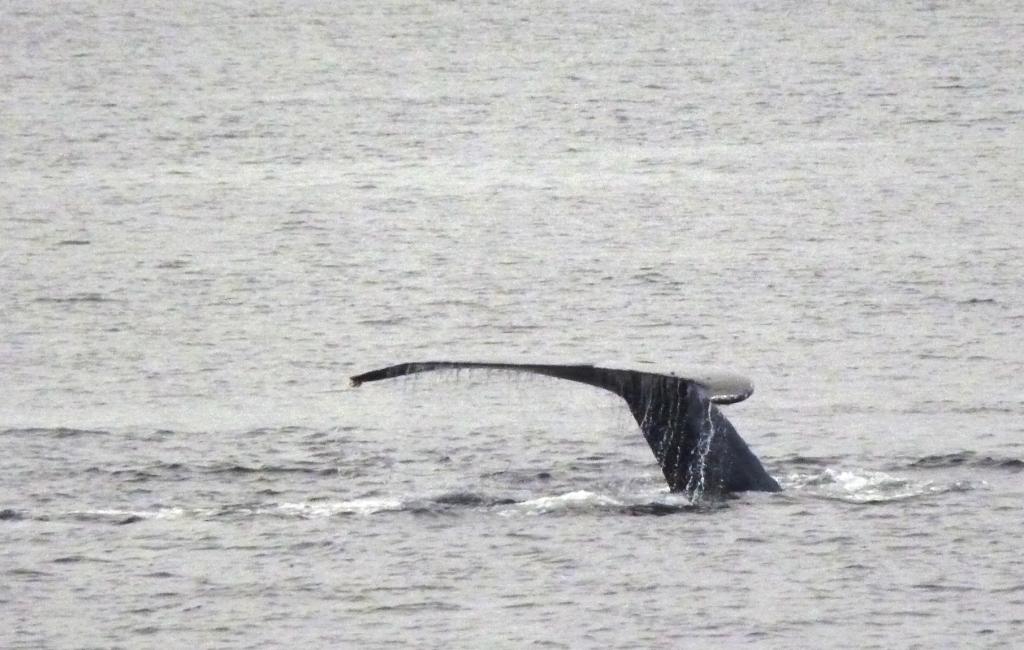
A humpback whale begins arching its back and showing its tail just before diving for herring Nov. 3 in Sitka Sound.
A humpback whale begins arching its back and showing its tail just before diving for herring Nov. 3 in Sitka Sound. Photo by Ed Schoenfeld.

There’s a baby boom going on with Alaska’s humpback whales.

Slow-but-steady population growth is good news for the species, as well as whale-watchers. But it could be bad news for boaters, hatcheries and the herring fleet.

The healthy population was visible during a boat tour held as part of the Sitka WhaleFest Science Symposium, held Nov. 1-4.

“There’s a few more whales further out. I’m not sure if they’re whales we’ve had close views of this morning, but we’ll find that out,” says Capt. John Dunlap as he pilots a catamaran through a protected area of Sitka Sound.

The Allen Marine vessel is carrying several dozen passengers, plus expert marine biologists.

Humpback researcher Jan Straley shows whale baleen to a passenger during a Nov. 3 whale-watching tour in Sitka Sound.
Samples of baleen are examined during a Nov. 3 whale-watching tour. Baleen filters krill and small fish from sea water. Photo by Ed Schoenfeld.

One is Jan Straley, festival science director and a University of Alaska professor who’s studied the marine mammals for more than 30 years.

“The population increase in humpbacks is going gangbusters,” Straley says.

“They are reproducing at about 6 to 7 percent a year in Southeast Alaska. So that means for every hundred whales we get six or seven more whales the next year. And their mortality rate isn’t that high, so we’re just getting more and more whales, which is a good thing, but it also comes with some problems,” she says.

Those problems aren’t evident on this day. Passengers gather on deck to watch, photograph – and hear – some of the sound’s spouting humpbacks.

The numbers are up as the species continues recovering from global commercial whaling. But researchers say trouble’s ahead, as the population grows.

John Moran is a research biologist with the National Marine Fisheries Service in Juneau. (Scroll down to hear Moran’s speech, Living in a Humpback World: The Shenanigans of a Recovering Population.“)

“The amazing thing is that there’s not more issues. There’s a lot of cruise ships, a lot of whales, and there’s a lot of gear in the water,” Moran says.

Whales do get hit and killed by the big ships. And they do become tangled in commercial fishing lines. But Moran is more worried about interactions between whales and skiffs, cabin cruisers and other small vessels.

“People don’t really pay attention when they’re driving boats like they do when they’re of driving a car. And small boats are fast and whales are big. And it’s like hitting a brick wall and I don’t think people fully realize that,” he says.

A humpback whale shows its tail as it dives for food in Sitka Sound.
A humpback whale shows its tail as it dives for food in Sitka Sound. Photo by Ed Schoenfeld.

Passengers watch several whales arch their backs, show their tails and dive. Captain Dunlap asks everyone to keep their eyes open.

“We’re in relatively deep water. It’s over 350 feet deep here. And depending on where these whales are feeding, they could be down for quite a while,” he says.

Some people think humpbacks eat only krill, a small, shrimp-like crustacean filtered out by their baleen. But Straley tells the whale-watchers they also feed on fish.

“There’s a nice layer of herring right on the bottom that’s about 80 fathoms deep. So these whales come right now, and they’re feeding prior to their migration, just bulking up because they don’t feed a lot in Hawaii,” she says.

That’s where most Sitka whales go during winter months. Some also swim from Prince William Sound and other locations to Mexican waters.

Research shows the growing humpback population eats enough herring to reduce local stocks.

Moran says they take about 20 percent of the biomass in Prince William Sound — about the same as the commercial harvest before the Exxon Valdez disaster. The whales may be slowing herring recovery since the oil spill.

Moran says humpbacks are very effective herring hunters.

“The whales dive down into the school and more whales come and they start breaking up this big school into smaller schools. Fish get stunned, fish are scattering, and it’s a lot easier for a sea lion,” he says.

That’s another impact of humpback population growth. Their feeding helps other marine mammals, as well as birds, which sometime follow whales.

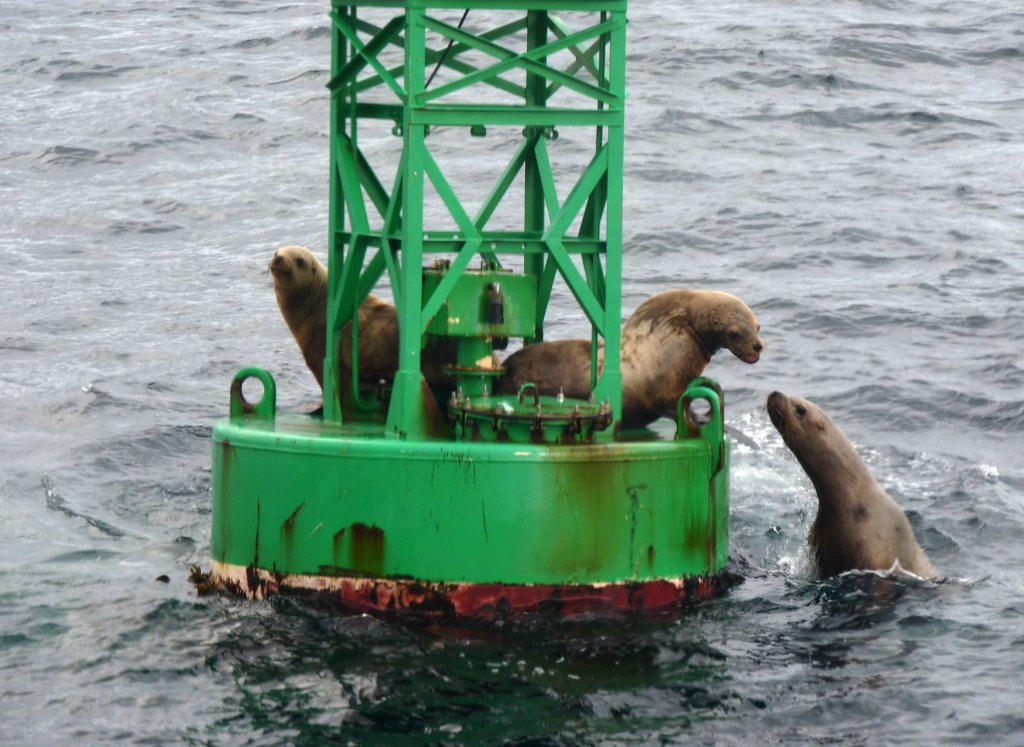
Sea lions touch noses as one clambers onto a buoy near feeding whales in Sitka Sound. Sea lions follow humpbacks, eating herring stunned or killed during feeding.
Sea lions touch noses as one clambers onto a buoy near feeding whales in Sitka Sound. Sea lions follow humpbacks, eating herring stunned or killed during feeding. Photo by Ed Schoenfeld.

Then there’s the salmon hatcheries. At Baranof Island’s Hidden Falls, and some other sites, whales have learned to feed on newly released fry.

“One thing they’re really good at is being maneuverable,” Moran says. “They have those really long pectoral fins that allow them to turn real sharp so they can get in really close to shore and they can work around the net pens and they figure out this is a great place to eat.”

Marine scientists continue to study humpback population growth, and what it might mean for the ocean ecosystem, as well as people.

But on this cruise, more whales just means more photos.

A whale spouts, and the cameras go “click-click-click.” The shutters sound even more as it lifts its tail to dive.

“Beautiful,” one wale-watcher says.


State warns about bad PSP info

Cockles, a type of clam common in Southeast Alaska. A widely-read magazine incorrectly reported cold water temperatures could prevent PSP. Photo courtesy the state Department of Health and Social Services.

State officials say a magazine article about shellfish incorrectly states when they can be gathered safely.

Alaska Magazine’s December-January issue includes a first-person story about collecting cockles, a type of clam, on shores near Juneau. It includes a warning about paralytic shellfish poisoning. But it says cockles can be dug safely in late fall and winter, because colder water keeps PSP-producing algae from blooming.

Department of Environmental Conservation health officer George Scanlan says that’s not the case.

“There are no safe months. PSP can occur anytime. And the only way time you would know is to test it and to have the lab analyze the animal,” he says.

The Departments of Environmental Conservation and Health and Social Services, say only commercially-grown shellfish is considered safe.

That’s because of the tests. Checks last week, for example, found some Southeast geoducks clams had toxin levels four times more than what’s safe for human consumption.

PSP can cause loss of arm and leg control and make breathing difficult. It can kill a person in about two hours.

Alaska Magazine could not be reached for immediate comment.

Paralytic shellfish poisoning can be found in clams, mussels, oysters and scallops. Crab meat is not known to contain the toxin, but crab guts can.

DEC spokesman Ty Keltner says shellfish gatherers should know the facts.

“We certainly don’t want to discourage anybody from going out there and having their right to recreational harvests. But we just want folks to know that safety is really important and we want people to be aware of the risks when they do this,” Keltner says.

Here’s where to learn more about PSP and shellfish safety:

— Alaska’s Division of Public Health Paralytic Shellfish Poisoning Fact Sheet

— The Division of Environmental Health’s Recreational Shellfish Program


Site notifications
Update notification options
Subscribe to notifications