Then-Sen. Albert Kookesh addressed a 2011 Native Issues Forum audience in Juneau. He remains hospitalized in Anchorage after suffering a heart attack.
An Alaska Native leader and former lawmaker remained in the hospital Tuesday after suffering a heart attack Monday in Juneau.
Providence Alaska Medical Center in Anchorage listed Albert Kookesh in critical condition as of late Tuesday afternoon.
Kookesh co-chairs the Alaska Federation of Natives and chairs the Sealaska regional corporation’s board of directors.
His family could not be reached for immediate comment. But Sealaska posted an update on its website saying he is resting after undergoing surgery to correct a blockage.
The update says doctors plan to wake him up from sedation Wednesday.
It says his family asked that no flowers be sent because Kookesh is allergic.
The Angoon Democrat served eight years in the House and eight years in the Senate. He lost a re-election bid last year after redistricting separated him from many of the communities he represented.
Kookesh has also been involved in a number of regional and nationwide Alaska Native organizations. He has a law degree and has been a seiner and a store- and lodge-owner.
In a recent interview, he said he was contemplating rejoining the fishing fleet.
Both would turn about 70,000 acres of the Tongass National Forest over to Sealaska, the regional Native corporation for Southeast Alaska.
Murkowski’s version includes numerous changes meant to reduce opposition from environmental groups, tourism businesses and small communities.
She says it would still complete a promise made 40 years ago by the Alaska Native Claims Settlement Act.
Senator Lisa Murkowski.
“In terms of what we set out to do, which is to provide completion to Sealaska in terms of allowing them to select their lands that were committed, this will help finalize that selection and really work to balance the interests of all of those in the region,” she says.
Both bills transfer about 68,000 acres to Sealaska for timber harvest and development. They remove about 26,000 controversial acres on or near northern Prince of Wales Island and replace them with other parcels.
Sealaska Vice President and General Counsel Jaeleen Araujo says the new acreage is near some previously-logged areas.
“There was some infrastructure already in place on north Prince of Wales, so we had to find other alternatives that would have proximity to infrastructure that would be helpful in timber development,” Araujo says.
The Southeast Alaska Conservation Council, an umbrella environmental group, has been one of the groups critical of the legislation.
SEACC Attorney Buck Lindekugel says he hasn’t seen Young’s bill and is still looking through Murkowski’s measure. But he sees some significant improvements.
“Senator Murkowski has shown some solid leadership and tried to address some thorny issues that were raised by Southeast Alaskans. There is a lot of bittersweet stuff here, particularly with some of the timber lands. Nobody’s going to be happy with all of them. But both Sealaska and Senator Murkowski helped avoid some real controversial places,” Lindekugel says.
Congressman Don Young.
He says his group will run the measures by its membership before taking a formal position.
The Alaska Forest Association backs the measures.
Executive Director Owen Graham says Murkowski’s version makes too many concessions. But he says they’re needed to keep the logging industry alive.
“We’re holding our nose on the conservation areas. We don’t think there’s anything special about them. They’re certainly not needed because there are other protections for the land. But we’re willing to accept those conservation areas in order to get this bill done quickly,” Graham says.
Both bills also cut the number of small parcels set aside for tourism, energy or other economic development. They also reduce the acreage to be selected as sacred or cultural sites.
Murkowski’s version increases the required stream-buffer zone from 66 to 100 feet to protect three salmon spawning areas. It also balances Sealaska’s timber selections with 150,000 acres of conservation areas.
Don Young spokesman Michael Anderson says that’s where his version differs.
“The House bill doesn’t contain any conservation set-asides. Though the two bills convey the same overall acreage to Sealaska, the House bill includes a few more small parcels. The House bill does not include any buffer requirements beyond what is required in the Alaska Forest Practices Act,” Anderson says.
Similar legislation was introduced in previous Congresses.
Young’s version passed out of the House as part of a larger lands package last year. Murkowski’s bill did not make it to the Senate floor.
Sealaska Plaza in Juneau, headquarters of the Southeast regional Native corporation.
She says it will have a better chance this year. That’s because Senator Ron Wyden, an Oregon Democrat, took over chairmanship of the chamber’s Energy and Natural Resources Committee.
“He has pointed out to me numerous times that he’s very pleased with the fact that we have engaged in this level of sit-down and dialog with everyone from the administration to the energy committee staff, to those within all aspects of industry, whether they’re fishermen, environmental groups, tourism. I think he’s impressed by the process that he’s seen,” Murkowski says.
She says Wyden has agreed to move several land bills out of the Natural Resources Committee. Sealaska would not be part of the first package, which will only include measure that already cleared the committee. But it could be in a later version.
Patrick Quinton, executive director of the Portland Development Commission. He addressed the Southeast Innovation Summit in Juneau. Photo courtesy PDC.
A Pacific Northwest development expert says Southeast leaders are on the right track toward improving the region’s economy.
A large group of Southeast business, government and other leaders have spent the past two years searching for ways to grow the region’s economy.
“If that list were to expand, I think it would really tax the resources of the organizations that are helping companies, as well as the companies themselves,” says Patrick Quinton, executive director of the Portland Development Commission.
He addressed cluster initiative members during the 2013 Southeast Innovation Summit at Juneau’s Centennial Hall, organized by the Juneau Economic Development Council.
Quinton’s organization used the cluster process to develop the Portland area’s clean technology, outdoor recreation products, software, and advanced manufacturing industries.
“This is a very long-term process,” he says. “You’re fundamentally talking about changing the nature of the economy. You’re talking about diversifying the economy. Those changes take a long time.”
Southeast’s initiative began a little more than two years ago.
Quinton says it’s made good progress so far. Those involved have engaged industry and the government agencies that can help.
“In a few years, you would want to see how successful are you in executing the plans that have been laid out,” he says. “So if you have two or three initiatives, what kind of progress are you seeing there? And I would imagine three or four years out, you would want to see some actual change in the job numbers and the economic output.”
He says he doesn’t know enough to about the region to predict what will work best. But he’s intrigued by the Mining Service and Supply focus.
“Import substitution is the more technical term. But how do we replace services that are being provided from distant places with more local services? And Juneau seems to be well-positioned to be the more local provider of those services,” Quinton says.
He says cluster-process leaders have to make hard decisions, and it’s not a democratic process. Otherwise, he says, the effort will lose focus.
Alaska State Troopers will not make public any information from the autopsy of a 13-year-old girl killed last week in Kake.
Spokeswoman Megan Peters says the official report is expected to be delivered to troopers today. But she says, quote, “We will not be releasing any details of it.”
The State Medical Examiner’s Office completed the autopsy Friday.
Mackenzie Howard’s body was found Feb. 5th at a Kake church. Troopers say her death is being investigated as a homicide. They will not discuss a murder weapon or most other aspects of the case.
Peters says releasing more information could compromise the integrity of the investigation.
She says at least five investigators traveled to Kake to secure the crime scene, gather evidence and conduct interviews. She says that effort continues.
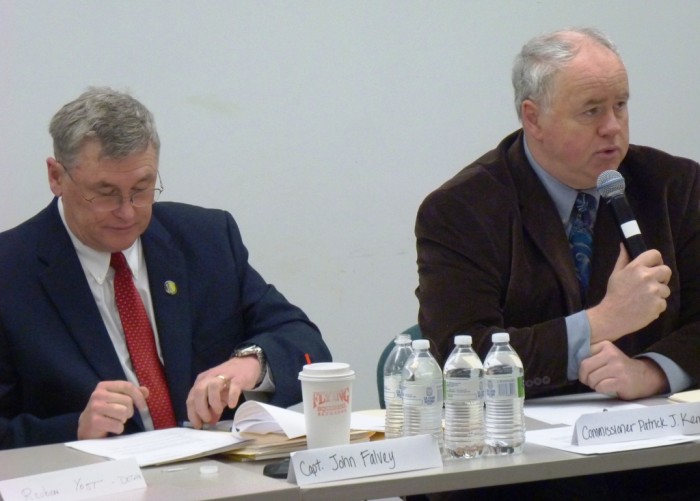
Ferry system General Manager John Falvey looks through paperwork as Transportation Commissioner Pat Kemp addresses the Marine Transportation Advisory board Jan. 22, 2013. Ed Schoenfeld/CoastAlaska photo.
Transportation Commissioner Pat Kemp has apologized for keeping the Marine Highway Advisory Board out of the loop on the Alaska Class Ferry. He and his staff also released a few more details on the vessel’s proposed replacements.
“I sincerely apologize for not keeping the board involved or not knowing more about the board,” Kemp told the ferry advisory panel during a face-to-face meeting this week in Juneau.
“I wasn’t involved with the board before and, in fact, when this whole thing was going down,” he said. “I wasn’t even commissioner. I was acting commissioner. And I didn’t know the sensitivities of the board. I wasn’t sure how the board operated.”
Kemp used to be deputy commissioner for highways and public facilities. He was named acting transportation commissioner in August, and got the full appointment in December.
He said he came into a leadership structure that isolated managers. And that’s why he didn’t know the rules of the road, or the fact that the Alaska Class Ferry project was headed way over budget.
“I was kind of in head-scratching mode for a while because I really didn’t know what to do. I’ve developed projects for my entire career and I had to just get up to speed with this one,” Kemp said.
He decided the plans should be scrapped before an October advisory board meeting. But he couldn’t bring it up without Governor Sean Parnell’s approval.
That came in December, when the governor announced plans to design two smaller, cheaper shuttle ships.
Most Marine Transportation Advisory Board members criticized Kemp’s handling of the design change.
Angoon’s Maxine Thompson represents Southeast villages on the panel. Said she was blind-sided.
“I was extremely frustrated because over the years we have worked really hard to develop a communication line. And we were under the impression that our input was appreciated. So reading about it in the paper and responding to the people in the communities, we’re at a loss as to what happened,” she said.
Sitka’s Gerry Hope, who represents central Southeast, agrees.
“We became accustomed to really being plugged into the process and feeling like we had a positive role to play. And then when it was announced in the news … I was really surprised,” he said.
Some members had no complaint with the decision to drop the Alaska Class Ferry design. They were happy to see what they considered an out-of-control project return to its simpler beginnings.
Advisory board Chairman Robert Venables accepted Kemp’s apology.
“I thought that was somewhat unprecedented and very well received. I think the board has had a very warm and close-working relationship with the commissioner’s office and the staff. And I’m glad to see that bridge-mending underway,” Venables said.
Transportation officials told board members a few more details of the shuttle ferry, which will sail Lynn Canal.
They say the shuttle system could create 15 to 25 jobs in Haines. That’s in part because those traveling Juneau-to-Skagway, or the other way around, will need to change ships in Haines.
Recently appointed Deputy Commissioner Reuben Yost said the latest Alaska Class Ferry plans could be used for another ship.
“Basically, we have a preliminary design for a 350-foot Taku replacement that will be on the shelf. In the future, after the Tustumena is replaced, if the next vessel to be replaced is the Taku, we are that much ahead in terms of design,” Yost said.
Kemp said more details of the new shuttle ferry plans will be released soon. He said the advisory board will be involved.
“I’ll have a close relationship with you. I like ferries. I like marine highway stuff. I think it’s a great system and I have the utmost confidence in Capt. Falvey and the utmost confidence in Reuben (Yost). And I think we’re going to be fine,” he said.
Kemp named Yost as one of three deputy transportation commissioners. But he will oversee other agencies and special projects, along with the ferry system.
Several legislators last week said state law requires such hires to go through the advisory board. Kemp said it’s a different job and should not be covered by the legal language.
This poster illustrating cruise ship wastewater was displayed at a Sept. 20, 2012, science panel open house.
The Parnell Administration wants to change another part of the 2006 cruise ship initiative.
The voter-approved measure required strict new standards for wastewater discharges.
Bills introduced this session at the governor’s request would effectively allow more chemicals and minerals to be released into the water. Backers say the levels would still be safe.
Senate Bill 29 had its first hearing Wednesday before the Senate Resources Committee.
Environmental Conservation Commissioner Larry Hartig told the panel the bill would allow a more practical approach to controlling pollution.
“It recognizes that it’s really difficult, if not impossible, for many dischargers to meet the water quality standards at the point of discharge,” Hartig says. “So they allow a limited area of mixing the treated effluent … with the receiving water at the edge of the mixing zone. “
The industry has asked state officials to make such a change. Cruise lines say strong new standards that start in 2015 are impossible to meet.
Hartig says wastewater-control measures would remain in effect under the legislation.
“It can’t bioaccumulate, it can’t have toxic effects, it can’t affect anadromous fish that would be going through that area, it can’t affect that water body’s ability to produce aquatic life in the future. It just goes on and on about the things it can’t do,” Hartig says
The committee took no testimony, but the measure has opposition.
“I think the bill is unnecessary,” says Chip Thoma, president of Responsible Cruising in Alaska, which backed the 2006 initiative standards.
“And the reason is because the cruise ships and DEC have made such great improvements in the last few years in lessening the effects of some of their discharge problems,” Thomas says
Thoma and Hartig both agree it’s important to remove copper from cruise-ship wastewater. That’s because, among other things, it affects salmon behavior.
Thoma says copper-removal is an example of how new technology can reduce pollution.
“These are older ships that were all piped with copper. The new ships are all flex-piped with plastic. It’s an incredible revolution. Just in the last few years, we’ve eliminated the copper problem on the new ships,” he says.
An appointed science panel has been investigating technological solutions for about two years. Hartig says it hasn’t found economically-viable equipment.
The Senate Resources Committee will hold another hearing Friday afternoon where it will take public comments on the bill. An identical bill will be heard that day in the House Resources Committee.
The Legislature has already rolled back one part of the cruise ship initiative.
At the administration’s request, it reduced head taxes that fund local tourism projects by more than 50 percent. It did not change a portion of the tax that funds onboard environmental monitors.
Close
Update notification options
Subscribe to notifications
Subscribe
Get notifications about news related to the topics you care about. You can unsubscribe anytime.