Ed Schoenfeld, CoastAlaska

Preliminary shuttle ferry plan released

New Lynn Canal shuttle ferries will be 280 feet long, seat about 300 passengers and operate no more than 12 hours a day.  

Part, but not all, of the car deck may be open. And the ships will have no staterooms or crew quarters.

That’s according to a draft design-concept report prepared for the Alaska Marine Highway System by Anchorage-based Coastwise Corporation.

Officials say it’s one of several steps in the design process for what’s being called the Day Boat-Alaska Class Ferry.The shuttle plan replaces an earlier Alaska Class design that called for a larger vessel that could sail longer routes.
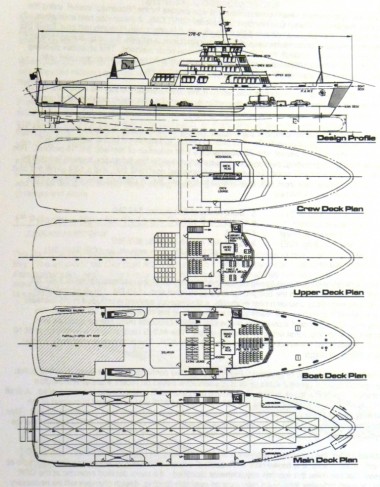
Preliminary shuttle ferry deck plans are part of a design concept document released by transportation officials. AMHS image.

Deputy Transportation Commissioner Reuben Yost says amenities will be limited, including food service.

“What we envision at this point of time is vending machines. So it would be similar to what we have on the fast ferries, in terms of amenities. So there won’t be a cafeteria, there won’t be cooked for but there will be food in machines and drinks in machines most likely,” Yost says.

Hulls and decks will be configured so vehicles can drive in one end and out the other, for quicker loading and unloading.

Yost says the ships could carry 53 large vehicles, but not all would be under cover.

“Essentially the vehicle space for the last 15 vehicles, if the car deck was full, would be in an area that we’re saying potentially could have an open roof,” he says.

Yost says high walls and other design elements will protect against ocean spray. He also says the vehicle deck is usually not full in winter months when wind and waves are at their worst.

Marine Highway General Manager John Falvey says the ships will be designed for Lynn Canal’s harsh conditions. For example, they’ll lack sponsons, which project from the side of the hull.

“It will not have the sponsons forward, which eliminates a lot of the slamming and potentially a very flared … bow which will deflect the spray. We feel that a vessel of these characteristics will have very good sea-keeping ability,” Falvey says.

They would be built to sail at an average speed of 15-and-a-half knots. That’s about the same as other ships in the fleet, except the fast ferries.

The design document estimates the final design could be completed by next November. And officials hope to keep costs within the $117 million put aside by the state.

Falvey says plans are to build two identical vessels.

“The shipyard is, in essence, lofted up and tooled up as far as their particular class of vessel that they’re building. You can throw a lessons learned and experience factor into the second vessel. There are actually many savings we will be able to see on the second vessel if we are able to sign a two-ship contract with the shipyard,” he says.

The draft plan was presented to the Marine Transportation Advisory Board Wednesday, Feb. 27, and will go before the House and Senate Transportation Committees Thursday, Feb. 28.

Opportunities for public comment will come later in the process.
Malaspina to celebrate 50th Anniversary of the Ferry system

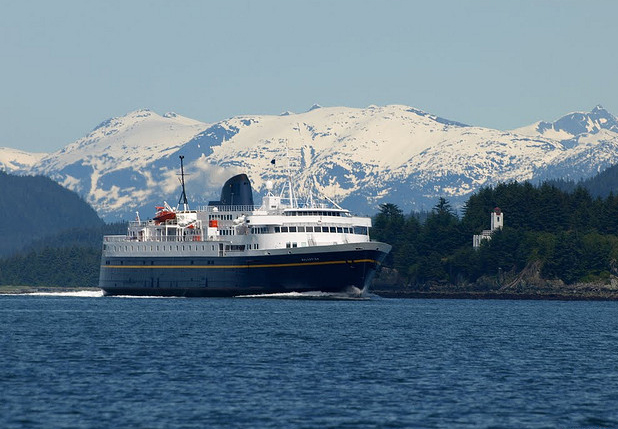
The Malaspina returns from Skagway.
The Malaspina returns from Skagway. (Photo by Gillfoto/Flickr Creative Commons)

The ferry Malaspina will take a celebratory trip through Southeast Alaska in early May.

Spokesman Jeremy Woodrow says it’s one of the Alaska Marine Highway’s 50th anniversary events.

“This is to celebrate in part its inaugural run in 1963. And that will include community events in Ketchikan, Wrangell, Petersburg, Juneau, Haines and Skagway,” Woodrow says.

Woodrow says the Malaspina will make extended stops in each community and be open for tours. Local celebrations are also being planned during port calls. One will also take place this fall in Sitka.

He says the ferry will make special excursions in the gateway and capital cities.

“One will be sailing through Misty Fjords National Monument. They’ll start in Ketchikan and do a day trip through Misty Fjords and back to Ketchikan. And the other, when it’s in Juneau, will sail from downtown, not Auke Bay, to Tracy Arm fjord and back,” Woodrow says.

What’s called The Golden Voyage will run May 1st to May 5th.

More details on the sailings and community celebrations are on the website www.FerryAlaska.com.


Southeast summit to boost local leadership

Southeast business, tribal and government leaders meet this week in Juneau for the Southeast Conference’s Mid-Session Summit.

Executive Director Shelly Wright says the event has a leadership focus.

Motivational speaker D.J. Eagle Bear Vanas

That includes a keynote presentation by Native American motivational speaker D.J. Vanas titled “Integrating the Warrior Culture into Your Culture.”

Wright says a community character-building session is also part of the leadership focus.

“There’s always room for a refresher, there’s always room for re-invigorations, which is basically what this is. It’s not necessarily, ‘Let’s teach you more skills,’ but (putting) insight and excitement into what your skills are,” Wright says.

Southeast Conference members will also celebrate the 50th anniversary of the Alaska Marine Highway System with screenings of a new documentary, produced by KTOO-TV.

The conference first organized to push for development of the ferry system.

Summit sessions run all day Tuesday, Wednesday and Thursday at Juneau’s Centennial Hall. The documentary will screen at a noon luncheon Thursday. There’s a fee for lunch, and a larger registration charge for the whole conference.

Wright says the group’s fisheries, mining, energy and other panels will meet during the summit.

“We do break-out committee work where we can see people face to face, and give people a chance to go see their legislators if they need to, and kind of turn it into a work meeting,” she says.

The conference holds its annual meeting in mid-September in Sitka.

Can wave energy get Yakutat off diesel?

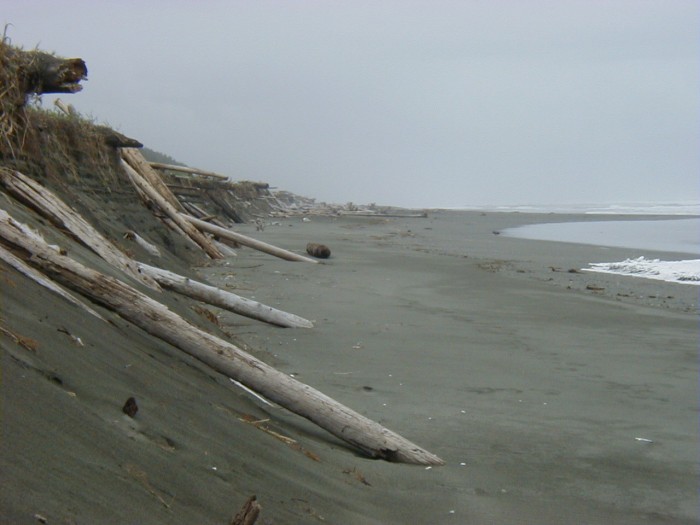
Waves crash onto Yakutat’s Cannon Beach. A New England company was recently awarded a preliminary permit for work toward a community wave-energy project here. Photo by Ed Schoenfeld/CoastAlaska.

Surfers from around the world travel to Yakutat’s remote beaches to catch big waves.

Now, the community, hundreds of miles away from the nearest grid, wants to make another use of that power.

“If we’re able to convert that energy that’s pounding on our shores and displace diesel, the state’s going to save a lot of money,” says Chris Rose, founder and executive director of REAP, the Renewable Energy Alaska Project.

“We’re a place that makes sense to test this stuff, because we have higher energy costs than a lot of other places,” says Rose, who’s been watching the project’s progress.

Yakutat Borough Manager Skip Ryman says the bottom line is to get away from diesel.

He says the municipal power plant sells electricity for about 57 cents a kilowatt hour. The state’s Power Cost Equalization Program halves the residential price. But still …

“People are finding that anywhere from 45 to 60 percent of their disposable income has been going for utilities and home heating,” Ryman says. “This in turn is hurting retailers. We’ve been losing families, losing kids in the school system and essentially sending the community into a bit of a death spiral.”

Yakutat, about halfway between Juneau and Cordova, has been interested in wave energy for some time.

A study completed in 2009 recommended devices installed near the shore, rather than father out into the ocean.

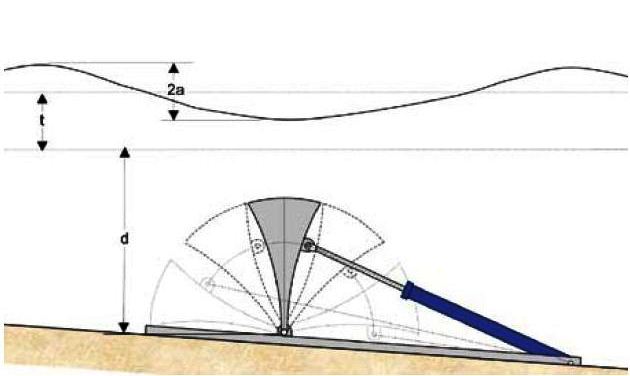
“The device that we’re working on is called an oscillating wave surge converter,” says Cliff Goudey is senior engineer for Massachusetts-based Resolute Marine Energy.

A diagram of Resolute Marine Energy’s Surge wave energy converter and how it works. Image courtesy RME.

“That’s sort of a fancy word for a paddle that sits on the bottom, that’s hinged at the bottom, the hinge being parallel to the shoreline,” Goudey says. “So as the surge of the waves pass over the top, the paddle gets pushed toward the beach and then back and forth.”

The company is working with federal, state and local officials to research and fund the Yakutat project.

It will use Resolute’s Surge Wave Energy Converter, which powers hydraulic pumps, which drive a generator. (Read more about the Surge.)

The device has been tested off the North Carolina coast. But it doesn’t have a track record.

Northwest National Marine Renewable Energy Center Director Belinda Batten says its competitors don’t either.

“In terms of commercial arrays of wave-energy devices, they currently don’t exist anywhere in the world,” Batten says.

She says Scotland has taken the lead, testing a number of different devices and systems at a major research facility in Orkney.

“Until we really get the first arrays of small devices in and producing energy over some time where we learn operating and maintenance costs, reliability, sustainability and those kind of those kinds of things, it’ll be tough to call the winners,” she says.

Resolute Marine Energy was recently granted a preliminary permit allowing more research and planning. But it still must clear other regulatory hurdles.

The company and its partners also need to address environmental impacts and conflicts with other users of the area.

There’s the surfers, of course. (Watch a video of Yakutat surfers in action.)

Borough Manager Ryman says that’s not all.

Yakutat’s Cannon Beach.

“It is an area used by trollers. You have whale migration off shore. There’s some concern about the noise these may be making and how that might interfere with whale migrations,” he says.

An Oregon wave-energy proposal has drawn opposition from crabbers and recreational boaters.

Yakutat’s project is being designed to meet the community’s power needs for much of the year.

Ryman says diesel generators would fill the gap when needed, especially when the local fish processor operates.

Rose, of the Renewable Energy Alaska Project, says hybrid systems are common.

“We now have 26 wind-diesel projects out there that are using sophisticated control technology to marry the wind and the diesel. Wave power’s actually a lot more predictable than wind power,” he says.

Experts say wave patterns can be forecast a day or two in advance.

Goudey, of Resolute Marine Energy, says the project could have statewide implications.

“If we can make this work in Yakutat, there will be other opportunities to do similar things in other locations around coastal Alaska,” Goudey says.

Research and construction could take years, possibly a decade.

In the short term, Yakutat is considering a biomass energy plant to fill the gap. But Ryman says that’s expensive too.

Update: Kookesh upgraded to fair condition

Albert Kookesh addresses the Native Issues Forum in Juneau.

Former state Senator Albert Kookesh’s condition has been upgraded from serious to fair. 

He’s recovering from a Feb. 18 heart attack at Providence Alaska Medical Center. 

Kookesh chairs the Sealaska regional Native corporation’s board and co-chairs the Alaska Federation of Natives board. The Angoon Democrat served 16 years in the state House and Senate. 

Sealaska recently posted an online update saying he has become more awake and alert and has been able to communicate with his family. The website says his strength is slowly returning. 

Family members have asked that no flowers be sent, since he is allergic. They have also requested friends and associates wait until he recovers further before trying to contact him.

Alaska innovators share success stories

Juneau’s Alaskan Brewing Company is using an innovative boiler to save fuel and shipping costs. The business is among those highlighted at a recent innovation summit in Juneau.  Photo courtesy of Alaska Brewing Company.

Most of us have heard stories of an Alaskan with an idea for a business that just takes off.

There’s the boatyard that became a major tour operator. Or the beer-lovers who now sell in more than a dozen states.

Representatives of some of those businesses talked about how they made it work during the recent Innovation Summit at Juneau’s Centennial Hall.

One is a business that provides the flexibility needed for local hire.

Huna Totem Corp. Board Chairman Russell Dick says its Icy Strait Point tourist attraction does just that. He says the seasonal business employs village residents who don’t want a year-round job.

Russell Dick, Huna Totem Corp. and Haa Aani’

“Nobody works in these communities to work for a Microsoft,” Dick says. “Their idea of lifestyle compatible is the ability to go deer hunting, the ability to go berry gathering, to do these things that make living in a rural community critically important to them.”

Dick is also president and CEO of Haa Aani’, a Sealaska subsidiary pursuing economic development in Southeast. It’s been helping village residents set up oyster farms and sell their product.

He says it’s a collaborative business model, not a grant program.

“We as a for-profit entity were willing to put money into this, we’re willing to put in time. But we’re not going to solve the problems within the region,” he says.

Another innovator is Allen Marine, based in Sitka.

The family-owned business began as a ship-repair yard. It fixed up a derelict boat and began providing tours. Growing demand led the company to buy, then build more vessels.

Wildlife-viewing excursions expanded to Juneau and Ketchikan, and the company eventually formed its own small cruise line, Alaskan Dream.

Vice President Jamey Cagle says its onboard shops are part of its business plan.

“We try and support and procure as many local products as we can, whether it be the foods on board or the gifts that we sell,” Cagle says. “And we’ve found that to be a very successful program for us. It’s what our customers like to see and the quality’s good.”

Jamey Cagle, Allen Marine.

Juneau-based Alaskan Brewing Company’s innovation is resisting pressure to grow too fast and create too many products.

Brewing Operations Manager Brandon Smith says the craft beer market has expanded significantly since the company began operations.

“You look at some breweries and they have 60 different products and it gets kind of insane,” he says. “We have a somewhat different philosophy there, that we want to do a smaller number of products very well and not confuse the consumer with the dizzying array of things that we put out.”

The company has also invested time and money into new technology. The most recent innovation is a boiler system that burns spent grain, saving heat and shipping costs.

Another business, Juneau’s Gastineau Guiding, tapped into the cruise-ship excursion market during a time of rapid passenger growth.

Owner Bob Janes says it wasn’t alone. He says his business recognized opposition from residents needed to be addressed.

“We saw tours driving through neighborhoods. People weren’t sure whether the trails were going to be packed with tourists every day. So there was a lot of dissention in Juneau,” he says.

Bob Janes, Gastineau Guiding.

He cites the Tourism Best Management Practices program and similar efforts with reducing conflicts and allowing for smoother growth.

Yet another innovator is a much larger company, Anchorage-based Alaska Communications Systems.

ACS CEO Anand Vadapalli says his company took a new direction by partnering with a longtime competitor.

“For those of you who have been in Alaska at least 10 years or more, you have a sense of the degree of competition and rivalry that exists between ACS and GCI,” Vadapalli says.

“But guess what? Last year, ACS and GCI announced a joint venture to combine our wireless networks together to form the single largest wireless network in the state of Alaska.”

That, he adds, is to compete against telecom giant Verizon, which plans to begin service in the 49th state this year.

University of Alaska Southeast Management School Dean John Blanchard moderated the panel.

“We’ll hopefully be inspired to go and incorporate some of those great those ideas as we move the needle a little bit further in creating innovative ideas for Southeast Alaska,” he says.

Some regional business and government leaders are pursuing such an approach through the Juneau Economic Development Council’s cluster initiative.

Site notifications
Update notification options
Subscribe to notifications