

The Gold Medal Basketball Tournament is happening in Juneau this week. More than 20 teams from Metlakatla to Yakutat are competing in three brackets.
But it’s more than a sports event.
See Gold Medal photo slideshows.

The Gold Medal Basketball Tournament is happening in Juneau this week. More than 20 teams from Metlakatla to Yakutat are competing in three brackets.
But it’s more than a sports event.
See Gold Medal photo slideshows.

The U.S. Fish & Wildlife Service has a new proposal for defining handicrafts made out of sea otter pelts. The agency sets rules for hunting of sea otters and other protected marine mammals.
Its rules allow coastal Natives to hunt otters for traditional and subsistence use. And it permits pelts to be sold to non-Natives after they’re significantly altered.
But part of the rules are hard to decipher. And different interpretations have led to citations, fines and other legal action.
Sealaska Heritage Institute President Rosita Worl is part of a region-wide effort to expand the otter business.
“Our desire is to move away from the vague language that we’ve had that has resulted in some consternation with the hunters and with the craftspeople in not knowing what’s legally acceptable,” she says.

The Fish & Wildlife Service has released new wording and is taking comments through May 17th.
It defines “substantially altered” as weaving, carving, sewing, lacing, beading, drawing, painting and some other methods.
Fish and Wildlife’s Bruce Woods says artisans can make mittens, hats, gloves, purses and scarves. But it prohibits some larger items.
“If someone simply drew a picture on the back of a tanned sea otter hide and attempted to sell that as significantly altered, someone who was running a souvenir factory conceivably could buy those hides and turn them into a whole series of little otter dolls and sell them in competition (with) people who are doing the work as a handicraft,” Woods says.
Woods says Native craftspeople could work in cooperatives or other groups. But they could not use extensive mechanization or divide tasks in anything like an assembly line.
He says the new rules include input from hunters and other groups.
“So the service has been meeting with some handicrafter groups and other interested parties in an attempt to refine that definition and sort of take some of the angst out of the community of crafters who may not be certain that what they’re manufacturing is legal,” he says.
Some craftspeople are not happy with the proposed rules.
Worl says crafters worked with the Indigenous People’s Council for Marine Mammals and other organizations to come up with their own, more flexible proposal. But that’s not the Fish and Wildlife Service draft.
“All of us are busy studying it right now, but there’s a lot of unhappiness that it came out of the blue. So it’s like we’re back to the drawing board,” Worl says. (Hear a report from the last round of otter handicraft proposals.)
The heritage institute is training tribal members to sew otter pelts to help build a cottage industry, especially in economically depressed villages.
Worl says the workshops have waiting lists and more are planned.
The effort comes as hunters, lawmakers and scientists debate the impacts of rapid otter population growth in Southeast and some other parts of the state. Bills in the House and Senate would subsidize hunting with a $100-per-pelt bounty.
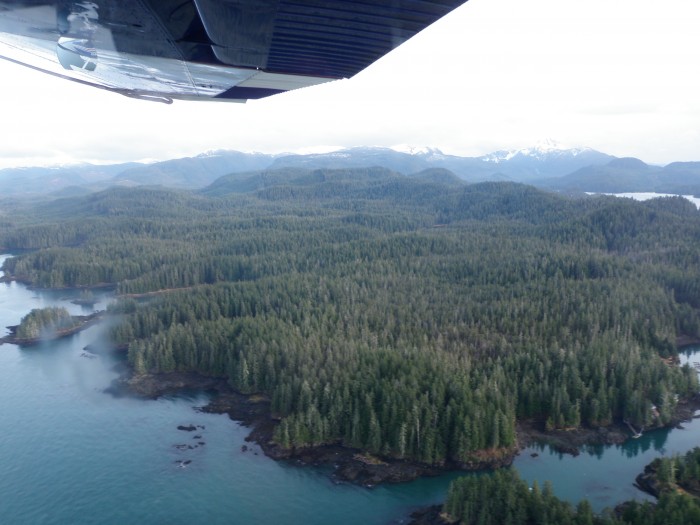
A major Southeast Alaska environmental organization has endorsed the latest Sealaska land-selection legislation. But a group of communities on or near Prince of Wales Island continues to strongly oppose the measure.
The Southeast Alaska Conservation Council opposed the Sealaska bill from the start.
It negotiated with the regional Native corporation, but actively lobbied against the measure in Southeast and Washington, D.C., as well as online.
Now, it’s endorsed revised legislation proposed by Alaska Senator Lisa Murkowski.
“This wasn’t an easy decision,” says Buck Lindekugel, a SEACC attorney who’s been active in timber issues.
(Read SEACC’s explanation of its decision.)
“We tried to be realistic about our chances of stopping the bill or the opportunities available to continue to try to influence decision-makers as the bill moves forward,” he says.
Murkowski’s bill would transfer about 70,000 acres of the Tongass National Forest to Sealaska ownership.
The Alaska Native Claims Settlement Act required the corporation to choose property from within boxes surrounding communities with large numbers of shareholders.
Murkowski’s bill allows selections from other parts of the Tongass.
“We’ve also got to remember that Sealaska has received 290,000 acres already around the villages. And those lands have been heavily hammered,” he says.
SEACC wants further changes to the bill, such as dropping added acreage at Calder, on northwest Prince of Wales Island.
But Lindekugel says the new measure removes some very sensitive watersheds.
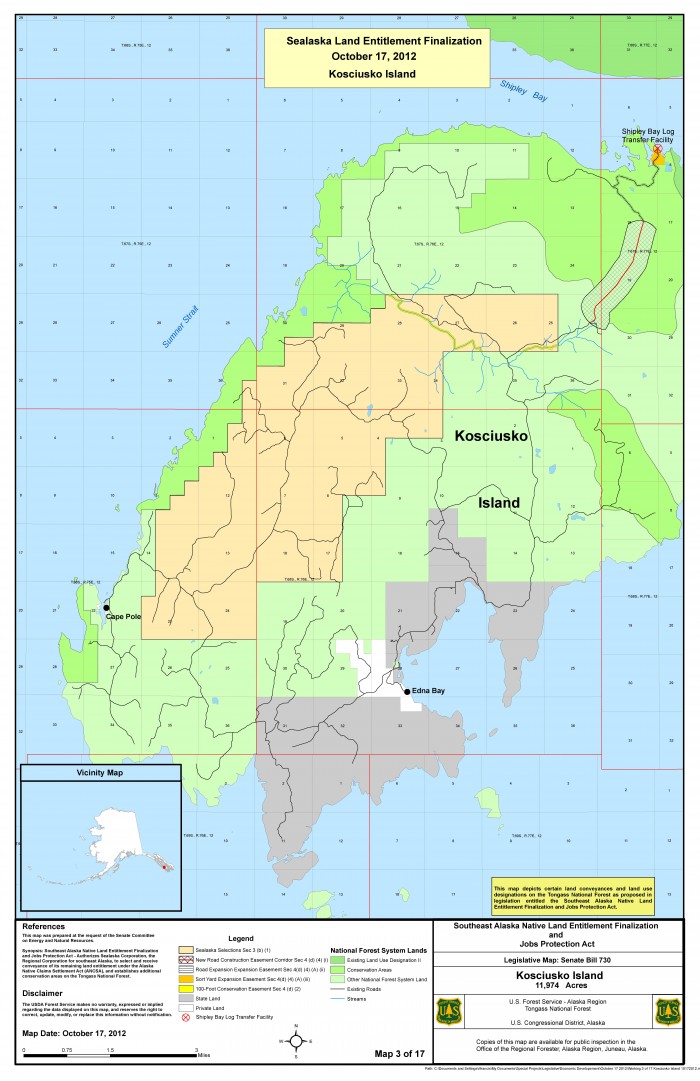
“It drops nearly 30,000 acres of incredibly productive lands on north Prince of Wales from selection. And it dropped another 4,000 acres of high-value karst lands on Kosciusko Island,” he says.
While SEACC changed its stand, others did not.
Nine Tongass communities near the proposed selections are actively opposing Murkowski’s new bill. (Read a letter critiquing the bill.)
“Greetings from your neighbors on north Prince of Wales Island. We, the residents of Point Baker and Port Protection, are asking you to join our voices in opposition to the latest Sealaska lands bill,” says one of the residents of the towns’ residents on a radio commentary. (Hear or read the full commentary.)
That’s the beginning of a radio commentary voiced by 20-plus residents.
Point Baker’s Andrea Hernandez says the people in the recording speak as a group and didn’t want to put names to specific statements. She did provide a list of those who spoke.
The commentary points to Sealaska’s agreement to a Native claims settlement act amendment limiting selections to areas around Native villages. And they say they’ve built their lives and communities around the guarantee that they’ll be able to hunt, fish and log on nearby Tongass lands.
“Now the corporation wants to exchange the land from their designated areas to areas around our towns. How fair is this?”
They particularly oppose a provision transferring additional land from part of the northwest coast.
“Calder Creek is a highly productive salmon stream. And some of the highest volume of old-growth left on the north end of Prince of Wales Island is on Calder Bay. Sealaska will most assuredly clear-cut every last bit of it, leaving the entire watershed bare, with inadequate protection to the streams,” another voice on the commentary says.
Thorne Bay, Hollis, Naukati, Whale Pass, Kupreanof, Edna Bay and Cape Pole are the other communities in the group of nine.
Sealaska says the legislation has undergone many changes since it was first proposed in 2007. (Hear or read an earlier report on the bill.)
“We can prove that we’ve listened to people and that we’ve been able to go in and make changes that try to remove the rough edges off this bill,” says Vice President Rick Harris.
He says the latest version reflects most critics’ concerns: “Nobody’s going to be happy with every aspect of it. But if you go compare what we could select inside the boxes versus this selection we think we end up with a much better result.” (Link to Sealaska’s statement on the new bill.)
“We see it as a bill that would just make a lot of rich people within Sealaska richer,” says Dominic Salvato, a shareholder living in Anchorage. He runs Sealaska Shareholders Underground, a Facebook page with 800 “likes” that’s critical of the corporation.
He says past practice shows the corporation is not environmentally responsible.
“It’s a man-made tsunami that went through Kake and went through Hoonah, and it’s just promising to be more of the same. It’s got to stop somewhere. The Tongass has given enough,” he says.
Salvato says shareholders will not get much of a benefit from land selections or timber operations.
“They’re looking at the land like, ‘How can we convert it to cash?’ They don’t look at it for its beauty and scenery. They’re looking at it for how they can convert it to long-term … bonuses for executives,” he says.
Other Native activists support the bill.
Richard Peterson is president of the tribal government of Kasaan, a Haida village on Prince of Wales Island.
“Sealaska has so far been good stewards and they’ve been coming and meeting with our community and working with us and engaging us in that process. So it’s a deal that needs to be closed,” Peterson says.
Murkowski’s land selection bill has not yet been heard by the Senate Energy and Natural Resources Committee, where she’s the ranking Republican member.
Spokesman Robert Dillon says this is about as good as it’s going to get.
“We believe that we’ve addressed the majority of their legitimate concerns and we would hope that would take a hard look at that. Because the land selections have got to be finalized one way or another. And as SEACC pointed out, this bill is better than letting them select out of their original boxes,” he says.
The Alaska Forest Association, an industry group, supports the bill, though it says the measure has undergone too many changes.
The U.S. Forest Service has not taken a formal position. The agency was critical of earlier bills.
A similar measure with fewer compromises was introduced in the House by Representative Don Young. While his measure passed the House last year, most involved say the Senate bill is the most likely to get attention.
A bill rewarding sea otter hunters was praised and panned at its first hearing on Wednesday.
The measure proposes paying $100 per otter. Only Alaska Natives can legally harvest the protected marine mammals. And federal rules limit processing and sales.

The sponsor is Bert Stedman, a Sitka Republican whose district includes Southeast’s outer coast. He wore an otter pelt on his shoulders as he came before the Senate Resources Committee, saying a bounty would slow rapid population growth.
Craig Mayor Dennis Watson, a former commercial diver, says he’s watched as otters moved in — and his catch disappeared.
“For 16 years I stared into a viewer as my partner and myself drug an underwater camera along the bottom of the ocean surveying for sea cucumbers. Through that, I have witnessed first-hand the devastation these creates cause while their numbers grew,” he says.
Scientists estimate the Southeast otter population at around 21,000. Research shows 12 percent annual growth in the southern part of the region, and 4 percent in the north. Other coastal areas, such as Kachemak Bay near Homer, have also seen large increases.
Joe Sebastian, a commercial fisherman from Kupreanof, near Petersburg, says overharvesting is likely the cause of shellfish declines.
He says the bill wrongly blames otters.
“I find it unprofessional, unscientific, racist and culturally destructive. This particular bill, in its present form, is not the way to go and would start the new sea otter gold rush with little or no oversight or scientific direction,” he says.
Bill sponsor Stedman admits the measure conflicts with federal marine mammal protection rules. He says if a bounty isn’t legal, the state could subsidize tanneries to help build the otter-products industry.
He stressed that the bill would not exterminate otters. He says about 850 were killed last year and an increase to about 2,100 would not significantly damage the population.
Former commercial diver Julie Decker of Wrangell agrees.
“Otters are a renewable resource. They can contribute to the economy of Southeast. However, if they are protected and the population allowed to grow at the rate it is growing now, they will destroy all the shellfish resources,” he says.
The committee delayed further testimony until Friday afternoon.
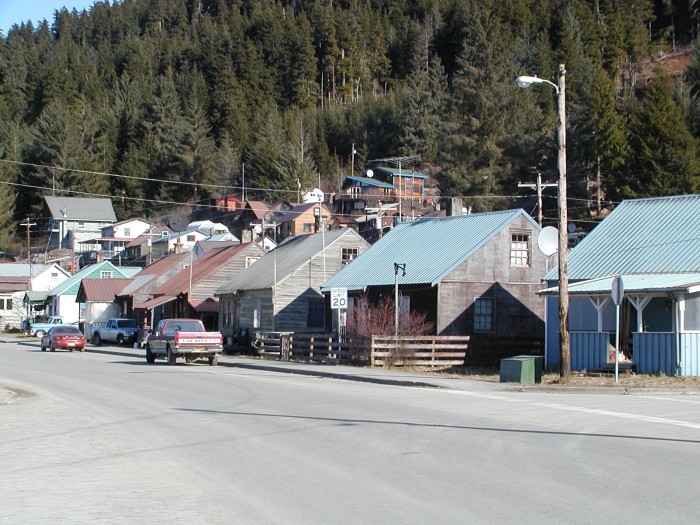
The Federal Energy Regulatory Commission has issued a much-needed license for the Gartina Falls project near Hoonah.
The developer is the Inside Passage Electric Cooperative, which serves the 850-population town, about 40 miles west of Juneau.
Jodi Mitchell is CEO and general manager of the cooperative, known as IPEC. She spoke at the recent Southeast Conference Mid-Session Summit in Juneau.
“It will displace about 30 percent of our diesel in Hoonah. We’re still 70 percent diesel-dependent, but that’s very significant for the community,” Mitchell says.
The project will use a small dam to divert water from just above Gartina Falls, about 5 miles from Hoonah. A pipe will carry the water to a powerhouse at the falls’ base. Transmission lines will carry electricity to the community.

Mitchell says Gartina Falls is fully funded at just under $8 million. But she knows other Southeast projects have seen costs rise dramatically.
“We’re hoping to break ground, at least to put the access road in this year, then install the equipment next year and hopefully have it up and running by the end of next year,” she says.
IPEC says the falls are a natural barrier to anadromous fish and the project should not impact salmon runs.
Southeast Alaska Conservation Council spokesman Dan Lesh says the environmental group has no problem with the project.
“We’re definitely supporting of the project and in general all the communities in Southeast trying to get off diesel and trying to move on to renewable energy,” Lesh says.
One of Hoonah’s largest electrical customers is Icy Strait Point, an old cannery renovated as a cruise-ship destination.
Manager Johan Dybdahl says the small hydroproject will help.

“That could mean a lot for us because we don’t get the benefit of the PCE, of course, so our electricity bills at Icy Strait Point run pretty high,” Dybdahl says.
PCE is power-cost equalization. It’s a state program that lowers high electrical rates for qualifying communities. Homes are eligible, but businesses are not.
Mitchell says the project faces one more regulatory hurdle, from the U.S. Army Corps of Engineers.
“Because of the project being on wetlands, they’re requiring us to set aside an equal parcel, which is about 5 acres, to classify as wetlands and say that we won’t develop it,” Mitchell says. “IPEC doesn’t own any land, so we have to make a visit to DC to try to get some help from our delegation to overcome that obstacle, because I think it’s unreasonable.”
Gartina Falls is a run-of-the-river project. That means it makes power from whatever amount of water is flowing. It has no containment dam, which would create a lake that would help average out the amount of electricity generated.
Southeast Conference Energy Coordinator Robert Venables says that’s not ideal.
“The highest target-value resource that communities and utilities are looking for are projects that have storage capacity. So usually your lake hydros are the best,” Venables says.
But that’s not a possibility for Hoonah, Kake and some other Southeast communities. So run-of-the-river is a good alternative.
“We’re very excited to get some relief for the folks there in Hoonah, but this is just the beginning, not the end of meeting their energy needs,” he says.
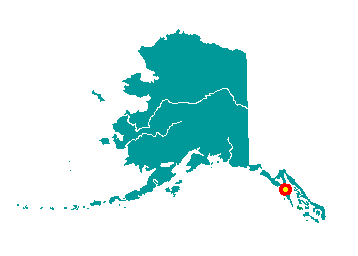
The Inside Passage Electric Cooperative is also looking at the potential of a geothermal site near Hoonah. It’s near Pegmatite Mountain, at the head of Tenakee Inlet.
Residents of Tenakee Springs, to the east, have strongly objected. They say it could disturb fish habitat and change the character of the remote area.
Sealaska regional Native corporation had hoped to obtain the site as part of its final land selections. But it’s not in the latest Senate version of that bill.
Mitchell, in a follow-up phone interview, says IPEC remains interested.
“That’s the project that we brought to legislators this season to ask for more funds to take a closer look,” she says.
The cooperative is asking for about $3.5 million for drilling to determine the temperature and water flow.
Mitchell says it’s also looking at additional run-of-the-river projects in the area.
IPEC’s current rate structure averages out costs of power production in Hoonah and the four other areas it serves. That would lessen the impact on the community.
Mitchell says that structure is changing to a rate based on local costs. That encourages projects, such as Gartina Falls, that lower local rates.

Legislation proposing sea-otter bounties will get its first hearing next week. It’s already drawing opposition from environmental groups and the federal marine mammal protection agency.
Fishermen harvesting Dungeness crab, geoduck clams and some other ocean-floor species have been coming up empty in recent years.
The reason is the rapid expansion of the sea otter population. The marine mammals mostly eat clams. But as they bring their voracious appetites into new areas, they clear out many of the shellfish sought by commercial, subsistence and personal-use divers and fishermen.
“So what we’re trying to do is come up with some assistance for the folks in the area that want to go out and harvest them to afford to be able to do so,” says Sitka Republican Senator Bert Stedman. He represents Kake, Prince of Wales Island and other coastal Southeast communities where otters have moved in.
He’s authored a bill that would give Alaska Natives – the only people who can legally hunt marine mammals – a $100 reward for each pelt they take.
“You’ve got your costs of your fuel and other items you need. Also, there’s tanning cost issues. We’re just trying to assist in the harvest,” he says.
Otters were once widespread along the West Coast from California out to the Aleutians. Russian and American hunters virtually wiped them out, except for a few remote areas.
They were reintroduced to Southeast about 50 years ago. Recent studies say their numbers have grown by as much as 12 percent a year in southern Southeast and 4 percent in the north.
Federal legislation protects otters, only allowing Alaska Natives to harvest them for traditional purposes.
U.S. Fish and Wildlife Service spokesman Bruce Woods says states can’t impose bounties.
“The Marine Mammal Protection Act prohibits any state from enforcing a law that affects the take of a marine mammal without first soliciting and receiving management authority for that species from the Secretary of the Interior,” Woods says.
The agency is working with Native hunters and craftspeople to better define the legal use of pelts. That could increase the overall harvest.
But Woods says Stedman’s legislation, and a similar bill in the House, are trumped by federal rules.
“We’ve got nothing to say about whether the law could be passed or not. But if the law were enforced, at least by an initial reading of the MMPA, that enforcement would be illegal,” he says.
Opposition to the bill is growing among some of the same organizations that campaigned against wolf control. They say otter population growth is a good thing.
“They’re a keystone species,” says Tina Brown, president of the Alaska Wildlife Alliance.
She points out that otters eat sea urchins, which eat kelp, allowing coastal Southeast to return to its natural balance.
“When you have the kelp forest, you have nurseries for finfish and it’s thought that the kelp forest can increase herring populations and salmon populations. Another benefit is they reduce CO2 emissions and slow ocean acidification,” she says.
Brown says the alliance is talking with other groups, as well as legislators and attorneys, about the bounty bill’s impacts.
“I can’t say whether it makes a difference in the numbers of sea otters. I can say that it makes a difference on the way Alaska appears before the rest of the country and the world,” Brown says.
And what about the hunters?
Tlingit-Haida Central Council Economic Development Director Carrie Sykes has been working on the issue. She says tribal members have mixed feelings.
“Some people think that it would be a good idea, in that it could offset the cost of hunting and tanning,” she says. “The others are worried about what the perception will be from different organizations, like Defenders of Wildlife. And we’re not sure how it would really work.
Sykes says local tribes have more influence on the issue than the regional Central Council.
Stedman, the Senate bill’s author, says it should be considered a first draft. He expects changes as it’s considered by the Legislature.
“Maybe we end up having this just a Southeast program and we exclude areas where the sea otters are elsewhere, out in the Aleutians and other places,” he says. “We’re not trying to eradicate, but we’re trying to control the growth.”
He also expects organized opposition.
“And I recognize that there are a lot of citizens outside of Southeast Alaska that might just think this is a ghastly thing to do. But I can assure you we’re better prepared to take care of our own backyard than people in San Francisco and Florida are,” Stedman says.
His legislation comes before the Senate Resources Committee on March 13. The House version, introduced by Anchorage Republican Representative Charisse Millett, is not yet scheduled.