Ed Schoenfeld, CoastAlaska

Senators debate otter bounty legality

A tagged otter pelt sits on a table during an April 5 skin-sewing workshop sponsored by Sealaska Heritage Institute. A Senate bill aims to increase legal otter harvests. Photo by Heather Bryant/KTOO.

Some legislators hope to find ways to get around federal prohibitions on establishing sea-otter bounties. Backers say the payments could increase legal harvests and slow the otters’ population growth.

Sponsor Bert Stedman proposed Senate Bill 60 to set up a state-funded, $100-per-hide bounty. It would only reward coastal Alaska Native hunters, since federal law prohibits others from taking otters.

The U.S. Fish and Wildlife Service has made clear that a bounty would violate the federal Marine Mammal Protection Act. That’s because such payments could affect otter harvests, which only the feds are allowed to do.

But some lawmakers think there’s a way around it.

“I do not agree at all that the state is not entitled to make that fee. I believe we have it absolutely within our sovereignty,” says Anchorage Sen. Lesil McGuire, vice-chair of the chamber’s Judiciary Committee, which recently took up the bill.

“Where I think the concern is is perhaps the word bounty. Bounty implies incentive. Bounty conjures up all kinds of images. Maybe what the circling back is is to say it’s a subsistence artisanal offset fee” she says.

“It incentivizes taking sea otters,” says Alpheus Bullard, the legislative attorney who issued an opinion saying the bill will likely not pass federal muster.

He says when state and federal law conflict in this area, the feds win.

“At the point we’re just providing a bounty for these taken sea otters, this is a state law that is really inconsistent with the protection of sea otters, which is the purpose of the federal act,” Bullard says.

Backers of the bill want population growth limited because otters eat so many marine species. They say commercial and subsistence divers and crabbers are losing their stocks, valued at millions of dollars a year.

Fish and Wildlife Service spokesman Larry Bell says that’s not a concern included in the federal laws.

“The Marine Mammal Protection Act does not address issues of managing marine mammal stocks regarding their impact – be it beneficial or negative to other species of wildlife,” Bell says.

But some lawmakers want to see what they can do. They include Judiciary Committee Chairman and Senate Majority Leader John Coghill of Fairbanks.

“My commitment is to work with the sponsor to navigate those very areas … . With your minds and with the help of some of my staff, who have legal expertise, we will navigate through this,” Coghill says.

Sitka’s Stedman, the measure’s author, says he’s willing to consider something other than a bounty. He’s suggested several times that alternative approaches might work better.

“They don’t necessarily have to be offset at the level where individuals are harvesting it. It could be backed up into the tannery or the marketing area. We could work with that,” Stedman says.

There’s little chance the bill will go much further this year, since the Legislature adjourns Sunday. But it will continue over to 2014, the second year of this two-year session.

Southeast wins, loses in capital budget

Juneau Reps. Beth Kerttula, left, and Cathy Munoz, right, listen as Sen. Dennis Egan addresses budget issues during Wednesday’s Native Issues Forum in Juneau. Photo by Ed Schoenfeld/CoastAlaska News.

Southeast communities won and lost when the Senate Finance Committee released its capital budget this week. Some projects proposed by the governor were cut, but others were added. 

Every year, Alaska lawmakers collect want-and-need lists from communities, organizations and individuals in their districts.

It’s been much the same this year.

“There’s close to $50 million in requests from Juneau alone,” says Dennis Egan, who represents the capital city and several other Southeast communities in the state Senate.

“There’s $43 million from Petersburg. Tenakee has requested money. Right now I have a restroom for Gustavus. But there are other requests from Gustavus as well,” says Egan, noting Skagway also sent him a list of projects.

“It is a tough year,” says House Minority Leader Beth Kerttula, who represents the same communities. “I guess I can be the bearer of bad news. This year, many capital projects that we would have absolutely hoped to fund will not be funded.”

(Read the project list by House District. Southeast districts are 31-34.)

The Senate Finance Committee’s capital budget added some Southeast projects to the list proposed by Gov. Sean Parnell in December.

There’s $73,000 for that Gustavus restroom, $10 million toward Ketchikan’s Medical Center addition and $2.5 million for Petersburg’s police station and jail.

Egan, a former Senate Finance Committee member, says the panel also inserted money for regional hydroprojects — after being lobbied.

“It went out, it’s back in now, and at this time — but things change, especially near end of the session — it includes three Southeast projects,” Egan says.

There’s $4 million toward Sitka’s Blue Lake expansion, almost $7 million for Hoonah’s Gartina Falls development, and $3.3 million toward Tenakee Springs’ Indian River hydro.

But along with the additions, Senate Finance removed some projects from the governor’s budget.

It cut $10 million toward a highway north out of Juneau and $3 million for Ketchikan’s Shoenbar Road water, and sewer project. Also removed was about $1.4 million for a pair of Sitka road projects.

Figures from the Legislature show Southeast capital spending totaling about $195 million. That includes around $20 million in additions and $4 million in cuts.

Lawmakers usually add smaller amounts, such as grants for nonprofit groups, to what Senate Finance drafts.

Egan says, maybe not this year.

“We were told a few days ago that there would be no discretionary funding on the Senate side this year. I hope that’s not the case. We’re working hard on trying to get it back,” he says.

Juneau Rep. Cathy Muñoz, a House Finance Committee member, says she won’t be able to contribute much.

“The community project money, we have not yet been told what that amount will be for this year. But we have been told it will be less than previous years,” Muñoz says.

One of the largest projects in the region is the new State Library, Archives and Museum facility, known as SLAM.

It’s in for $20 million. But Egan says it’s listed as a Juneau project.

“It’s a statewide project. And we’re having issues right now about a change that was made to include that statewide project into our budget. We don’t think that’s correct.”

That makes Juneau’s total appear larger than it is, and could displace other projects within the district.

Both chambers of the Legislature have to pass the same version of the capital budget for it to be finalized. So there may still be some room for some additional funding.

Of course, the governor can veto projects he deems untimely or unnecessary. 

THCC President Thomas will leave post in 2014


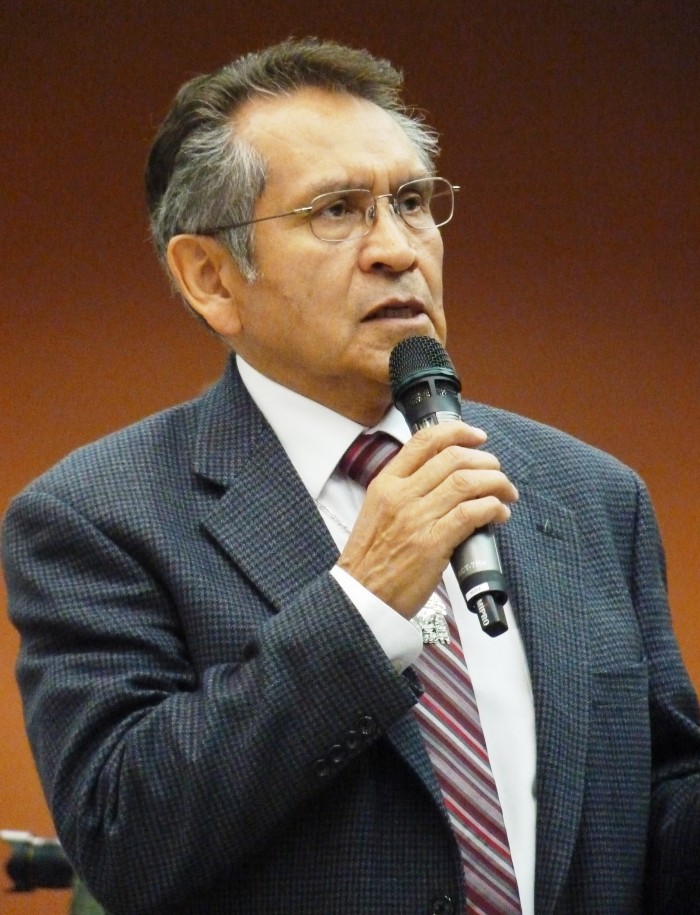
Tlingit-Haida Central Council President Ed Thomas speaks at Wednesday’s Native Issues Forum in Juneau. Thomas plans to step down in 2014. Photo by Ed Schoenfeld/CoastAlaska

Ed Thomas is the elected leader of the Central Council of the Tlingit and Haida Indian Tribes of Alaska.

He’s telling tribal members that he will not run for re-election when his term ends next year.

Thomas became council president in 1984. He retired on short notice in 2007, but returned to win back the post three years later.

“I’m planning to give people a bit more chance to find my replacement and get more involved and have more of a say in who my successor is, rather than me just walking out,” he said in an interview following a forum at Juneau’s Elizabeth Peratrovich Hall.

The central council’s president has a full-time job, overseeing programs including vocational training, public safety, family and youth services, and tribal courts.

Thomas plays a leadership role in other Native organizations and businesses, including serving on Sealaska corporation’s board of directors.

He says retirement will allow him to continue that work.

“I’m involved in the National Congress of American Indians and the AFN also. So, it gets to be just a little bit challenging to do all that stuff. I’d like to focus on being a board member and helping out the tribe wherever I can,” he says.

The central council is federally recognized, but most member communities have their own tribal governments. The council lists 21 local affiliates, most in Southeast, with others in Anchorage, Seattle and San Francisco.

Thomas says he doesn’t plan to endorse a successor.

“I think it should be wide open. I think the people should decide. I think there’s some good candidates, but there are also some that would create more political issues than positive administrative opportunities for us,” he says.

The central council was founded in 1935. By the time he retires next year, Thomas will have been president for about a third of the organization’s existence.


“Un-Cruise” line boosts Alaska sailings

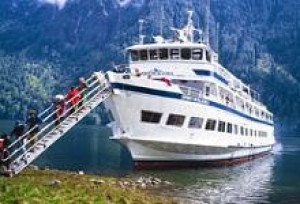
Un-Cruise Adventures’ Laurie Cooper, left, and Larry West stand by the Wilderness Explorer, which begins sailings soon between Juneau and Sitka. Photo by Ed Schoenfeld/CoastAlaska.

It’s still a few weeks before the tourist season begins. But the small cruise ship Wilderness Explorer is already tied up at a Juneau dock.

“One thing you’ll notice if you look at the back of the vessel is that it’s been modified to accommodate a platform that can be easily lowered into the water to launch kayaks and things,” says Larry West,  an Un-Cruise Adventures staffer providing the tour.

“Once you’ve done your active adventure, we always have saunas and hot tubs on all of our vessels, so you can come back on board and relax until the next day’s adventure,” adds Laurie Cooper, an expedition guide for Un-Cruise Adventures. 

Kayaks are stacked up on the stern of the small cruise ship Wilderness Explorer.

The 76-guest Wilderness Explorer is one of several ships added to the company’s line-up in recent years.

This year’s addition is the 88-passenger Legacy, where West will lead a team of costumed guides.

“We will be focusing especially on recreating authentic historical moments,” he says.

The living history theme is a different approach for Un-Cruise Adventures, the new name for sister lines InnerSea Discoveries and American Safari.

“The vessel itself is designed to look like and be patterned after a vessel from the late 19th century that would have brought anxious miners to Alaska in search for gold in the Klondike,” West says.

The Legacy will have its first sailing in August.

It used to be the Spirit of ’98, one of a fleet of small ships operated by Cruise West, which went out of business in 2010.

Other companies, including Sitka-based Alaskan Dream, have purchased and renovated other Cruise West ships for Inside Passage operations.

“I think this coming season, we’ll actually be seeing more small cruise vessels in Southeast than ever before,” says Joel Hanson of Sitka, who works for The Boat Company, a two-ship line sailing between Juneau and his hometown.

Unlike the big cruisers, there’s no centralized database of small-ship sailings. But Hanson’s convinced capacity is increasing.

“I think the trend is: It may not grow rapidly, but it does seem to be and it has the potential to continue to grow,” he adds.

The Baranof Dream is operated by Sitka-based small cruise line Alaskan Dream.

The small ships are particularly valuable to Southeast’s smaller ports.

“It’s always nice to have visitors come to town and be interested in our unique culture,” says Liz Cabrera of the Petersburg Economic Development Council.

Her town sees no large cruise ships dock during the summer. So when a new small vessel ties up, the passengers are noticed.

“And hopefully spending a little bit of their money on our local shops downtown. And that’s great for our merchants and also for our sales tax revenue for our borough,” she says.

Many small-ship passengers have more money. Their cruises often run in the range of $3,000 to $12,000 per person. Larger ships offer deals below $1,000 — or less.

A number of the small lines employ regional residents.

Sitka’s Alaskan Dream cruises make that part of its marketing with the slogan, “True Alaska with True Alaskans.”

Dan Blanchard, of the Un-Cruise line, says his company is opening an office in the Capital City this May.

“We are slowly moving more and more up to Juneau, particularly in the form of our operations end of the company. It’s hard to say how far we’re going to go with that, but we’re definitely headed into that direction,” he says.

His company’s 60-passenger Wilderness Adventurer leaves Seattle for Alaska at the end of this month. Other small lines will follow, sailing along with the much larger ships, through September.

Companies sailing small ships in Southeast include:


Former CFO named to Sealaska board

Sealaska corporation has a new board member.

Richard Rinehart Jr. was appointed at the regional Native corporation’s board meeting last week in Juneau.

Rinehart was Sealaska’s chief financial officer and corporate controller from 2003 to 2009. He is from Wrangell and is managing partner at Raven Potlatch Real Estate in Bellevue, Washington.

He’s run for the board several times, starting in 1995.

New Sealaska board member Richard Rinehart. Photo courtesy Sealaska.

“It’s just something I’ve wanted to do for a long time and I feel very honored and quite humbled by it all,” he says. “I understand there were many qualified candidates and I know Sealaska has a number of qualified shareholders. So I was just glad they chose me.”

Rinehart says he hopes to apply his familiarity with the corporation and his business expertise while on the board. That includes Sealaska’s efforts to develop new ventures within Southeast.

He fills the seat left open when Clarence Jackson Sr. of Kake died earlier this year. Jackson was on the board since the corporation’s beginning.

“He’ll be greatly missed. And I’m honored to fill that position for this remaining few months of his term. But I think I’m there as a Sealaska person, not as somebody to replace Clarence,” he says.

Rinehart is one of 13 Sealaska board members. He’ll run in this spring’s shareholder elections.

His business, Raven Potlatch Real Estate, works with tribal and other investors. It’s worked on housing projects in petroleum-producing regions.

“I’ve seen a huge opportunity with all the explosive growth in western North Dakota, from the oil exploration that’s happening out there. Coupling that with the extreme lack of housing, it’s kind of the fastest growing area of the country as far as housing development and growth,” he says.

Rinehart is Tlingit and Haida, Kiks.ádi, Raven/Frog and is originally from Wrangell. He also spent about 20 years in Oregon.

Sealaska has about 21,000 shareholders, and many of those not living in Alaska are in Washington State.

Spring Sealaska dividends total $12 million

Sealaska Plaza in Juneau, headquarters of the Southeast regional Native corporation.

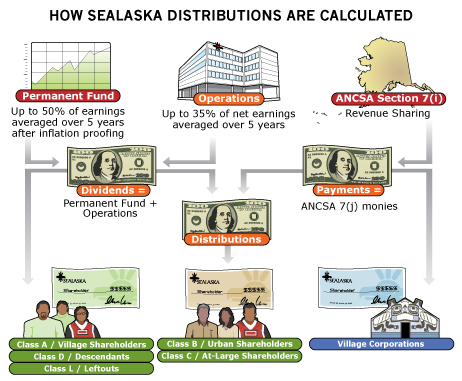
Sealaska’s approximately 21,000 shareholders will get their spring dividends around April 12thSealaska’s Board of Directors approved the more than $12 million distribution at a meeting today at its Juneau headquarters.

Here are details of how the distribution is divided up. Totals assume ownership of 100 shares, the most common number.

  • Urban and At-Large Shareholders: $698
  • Elder Urban and At-Large Shareholders: $852
  • Non-Elder Village and Leftout Shareholders: $154
  • Elder Village and Leftout Shareholders: $308
  • Descendant Shareholders: $154

Here‘s how the shareholder categories are defined:  

  • Urban: Also a shareholder in an urban Native corporation, such as Juneau’s Goldbelt or Sitka’s Shee Atiká.
  • At-Large: Not a shareholder in any urban or village Native corporation.
  • Village: Also a shareholder in a village Native corporation, such as Huna Totem, Kake Tribal, Klukwan and Cape Fox corporations.
  • Leftout: Those who were eligible in 1971, when the Alaska Native Claims Settlement Act became law, but enrolled later.
  • Elder: Original Sealaska shareholder who has reached the age of 65.
  • Descendent: Direct descendents of original shareholders who are at least one-quarter Alaska Native.

Here’s where the money comes from, per 100 shares: 

  • $544 from ANCSA Section 7(i) (regional corporation resources earnings) revenue sharing. A $5.44 per share payment will be made.
  • $100 from corporate earnings. 35 percent of the corporate consolidated net earnings averaged over five years, minus earnings associated with the Permanent Fund. The distribution includes an operations dividend of $1.00 per share.
  • $54 from dividends from the Marjorie V. Young Permanent Fund, which are based on a percent of market value (POMV) of the fund balance. Based on the POMV calculation, the 2013 April dividend will be $0.54 per share.

Some members of the Juneau-based regional Native corporation have more or fewer than 100 shares due to inheritance or gifting.

Much of the dividend – close to $550 – comes from a pool of regional Native corporation resource earnings. Most of that money comes from Northwest Alaska’s NANA, an owner of the Red Dog Mine.

Sealaska’s urban shareholders receive that part of their dividend directly. The corporation pays village members’ share to their local corporations, which decide whether to pass it on.

Last spring’s distribution was about 20 percent more for urban shareholders and about the same amount less for village members.

Sealaska’s shareholders are mostly of Tlingit, Haida or Tsimshian descent. Close to half live in Southeast.

Site notifications
Update notification options
Subscribe to notifications