Ed Schoenfeld, CoastAlaska

Rep. Wilson calls 2013 Legislature “difficult”

Wrangell Republican Rep. Peggy Wilson said this year’s legislative session was difficult. She got some of what she wanted – the oil tax cut and a good number of capital projects. But she has questions about the tax — and worries about legislative dynamics.

This is Wilson’s 13th year in the Legislature. But it’s her first representing a new district stretching south to Ketchikan and west to parts of Prince of Wales Island.

It’s also the year lawmakers – including Wilson — changed the state’s oil-tax system.

“Am I happy with 100 percent of it? No. However, we had to do something with what we had,” she said.

Wrangell Rep. Peggy Wilson poses at her Capitol office at the start of this year’s legislative session. Her district includes Ketchikan and parts of Prince of Wales Island. Photo by Ed Schoenfeld, CoastAlaska.

The Wrangell Republican said she knows the change will be significant, and could lower revenues – at least in the short term.

“I think some of the things we did, some of the credits we gave, are going to bring that production up. We will be able to tell a little bit more in the next three to five years, probably. Unfortunately, there’s no way to be able to tell until we wait and see,” she said.

Wilson, House majority whip, voted for other leadership priorities. That included the in-state gas pipeline bill and to drop new, stronger cruise-ship wastewater rules.

She also voted for the state operating budget, but was disappointed at how it funded schools.

“In every single department that we have, we automatically give them the pay raises that the unions negotiate. They automatically get extra money for the heat and anything that it costs, except when we come to the schools. Any they expect the schools to absorb that. And they’re no different than any of the rest of them,” she said.

She also said funding for municipalities was also short-changed. (Scroll down to read and hear what other Southeast lawmakers had to say about the 2013 session.)

“The last two years we’ve gotten an extra $20 million or $25 million as extra money for revenue sharing and I really had hoped that would get in. And I was very disappointed that it did not get in,” she said.

One of Wilson’s top priorities this year was creating a dedicated transportation fund to build and maintain roads, airports and ferries.

Three measures needed to do that – one asking for a public vote – were in the House Finance Committee at the end of the session. She said the regular budget process offers no guarantees.

“I think it’s extremely important that we take it to the vote of the people and that we get it in statute and in our Constitution so that we can make sure,” she said.

Wilson chairs her chamber’s Transportation Committee.

It held hearings on changes to the Alaska Class Ferry design. The Wrangell Republican said she looks forward to more design details and public meetings, which are expected soon.

Wilson, as majority whip, is part of the House leadership. But she said her influence is limited, in part due to redistricting.

“Unfortunately, the numbers are in the Railbelt. And when Anchorage and Mat-Su and Fairbanks all get together, the rest of us go along for the ride sometimes,” she said.

Overall, Wilson said it was a difficult session.

“And the reason was, is this was the biggest freshman class we’re had for a long time. There were 13 of them. That’s a huge difference. And I would say they were the most pushy freshmen class we’ve ever had,” she said.

She said some had limited knowledge of how government and the Legislature work. And that made it worse.

“Usually freshmen come in and they want to learn. And they come in with high ideals. But before the session’s over they kind of mellow out a little bit and realize they have to work with everybody. And this was a difficult session not only because we had less money, but because they didn’t mellow out as the session went along.”

Wilson also hoped to push a four-day school week bill through the Legislature this year.

It made it to the House Finance Committee. But she said there may be a way to allow districts to plan longer, but fewer days without legislation.

Read and hear what other Southeast lawmakers had to say about the 2013 session:


Final capital budget boosts region’s projects

Southeast representatives added dozens of projects worth about $13.5 million to the capital budget before it passed the House. They were included in the final public-works funding list passed by the Legislature before it adjourned.

One large project is the Lynn Canal Highway, slated to run north out of Juneau. It got $10 million toward construction from the capital budget and other sources.

Another is Ketchikan’s Medical Center addition, which picked up $5 million on top of $10 million already included by the state Senate.

Southeast’s four House members also added smaller community grants, most helping local government, social-service or similar groups.

Those ranged from $150,000 for Hydaburg teacher housing to $80,000 for Pelican fuel dock and float repairs.

The budget also includes $200,000 for manhole covers and sewer line repairs in Thorne Bay. Wrangell Representative Peggy Wilson says the lines can’t handle heavy storms.

“That system was so bad that when they have a lot going on it actually comes up through the manholes. And the manhole lids get floated away,” Wilson says.

Read a report on the Senate’s capital budget.

The governor can veto projects in the capital budget.

The House did not restore some funding cuts made by the Senate. For example, close to $1.5 million for two Sitka water and sewer projects remained out of the budget.

The House also cut some items the Senate included. An example is $2 million for repairs to Juneau’s State Office Building parking garage.

Read the final budget document.

Here’s a few other small projects added by the House:

  • Juneau Filipino Community building repair and maintenance, at $80,000.
  • Juneau’s Haven House transitional program for women released from prison, $50,000.
  • Hollis Volunteer Fire Department Emergency Radio Equipment, at about $16,000.
  • Port Protection boardwalk repairs and maintenance, at $18,000.
  • $200,000 toward Saxman’s Mahoney Lake hydroelectric project.
  • $500,000 for improvements to Southern Southeast Regional Aquaculture Association facilities.

Central Council tribal assembly meets in Juneau

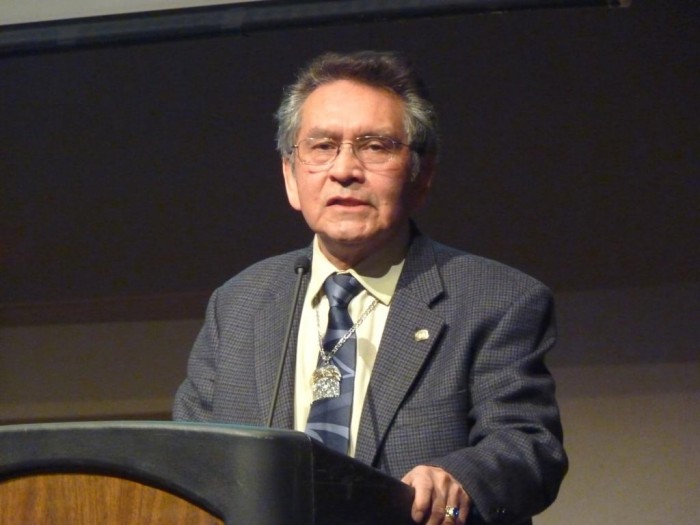
Ed Thomas, president of the Central Council of the Tlingit and Haida Indian Tribes of Alaska, which holds its general assembly in Juneau this week.

The Tlingit-Haida Central Council holds its 78th Annual Tribal Assembly in Juneau this week.

Delegates from around Southeast and a few other areas will hear reports from Sealaska Corporation, the Alaska Native Brotherhood and Sisterhood, and other organizations.

Council President Ed Thomas says this year’s theme is “Hold Each Other Up.”

“We find that so often we spend a lot of time focusing on the negative. So we want to ask people to work together, lift each other up and try to have a positive way forward,” Thomas says.

Delegates also will discuss and vote on resolutions addressing a variety of issues.

They include elder housing, Native language instruction, the Sitka Sound sac roe fishery and sea otter harvests.

“We’re pretty much going to be dealing with the normal agenda. We have some constitutional amendments that I’m proposing and some statutes on tribal courts that will be strengthened,” Thomas says.

Delegates will meet through Saturday at the council’s Elizabeth Peratrovich Hall in downtown Juneau.

The president’s seat is not up for election this year. Thomas, 71, has announced he will retire in 2014, at the end of his term. He’s been in the post more than 25 years.

One issue before delegates is changing some of the rules for electing the council’s president. 

Voter-ID bill still drawing opposition

A bill adding new voter identification requirements could go to the full House before the Legislature adjourns Sunday.

House Bill 3 is strongly opposed by a number of Southeast leaders, including lawmakers and Native officials.

It passed out of the House Judiciary Committee on Wednesday. As of today, it was in the Rules Committee, waiting to be scheduled for the House floor.

At a recent hearing, Alaska Native Brotherhood Grand Camp President Bill Martin said a photo-ID requirement could keep people from casting ballots.

“There are many people who are my age group who actually do not have ID cards. The ID card is not required when we go for health care at SEAHC or to vote in our tribal elections, because we have our own cards with no picture on them,” he says.

Tlingit-Haida Central Council, the House Bush caucus and some other groups also oppose the legislation.

Alaska Native Sisterhood Camp 70 President Jan Trigg went a step further. She said the measure discriminates against rural Alaskans and others.

“It creates an impediment to the most democratic practice as citizens. The homeless, the home-bound, returning veterans, the elderly, people of color and college students would be vulnerable to this new law,” she says.

The voter-ID bill was praised by Travis Lewis, vice president of the group Alaskans for Alaska.

He said weak laws have inflated voter rolls in his home town of Elfin Cove. And he said proper identification is easy to get.

“As a veteran, I want to say that when I got out of the military, I had all kinds of ID on me. It’s pretty hard to understand in this day and age how a person could not have proper identification,” he says.

Sponsor Bob Lynn of Anchorage said his bill gives voters several options, including presenting no ID and casting a questioned ballot.

“Nothing in this bill would restrict anybody’s who is currently registered to vote and motivated to vote from voting, wherever they live in the state, whether it’s an urban area, a rural area or on an island or wherever,” he says.

No companion legislation has been introduced in the Senate, so the measure will likely carry over to next year.

The Alaska Folk Festival also rocks, jazzes, belly dances — and barks

A dog took the stage during this year’s Alaska Folk Festival. So did a drum-and-pipe band, a much-traveled singer-songwriter and some Middle-Eastern-style singers and dancers. We spoke with some of the performers at the 39th annual Juneau event, and assembled this audio post card.

You can watch and listen to more concerts through April 14 at KRNN.org. You can also find more photos on the CoastAlaska News and Rain Country Radio Facebook pages.


Southeast critiques 2013-2014 ferry schedule

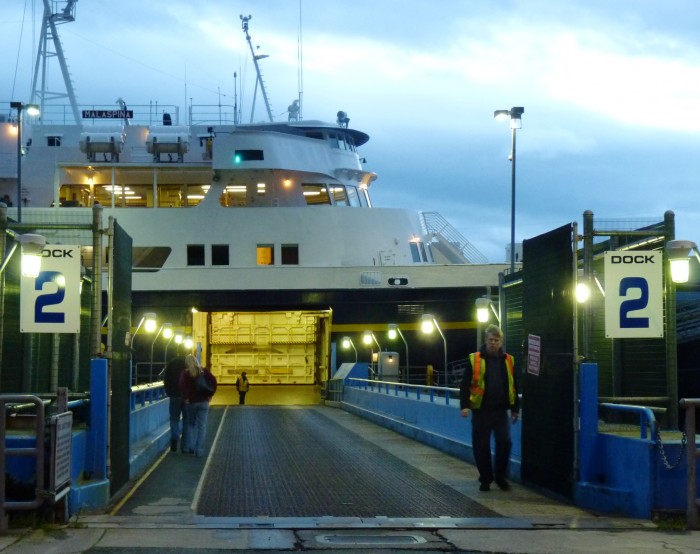
The ferry Malaspina awaits passengers at Juneau’s Auke Bay ferry terminal. Photo by Ed Schoenfeld/CoastAlaska.

Southeast Alaskans critiqued the Marine Highway System’s 2013-2014 fall, winter and spring schedule Tuesday.

Leaders and some others from around the region spoke and asked questions during a teleconference.

Some thanked ferry officials for answering past concerns. But many said other problems need to be addressed.

Here’s an edited version of what they had to say.

Southcentral and Southwest Alaskans gave their comments during a separate teleconference.

Site notifications
Update notification options
Subscribe to notifications