A second measure transferring Tongass National Forest land to Sealaska is before Congress on Thursday.
It’s stopgap legislation turning 3,600 acres over to the Southeast-based regional Native corporation. Two parcels are proposed, one on the Cleveland Peninsula and the other at Election Creek on Prince of Wales Island.
A much larger bill before Congress would transfer about 70,000 acres.
Sealaska CEO Chris McNeil says it’s needed to keep logging operations going.
“Obviously we’d like the more systemic bill, but it’s important for us to be able to recognize that we have important timing and operational considerations to achieve. And that’s why there’s the second bill, which is really a subset of the first,” McNeil says.
Both measures are sponsored by Alaska Congressman Don Young.
The House version of the larger measure includes more of what Sealaska asked for. The Senate bill shows more changes resulting from negotiations with environmental groups, small communities, tour operators and other critics.
Young’s measures are House Bill 740 and House Resolution 1306. The main Senate bill, sponsored by Lisa Murkowski and Mark Begich, is Senate Bill 340.
Passengers board the ferry Malaspina while vehicles wait to load at the Auke Bay terminal in Juneau. Travelers will no longer be able to take advantage of some discounts, due to budget cuts. Photo by Ed Schoenfeld, CoastAlaska News.
Say so long to summer drivers riding the ferry for free.
Wave goodbye to the winter roundtrip discount.
And printed schedules? Those are on their way out too.
They won’t happen for a while. But the changes are some of the ways the Alaska Marine Highway will address a $3.5-million spending cut mandated by the Legislature.
Ferry Business Enterprise Director Dick Leary described the cuts at Tuesday’s Marine Transportation Advisory Board meeting.
He said managers won’t cut sailings where tickets have already been sold. That means no reductions to the summer schedule that runs through September.
“We also feel very strongly that the winter schedule as it now exists is a bare-bottom service level and so if possible, we don’t want to cut any of the winter schedule,” Leary said. “And that takes us from October first to April 30th. So, of course, you put one and two together and you’ve only got May and June left.”
Managers also agreed that none of the system’s 35 port communities should lose service for an extended amount of time.
The Taku will not operate on its Prince Rupert-to-Juneau run in June of 2014. That reduces sailings to Ketchikan, Wrangell, Petersburg, Kake and Sitka. Another ship, the Malaspina, will continue to offer that service.
The Juneau-based fast ferry Fairweather will sail less often during the first two weeks of next May. That affects Sitka and Lynn Canal routes.
Advisory board member Gerry Hope of Sitka said that hurts his hometown.
“It seems like we’re a frequent visitor to your cut-budget system. I want to support you; I want to back you up. But it feels at this point that I can’t get fully on board, no pun intended,” Hope said.
Business Director Leary said other cuts were chosen to avoid further service reductions. The roundtrip discounts will go away this fall. The drivers-ride-free program will end at the same time.
Board Chairman Robert Venables said the marine highway should prepare for further reductions.
“It was obvious that the Legislature’s squeezing all areas of the state budget and that’s going to be a trend that’s going to continue for the foreseeable future. This year’s cuts were probably more of a nick than an amputation,” Venables said.
Officials said they would consider raising ticket prices and retiring ferries if further cuts come in future years.
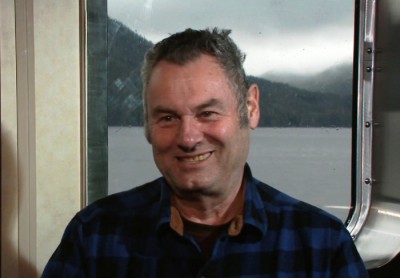
Bob Pickrell moved to Alaska before a few years before the ferry system started up. He was one of the passengers on the 50th anniversary voyage of the Malaspina. Photo by 360 North.
Bob Pickrell moved to Ketchikan a few years before the ferry system started up.
But once it began, it became a part of his life, as a writer, newspaperman, timber advocate and political leader.
He remembers what travel was like before the ferries arrived.
“The only mode of transportation into Ketchikan was landing on Annette Island, which is 25 miles away on an Indian reservation, getting into either a Grumman Goose or a PBY, to fly over and land on the water in Ketchikan, which scared the heck out of a lot of people when they saw the water cascading beside their window,” he says.
The Ketchikan resident was interviewed by 360 North TV during the Malaspina’s 50th anniversary sailing.
Pickrell was a leader in Wally Hickel’s 1990 campaign for governor.
He remembers being among those chartering the ferry Columbia so he could bring supporters to the inaugural ball in Juneau.
“We lined up about 200 people in Ketchikan, Wrangell and Petersburg and the boat was ours for four days. We took off with the big band, this was the big jazz band, Glenn Miller-type music, traveling up with us at the inaugural ball.”
Pickrell says it was a comfortable arrangement, until it came time for the formal celebration.
“We moored at the dock and the boat went up and down but the dock didn’t. So just about the time we were supposed to go to the inaugural ball, if you weren’t aboard ship, forget it because you couldn’t get back … by reasons of tide,” he says.
“So, our tuxes and everything remained on board. And we red-rubber-booted to the inaugural ball. And in Alaska nobody cares.”
Pickrell, now 83, ran a monthly regional newspaper with a section called “Ferry Tales.” One of his favorites came from a purser – he can’t remember the ship – watching a passenger behaving oddly.
“It was a particularly hot day and these ships are warm. The purser was watching this guy with a black garbage bag. He was near the doorway and he’d watch this guy run outside and then he’d run back inside. And then a little while later he’d run outside again with this black garbage sack and he’d run back in. (The purser) finally figured out he was filling it up with air, trying to make his stateroom cooler — and that’s a true story,” he says.
Bob Pickrellc is a retired Ketchikan newspaperman, timber advocate and political leader. He spoke with Kelli Burkinshaw of 360 north on board the 50th anniversary sailing of the Malaspina.
Sealaska Plaza is the corporation’s Juneau headquarters. Officials just released the regional Native corporation’s 2012 report.
Sealaska is making more money.
Southeast Alaska’s regional Native corporation says it brought in almost $312 million during 2012.
That’s close to 20 percent more than the previous year — and the largest amount from the past five years.
The numbers are for total income, also called gross revenues.
Sealaska’s profits, or net revenue, are $11.3 million for 2012.
That’s 40 percent more than 2011. But it’s lower than the previous two years.
The numbers are in Sealaska’s 2012 annual report, which was released Friday. The Juneau-based corporation has about 21,000 shareholders. Corporate officials were not immediately available for comment.
More than half Sealaska’s 2012 gross revenues were in the service sector, including environmental contracting and security.
About a quarter came from manufacturing, mainly plastics factories in the Lower 48 and Mexico.
A little less than a fifth of the overall earnings came from natural resources, including timber and gravel operations. The rest was from investments.
The manufacturing, service and investments had higher profits than the previous year. But natural resource profits dropped. We’ll take a closer look at some of those business sectors in a future report.
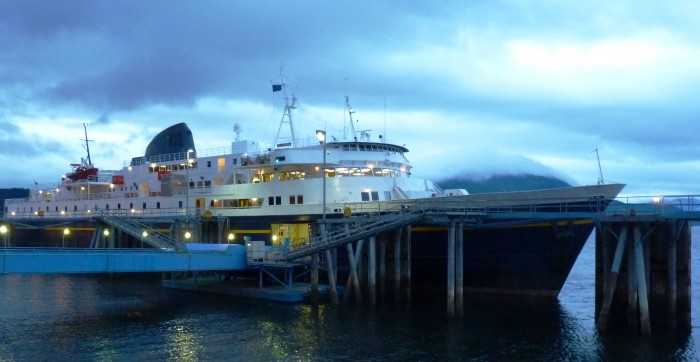
The ferry Malaspina gets ready to sail from Juneau’s Auke Bay terminal last fall. Its stack has since been painted yellow in honor of the 50th anniversary of the Alaska Marine Highway. Photo by Ed Schoenfeld, CoastAlaska News.
John Kanarr didn’t know how his life would change when he took a job on the ferry Taku.
The able-bodied seaman was working on tugs in Puget Sound, but looking for something better.
“I got a phone call from the union hall one day. And he says, ‘Hey … I’ve got a job for you up in Alaska.’ He says, ‘Come to the union hall and we’ll talk it over.’ ”
“So I hopped into the pickup, and up to Seattle I went from Tacoma. And when I came back that afternoon, I had an airplane ticket for Pan Am the next morning … to go to work at 1 o’clock the next afternoon on the MV Taku. “
“So I went from here to there. And I’m still there.”
He says lots of other crew members also met their spouses there, even what he calls the “bachelor skippers.”
Longtime ferry staffer John Kanarr is interviewed on board the Malaspina during its anniversary voyage. Photo by 30 North.
“The socializing while you were on board the ships was a lot closer than where you work or in your community in a lot of cases. Because you have one common thing together, because you’re on the ferry to start with. And you’re all going in the same direction.”
And it wasn’t just people.
Kanarr tells a story from the ‘60s, before the days of security checks and guarded loading ramps.
He says sometimes, while sailing north, a cocker spaniel would get on board in Wrangell and get off in Petersburg.
“And at first we though it must be with one of the passengers, taking the dog ashore, walking him and bringing him back.”
He watched as the dog came and went, sometimes sailing north from Wrangell, sometimes south from Petersburg.
“I told the terminal agent in Wrangell and he says, ‘Yeh, he’s doing that all the time.” I say, ‘What’s the deal?’ He says, ‘He must have a girlfriend up there.’ ”
Kanaar started with the ferry in 1963. And after three decades, he started making plans to retire.
But then, he got to talking with a young deckhand who was new to the job.
“Finally he says, ‘You know, you worked with my dad. And I says, ‘Really? Who is you dad?’ “
“A few days later we got to talking again and he says, ‘You worked for my grandfather.’ And I says ‘I did what?’ And he says, ‘Yeh, my dad was telling me that you worked for his dad when he went to work for the ferry system back in 1963.’ ”
“And it made me a little unsettled. So I’m thinking, ‘I’ve been here for 34 years. I was going to work 35. But maybe I should just quit now and go out on top of the pile.’ “
Cultural Heritage Guide Faith Grant discusses Tlingit heritage with cruise ship visitors. Courtesy Alaska Native Voices.
A Southeast village Native corporation wants to export its cultural tourism expertise. It’s opened a consulting business to build on more than a dozen years in the business.
Huna Totem Corporation has more than 1,300 shareholders with ties to the Tlingit village of Hoonah, about 40 miles west of Juneau.
It places cultural interpreters onboard cruise ships sailing the ancestral homeland of Glacier Bay. It also presents educational programs at the national park’s lodge, the jumping-off point for many visitors.
Now, those efforts have a different name and goals.
“Alaska Native Voices is going to be an expansion of what we are currently working on,” says Mark McKernan, who heads up what Huna Totem used to call its Interpretive Services Department.
“We’re going to now provide consulting services for other cultural interests, Native groups, small communities and what have you. We’ll provide these services to them to help them answer the big questions of how do they start, where do they start and what goals should they be aiming for,” he says.
A number of other Alaska Native corporations and tribal entities use cultural tourism to make money and employ shareholders or members. (Scroll down for links to some other cultural tours.)
But McKernan says others are looking for help.
Cultural Heritage Guide Irene Lampe explains the construction and use of a bentwood box. Courtesy Alaska Native Voices.
“What we have learned and what we can pass on is just as relevant in Southeast Alaska as it would be in Costa Rica or somewhere on the East Coast or the Midwest,” he says.
Alaska Native Voices began operations early this month.
McKernan says it has no formalized consulting agreements. But several groups have expressed interest and are discussing options.
Rosita Worl, president of the Juneau-based Sealaska Heritage Institute, says Hoonah Totem is well-equipped for the business.
“I think they have the experience. They’ve got the professional background and business experience in it. And I think they’ve done a great job in terms of trying to educate people about their culture and their history and meanwhile making a profit,” Worl says.
Huna Totem’s heritage guides are scheduled to be on about 200 cruise ships this year. That includes the Holland America Line, which sails large ships, and Alaskan Dream and Lindblad Expeditions, which operate much smaller vessels.
McKernan says cultural tourism programs need to tap traditional knowledge — and not just be another stop on the road.
“We do consult regularly with elders and others in the community and develop resources for these cultural guides to be able to grow and expand their knowledge base,” he says.
Huna Totem operates its own attraction, Icy Strait Point, which expects about 135,000 cruise passengers this year. Traditional culture is part of most of its excursions and programs.
McKernan says Icy Strait managers could also consult with other businesses interested in similar developments.
Learn about some other Alaska Native cultural tourism programs: