Ed Schoenfeld, CoastAlaska

Designers: Cover shuttle ferry car deck

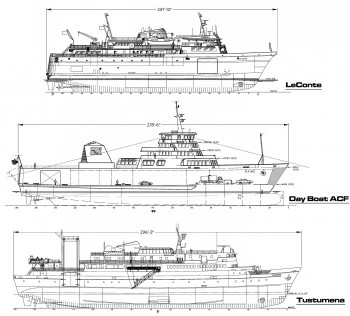
An early drawing compares the proposed Alaska Class Shuttle Ferry with other ships. Image courtesy Department of Transportation.

Naval architects working on the new shuttle ferry recommend against uncovered car decks. 

Marine highway officials earlier said a partially open deck could save construction and operational costs.

But Project Engineer Will Nickum said it’s not the best option.

“The general recommendation we have is that it should be closed. That that would be the better approach long-term,” he said.

He said a closed deck would boost the comfort level and protect equipment. But it would increase construction costs by 1.5 percent.

Nickum, of Seattle’s Elliot Bay Design Group, spoke at this month’s Marine Transportation Advisory Board meeting.

Plans call for two shuttle ships sailing between Juneau, Haines and Skagway. They’re the latest approach to what’s called the Alaska-Class Ferry. (Read about plans for the shuttle ferry.)

Nickum said the shuttles’ target length is now 280 feet. That’s 20 percent longer than the small ferry LeConte.

“Comfort needs to be better than the LeConte-class vessels and approach that of the Taku. That is a serious requirement and we have to look at length to make sure we can meet that particular thing,” he said.

Comfort refers to the ride, especially in high winds and seas.

Designers continue to work with some earlier assumptions.

The ferries will not have staterooms or crew cabins. Food service will be limited. And they will be easily maneuverable for quick loading and unloading.

But there will be a few amenities.

“We think it makes sense to have a family and children space. We’d have a work space or quiet room. That would be the library space. We’d also have the traditional forward observation lounge,” he said.
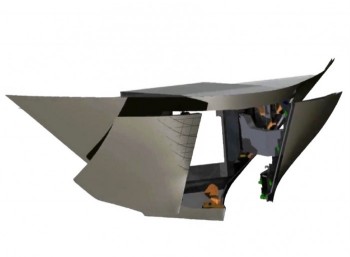
Click here to see a short animation of how the shuttle ferry’s bow door could work. Courtesy Elliott Bay Design Group/Alaska DOT.

And that space may be on a level above the main passenger deck.

Nickum said the shuttles will also have a small theater, similar to some other ferries.

A draft report on vessel plans will be out for public review on June 13th.

Marine Transportation Advisory Board member Cathie Roemmich of Juneau expects some battles.

“You have a handful of people in a couple communities that are just going to give you negativity. They don’t like it and they don’t want it. I hope the public process is very swift and you guys can move on with the job,” she said.

Advisory board members also asked about a proposed bow-door system. And some worried whether the ships would be compatible with ramps and docks outside Lynn Canal.

Former board chairman Dave Kensinger of Petersburg urged designers to consider staffing as well as construction.

“I think the most important thing you do on whatever else you build is you make for sure it’s as cheap as possible to operate,” he said. “We did an exercise quite a few years ago and if you look at the life-cycle cost of one crewmember on one boat, it’s astounding.”

Designers are working on the assumption that the first vessel will be completed by mid-2016.

Read earlier reports:

Significant wave height charts, courtesy Glosten Associates/Alaska DOT: 
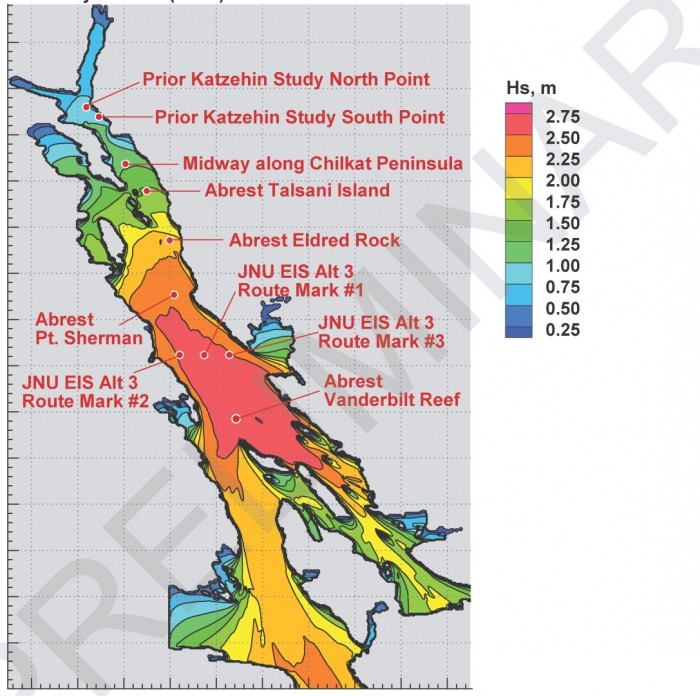
A chart showing Lynn Canal-area waves in strong north winds, measured in meters, in the worst weather month.


A chart showing Lynn Canal-area waves in strong south winds, measured in meters, in the worst weather month.

Parnell blocks fund transfer from Hoonah dock to Sitka pool

Cruise ship passengers board a tendering vessel at Huna Totem’s Icy Strait Point. Lawmakers have funded a new berthing facility, which has not been built. Photo by Ed Schoenfeld, Coastalaska News.

Governor Sean Parnell left Southeast Alaska project funding intact when he signed the capital budget Tuesday.

But he blocked the transfer of money from one older project to another.

The Legislature’s capital budget called for taking $5 million out of $17 million set aside for a cruise-ship dock in Hoonah. Lawmakers transferred that money to a planned aquatic center in Sitka.

During an Anchorage press conference, Parnell said it was a bad idea.

“That dock is still needed. The growth in passenger traffic, travel-industry traffic, is creating jobs in Hoonah, right down to our high-school age level. That money needs to stay there so they can continue to build their economy there,” he said.

He said it’s unfair to let one town, quote, “rob” another of its capital-project funding.

Sitka’s aquatic center, which has other funding, will be part of the state-run Mount Edgecumbe boarding high school.

Money for Hoonah’s dock was in the 2011 capital budget. And Hoonah’s municipal government and the local Icy Strait Point tourist attraction have clashed over its location.

Parnell’s Budget Director Karen Rehfeld said the project is still on track.

“The mayor and others have been in touch with us to let us know that they are doing some of the geotechnical work now and that it is moving forward,” she said. “And clearly if the $5 million had been reapporiated from the project for another community’s project, they simply would not be able to move forward with it.

Gov. Sean Parnell discusses budget bills in Anchorage Tuesday as Budget Director Karen Rehfeld reviews paperwork.

The governor did allow $2 million from the dock project to be transferred to the Hoonah Health Center. The Southeast Alaska Regional Health Consortium facility needs matching funds to begin construction of a new building.

Rehfeld said Hoonah leaders told her office they supported that change. And since it was in the same community, the governor kept it in the budget.

Sitka Democratic Rep. Jonathan Kriess-Tomkins said he was not involved in the reappropriation effort. Sitka Republican Sen. Bert Stedman could not be reached for immediate comment. Both also represent Hoonah.

Southeast projects in the Capital Budget include:

Infrastructure

  • Haines – Haines Highway reconstruction/Chilkat Bridge replace, $31 million
  • Juneau Access, $10 million
  • Ketchikan – replacement of Water Street Trestle No. 2, $10 million
  • Inside Passage Electric Cooperative – Gartina Falls Hydro Project, $6.7 million
  • Juneau – Glacier Highway – Multi-use path to UAS, $5.5 million
  • Haines – Klehini River bridge, $5 million
  • Wrangell – Evergreen Road upgrade and pedestrian access, $5 million
  • Ketchikan – Bar Harbor South, $4.78 million
  • Alaska Marine Highway System – Skagway Terminal modifications, $4.5 million
  • Juneau – Egan Drive illumination – 10th to McNugget Intersection, $4.2 million
  • Sitka – Blue Lake Hydroelectric expansion project, $4 million
  • Juneau – Amalga Harbor Road/bridges reconstruction/replacements, $3.5 million
  • Petersburg – Haugen Drive and bike path improvements, $3.3 million
  • Alaska Marine Highway System – Ketchikan Ferry Terminal, $3 million
  • Wrangell Airport – apron and taxiway rehabilitation, $3 million
  • Petersburg Airport – apron and taxiway rehabilitation, $3 million
  • Juneau – Airport snow removal equipment facility, $3 million
  • Tenakee – Indian River Hydroelectric Project construction, $2.98 million
  • Juneau – Egan Drive improvements – Main Street to 10th Street, $2 million
  • Juneau – Riverside Drive rehabilitation, $2 million
  • Skagway – Port of Skagway gateway project, $1.5 million
  • Alaska Marine Highway System – Auke Bay Ferry Terminal, $1 million

Public Health and Safety

  • Ketchikan – Medical Center addition and alterations phase I, $15 million
  • Petersburg – Police station and jail facility, $2.5 million
  • Ketchikan – Jackson/Monroe/4th/7th water and sewer, $2.3 million
  • Hoonah – Water Transmission line replacement, $1.9 million

Education

  • State Library, Archives and Museum facility construction funding, $20 million
  • Metlakatla Elementary School renovation, $14.5 million
  • Petersburg Elementary School exterior wall renovation, $2.15 million

Information provided by the governor’s Office of Management and Budget


Fourteen shareholders run for Sealaska Board of Directors

The cover page of Sealaska’s proxy statement and annual meeting notice. Fourteen candidates are running for for board of directors seats.

Ten Sealaska shareholders are challenging four incumbents for the regional Native corporation’s board of directors. That’s the largest number of independent candidates in five years, although some earlier ballots came close.

Proxy statements, which include ballots, were sent to Sealaska shareholders May 10th. Voting runs through June 20th, just before the corporation’s annual meeting, which is June 22th, in Hoonah.

They can be mailed, faxed or dropped off in person. Ballots can also be cast at the annual meeting.

Corporate Secretary Nicole Hallingstad said online voting has become increasingly popular.

“The first year of online voting, about 11 percent of our shareholders voted online. The second year that rose just a little bit to 13 percent,” she said. “We’re early in the proxy process, so it’s impossible at this point to say where that final percentage will fall. But higher levels than that have already come in through online voting for this year’s proxy season.”

This year’s online voting is done through a new shareholder-information system called “My Sealaska.” The secure site also includes stock information and dividend payment history.

No resolutions are on this year’s ballot. Prior years’ measures addressed term limits, discretionary voting and stock for shareholder descendants. (Hear a report on last year’s issues.)

Tribal members can vote a specific number of shares for up to four candidates they support. Or they can vote “discretionary,” turning their ballots over to the board, which supports its own members.

Most of this year’s 14 board candidates are in their 50s, 60s or 70s. But three are between 30 and 40.

Hallingstad, also vice president of communications, says that includes Ralph Wolfe. He was last year’s appointed youth representative on the Sealaska board.

“This year’s slate does include some of our younger shareholders and it’s great to see that successive generations of shareholders for Sealaska are seeing this as a mechanism to serve the Native community,” Hallingstad said.

Sealaska added several thousand younger shareholder descendants after a 2007 vote.

The regional Native corporation is headquartered in Juneau and has more than 21,000 shareholders. Most are of Tlingit, Haida or Tsimshian descent. Close to half live in Southeast.

Read the proxy and annual meeting notice, which includes candidate statements and biographical information starting on page 10.

This year’s independent candidates are:

• Mick Beasley, Myrna Gardner and Ernestine Hayes of Juneau.
• Frank Jack III of Angoon.
• Angela Michaud of Anchorage.
• Ralph Wolfe of Yakutat.
• Will Micklin of Alpine, California.
• Edward Sarabia Jr. of South Glastonbury, Connecticut.
• Richard “Jack” Strong of Bonney Lake, Washington.
• And Bonnie Jo Borchick of Tucson, Arizona.

This year’s board incumbents are:

• Patrick Anderson of Anchorage
• Jodi Mitchell of Juneau.
• Jackie Johnson Pata of Fairfax, Virginia.
• And Richard Rinehart Jr. of Bellevue, Washington.

Board members serve three-year terms.


Forest compromise group ends work


A logged area of Admiralty Island sandwiched between stands of old-growth forest regrows. Logging and environmental protection were among the issues the Tongass Futures Roundtable tried to address.

The Tongass Futures Roundtable is shutting down. The organization tried to resolve Southeast Alaska forest-issue conflicts.

It formed about seven years ago.

Organizers hoped to bring together all parties involved in the forest to craft compromises on land-use issues, such as logging and habitat protection.

The roundtable brought people together who had never had to sit across from each other at a table. The normal environment was a courtroom,” says Bruce Botelho, the group’s facilitator and moderator.

A map of the Tongass National Forest. Image courtesy USFS.

The former attorney general and Juneau mayor says roundtable members decided to end their work during a meeting earlier this month.

“One of the benefits for us to dissolve right now is to create the opportunity for people to come together and perhaps learn from our experience, but also build on it. And one would hope that any assembly of stakeholders would truly bring back the whole range of participants,” he says.

Membership originally included industry, government, tribal and environmental leaders. But about two years ago, the state, timber representatives, four towns and some conservation groups pulled out.

“We didn’t have enough movement in the direction we felt needed to occur,” says State Forester Chris Maisch, one of the original roundtable members.

“So the governor decided it would be best to put state energy and time and resources into a task force, which he established through an administration order,” he says.

Maisch chaired that task force, which released its final report a few months ago.

It recommended a number of actions meant to increase logging. One was expanding state forests. Another was revising state rules to help small timber operators.

Yet another called for the federal government to turn two million acres of the Tongass over to the state to be managed for harvest.

Maisch says the timber task force has since shut down.

Botelho says the roundtable eventually decided it couldn’t fully do its work without the groups that left. It will cease operations July 1st. But he says it achieved some of its goals.

“We devoted a great deal of time to examining the proposed mental health land exchange between the state and the trust and ended up endorsing a process, which is underway. And I think that, absent the support of the roundtable, would have been more difficult,” Botelho says.

He says some of the roundtable’s working groups will also continue meeting. One focuses on Alaska Native issues, another on sustainable forests.

The Tongass Futures Roundtable had about 35 members and tried to reach decisions by consensus. State Forester Maisch says that just didn’t work.

“It was a well-intentioned effort. And a lot of people spent a lot of time in trying to make that process work. And unfortunately, it just wasn’t the right time and the right place. So it’s too bad that it didn’t come to a better conclusion,” he says.

The roundtable had funding support from the Rasmuson Foundation and other donors. The Juneau office of the Nature Conservancy, an international conservation organization, staffed the group.

Roundtable Coordinator Norm Cohen says money was not the reason the group decided to dissolve.


Feds oppose smaller Sealaska land bill


Alaska Rep. Don Young oversees a Thursday House Committee on Indian and Alaska Native Affairs hearing on Sealaska land-selection legislation. Image courtesy the committee.

A new, smaller Sealaska land-selection measure faces opposition from the federal government.

The legislation would transfer 3,600 acres of the Tongass National Forest to the Southeast-based regional Native corporation.

Sealaska’s timberlands have been logged of much of their harvestable trees. Officials say the acreage will keep timber operations going.

At a Congressional hearing Thursday, U.S. Forest Service official Jim Peña objected to a requirement to transfer the land within 60 days of passage.

“These two parcels would be conveyed without the carefully negotiated replaced to special use authorizations and public access that many stakeholders view as essential,” Peña said.

One parcel is on the Cleveland Peninsula, between Wrangell and Ketchikan. The other is at Election Creek, on Prince of Wales Island. (Read the measure.) (See maps of the parcels.)

Peña spoke before the House Committee on Indian and Alaska Native Affairs. The bill’s author, Alaska Congressman Don Young, chairs that panel.

The acreage is also part of a much larger measure that would transfer about 70,000 acres to Sealaska. (Scroll down to read earlier reports on both bills.)

That bill was also before the committee.

Young said it’s a compromise. (Read the larger bill.)

“First introduced over six years ago, this bill has undergone an extensive vetting process throughout the region. It has resulted in meaningful changes, such as providing for continued public access to lands, and modified certain lands among them,” he said.

The Forest Service’s Peña said the larger measure is much improved. But he wants further changes before the administration lends its support. 

He said the bill “leaves out key provisions essential to a balanced solution and adds others that make reaching a solution more difficult. Consequently the Department of Agriculture does not support enactment.”

Some environmental groups and towns near areas to be logged oppose the measure.

Southeast hunting guide Jimmie Rosenbruch spoke for sportsmen’s groups against the land transfers.

He said Sealaska’s logging will reduce access, as well as wildlife numbers.

“It’s kind of Sealaska to offer access for guides to utilize these lands for a 10-year period after their Forest Service permit expires. (But) I don’t know there will be much benefit. Having access to clearcut areas wouldn’t be worth anything. There’s no wildlife there. They are D-O-N-E … finished,” Rosenbruch said.

Last year’s version of Young’s bill passed the House, but not the Senate.

And the Senate’s latest version, sponsored by Lisa Murkowski and Mark Begich, has undergone more negotiation and changes.

Sealaska board member Bryon Mallott said that measure is more likely to be the final legislative vehicle.

But he prefers the House version.

“In my personal judgment, there is more equity and justice in the House bill. But I also know from long, long experience, that what the Native community can easily and passionately feel is equity and justice for others is often very hard to ultimately make possible,” Mallott said.

Young’s Sealaska bills now head to the full House Resources Committee. If either passes, it will go to the House floor for a full vote.

It would most likely be packaged with other legislation. That’s what happened last year.

Read earlier reports on the legislation:


Yakutat to celebrate return of the terns


An Aleutian tern nests near a Yakutat beach. The rare seabirds will be celebrated at this year’s Yakutat Tern festival. Image from www.yakutatternfestival.org.

Yakutat is gearing up for an influx of birders.

They’re coming to the northern Southeast Alaska community to celebrate the return of the Aleutian tern, a somewhat rare seabird.

There’s a lot yet to learn about its migration patterns. But what Yakutat residents do know is that the seabirds return every spring.

“We have one of the southernmost known and one of the largest known breeding colonies of Aleutian tern,” says Susan Oehlers, a Forest Service biologist and one of the Yakutat Tern Festival’s organizers.

“So we decided we wanted to have a birding festival highlighting the Aleutian terns as well as the other natural and cultural resources here in Yakutat,” she says.

The tern festival began in 2011. This year’s event runs May 30th to June 2nd.

It attracts bird-watchers from around the state and the Lower 48.

But Oehlers says it’s not all about birds.

“It’s a very family-friendly festival. It’s for birders and non birders. So we have field trips looking at birds, but also all the great scenery we have here like the Hubbard Glacier and Russell Fjord and getting out into the bay,” she says.

Bird-banding and calling sessions are among events planned for kids.

The festival has a focus on Alaska Native culture and will include performances by Yakutat’s Mount Saint Elias Dancers.

Tlingit carver Doug Chilton is the festival’s featured artist. Authors and language experts Richard and Nora Marks Dauenhauer are the keynote speakers.

Festival field trips will take birders to the Aleutian tern’s breeding grounds. But they won’t get too close.

“They are sensitive to disturbance. So we keep a distance from where they’re nesting. But you can still get a pretty close-up view of them and possibly even see one on a nest,” she says.

The Aleutian tern lives in Alaska and eastern Siberia. Researchers are studying Yakutat’s colony to learn more population trends, nesting and migration patterns.

Site notifications
Update notification options
Subscribe to notifications