Ed Schoenfeld, CoastAlaska

Sitka barge line plans Southeast expansion

A Samson barge departs Seattle for Alaska on May 6th. Image Copyright © Samson Tug and Barge, used with permission.

A Sitka-based barge line hopes to return to serving Southeast by the end of the year. It depends on a shipping-industry shuffle, where a much larger company is trying to absorb its chief competitor.

Samson Tug and Barge used to do a lot of business with loggers and mills around Southeast Alaska.

But as the timber industry shrunk, the line’s service area moved farther west. The Sitka-based company now carries cargo to and from Seattle, Prince William Sound, the Kenai Peninsula, Kodiak, King Cove and Dutch Harbor.

The list could expand – later this year.

“We started in Southeast, we still have our headquarters in Southeast, so why not be in Southeast. It just makes sense,” said Samson Tug and Barge Vice President Cory Baggen.

“We’ve looked at entering the Southeast market over the years. But with two carriers in the region there really hasn’t been room for a third,” she said.

That number could shrink later this year.
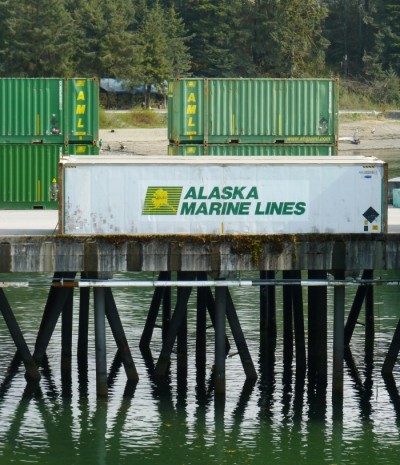
Alaska Marine Lines containers wait for loading on Yakutat’s dock. AML is part of Lynden. Image by Ed Schoenfeld, CoastAlaska News.

Lynden, which owns Alaska Marine Lines, is in the process of buying Northland Services. The two lines handle the lion’s share of cargo shipments to Southeast communities.

Samson does some barging to and from Sitka. Baggen said the purchase allows her company to compete in other communities.

“Our plans right now are to serve Ketchikan, Juneau, Wrangell, Petersburg, all of Prince of Wales Island and Metlakatla,” Baggen said.

Northland’s barge line will continue to exist as a Lynden subsidiary. But operations will be combined in Southeast towns that both serve.

The purchase has to clear a number of hurdles. Among the concerns: The combination could effectively create a monopoly.

Lynden CEO Jon Burdick said that’s why his corporation supports Samson’s Southeast expansion.

“There is a regulatory review process and the state of Alaska wants to ensure that where there’s competitive overlap between Lynden and Northland, that there’s alternative services available,” he said.

Burdick said buying Northland expands Lynden’s service area to Western Alaska, as well as Hawaii.

But he said Lynden’s Alaska Marine Lines subsidiary will not reduce Southeast port calls.

“At a minimum, they’ll receive equal frequency of service. In terms of equaling what AML’s doing now or what AML plus Northland’s doing now? AML plus Northland,” he said.

Burdick expects most Northland employees will either keep their jobs or find new ones with Alaska Marine Lines or Samson Tug and Barge.

Baggen said her company will be hiring.

“Eventually, we’ll probably double our size, probably have somewhere between 120 and 160 employees. … Most of those employees will be in Alaska,” she said.

Baggen understands her company will compete against a much larger operation.

She said Samson will do that by providing personalized customer service.

“We’re not the box-box carrier. We’re not going to be the one that says you better do it at this time in this way. We don’t care how you want to do it. We’re going to say, hey, what do you need and we’re going to do the best we can to come in and really work for the customers,” she said.

Both companies expect the sale to be completed by the end of this year.

And both say they’ll be ready for a quick transition.

Yakutat’s tern festival in sound and pictures

A group of birdwatchers looks for seabirds from Sandy Beach during the Yakutat Tern Festival. Click for a slideshow of festival images. Photo by Ed Schoenfeld, CoastAlaska News.

Birders, biologists, carvers and kids gathered in Yakutat May 30th to June 2nd for the northern Southeast community’s annual tern festival.

The event included lectures, field trips, art classes for kids, a live raptor show, fund-raising meals, Tlingit oratory and a performance from the Mount Saint Elias Dancers.

Here’s an audio post card of the event, which celebrates the return of one variety, the Aleutian tern.

Five Aleutian terns sit on a protected beach on Yakutat’s Black Sand Spit, a nesting area. Photo by Ed Schoenfeld, CoastAlaska News.


Trust land timber cut raises questions

An Alaska Mental Health Trust investigator is headed to Wrangell to look into what some claim is improper logging on its land.

Trust official Marcie Menefee says her agency approved limited cutting of trees that threatened power lines along Zimovia Highway.

She’s heard complaints from residents of the highway, which runs south from downtown Wrangell. And she says she’s been sent photos that appear to show logging beyond what’s been approved.

Menefee says Trust Resource Manager Paul Slenkamp will travel to Wrangell early next week to investigate the situation. She said Slenkamp, who is based in Ketchikan, is not free to come sooner.

The trees were felled near Pat’s Creek, a popular recreation area.

Several years ago, trust land logging caused controversy after trees were cut on a steep slope along Zimovia Highway.

We’ll have more on this issue as it develops.

Sealaska sells one business, may buy another

Sealaska CEO Chris McNeil, right, poses with Vice President Rick Harris at the corporation’s board room. Photo by Ed Schoenfeld, CoastAlaska News.

Sealaska recently sold its Global Logistics business to 20Cubed, a much-larger firm with offices in about 10 countries.

The subsidiary managed international shipping, warehousing and related services, as does its new owner.

“We didn’t believe that that particular type of logistics would be able to grow to the size of company that we expect,” said Chris McNeil, Sealaska’s president and CEO.

He said the Southeast-based regional Native corporation is reengineering its portfolio and narrowing its variety of companies. That includes those accessing a controversial federal contract-preference provision.

“Some of the smaller companies were set up to take advantage of the section 8(a) opportunities,” he said. “And where the 8(a) opportunities have existed and been strong we’ve expanded our platform. But where we think that perhaps it will not going to be able to meet our goals, then we’re moving in other directions.”

While Sealaska’s shed one subsidiary, it’s looking for another.

Hear iFriendly audio.

McNeil said the board and management are discussing an investment closer to home.

“We’re expecting that we would move forward with an operation that would more strongly reflect our Native values, more particularly capacity building and leadership (and) the possibility of competitive advantage in the sector,” he said.

“We’re very interested in the impact an operation could have on our tribal-member shareholders in the region, as well as possibly in the Pacific Northwest.”

He won’t name the company or its line of business.

But he said this and other changes could reduce revenues in the short term.

“We’re doing it from a position of strength because we have a very strong balance sheet that will support us to be able to move forward in this direction,” he said.

The ultimate goal is to be profitable within three years – without depending on 7(i) payments. Those come from a pool of all regional Native corporations’ resource earnings.

Read details of Sealaska’s business operations in its annual report.

Sealaska’s business decisions and leadership are roundly criticized by some of its 21,000 shareholders.

Mick Beasley is among critics of Sealaska’s business operations.

Mick Beasley is one of 10 independent candidates challenging four incumbents for seats on the corporation’s board of directors. He’s among those frustrated with the corporation.

“So we sacrificed how many year for the last direction. Same leaders, different story now. I kind of think we’re still waiting for our stimulus,” Beasley said.

Beasley has authored resolutions calling for board term limits and an end to board-directed discretionary voting. He’s also run for the board before.

He said he’s frustrated Sealaska hasn’t moved faster on minerals development and other resource-extraction operations.

“Let’s just get new people in there. Let’s get some rotation; let’s get some change. It’s almost like if you just look at our operations, we could have anybody in there. If we didn’t have 7(i) right now, we’d be in a world of hurt,” he said.

Sealaska’s annual report for 2012 shows it made almost $312 million in gross revenues. That’s a 20 percent increase over 2011.

Net revenues, or profits, were $11.3 million during the same period. That’s 40 percent more than the previous year, but less than during 2010 and 2009.


Organization helps outfit Southeast children

Wayne Stevens, President and CEO of United Way of Southeast, watches as clothes gathered by the Kids in Distressed Situations program are readied to be sent to Sitka social-service groups. Photo by United Way staff.

A nationwide program is shipping new clothes to needy children in Southeast communities.

New York-based Kids in Distressed Situations sends several shipments a year to Anchorage-based Cook Inlet Tribal Council. The clothes are then delivered to organizations around the state.

Jennifer Treadway coordinates the program for United Way of Southeast Alaska.

“They take any of the clothes that didn’t sell. It’s like (the clothes have) Kermit and no one wants Kermit, they want Mickey Mouse,” Treadway said. “It’s all new clothes; none of it is used.”

Shipments, including this month’s, can also include children’s books, baby products and toys.

Boxes of clothes are stored by World Wide Movers, waiting wait to be shipped to social-service groups. Photo by United Way staff.

Treadway says the program also covers older children.

“Our more recent shipment was a lot of children’s pajamas. But it also included some name-brand athletic T-shirts with different colleges (names). And the shipment before that was a bunch of shoes similar to Ugg boots, which was definitely geared toward teenage girls,” she said.

The Juneau-based United Way chapter works with member agencies and The Salvation Army to get the items to kids in need. They include low-income and homeless families, victims of domestic abuse and children with incarcerated parents.

Alaska Airlines, Alaska Marine Lines and Worldwide Movers provide free shipping and warehouse storage.

Cook Inlet Tribal Council estimates the program serves about 8,000 families statewide.

This month, KIDS clothing went to: Aiding Women in Abuse and Rape Emergencies (AWARE), Catholic Community Service, Helping Hands, Sitka Counseling and Prevention Services, Sitkans Against Family Violence and St. Vincent de Paul, as well as Salvation Army Corps Community Centers in Haines, Hoonah, Juneau, Kake, Ketchikan, Klawock, Petersburg, Sitka, and Wrangell.

Site notifications
Update notification options
Subscribe to notifications