Ed Schoenfeld, CoastAlaska

Ferry system gets new boss, management structure


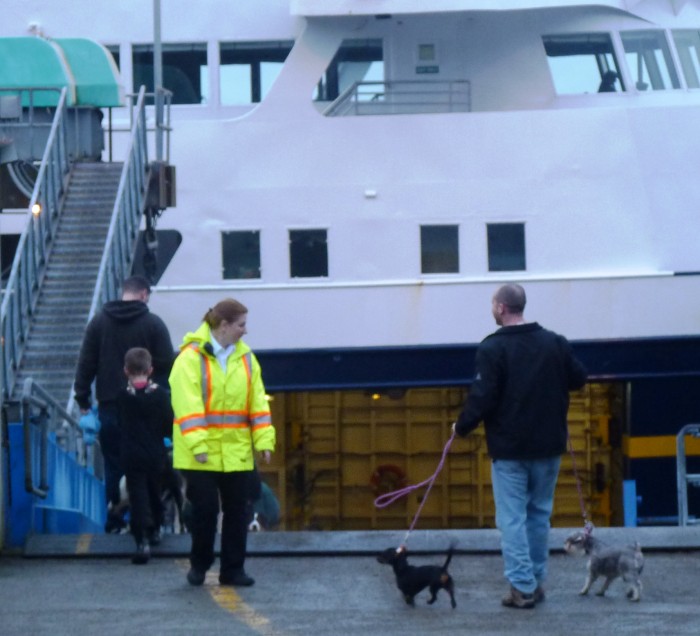
A marine highway staffer watches as passengers with dogs reboard the ferry Matanuska before departing Wrangell. The Mat is one of 11 ferries serving 35 communities.
A marine highway staffer watches as passengers return dogs to the ferry Matanuska before departing Wrangell. The AMHS has 11 ferries serving 35 communities. Photo by Ed Schoenfeld/CoastAlaska News

Juneau’s Reuben Yost is the new chief of the state ferry system. But he’ll spend only about half his time on that job.

Transportation Commissioner Pat Kemp named the long-time department employee to the deputy commissioner post Tuesday.

Reuben Yost is the new deputy commissioner for ferries, measurement standards and special projects. DOT Photo.

Yost will be in charge of the marine highway. But he’ll also oversee measurement standards, commercial vehicle enforcement and special projects.

Reuben Yost is the new deputy commissioner for ferries, measurement standards and special projects. DOT Photo.
“Commissioner Kemp envisions three deputies that have areas of responsibility, but aren’t limited to just one area,” he says.

Yost says the structural changes will shift some responsibilities to marine highway General Manager John Falvey. He’s been in that position about eight years.

One big job is to oversee design of the Alaska Class Ferry. Gov. Sean Parnell last month announced two smaller shuttle ships will be built with existing funds. Earlier plans called for one larger ship.

Yost says he will also work to fund and design other new ships for Southwest and Southeast service.

“The Tustumena is in need of replacement. And so are some of the original mainliners. That’s an aspect that people really haven’t focused on with the Alaska Class Ferries,” he says.

Yost replaces Mike Neussl, who was in charge of just the ferry system for about two years. Several predecessors also had that focus.

Yost has been overseeing a number of transportation efforts, including the Juneau Access Project. That would build a road north out of Juneau to a shuttle-ferry terminal across Lynn Canal from Haines.

He began his 18-year state career as an environmental analyst and manager. More recently, he’s been Southeast regional director of construction, maintenance and operations.

“I’ve kind of been involved in all areas of the Department of Transportation in terms of types of projects and different modes: rural airport projects, highway projects and some marine projects,” he says.

Yost will be the sixth person in about a decade to head up the marine highway system. He says he’s in his early 60s and thinking about retirement, but not anytime soon.

Before moving to Juneau, Yost commercial-fished out of Pelican, where he served as mayor. He says he learned the value of the ferry system while living in the remote Chichagof Island town.

He’s also worked as a teacher. His degrees are in industrial education and zoology.
Wilson: Endow road, ferry, airport, harbor projects

Southeast Rep. Peggy Wilson will try to change the way transportation projects are funded this session. The Wrangell Republican also wants to come up with a system to improve rural hospitals.

Wilson says the state has fallen behind on improving its transportation infrastructure.

“No matter what’s going on in our economy, we have to maintain our roads and … we should be building new ones. And we aren’t doing a very good job of doing that,” Wilson says.

Wrangell Rep. Peggy Wilson poses at her Capitol office Jan. 8, 2013. Her district includes Ketchikan and parts of Prince of Wales Island. Photo by Ed Schoenfeld/CoastAlaska.

She’s spent several years pushing legislation that would create a transportation endowment fund. It’s passed the House, but not the Senate.

Along with roads, it would fund ferries, harbors and airports. Her priorities include deferred maintenance and roads to natural resources.

“I would like to seed it with one to two billion dollars to begin with. So that we have an endowment that will be there and then we could just use the interest as it grows,” Wilson says. (Hear an earlier report on Wilson’s 2010 Transportation Endowment legislation.)

Continued funding would come from license-plate fees, fuel taxes, vehicle registrations and similar revenue streams.

Wilson wants the transportation endowment to be managed by Alaska’s Permanent Fund. She says it would be overseen by an appointed board or commission.

“And I would like to see a group of people that are non-partisan that would look at what’s best for the state as a whole. And stop the partisan-type thinking, ‘Well, I want it for my district’,” Wilson says.

She’ll face opposition.

Sitka Sen. Bert Stedman, who represents Wilson’s district in the Legislature’s upper chamber, calls the endowment “a dumb idea.” (Hear a report on Stedman’s priorities.)

“I couldn’t think of anything worse to do to hinder our development as far as roads or transportation systems, dealing with the marine highway or anything dealing with DOT, than to create an endowment and turn it over to a bunch of folks who are unelected, basically dominated by the Railbelt,” he says.

Wilson says putting the right people on the fund’s board would take care of that problem.

The Wrangell Republican will try to move the endowment forward through the House Transportation Committee, which she chairs.

She also wants to work with marine highway officials to cut expenses. She wants new ships to have interchangeable parts, and she has some other ideas.

“We have to make sure that our ferry system will run economically [and] that we will have as few workers on it as we can. I know that’s controversial, but we have to realize that the two biggest expenses on our ferry system are the staffing and the fuel,” she says.

The committee will also review Gov. Sean Parnell’s decision to change plans for the next line of ferries. And, there’s the forced resignation of ferry chief Mike Neussl.

Wilson says the governor and other top officials should run such changes through the state Marine Transportation Advisory Board before they become final. The panel only heard after the decisions were made.

She sponsored the legislation that created the board.

“The reason that I put it out to begin with is because we wanted the people of the state to have a say in it, and not just one person,” she says.

Wilson, who serves as House majority whip, is a retired nurse.

She plans to sponsor a bill providing matching grants for rural hospitals. One is in Ketchikan, which is trying to upgrade operating rooms.

“Right now it’s very difficult for them, because it’s pretty ancient. And any surgeon they try to recruit is going to look at it and say, ‘Golly, I want something a lot more modern than that.’ And I think that’s happening all across the state,” she says.

Wilson voted for the controversial oil tax and incentive legislation that passed last year’s House, but not the Senate.

She says she still supports the idea, but worries about some of the details.

“If we do all these tax credit things, how much money is actually going to be coming into the state. We have to be careful there. We don’t want to do so many tax credits that we’re putting the state in jeopardy,” she says.

Redistricting moved Ketchikan and some Prince of Wales Island communities into Wilson’s election boundaries. But it took away Sitka and Petersburg.

She’s cosponsoring legislation requested by the POW-based Southeast Islands School District. It would allow a trial four-day-a-week schedule, which she says would improve attendance and save money.

Stedman concerned about oil tax, project funding

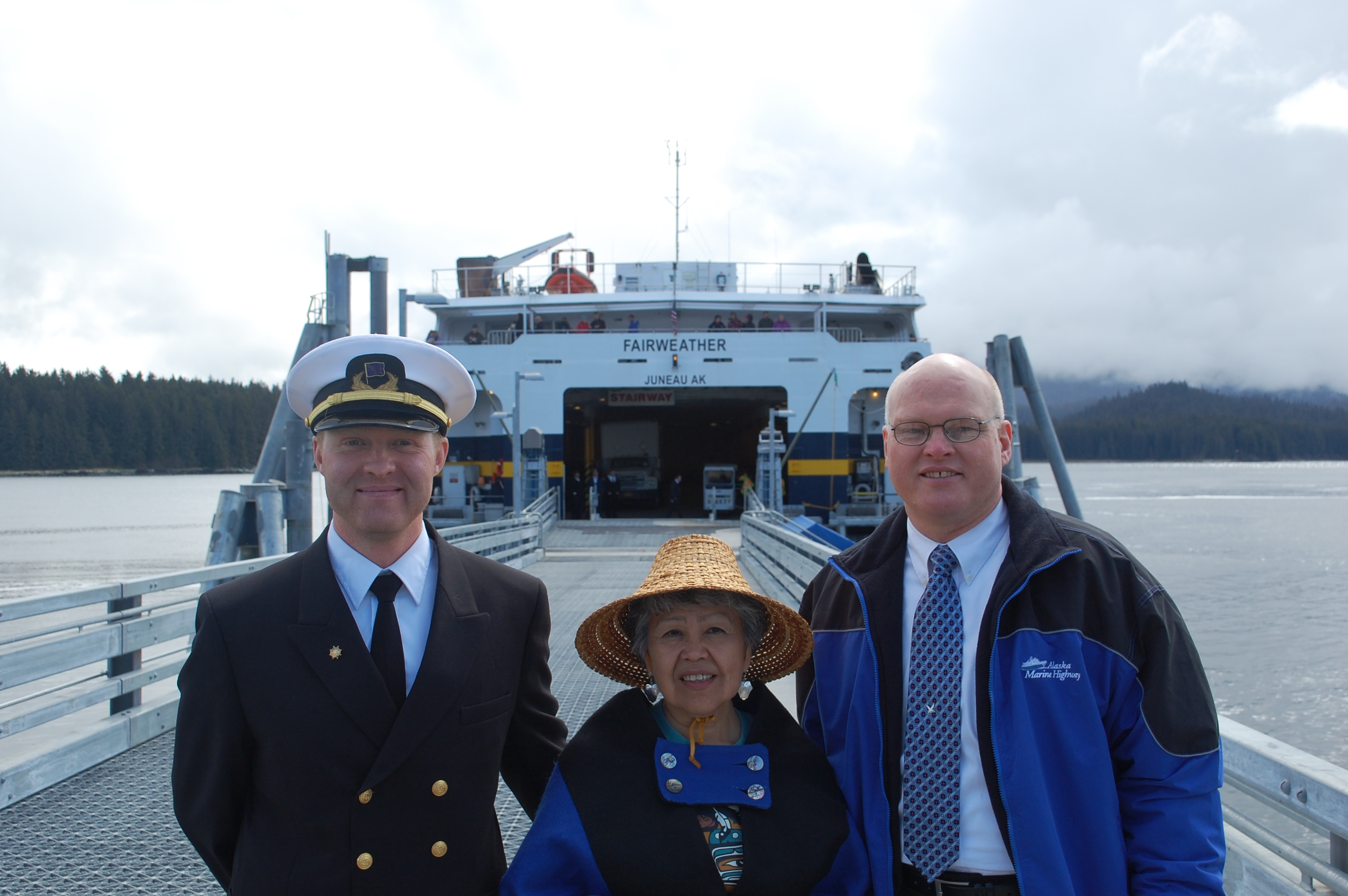
Bert Stedman, left, and Capt. Mike Neussl present Fairweather Capt. Leif Short-Forrer, right, a proclamation commending rescue efforts. Courtesy AMHS.

Sen. Bert Stedman spent six years as co-chairman of the powerful Senate Finance Committee. There, the Sitka Republican effectively blocked Governor Sean Parnell’s oil-and gas-tax rewrite plan.

When Republicans favorable to those changes organized this session’s Senate, they left him off the panel.

Stedman worries the Legislature will pass a bill that gives away too much and ignores the complexities of taxation and incentives.

“So if you just lower the oil tax and you don’t fix these other areas, the state of Alaska’s going to get the royal shaft and somebody’s going to end up with a gold mine,” Stedman says.

“And it won’t be the people who own the assets, which is the people in the state.”

The new Senate leadership put him in charge of the Health and Social Services Committee.

He freely admits that’s not one of his areas of expertise.

“I haven’t worked with that committee in the past. So I don’t have a lot of the historical issues that they work with front and center,” he says.

Stedman says he’ll meet with the state’s Health and Social Services commission and various interest groups.

He’s concerned about cuts or formula changes affecting federally-funded programs.

“There’s the health-exchange issue that the governor’s basically decided what he wants to do on. And that’s his role. And there’s a litany of other issues, so we’ll just have to wait and see and let then unfold,” he says.

His Health and Social Services Committee will likely see any legislation furthering the governor’s Choose Respect campaign against domestic violence.

“I don’t know if it’s the right approach, but it’s certainly a good approach. And it gets it out in the public eye a lot more. So I think it’s definitely beneficial to the interests of all the communities. And I do think he’s on the right track by increasing the state troopers and village public safety officers,” he says.

Stedman used to write the Senate’s capital budget. That gave him the power to select public-works projects for his district and other parts of the region.

This year, it’ll be different.

“We’ll be going through the communities’ lists throughout the region and trying to fill some of the gaps. But there is a difference between when you’re a committee member or a non-committee member and when you’re in charge of actually writing the budget,” he says.

He says previous sessions’ projects will be spread out over two or three years. That means some lag time before construction and other work slows down.

The governor’s proposed capital budget, released in December, allocates close to $200 million for Southeast projects. They range from road repairs to ferry engines to school improvements.

Stedman says he’ll continue to push for regional energy projects. But he worries too much money will go toward gaslines to Fairbanks and an export terminal further south.

“So I think we need to be able to be careful on what decisions we’re making that they’re not just political knee-jerk decisions for consumption in your own district. But we have to look at the long-term best interests of the state over several decades,” he says.

A big issue for Stedman – and all Southeast lawmakers – is reduced regional power.

Redistricting shrunk the delegation from eight to six. And the last elections took out three incumbents and left only one representative, Juneau’s Cathy Munoz, on a finance committee.

Stedman also worries about the loss of other coastal lawmakers from the top leadership positions.

“We have one member out of Kodiak out of 10 and when you run a democracy one vote in 10 doesn’t get very far. So we’ve got some work to do along coastal Alaska,” he says.

That one is Alan Austerman, the new co-chairman of the House Finance Committee. He’ll be the lawmaker assembling the operating budget.

Stedman’s Senate district has changed since last year, losing Petersburg and adding Haines, Craig, Hoonah, Angoon, and other small communities. He continues to represent Sitka and Ketchikan.

Resignation reaction: It’s sad, but we’ll move on

Ferry Chief Mike Neussl helps celebrate the resumption of Sitka-Angoon service at the Baranof Island city’s terminal in May, 2012. He leaves the job this week. Photo by Robert Woolsey/KCAW.

Southeast leaders were surprised by Captain Mike Neussl’s announcement that he would resign from his job as marine highways chief. But some say it won’t hurt the ferry system in the long term.

Neussl was hired as deputy commissioner for marine operations just a few weeks short of two years ago. The move came after the former helicopter pilot, engineer and manager retired from a 30-year Coast Guard career. (Hear a report from when Neussl was hired.)

Cathie Roemmich is on the state’s Marine Transportation Advisory Board, and is the Juneau Chamber of Commerce’s CEO.

“I’m saddened and disappointed in a way because I know Capt. Neussl put his whole heart in and did a fine job and had the respect not only of MTAB but the marine highway employees as well,” she says.

Advisory Committee Chairman and former Haines Borough Manager Robert Venables echoes the sentiment.

“I think we’re always sorry to lose the top guy at the helm for the marine highway system. But we have had a lot of turnover,” he says.

Captain Leif Short-Forrer, left, MTAB’s Maxine Thompson and Capt. Mike Neussl at the Angoon AMHS Terminal. Photo courtesy DOT.

Neussl took over the job from Jim Beedle, a longtime ferry staffer who worked his way up through the ranks. He stayed about three years, the longest tenure in recent memory.

In all, five people have headed up the marine highway system over the past seven years.

“We’ve seen each one have their own personality and way of doing things, but they all left a mark as they passed through,” Venables says.

Neussl resigned just a few weeks after Pat Kemp was named Department of Transportation commissioner. It’s also shortly after the governor announced significant changes to the Alaska Class Ferry design.

Neussl says he was not part of that decision-making process. But he did not say either change led to his departure.

“There’s been a lot of changes all at once. I think maybe, in the long run, they could be positive,” says Peggy Wilson, a Wrangell representative who chairs the House Transportation Committee.

“I’m really pleased with the new commissioner. I think at least with him, we will not have as many surprises,” she says.

Wilson is critical of former Transportation Commissioner Mark Luiken. She says he changed projects without notice and was not transparent enough in his decisions.

There’s no word on the hiring process for Neussl’s job, or how soon it will be filed.

But Venables is optimistic.

“The marine highway system has been running and is running very, very well and effectively. We’re glad for that and wish to help it continue,” he says.

Roemmich takes a similar view.

“We can just hope there’s somebody out there that can take on this role with enthusiasm and the spirit to help continue to improve and look forward to a future that our marine highway can operate under,” she says.

The change of leadership and ferry-design plans will get some official attention later this month.

The Marine Transportation Advisory Board meets January 22nd in Juneau. And Representative Wilson says the House and Senate Transportation Committees will hold joint sessions once the Legislature resumes work.

Study: Otters eating urchins reduces greenhouse gas

Sea otters rest on their backs near Sitka Sound in 2011. Photo by Ed Schoenfeld.

There’s more scientific evidence that sea otters reduce the amount of greenhouse gasses in the atmosphere. That has meaning for Southeast Alaska, where the population is booming, and Southwest Alaska, where it’s dropped.

Researchers already linked sea otters to carbon sequestration.

It’s a simple case of cause and effect. Kelp absorbs and stores carbon from the atmosphere. Sea urchins eat kelp, lowering the amount of carbon the marine plants take in. Otters eat urchins, allowing healthy kelp forests to grow.

“Most of the carbon that’s in living tissues of organisms is tied up in plants,” says Chris Wilmers, an environmental studies professor at the University of California, Santa Cruz.

“So if plants are doing a lot better, then it stands to reason that maybe there’s more carbon in the system,” he says.

Wilmers led a project to calculate the amount of the greenhouse gas otters help remove. He spoke during a recent teleconference hosted by the Alaska Center for Climate Assessment and Policy. (Hear an interview with Wilmers on the program “Living on Earth.”)

He says scientists compared data collected over the past 40 years to more recent information. They studied sites from southern British Columbia to the end of the Aleutians. And they compared otter-rich areas to those with few of the marine mammals.

Researchers found areas where otters live had 5 to 10 percent less atmospheric carbon than those where they don’t. Wilmers says it’s about the same amount 5 million cars would emit in an average year.

Researchers also calculated its value on the European Carbon Exchange.

“We looked up what the price of carbon futures were when we were writing up the study. We multiplied it by the amount of carbon otters are indirectly sequestering. And it comes out to be roughly worth somewhere between $200 million and $400 million,” Wilmers says.

But there’s a down side. The greenhouse gases ocean plants remove from the atmosphere do not disappear.

“If the kelp are taking up more carbon and sinking that carbon into the deep ocean, then over long time-scales there will be more carbon in the ocean, so theoretically it could increase acidification,” Wilmers says.

Scientists know higher levels of acidity damage shellfish, including crab. It may also affect salmon behavior.

But Wilmers and his fellow researchers say the impacts are limited.

“The real point of the study is to show that an animal, in this case a predator, can have a big effect on the carbon cycle and its ecosystem. And if otters covered the planet, they could have a huge impact on climate change and ocean acidification,” he says.

“But the reality is they just occupy this little sliver of the planet. So where they do live, their impact is large.”

He says otters do not remove all sea urchins. But they eat enough to drop numbers significantly.

Otter populations are growing in Southeast Alaska, Katchemak Bay and some other locations.

While they eat urchins, they also consume crabs, clams and sea cucumbers. That’s impacting fishermen and divers, who harvest those valuable species.

New ferry a “stretch Lituya,” not a “stretch LeConte”

A drawing of a recent design of the larger Alaska Class Ferry created by Eliott Bay Design of Seattle.

More details are emerging about the Alaska Class Ferry redesign. The smaller shuttles could have partially open car decks. And three, rather than two, might be built.

State officials say they’re looking at more ways to cut the cost of what will be the Lynn Canal shuttle ferries. They’re what will replace a partially-designed ship that could handle a larger variety of routes.

The ferry LeConte ties up at Auke Bay, Juneau’s ferry terminal. Photo courtesy Alaska Transportation Department.

“I have previously described the current, 350-foot Alaska Class Ferry as a stretch LeConte,” said marine highways chief Capt. Mike Neussl, addressing a recent phone meeting of the Southeast Conference’s Transportation Committee.

The LeConte, which serves northern Southeast, has a cafeteria and crew quarters, allowing for longer sailings. Neussl says the shuttle ships will have none of those amenities.

“The concept for the replacement Alaska Class shuttle ferry is more of a stretched or supersized Lituya,” Neussl says.

That ship, which links Ketchikan and Metlakatla, has an open car deck and a small passenger area. (See profiles of all state ferries.)

Neussl says details are far from being worked out. But having a partially uncovered car deck would save money.

The ferry Lituya serves Metlakatla and Ketchikan. Photo courtesy Alaska Marine Highway System.

Juneau Mayor Merrill Sanford says the weather’s too rough for that.

“All of have been in Lynn Canal in times when we shouldn’t have been and/or wished we weren’t. And unless you can really show me that it’s safe, that’s kind of a ridiculous concept to be even looking at,” Sanford says.

Ferries now sail a single daily Juneau-Haines-Skagway round trip. The LeConte runs in the winter and the larger Malaspina in the summer. Earlier Alaska Class Ferry plans called for much of the same.

Neussl says more and smaller shuttles would allow for a flexible schedule.

“The goal will be with these two vessels, and potentially a follow-on third vessel, is to run them one of them Juneau to Haines and back every day,” he says. “Or perhaps with two crews, twice a day. And to have an additional one of these vessels run back and forth four times a day or so between Haines and Skagway.”

An eventual third shuttle, if built, would be home-ported in Skagway and sail to and from Juneau.

The change from one large ferry to several shuttles raised the ire   of many involved with the marine highway — but not everyone.

Juneau Chamber of Commerce Executive Director Cathie Roemmich serves on the Southeast Conference’s Transportation Committee as well as the governor’s ferry advisory panel.

“We originally asked that we could get two small vessels. And over the past five and a half years, this shuttle/dayboat has morphed into this big ship,” Roemmich says.

Several committee members asked about community input into the new design.

Roemmich says she wants a review, but not a full set of hearings.

“But if we go back to the beginning, we will never get anything built. Because that’s what happened last time. We went from a shuttle/dayboat and it got out of control. And now we’ve lost that,” she says.

Ferry chief Neussl didn’t yet know how public input will be taken. But he said residents already shared their ideas during the larger ship’s planning process.

That raised questions from Mike Korsmo of Skagway.

“So what I’m hearing is basically, this plan is somewhat solidified. You’re going to say you’re taking public input, but you’re going to go ahead with this plan regardless of communities, mayors and legislators that don’t like it,” Korsmo says.

Neussl says the state is open to differing views, but wouldn’t commit to using new ideas.

Governor Sean Parnell announced the new Alaska Class Ferry plan in early December, surprising some lawmakers, advisory board members and ferry staff.

Further discussion is expected before the House and Senate Transportation Committees, both chaired by Southeast legislators. It will also be on the agenda for the next Marine Transportation Advisory Board meeting.

Site notifications
Update notification options
Subscribe to notifications