Ed Schoenfeld, CoastAlaska

Many legislative races remain unchallenged

With the filing period nearly over, more than a third of the legislative seats on this year’s ballot remain unchallenged. Candidates have until 5 p.m. Friday (June 1) to submit their paperwork to the state Division of Elections.

Fifty-nine seats – 40 in the House and 19 in the Senate –are up for grabs in the August primary and November general election. It’s a larger-than-usual number because reapportionment requires elections in all but one district.

But so far, the state elections website shows only 37 races with more than one candidate. The other 22 seats are unchallenged, meaning the person running will almost certainly win. (See the list of filed candidates on the state elections website.)

Retired Juneau lawmaker Mike Miller says the small number of candidates is surprising. He says it wasn’t that way in the past.

Miller served 16 years in the state House during the 1970’s and 80’s. That means he won eight elections.

“Maybe politicians just have a bad name these days and people don’t want to do it. Although I can’t imagine that, because in Alaska, I’ve always been proud to serve with members of both parties,” Miller says.

The single-candidate contests are spread throughout the state. Eight of 19 Senate seats are unchallenged. So are 14 of 40 House races.

Candidate numbers have grown since earlier this week, when almost half of the races were unchallenged.

Three of Southeast’s four House districts have only one person on the ballot.

The region’s sole Senate race has two candidates running. Its second Senate seat is not on the ballot because it saw few redistricting changes.

Most of the open seats are held by incumbents, and many have a strong hold on their districts.

“The seats that are pretty safe, people just don’t contest them because it costs money, although not a lot of money in Alaska, compared to a place like California or even a place like Indiana,” says Clive Thomas, a retired University of Alaska Southeast political science professor.

The author of an Alaska politics and policy book says plenty of earlier elections have seen uncontested races.

“I guess it’s hard to round up somebody because campaigning takes a lot of energy out of somebody, and I guess there’s the big deflation when you lose,” Thomas says.

Republicans make up the majority of single-candidate races. They have 15 uncontested seats, while Democrats have only 7.

Thomas wonders whether people feel much need to challenge incumbents.

“Most people in Alaska I would figure are very satisfied. There’s a lot of money around in Alaska. We’re one of the very few states … that hasn’t cut its budget. Those people who follow California or read about it … will notice it’s going through amazing problems. In Alaska, we have large capital budget this year. Alaska’s in the chips, you might say, and that may affect the way that people may feel about challenging or not challenging,” he says.

Some of the challenged candidates face no opposition in the August party primaries. They’ll face off with another party’s nominee in the November general election.

Unchallenged Southeast races are in districts held by Haines Republican Bill Thomas, Juneau Republican Cathy Munoz and Juneau Democrat Beth Kerttula. All now serve in the House of Representatives.

Two incumbents, Angoon Democrat Albert Kookesh and Sitka Republican Bert Stedman, are running for the lone Southeast Senate seat on the ballot. Juneau Democratic Senator Dennis Egan does not have to run this year.

Court ruling restores SE Native influence district

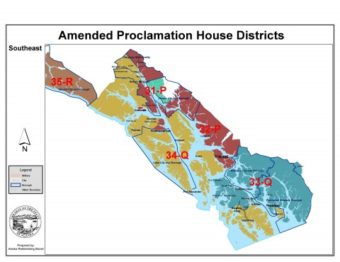
Southeast will have four House and two Senate districts in the reapportionment plan in place for the 2012 elections. Map courtesy Alaska Redistricting Board.

Some Southeast Native leaders are relieved that the latest redistricting plan was thrown out in court.

Tuesday’s action by the Alaska Supreme Court restored a Native-influence district in the region. It includes Haines, Angoon, Hoonah, Kake, Kasaan, Klawock, Saxman and Metlakatla.
The Alaska Federation of Natives, the Alaska Native Brotherhood, Sealaska Corporation, and the Tlingit and Haida Central Council had protested the rejected plan.

Ed Thomas is president of the Central Council.

“The representation from rural communities is very important because their challenges are increasing, instead of getting any better. So it’s very important to have a voice in the state Legislature from our villages,” he says.

Read more about the regional redistricting picture.

The rejected plan, released just last week, would have put Haines and Juneau’s Mendenhall Valley in the same House district. That would have pitted incumbent Juneau Republican Cathy Munoz and incumbent Haines Republican Bill Thomas against each other.

Thomas, who is Tlingit, has spent several terms representing most of the region’s small cities and villages.

Both redistricting plans set up a hard race for Southeast’s senior Tlingit lawmaker, Angoon Democratic Senator Albert Kookesh.

Angoon will be in the same Senate district as Sitka Republican Bert Stedman. He co-chairs the powerful Senate Finance Committee, and Kookesh has said he expects an uphill battle.

Thomas, of the Central Council, worries about the overall loss of Native representation.

“I have to say that with redistricting we really end up losing a rural voice, no matter what we do. So we have to do our best to really have a better mixture,” Thomas says.

The region’s redistricting plan is only in place for the 2012 election. It also sets up a race between incumbent Republican representatives Kyle Johansen of Ketchikan and Peggy Wilson of Wrangell.

Population shifts have reduced Southeast’s eight current legislative seats to six.

Link to the Alaska Redistricting Board.

Numbers up for Alaska cruise ship season

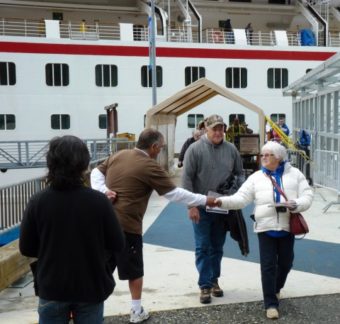
Carnival Spirit passengers are greeted with a handshake as they walk onto Juneau’s waterfront on Thursday. Photo by Ed Schoenfeld.

Tour buses line up as the first passengers of the year walk down the Carnival Spirit’s ramp to Juneau’s Princess dock.

Excursion greeters hold up signs to attract confused customers, sending them down the line to their tours.

“Glacier Wildlife Tour,” calls out a guide.

“Hey-oo, welcome, come on board,” adds the driver.

Those not already booked on a tour walk on by gift shops to a row of kiosks.

There, salesman Khalid Habash of Last Chance Tours is surrounded by signs for trips and experiences.

“We offer a variety of shore excursions. For example, whale-watching, helicopter tours, seaplane tours, zip-lining, fishing, canoeing, kayaking, salmon bakes, pretty much anything you can do in Juneau,” he says.

A tour vendor readies one of a line of tour-sales kiosks near Juneau’s Mount Roberts Tram terminal.

That’s the menu for many on board the Spirit, which can hold more than 3,500 passengers and crew. It’s one of the first large cruise ships to sail the Inside Passage this season.

Numbers vary from town to town. The capital city will see its passenger count climb to almost a million this season.

Lorene Palmer of Juneau’s Convention and Visitors Bureau says that’s encouraging.

“2012 is looking better than last year. With the addition of one of Princess’ ships we’ve added about 48,000 passengers. That’s a pretty big jump over last year,” Palmer says.

It’s coming close to the record number of a few years ago, when a little more than a million people sailed these waters.

Palmer says some of this year’s passengers are part of a growing trend of extended family travel.

“So Alaska is a very popular place to come to celebrate a milestone event, whether it’s an anniversary, family reunion, a 50th birthday. Any of those things tend to be a real motivator to bring family and friends to Alaska,” Palmer says.

She says cruise ships are also bringing younger passengers, many looking for hands-on experiences, such as kayaking or hiking.

Andrew Swanson helps Carnival Spirit passengers find their tours at Juneau’s Princess dock.

“We just added a paddle-boarding experience here in Juneau. So we’re starting to see more and more adventure-based travel,” Palmer says.

That’s a trend that’s been going on for several years.

“Our baby boomer generation is pursuing an active lifestyle. And so, you’re seeing that translated to the shore excursions and tour operations,” Palmer says.

Cruise lines like to fill their ships, so they’ll deeply discount tickets if demand is low.

Ron Peck of the Alaska Travel Industry Association says that’s not so much the case this year. But he does note some passengers’ purchasing time is changing.

“In some cases, they’re much more cost-conscious so they’re looking for those deals. In other cases they’re just doing a lot more research on their own. In some cases they’re delaying their bookings, but we still get a pretty good feel early on,” Peck says.

Cruise ship traffic has jumped since the 1990s, inspiring business-people to open new gift shops and excursions.

Peck says some didn’t make it through the drop of the past few years.

“If anything we’ve seen a little tightening of the belt and some operators not necessarily making it, just because there’s been a reduction of overall cruise visitors,” he says.

“So I’m not sure I’d say we’ve seen an increase. I would say we’ve seen an increase in the type of experience but not necessarily in the number of cruise visitors. “

Back at the dock, Khalid Habash watches as the first wave of passengers heads toward his kiosk. He laughs as he wonders what questions they’ll have this year.

“A lot of people asked me what the sea level is, which is pretty funny. A lot of people ask me if they can see whales from the helicopter trip, which is a pretty interesting question,” he says. “A lot of people ask me if the bald eagles in these trees are real or not.”

Habash, originally from Maine, says he enjoys the work. Like many on the docks, he puts in long hours.

And, like his customers, he uses his savings to travel.

Click here to see this season’s cruise ship calendar.

Thomas: Energy fund, harbors top session work

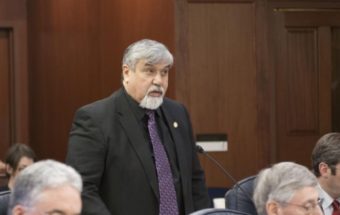
House Finance Committee Co-chairman Bill Thomas waits to speak during a House floor session on the operating budget. Image courtesy Alaska Legislature.


Haines Representative Bill Thomas spent much of this year’s session working on the state’s operating budget. He also got projects into the capital budget for his widespread district, made up of villages and small cities from Metlakatla to Prince William Sound.

Thomas has focused for several years on reducing energy costs.

Angoon’s Thayer Lake hydroproject got a chunk of money this year. But there weren’t many others in the capital budget.

Still, Thomas says one funding measure is a sign of progress.

“The renewable energy bill is critical to all of rural Alaska. It’s $50 million for the next 10 years, if we have the money. As long as we continue to have the money people will continue to retire diesel and hopefully put in wind generation and hydros,” he says.

The Haines Republican also praises a loan program to help build transmission lines and generation projects. That was added in by the Senate.

Other Legislative funding will benefit fishermen and women.

“Working with the governor we put a lot of money into the hatcheries and the harbor program to keep our harbors working. What we call our road to resources starts at the harbor,” he says.

Funded harbor projects are in Sitka, Saxman, Petersburg, Juneau, Haines, Hoonah, Hydaburg, Port Alexander and Skagway.

Thomas also worked to find money for a small veterans’ home in Haines.

“We don’t have a home in Southeast and our veterans have to go elsewhere and typically they end up passing there and then people have to go get them. People want to stay home in Southeast,” he says.

It will house 14 to 20 veterans when completed. The home will be named for Tlingit leader Walter Soboleff and noted Haines veteran Howard McRae.

Thomas was among lawmakers backing other legislation for service-members this session.

The Vietnam veteran sponsored a measure banning picketing and protesting during funerals. Another would have sped up the professional licensing of qualified vets. A third would have set a Welcome Home Vietnam Veterans Day.

They passed the House, but not the Senate.

“I think it was a dishonor for them to hold up honoring Vietnam Veterans Welcome Home Day, but that was their choice on the other side,” he says.

Thomas succeeded in pushing through a bill honoring Cordova vets. Fourteen unnamed bridges will soon recognize individual service-members from World War I and II, as well as Vietnam.

Another span, over the Eyak River will be named after Marie Smith Jones. She was the last fluent speaker of the Eyak language.

The measure also names a Petersburg bridge after Harry Kito, a hometown service-member who died in Vietnam.

“And also the airport in Klawock, they call it Klawock Frank Peratrovich Airport. Frank Peratrovich was the only Alaska Native in the constitutional convention for statehood. He also served in the territorial and state legislatures,” he says.

Thomas has served in the Legislature since 2004, representing a winding district with about 50 communities, many of them quite small.

The most recent reapportionment plan takes away some of those towns and adds Sitka, which will become the largest community in the district. He’s running for re-election in what’s for now called District 34.

Hear a report on Thomas’ plans before this year’s legislative session began.

Place names book documents Southeast Alaska history

Harold Martin, left, and Tom Thornton look through "Haa Leelk’w Has Aani Saax’u, Our Grandparents' Names on the Land." Photo by Ed Schoenfeld.


Click here for iFriendly audio

What’s in a name? If it’s a beach or a mountain or a stream, it can tell you what it looks like – or who’s been there. It can also document a change of ownership or geography — or the movement of a people.

A new book from the Sealaska Heritage Institute and the University of Washington Press presents about 3,000 Southeast Alaska Native place names. Many came close to being lost, replaced by western labels.

The title is Haa Leelk’w Has Aani Saax’u.

“It means ‘Our Grandparents’ Names on the Land’,” says Harold Martin, who handled many of the book’s research logistics.

He says the effort started about 20 years ago when anthropologist Tom Thornton came to him with an idea.

“We talked at length about what was happening, that we were losing our elders at a rapid pace. And that every time we lost an elder, we lost a lot of history and knowledge,” he says.

They found funding and started turning to those who knew the names. Thornton says they were not sure how much they would find.

“A lot of people thought these names were lost, but in fact, they weren’t. A lot of them were documented in sources, but a lot of them were still alive in people’s minds and memories,” Thornton says.

The researchers were also careful to follow protocol. A wrong move – asking the wrong person – could have closed doors.

“The first thing we had to do was to go out into the villages and get permission to proceed with the project. We couldn’t just go ahead on our own. We have to get permission from that area’s tribal government,” Martin says.

They took charts or maps to elders, pointing out places or asking for names. Martin found he remembered many from his childhood, sailing Southeast with his fisherman father, conversing in Tlingit.

The researchers found place names in historical documents, some with challenging spelling.

They tried out pronunciations on traditional speakers, to make sure they got it right. Sometimes, they didn’t.

“Tom always liked to be real precise on his pronunciation. There was one word he tried to say that came out like a private part on the human anatomy. Another one sounded like the Tlingit word for lovemaking,” Martin says.

“I always wondered why those old ladies were blushing,” Thornton says.

“They laughed. It was a lot of fun,” Martin adds.

In addition to names, the book includes scholarly discussion of Native languages and how its use differs with English.

Thornton points out that Western names often commemorate a person – a politician or a scientist or someone who funded an expedition.

“That’s a strong tradition in America. But in Tlingit, you almost never see that. Usually, it’s the opposite. The people are named after the places, rather than the places being named after the people,” Thornton says.

Tlingit, Haida and most other traditional names are descriptive. They can communicate geography – or the relationship between features.

“The example is Glacier Bay itself was supposedly named after the Tlingit name for the bay. But that name in Tlingit, ‘Sit’ Eeti Geeyi,’ literally means ‘bay taking the place of the glacier’,” Thornton says.

Finding the place names is more than an exercise in cultural history. They also document human migration and changes in the landscape, such as an ice age or changing sea levels.

Glacier Bay, across Icy Strait from Hoonah, is a good example.

“We learned that wasn’t the only name. There was an earlier name … referring to icebergs in the bay. And then the earliest name they had was …from when it was a muddy estuary of a river and people dwelled there,” Thornton says.

The names also document the use of the land. Martin says that’s helpful during subsistence and other political conflicts.

“State agencies, federal agencies and the conservationists say there’s no evidence that certain areas were ever used by Natives for subsistence purposes. All they had to do is look at our chart and see there’s no place in Southeast that wasn’t used at one time or another,” Martin says.

The researchers say the book is not complete. Thornton expects to find more place names, from documents and memories. And that’s not all.

“And hopefully, there’ll be new names on the land, because that’s a tradition that’s very important in Tlingit and Haida is to continue to name places,” Thornton says.

KTOO’s Jeff Brown contributed to this report.

Use the player below to hear a full interview with Tom Thornton and Harold Martin.

Click here for iFriendly audio

Juneau School District restores some staff cuts

Juneau’s School Board has restored some jobs and programs slated for cuts. But other positions on the chopping block will still be eliminated.

The board voted Tuesday to fund the top six items on a long list of reductions. All were threatened by a budget shortfall. A last-minute, one-time legislative funding boost allowed the jobs to be restored.

David Means is the district’s administrative services director.

“That included restoring the elementary cultural para-educators, elementary specialists, restoring five teaching positions for our classrooms across the district, two middle school counselors and our drug testing program,” Means says.

He says remaining cuts will include administrative positions, custodians, and some classroom staff.

Cuts would have totaled $5.8 million without the extra state money. But School Board President Sally Saddler says the extra $1.2 million just isn’t enough.

“Well, I’d like to say I feel relief, but it’s difficult to feel relief when we’re still laying off over 50 people. The money is just not there to continue all the fine things that we’re doing for our students,” Saddler says. “And while it’s great that we’re able to add back the 13 or so positions, you have to keep in mind that we’re still cutting $4.4 million from our budget.”

The district’s total spending plan for the next fiscal year is around $92 million.

Saddler says she knows the cuts disappoint many parents.

“People are advocating for art, they’re advocating for the truancy officers, they’re advocating for the nurses who serve the students. Each and every one of those positions is important,” she says. “And so it’s really all about having to make a Sophie’s Choice. Which of these programs is closest to the classroom and can benefit the most students, when the reality is all students are benefiting from these programs we’re cutting.”

Saddler says school expenses continue to rise at the same time state and federal funding has gotten smaller.

Site notifications
Update notification options
Subscribe to notifications