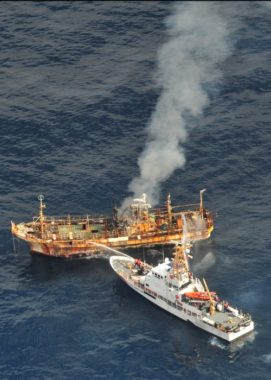
The Coast Guard is watching for fuel and debris from a derelict Japanese fishing vessel it sank off the coast of Southeast Alaska on Thursday.
Kip Wadlow of the agency’s public affairs office says nothing of significance has been found so far. A small sheen was spotted Thursday, but was expected to dissipate quickly.
Wadlow says the Petersburg-based cutter Anacapa began firing at approximately 1 p.m. Thursday.
The Ryou-Un Maru went down at 6:15 p.m. in about 6,000 feet of water.
“When the ship started to sink, the starboard quarter, or the right-back side, went in the water first. And then the ship just slowly rolled over and sank,” Wadlow says.
The approximately 200-foot vessel was washed out to sea by last year’s Japanese tsunami. It crossed the Pacific Ocean without crew or power, then drifted up the coast of British Columbia into Alaska waters.
Wadlow says the Coast Guard fired 440 rounds of explosive ordinance at the ship’s waterline.
“The reason why we decided to sink this vessel is that it posed a safety threat to mariners and maritime shipping that travel the sea lanes off of Southeast Alaska,” he says.
Firing was delayed when a fishing boat captain expressed interest in salvaging the ship. He decided against the idea after getting a closer look.
The Ryou-Un Maru caught on fire after the first round of shelling. Wadlow says the Anacapa’s crew put it out by shooting a stream of water from their vessel.
“There was a significant smoke plume and we didn’t want to worry any mariners in the area thinking that there might be a vessel on fire and people in danger,” he says.
The Japanese ship was about 180 miles west of Sitka when it sank.
It’s not clear what hazardous materials were on board. The Coast Guard does not believe the ship contained any radiation.
An agency C-130 aircraft is flying a grid over the area to check for oil or debris.
The Coast Guard Cutter Anacapa fires explosive ammunition at the adrift Japanese fishing vessel, Ryou-Un Maru, before it sank Thursday evening. Photo by Petty Officer 2nd Class Charly Hengen.
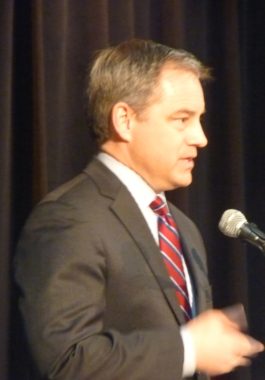
Gov. Sean Parnell addressed the Native Issues Forum April 4 in Juneau. Photo by Ed Schoenfeld.
Governor Seal Parnell is asking Alaska Native leaders to lobby the Legislature in support of his education initiatives.
He addressed officials of the Tlingit-Haida Central Council, Sealaska Corporation, Alaska Native Harbor Seal Commission and other groups at Wednesday’s Native Issues Forum in Juneau.
Parnell asked for support of his merit-based performance scholarship program, which began last year.
He said he’s willing to include a needs-based component. But he opposes using the program for students who pass the high school equivalency exam, earning what’s called a GED.
He said that would create a double standard.
“You have one class of kids that were counting on it and earning it and another class of young people who don’t have to go through the same rigor, yet are being given a scholarship. And that’s not something I support. There are other ways to address that. But certainly not to incentivize getting a GED rather than get a high school diploma,” he said.
Parnell also asked for support of his kindergarten-through high school school funding plan. That would give Alaska school districts a one-time payment to help cover inflation. He criticized Senate plans for a several-year increase.
The governor was asked if his administration would enforce tribal child-support orders. A judge recently told the state to turn over about $50,000 garnished from permanent fund dividends to the Tlingit-Haida Central Council. The money went to custodial parents.
Parnell said his administration will work with tribes. But his support was qualified.
“You should expect that we will continue to work on a daily basis as we do with the tribe on these matters to the best of our ability. And we will also work through and abide by lawfully obtained orders,” he said.
The governor was also asked to push for more support of subsistence rights.
He said his administration would manage fisheries for long term sustainable harvests. But it would not match federal standards, which place a higher priority on subsistence.
“What I can pledge to you is that we will listen, we will treat the cultures with respect … and we will work with the federal government so much as it is within our power to do so, from a lawful, legal perspective, from what we’re sworn to uphold,” the governor said.
Parnell also pledged to provide a village public safety officer to communities that want one. And he said he would try to help tribes with rising VPSO administrative costs.
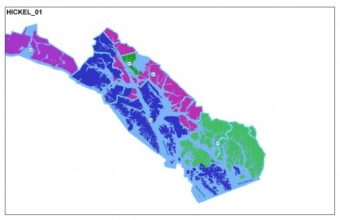
The latest district boundaries map for Southeast Alaska. Courtesy Ak Redistricting Board.
The latest reapportionment plan makes no changes to Southeast Alaska election districts. But it alters boundaries elsewhere in the state, which will likely be further changed because of federal requirements protecting minority voting strength.
The Alaska Redistricting Board released the plan Tuesday. And today (Wednesday), it considered a consultant’s report saying it would significantly reduce Alaska Native influence in one Interior House district and one western Senate district.
The plan responds to a recent state Supreme Court ruling saying the board put too much emphasis on protecting Native voting rights. The court said the board should have paid more attention to state constitutional requirements, which call for compact districts made up of similar communities.
Redistricting Board Executive Director Taylor Bickford says the controversy does not include Panhandle communities. (See the Southeast map.)
“There was an influence district that was built in Southeast. But the board never claimed and the court never found that the board’s drawing of an influence district in Southeast led to violations of the Alaska Constitution,” Bickford says.
Petersburg officials hoped for new boundaries closer to its current district, which includes Wrangell and Sitka. Those districts were reworked because of population shifts from Southeast and to Southcentral Alaska.
The new plan combines Petersburg, downtown Juneau, Douglas Island and Skagway. That angers Petersburg Mayor Al Dwyer.
“We don’t think that Juneau is similar in any way to Petersburg or a fishing community. It has a processor there, but it’s not considered a fishing community. It’s a tourist community and a government (community),” Dwyer says.
“I completely understand why people would be unhappy. And I think there are a lot of unhappy people around the state,” says Juneau Democratic Representative Beth Kerttula, who serves in the House district slated to include Petersburg.
“All I can say is wherever the district I’m in is I’d be honored to represent it and work hard to do a good job,” she says.
Petersburg sued to change last year’s reapportionment plan. Mayor Dwyer says the Supreme Court ruling provides another opportunity to challenge the redistricting board.
“We kind of knew that they would propose that again. But we’re against it and we’re going to oppose it,” Dwyer says.
He says Petersburg could return to court, depending on the cost.
Redistricting shrinks the region’s legislative delegation from eight to six. That means four lawmakers – two in the House and two in the Senate – will likely run against each other.
That puts one Southeast Native lawmaker – Angoon Democrat Albert Kookesh – at risk.
Kerttula worries the court-ordered change in the redistricting board’s focus – from voting rights to geography – could further isolate Alaska Natives.
“Whenever you start to redraw the lines you’ve got to have your eye on the fact that under the federal law we can’t dilute Native power,” Kerttula says.
One is a House district made up Interior villages. The other is a Senate district running from Yakutat to Kodiak and from Lime Village to Dillingham and out the Aleutians.
The redistricting board is scheduled to meet through Saturday. Executive Director Bickford says it should finish its work by then.
“We’re really just playing by ear at this point. We’re trying to do our due diligence, build the best plan we can and do it in a timely fashion,” Bickford says.
In Southeast, other district pairings put Sitka in a district with small cities and villages from Haines to Port Alexander. Ketchikan, Wrangell and northern Prince of Wales Island are in one district. And Juneau’s Mendenhall Valley and Auke Bay area remain on their own.
The latest reapportionment plan makes no changes to Southeast Alaska election district boundaries.
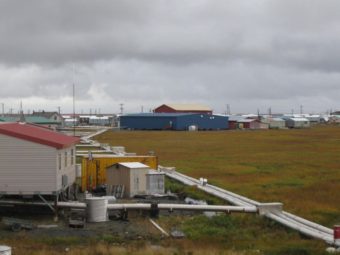
Quinhagak's sanitation system, part of the Village Safe Water Program. Photo courtesy CRW Engineering
A measure helping villages set up safe water and sewer systems is getting some attention in the Legislature.
The bill would create a task force that would collect information and look into simple systems that could work in rural communities. It would also come up with a list of the most-needed projects.
The measure passed out of the House Community and Regional Affairs Committee on Friday (March 23rd.) It’s a companion bill similar to one in the Senate sponsored by Angoon Democratic Senator Albert Kookesh.
“We’ve got numbers that show that there are 6,000 homes that are without water and sewer in rural Alaska. Nobody seems to be paying a lot of attention to them. So we’re concentrated on it and hopefully we can put that together and people will pay attention to that,” he says.
The Senate measure made it out of the chamber’s Community and Regional Affairs Committee around the beginning of March. Both bills next go to their chambers’ Finance Committees.
If passed, the nine-member task force would research water and sewer systems in other northern nations. It would also work with state and federal agencies to streamline regulations and fund programs that could speed development.
Fiscal notes estimate the task force would need about $100,000 for its one year of work.
A village corporation’s petition to manage a Chatham Strait fishery goes before the Federal Subsistence Board this week.
Kootznoowoo Incorporated says state-managed commercial fishing is hurting subsistence harvests near Angoon. It has petitioned the board to assert authority over waters near the west Admiralty Island community.

Ferry chief Mike Neussl listens as Cecile Elliott, aide to Rep. Bill Thomas, reads the legislative proclamation commending the Alaska Marine Highway System at this week's Southeast Conference meeting. Photo by Ed Schoenfeld.
The state’s Marine Transportation Advisory Board has added its voice to a legislative citation commending the Alaska Marine Highway System.
The citation came from the office of Representative Bill Thomas, a Haines Republican, and was approved by the House.
It was presented to ferry chief Mike Neussl during this week’s Southeast Conference meeting in Juneau.
Thomas aide Cecile Elliott read from the document.
“Every year, alert crews assisted those in trouble on land and sea. In 2011 there were at least three notable rescues that, without the assistance of the AMHS crew, could have meant the loss of life,” Elliott said.
In one case, the Malaspina rescued a hiker who had fallen off a cliff near Skagway. In another, the Fairweather helped a boat that lost power close to a reef near Hoonah. In the third, the Fairweather took a severely ill woman from a protected cove to Juneau.
The citation also praised ferry staff for helping sick or injured passengers.
Marine Transportation Advisory Board Chairman Robert Venables added his voice to the praise.
“We’re very, very pleased with the level of support that the Alaska Marine Highway System lends to not just the transportation side of things, but public safety. And we see that their efforts in the region have made a big impact,” Venables said.
Neussl accepted the citation of behalf of the ferry system and its employees.
The citation reads:
The members of the Twenty-Seventh Alaska State Legislature join with the traveling public and the citizens of Alaska in honoring the Alaska Marine Highway System (AMHS) employees. Every day these public servants are asked to deal with a unique set of circumstances, in a dynamic environment, and with ever changing variables. Whether aiding an ill passenger or responding to a mayday call, they are plying Alaska’s waters and are always ready to serve.
As part of their job qualifications, members of the AMHS team are expected to respond and assist with customer needs, respond calmly to any emergency while maintaining the confidence of the traveling public, perform strenuous work for extended periods on steel decks, and successfully perform all their duties despite high winds, heavy seas, and severe weather.
Crew members are trained as Emergency Trauma Technicians (ETT) and at the USCG designated Medical Person in Charge (MPIC) level providing valuable skills for the safety of the traveling public and fellow crew members by treating and stabilizing anything from heart attacks, broken bones, sprains, cuts, and burns to diabetic shock. In the event that a crew member or passenger is in need of a doctor and there is not one on board, crew has the training required to respond with the help of a doctor by phone. The Alaska Marine Highway System makes every effort to procure and maintain state of the art medical equipment and supplies in order to respond to any medical emergency they may encounter while at sea.
Alaska Marine Highway employees also deserve great accolades for their assistance in responding to emergencies of all kinds. Every year, alert crews assisted those in trouble on land and sea. In 2011 there were at least three notable rescues that, without the assistance of the AMHS crew, could have meant the loss of life. The following rescue efforts by AMHS vessels and crews were performed:
— The M/V Malaspina performed the beach rescue of a hiker who had fallen from a cliff near Skagway. Had the alert bow lookout not heard the calls for help the hiker may not have survived his cold water immersion and rocky shore trauma.
— The M/V Fairweather responded to a distress call from the F/V Whisker III that had lost power near Hanus Reef. The AMHS crew launched the fast rescue boat to safely attach the towline from another Good Samaritan boat so the Whisker III could be towed safely to Auke Bay.
— The M/V Fairweather responded to a call in Barlow Cove where a small boat was seeking shelter from high winds and stormy weather. A young woman aboard the vessel was having a severe asthma attack and was approaching hypothermia. The M/V Fairweather, underway in the area on an engine maintenance test, retrieved the ailing woman and transported her to Auke Bay where an emergency medical team was waiting.
It is with great appreciation and gratitude that the 27th Alaska State Legislature honors the Alaska Marine Highway System crew for their tireless efforts to serve Alaskans and travelers alike. They are an excellent example of the Alaskan spirit! Keep up the good work!
Close
Update notification options
Subscribe to notifications
Subscribe
Get notifications about news related to the topics you care about. You can unsubscribe anytime.