Ed Schoenfeld, CoastAlaska

Charters, longliners reach rockfish compromise

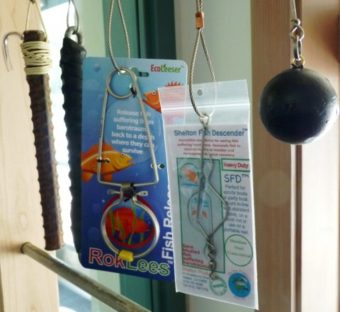
Fish descenders, or safe-release devices, are displayed at the Board of Fisheries meeting in Ketchikan. Photo by Ed Schoenfeld.

Guided fishermen will have to return deep-water rockfish to a safe depth under a plan approved this week by Alaska’s Board of Fisheries. The proposal is an unusual compromise between longliners and charter-boat operators.

Yelloweye live a couple hundred feet below the ocean’s surface. So the rockfish usually die when they’re reeled in – because of the difference in pressure.

That occurs when fishermen are over their limit and throw them back.

“It does happen relatively frequently, particularly with declining halibut stocks, there’s increased pressure on DSR resources,” says Heath Hilyard, executive director of the Southeast Alaska Guides Organization.

The group, called SEAGO, represents about 40 regional charter-boat operators.

DSR is short for demersal shelf rockfish, a group of near-shore bottom-dwellers.  Yelloweye are the most sought. They’re sometimes called Pacific red snapper or red rock cod.

Yelloweye rockfish. ADF&G photo.

A variety of devices can be used to return the rockfish safely. The most basic are weighted milk crates.

“Essentially, they are put in the crates upside down, dropped and then they pull the line back up and the fish can swim away at depth, increasing survivability,” he says. “There’s reverse hooks and a variety of different mechanisms that can be used. Ultimately, you bring the fish back down to a reasonable depth to where they can survive and then pull back the line.”

He says up to 90 percent of caught rockfish survive when quickly returned to deep waters. Only about 10 percent make it when released on the surface.

The Board of Fisheries considered several yelloweye proposals at its Ketchikan meeting.

One, from the charter group, would have increased the sport allocation at the expense of the commercial sector. It was unanimously voted down.

A closeup of EcoLeeser, one brand of fish-release device.

Two others, one from the guides group and the other from Sitka’s board advisory committee, required safe, deep rockfish release.

The approved measure was a compromise among charter and commercial interests.

The conflict came before the fish board about half-a-dozen years ago.

“And at that time the board told both of us to figure out a way to live within your allocation,” says Linda Behnken, executive director of the Alaska Longline Fishermen’s Association, known as ALFA.

She says commercial fishermen put together a conservation network. It began mapping the seafloor, identifying where the accidental yelloweye harvests are high.

“Fishermen are moving their gear out of the high bycatch areas. We saw a 20 percent reduction in the bycatch rate of the fishermen participating in this network. The commercial fleet has not been over its allocation in the last six years,” she says.

She says her group was unhappy charter operators wanted to increase their take after several years of exceeded allocations.

Despite many battles over halibut, longliners and charter groups worked together on the compromise that was passed.

Behnken says the plan originally included individual sport fishermen. But that changed on the advice of Department of Fish and Game staff.

“They suggested we make it charter-only because of the implications of educating every sport angler about having to have one of these devices and release at depth. Then we both signed on,” she says.

Longliners mostly target halibut, not yelloweye, so their harvest is bycatch they’re allowed to keep, within limits.

But the guide organization’s Hilyard says more charters are chasing the rockfish.

“It’s not a species that a lot of our guys go out of their way to target. But it’s a natural bycatch for halibut. And with halibut declining, there’s increased pressure because it’s an additional species that clients can catch,” he says.

The safe-release requirement goes into effect next year. Hillyard calls it a key conservation measure.

See a video of how a fish descender works.

Read or hear related reports:

Sides in herring debate take case to Board of Fish

Board allows Jensen to vote on herring issues

Fish board OKs some Sitka herring changes


Fisheries board keeps powered reels legal

Fisheries Board members Mike Smith of Fairbanks, Tom Kluberton of Talkeetna and Vince Webster of King Salmon discuss proposals during a break. Photo by Ed Schoenfeld.

The state Board of Fisheries today (Tuesday) decided to continue allowing sport anglers to use electric reels. The panel voted down a proposal prohibiting power-assisted reels, except for disabled sport fishermen.

Power-assisted devices have been controversial since they came on the market.

Supporters say it’s just one more piece of gear in an ever-expanding toolbox. Opponents say it’s too easy, and gives too much access to commercial black cod stocks.

Current rules limit the size and weight of powered gear, but not who can use it. The proposal would have limited use in Southeast Alaska to people with disabilities.

Author Steve Merritt, president of the Alaska Trollers Association, testified power-assisted reels are taking the sport out of sport fishing.

“I mean it also on the principal of fair chase. We have rules for no night scopes, spotlighting deer, all involving electricity. That’s not really considered fair chase,” he said.

Some sport fishermen use electric reels to target black cod, which are also called sablefish. The deep-water dwellers can be hard to catch without power assistance.

A Penn 50 Motor Drive electric reel, one of many targeting the sport-fishing market. Photo courtesy Dolphin Electreel.

Larry Edfelt spoke on behalf of Juneau-based Territorial Sportsmen.

“Outlawing electric reels would close the black cod fishery in Juneau and the northern Chatham area. We fish in 1,500 to 2,000 feet of water there. It takes 10 minutes just to get the bait down,” Edfelt said.

Guided fishermen also use the devices. Richard Yamada of the Alaska Charter Association testified the plan is the wrong way to approach the issue.

“I think this proposal was a go-around to just restrict, to try to control harvest of sablefish. And I think the appropriate way is bag limits,” Yamada said.

Board of Fisheries members voted 6-1 against the proposal. Petersburg’s John Jensen was the only one in support.

Member Sue Jeffrey of Kodiak said it’s a social issue.

“I liken this to a debate in Kodiak about whether we should allow people to hike up a mountain on 4 wheeler versus on foot. The outdoors is for all users and for some people, just getting out in a boat on the water is sporting enough,” Jeffrey said.

Representatives of local Board of Fisheries advisory committees voiced support for the proposal.

Department of Fish and Game staff said the best way to reduce power-reel use would be to ban it all together. They said existing rules could allow disabled people to use the devices.

The proposal was among 145 before the board. Deliberations continue through Sunday.

Listen to the meeting online: Scroll down to Live Media Audio to find the player.

Read proposals and a wrap-up of action: Click on Southeast and Yakutat Finfish – February 24-March 4, 2012, and look for Proposals or Summary of Actions.

Read or hear related reports:

Sides in herring debate take case to Board of Fish

Board allows Jensen to vote on herring issues


Fisheries board takes up Southeast allocation issues

The Alaska Board of Fisheries addresses Southeast finfish issues starting on Friday (Feb. 24).

Members will consider 145 proposals from advisory boards, gear groups and individuals.

They range from Sitka’s sac roe herring harvest to Juneau’s Taku River king sport fishery to changes in seine boat size limits.

The meeting lasts 10 days.

Fish and Game boards director Monica Wellard says much of the first few days will be taken up by public testimony.

“They’ll be allowed that particular time frame to talk about the proposals they’re for or against. And then there’s also the written comments they can provide, put it all in writing and submit that during the meeting so their comments can be heard,” she says.

Other proposals involve sport fishing for fresh water kings, rules for reporting catches, and listing Haines’ Luta Inlet as a subsistence management area.

The board of fisheries is meeting at Ketchikan’s Ted Ferry Civic Center.

Audio will be streamed via the board’s website. The link is on our website.


Federal budget cuts could target Native programs

AFN President Julie Kitka addresses the Feb. 22 Native Issues Forum in Juneau. Photo by Ed Schoenfeld.

Alaska Federation of Natives President Julie Kitka warns that the continuing federal budget battle could impact essential services.

But she says it’s hard to tell where the ax will fall.
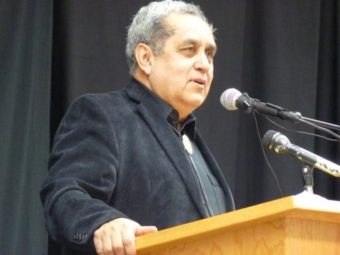
“We could see programs that we have spent decades building up and working and just will disappear in the budget acts as they deal with those federal deficits,” she said.

She told those attending Juneau’s Native Issues Forum on Wednesday, Feb. 22, to be ready for a last-minute call-to-action if major programs face significant cuts.

At the same time, Kitka expressed optimism about Native Americans’ chances in the coming year.

She pointed to an upcoming conference in Washington, D.C., cosponsored by the Center for American Progress. The think-tank is closely tied to the Obama administration.

“It’s one of those opportunities (where) you make of it what you can. It may turn out to economic development issues that could pop out of this and get done. It could be renewable energy. It could be regulatory changes or a whole array of things,” she said.

Kitka said the conference is a major focus for AFN during the last year of the Obama administration’s first term.

Watch Kitka and Sen. Albert Kookesh address the Native Issues Forum on GavelAlaska TV archives.

Senator calls for permanent fund, scholarship changes

Sen. Albert Kookesh addresses the Feb. 22 Native Issues Forum. Photo by Ed Schoenfeld.

The senator representing Alaska’s largest legislative district is suggesting major changes to the state’s Permanent Fund and the governor’s scholarship program.

Albert Kookesh, an Angoon Democrat, spoke during the Native Issues Forum in Juneau today (Feb. 22). Kookesh, who could be serving his final term, speculated on what he would do if he was king for a day.

He said the $41 billion Permanent Fund should be divided into three accounts.

One, starting with $20 billion, would fund annual dividends. The second, with half of what’s left, would become an education endowment. The third would use what remains to form an energy and transportation endowment.

“I’m not the king for the day. But that’s something I wish we could do and I wish people would think about it. And I’d take that whole thing to a vote of the people. Tell me what you think. We could take 20 billion dollars and give you a permanent fund check for the rest of your life and guarantee it,” he said.

Kookesh also said he would change Governor Sean Parnell’s scholarship program.

He said it helps very few rural students, who attend schools with few, if any, specialized staff. He said he told Parnell he would instead put the money into the Head Start preschool program.

“And I said ‘Governor, we don’t need the money on this end of the spectrum for scholars. We need it on the other end of the spectrum for students who are just starting out so they have good beginnings’,” he said.

Kookesh represents more than 125 villages and small cities in Southeast, Prince William Sound and the Interior.

He’s in his 16th year in the Legislature.

He faces an uphill re-election battle, because reapportionment left him in a Southeast-only district with about a quarter of his current constituents. That puts him up against Sitka Republican Bert Stedman, who will retain about three quarters of his current Senate district.

Kookesh also co-chairs the Alaska Federation of Natives and chairs the Sealaska Corp. board of directors.

Watch Kookesh and AFN President Julie Kitka address the Native Issues Forum on GavelAlaska TV archives.

Wood-pellet heat systems pitched to lawmakers

Backers of biomass energy pitched wood-pellet heat as a money-saver during a legislative hearing today (Feb. 21st).

Alaska Energy Authority staff and others talked to the House Committee on Economic Development about the Southeast Alaska Integrated Resource Plan. The document recommends developing more pellet and other wood heat, as well as some expanded hydroelectric generation.

AEA Biomass Program Manager Devany Plentovich said high fuel prices have driven many residents to heat with electricity instead of oil.

“Unfortunately, as we’ve switched so much to the space heating, we’ve seen the reserve hydro just disappear to a remarkable rate. It’s at the point where our utilities are having to supplement the hydro during the winter season with diesel generation. And that’s very high-cost diesel generation,” she said.

Southeast lawmakers and other officials have called for more hydroprojects with more connections to more communities.

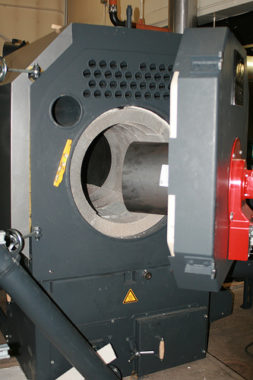
Sealaska Corp.'s wood-pellet boiler. Photo by the Alaska Center for Energy and Power - UAF.

But the resource plan calls for a larger focus on wood heat, in businesses, offices and schools. And some are already making the switch.

Plentovich said wood-pellet heat costs less than oil-powered systems, and has about the same price tag as electric ones. And, she said, boiler conversions are short-term investments.

The Sealaska building, that’s going to pay back in about four and a half years. The Kake school, if that gets funded through the renewable energy fund, that’s got about a six- to seven-year payback. The Coast Guard in Sitka is looking at about a five-year payback. So these projects have a great economic story,” she said.

Energy authority staff said pellets would be a better deal if a large manufacturing plant opened in Southeast. Now, most are shipped in from British Columbia.

Ketchikan’s Tongass Forest Enterprises just began operating a pellet plant in Ward Cove. It’s selling to local boilers, but not homes.

Several Prince of Wales Island groups have had less success. One, Alaska Mills LLC, shelved plans due to a high investment risk. Another, involving small mill owners, has not been able to find financing.

AEA Project Manager Jim Strandberg said low timber harvests are a barrier to regional pellet production.

“One of the major issues in Southeast Alaska is the ability to harvest timber. Since much of the land here is owned by the U.S. Forest Service, access will be a key driver in the ability to develop local industries,” he said.

Many of those involved in biomass say the wood for pellets would come from mill waste and logging leftovers. Other woody biomass includes chips, briquettes and traditional firewood.

The regional energy plan drew criticism at a House Resources Committee hearing earlier this month. Some speakers wanted stronger support for new hydroelectric development and a larger power grid.

Authors say it realistically considered the needs of a region where little population growth is expected.

Site notifications
Update notification options
Subscribe to notifications