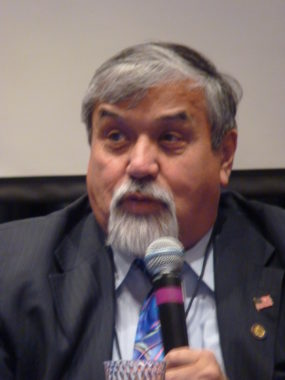
Ed Schoenfeld, CoastAlaska

Native groups oppose expanded otter pelt sales

Several Alaska Native organizations oppose a legislative effort to increase sea otter harvests. But they support efforts to get Alaskans more involved in federal management of the once-rare marine mammals.

The voracious marine mammals are expanding in number and range in Southeast and some other coastal areas. Crabbers and divers say otters are decimating populations of crab and other shellfish they gather for commercial or subsistence use.

Alaska Natives are allowed to hunt otters, but face strict federal limits on how they are used. Full pelts can be sold to other Natives. Traditional products, such as clothing or regalia, can be sold to anyone.

Sea otters near Sitka. Photo by Nathan W/Creative Commons

Representative Peggy Wilson, a Wrangell Republican, authored the legislative resolution asking federal authorities to work with state and Native leaders to allow more hunts.

“We’re hoping that the Natives can do what they traditionally have done for years. And they can be able to harvest (otters), use their skins to make other things so that they can make money. If we just keep it to them, we’re not going to overharvest by any means of the imagination,” Wilson says.

Wilson’s resolution would allow whole pelts to be sold to non-Natives, which is now illegal. She recently told the House Resources Committee that would boost harvests and lessen impacts on fisheries.

Tlingit-Haida Central Council President Ed Thomas says that could create problems.

“The biggest threat is that if we were allowed to sell those pelts unaltered, you could pretty much guess, if you look down here on South Franklin (Juneau’s tourist district), that they would come back as ‘authentic’ Native crafts made in Taiwan,” Thomas says.

Thomas supports other parts of the resolution calling for a new federal management plan that increases otter harvests.

So does Rosita Worl, who spoke on behalf of the Alaska Federation of Natives, Sealaska Corporation and the Sealaska Heritage Institute.

Sealaska and tribal governments in Sitka and Petersburg are among those trying to expand pelt processing. Worl says they’re providing training and equipment needed to support a growing cottage industry.

“We see sea otters as just one answer to trying to promote sustainable economies in our communities,” Worl says.

She says the current law is interpreted too narrowly. She wants Native craftspeople to be able to make and sell a wider variety of otter products, such as teddy bears.

“We’ve had a number of our people that have been cited. We’ve complained vigorously about the enforcement practices. We’ve advanced the ideas of co-management. But our idea was to really change the marine mammal law that would allow for the sale of contemporary items,” she says.

House Joint Resolution 26, Wilson’s measure, was introduced last year. Its first hearing was February 3rd in the House Resources Committee. It remains before that panel.

If passed, it will be sent to Alaska’s Congressional delegation and the Secretary of the federal Department of the Interior.

Veterans’ job measure passes House, Senate

Alaska’s House and Senate have passed bills aimed at easing veterans’ chances of getting jobs.

The measures direct the state to consider military training and experience when granting professional licenses. Alaska licenses about 40 professions, from barbers to contractors to nurses.

House sponsor Bill Thomas, a Haines Republican, says about 1,200 Alaska-based service-members leave the military every year. And the unemployment rate among young veterans is about 22 percent.

Haines Rep. Bill Thomas.

“Many have already received quality training through the military. I use an example of mechanics who have the ability to perform the duties and then have to go through the process of being certified at the local level. The other one is a plumber who’s been in the Navy for 20 years,” Thomas says.

“There’s no reason for them to come back and start over again. It’s a way to help them come out, get a job and go forward,” he says.

The bills also tell officials to grant temporary, six-month, professional licenses to qualified veterans. They also direct the University of Alaska to consider military training and experience as credit toward degrees.

House Bill 282 passed without opposition February 1st.

A similar measure, Senate Bill 150, passed the Senate 19-1 the same day.

Anchorage Sen. Bill Wielechowski.

Senate sponsor Bill Wielechowski, an Anchorage Democrat, says the measure recognizes veterans’ knowledge.

“There’s no special treatment here. What this bill does is it eliminates the need for duplicative education, classes and training. These service-members have already received this training,” Wielechowski says. “They’ve already received this education. This will help them more quickly integrate and it’s very likely to lower the unemployment rate for veterans.”

The two bills are very similar. But they have some differences, such as timing and cost. That means the House will have to approve the Senate’s version, or the other way around.

Thomas’ House bill has been assigned to one Senate committee, indicating it may be the most likely to pass both chambers first. Most senators have signed on as co-sponsors.

Will the Costa wreck hurt Alaska’s cruise industry?

The Costa Concordia partially submerged after hitting a reef. Photo by Roberto Vongher/Wikimedia Commons.

You’ve probably heard that cruise-ship bookings took a dive after the Costa Concordia hit a reef and partially sunk. But are travelers avoiding cruising or just delaying ticket purchases? And what does it mean for Alaska tourism?
The Carnival Corporation is the Costa Concordia’s owner. Carnival and its subsidiary lines will sail about 11 ships through Alaska waters this summer.

The corporation this month reported an almost 15-percent drop in worldwide bookings after the vessel struck a reef off Italy. The January 13th incident killed at least 30 people and badly damaged the ship.

But how will this tragedy halfway around the world affect cruise ship traffic here?

“I think Alaska is going to have a very good year,” says Stuart Chiron, a Miami-based industry analyst and cruise broker. He operates a website called “The Cruise Guy” that follows industry developments around the world.

Chiron says the sales dip won’t last – and may not hurt Alaska at all.

“There’s a lot of people who are on a wait-and-see type of scenario. But bookings as of now are looking very strong for Alaska. And there could be definitely some pickup if there are any hiccups on the international front, in the Middle East as well as in the Mediterranean,” he says.

(Read about the Prinsendam, which burned and sunk in the Gulf of Alaska. )

(Read about more recent cruise ship groundings and sinkings.)

Past crises, such as the 9/11 attacks, inspired American and Canadian cruisers to traveler closer to home.

Alaska Cruise Association President John Binkley says that might be the case this time too.

The Sapphire Princess docks in Ketchikan. Photo by Ed Schoenfeld.

“There could be a feeling by the consumer that cruises in the U.S. that are under the jurisdiction of the United States Coast Guard are inherently more safe than those abroad. I don’t know that but there’s that possibility,” Binkley says.

Alaska’s cruise-ship capacity will grow to about 950,000 passengers in the upcoming season. And even if bookings drop, he says the lines know how to bring them back up again.

“If they have to, then they will just discount the pricing until they fill those berths. So it shouldn’t have an effect on the overall number of people coming up to Alaska on cruise ships. It could have an effect, though, on the amount of earnings that the companies get from those different berths coming up to Alaska,” he says.

When berths are cheap, the lines still make money by selling drinks, spa time and shore-based excursions.

Industry analyst Chiron says his information shows the bookings drop is largely over. In the meantime, lines such as Carnival and Princess are offering attractive deals highlighting other destinations.

“I can tell you that bookings did pick up very nicely. And we’ve also seen cruise lines begin to push Europe, Alaska and Caribbean summer sailings,” he says.

But the shipwreck’s timing could not have been worse. Binkley says many people book Alaska cruises in January or February.

Watch a video of the partially sunken Costa Concordia from RT media.

Budget bill boosts logging

The most recent Interior Department appropriations bill includes provisions aimed at helping Alaska’s struggling timber industry. But one group says they go too far.
Budget bills often attract extra provisions that might not gain the attention needed to pass on their own.

That was the case for the most recent federal Department of Interior appropriations measure, signed in December by President Barack Obama.

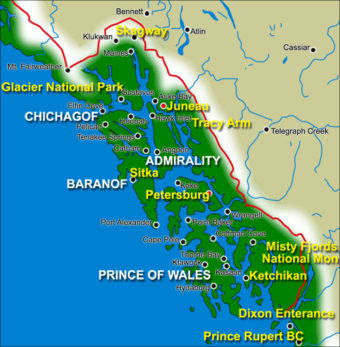
Senator Lisa Murkowski inserted four items targeting logging in Southeast’s Tongass National Forest. They also apply to Southcentral’s Chugach National Forest.

Robert Dillon, Murkowski’s Energy and Natural Resources Committee spokesman, says one provision changes the appeals process for timber sales and other projects.

“It says, ‘Listen, before we give you the permit, before you finalize the process, let’s go ahead and do any appeals and take care of it just to streamline it a bit’,” he says.

“We see that to be very consistent with our intentions of taking a more collaborative approach to forest management, “ says Alaska Regional Forester Beth Pendleton.

A Southeast Alaska logging site. Photo by Ed Schoenfeld.

She says the measure makes official what’s already being done.

“And I think it will increase the likelihood of resolving concerns and then resulting in a better, more informed decision in the long run,” she says.

The Southeast Alaska Conservation Council, a group that’s filed many formal objections, doesn’t like the provision. Bob Claus is SEACC’s forest program director.

“On the face of it, it doesn’t make sense that an appeal would happen before final approval. It happens after. That’s why they call it an appeal,” Claus says.

Another part of the appropriations bill aims to make it easier to sell red cedar, which is less common in the Tongass than hemlock or spruce.

SEACC doesn’t like that provision either.

“The Alaska red cedar export doesn’t do anything to help high-value-added industry in Southeast Alaska, which is where we think we ought to be capturing the value from the trees that are harvested her,” Claus says.

“It’s correct in that it does provide some authority for the export,” says the Forest Service’s Pendleton.

But she says that’s not the only priority.

“After that, that first right to process and mill goes to our local Alaska mills and our West Coast mills,” she says.

Another provision exempts logging road construction runoff from Environmental Protection Agency review. Pendleton and Murkowski spokesman Dillon say it just continues what’s been done for 30 years.

But SEACC’s Claus says it ignores an opportunity to protect clean water.

“There’s been a history of bad construction practice of roads. And this seems to continue that, which we would object to,” he says.

The final provision continues waiving a requirement that the Forest Service review management plans every 15 years.

Pendleton says it could impact decisions elsewhere, but not here.

“All of our plans, for the Tongass and the Chugach National Forest, are current in Alaska at this time,” she says.

Murkowski, in a press release, says the provisions are particularly important, since the Interior Department owns about two-thirds of Alaska’s lands.

Dillon, her spokesman, says the add-ons should help what was once one of Southeast’s main economic engines.

“We don’t want timber harvests and other activity to be stopped because of bureaucratic processes. So these provisions kind of fix loopholes and keep things going forward,”  he says.

Pendleton says the Forest Service has no objections.

“These provisions in the Interior appropriations bill, I find them all to be helpful. There’s really nothing in the appropriations bill for Alaska that’s really upsetting or of really any major concern,” she says.

But Claus, of SEACC, thinks it’s the wrong way to bring about change.

“Tacking things onto appropriations bills is not the best to make public policy,” he says.

The Forest Service says the provisions mesh with new rules for forest management plans.

Other Alaska items in the appropriations measure cover Native health programs and facilities, rural water system improvements and the Alaska Volcano Observatory.

Celebration 2012 embraces Native art

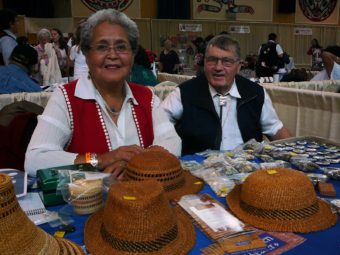
Merle Anderson and her husband sell Haida arts and crafts at the 2010 Celebration Artists Market. Photo by Ed Schoenfeld.

This year’s Celebration Native cultural event will have an added focus on art.
Celebration 2012 is set for June 7th through the 9th at Juneau’s Centennial Hall. It’s organized by the Sealaska Heritage Institute, the cultural arm of the regional Native corporation of the same name. This year’s theme is “Strengthen Yourself.”

The event will include dozens of dance groups, most from Southeast Alaska, plus traditional food contests and lectures.

Institute President Rosita Worl says organizers have been looking for new ways to promote traditional and contemporary Alaska Native art.

“We are going to have a Native artists’ gathering on Wednesday opening up celebration. And at the close of the day, we’ll have the jurried art show,” Worl says.

Celebration always includes an artists’ market. Worl says this year, it will have a new outdoor venue to allow for more displays.

“We’re planning to have it right here on our parking lot. And we own the lot across the street where we’re going to be building our Sealaska Heritage Center. So we’re going to be seeing if we can have dancing there. It will become more visible right here in the center of town,” she says.

More information is on the Institute’s website. That includes applications for dance groups, which are due by March 2nd.

Hear earlier reports:

Celebration 2010 features soapberry contest.

Taste-testing black seaweed

Watch a video of the soapberry contest from Kathy Dye of Sealaska Heritage Institute.


New rule means little immediate change for the Tongass

New planning rules for national forests will have little immediate impact on Southeast Alaska. But they could mean some changes for Southcentral forest lands.

Federal Agriculture Secretary Tom Vilsack today released an environmental impact statement needed to finalize the rules. They call for stronger protections for forests, water and wildlife, while supporting rural economies.

Alaska Regional Forester Beth Pendleton says the rules describe the type of restoration and watershed protection already underway in Southeast’s Tongass.

“The new real strength of this planning rule is that focus on collaborations and utilization of best science in that revision process,” she says.

The Tongass National Forest

The rules spell out priorities for forest management plans.

Pendleton says the Tongass plan is not due for a full-scale update until 2018. But Southcentral’s Chugach will be revised in the next two or three years.

“We will be doing that under a new, more modern planning rule that I believe is going to better reflect science, public values and knowledge on how to create and implement more effective land management plans,” she says.

The rules also say the plans should address climate change’s impacts on the forests.

Agriculture Secretary Vilsack, who oversees the national forest system, says the new rules should help nearby towns and cities.

“We know these communities rely on the forest for jobs, clean air and clean water. We believe that this framework will take their concerns into consideration. We also believe that if an amendment or a change is required, it will take less time and less money to accomplish that change than under previous efforts,” he says.

The Agriculture Department oversees 193 million acres of forest nationwide. Southeast’s Tongass has about 17 million acres and Southcentral’s Chugach has about 5.5 million acres.

Link to plan information.

Watch a video on the rules by U.S. Forest Service Chief Tom Tidwell.

Site notifications
Update notification options
Subscribe to notifications