Ed Schoenfeld, CoastAlaska

Southeast cruise line plans 2012 expansion

Sitka’s home-grown cruise company has wrapped up its first season. And it’s already planning to expand, with sailings to southern Southeast starting next year. Several other small lines also plan to increase capacity in 2012.

Allen Marine has offered whale-watching and other day tours for years. They’ve been popular with independent and cruise-ship tourists stopping in the company’s hometown of Sitka, as well as ports in Ketchikan and Juneau.

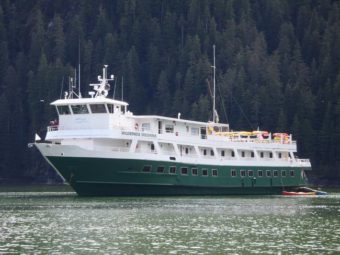
Last year, the company announced plans to expand into the small cruise market with a new brand, Alaskan Dream. It readied the 78-passenger Admiralty Dream for week-long roundtrips based out of Sitka.

Vice President Michael Wein says the season started slow.

“By the time we got everything up and running as far as marketing, our May had some very light loads. But every consecutive month we’ve had an increase in bookings and we’re sailing the month of August with very impressive loads,” he says.

A second ship, the 46-passenger Alaskan Dream, was brought into service when needed.

The company is expanding its itineraries in hopes of filling both ships next season. It will add one-way cruises between Juneau and Sitka. And it will begin sailing to Ketchikan.

“We’ll be offering two departure dates of an 11-day cruise that goes from Sitka to Ketchikan. And that’s a complete Southeast Explorer itinerary which has Glacier Bay, Skagway, Haines, Juneau, Petersburg, Wrangell, and of course Hobart Bay and Tracy Arm.”

Alaskan Dream offers the only cruises stopping in Hobart Bay, on the mainland between Juneau and Petersburg. The site, owned by Juneau Native corporation Goldbelt, offers kayaking, ATVs and small, powered inflatable boats.

The Sitka-based company is one of several offering up-close, small-ship voyages in Southeast Alaska. Wein says the difference is in the staff and approach.

“We’ve used the philosophy, which we’re very proud of, is ‘True Alaska with True Alaskans.’ The program we offer shows a complete history of Alaska and what life is like up here in Alaska 12 months out of the year versus just a couple months out of the year,” he says.

Alaskan Dream Cruises is among several small-ship companies expanding Inside Passage sailings next summer. InnerSea Discoveries, American Safari and American Cruise Lines will also increase offerings.

They’re, in part, filling a gap left when small-ship pioneer Cruise West went out of business about a year ago

“I think the cruise industry and the small-ship cruise industry in Southeast is really starting to see a rejuvenation of sorts,” says Hunter McIntosh, chief operating officer of The Boat Company, which sails between Sitka and Juneau.

McIntosh says its two boats, which carry up to a total of 44 passengers, ran at 90 percent occupancy this year. He calls that “phenomenal.”

“I think what’s happening is people are realizing that while our economy is down, and while things are difficult, people still want to take vacations. They still want to be able to relax and they still want to be able to enjoy small ship cruising,” he says.

The nonprofit company does not plan to add vessels or itineraries next season. But McIntosh says it will increase the number of guest-hosted tours. This season saw environmental activist and TV documentary producer Philippe Cousteau.

“We’d like to do more of those types of trips with Robert Glenn Ketchum, who is an Ansel Adams-award-winning photographer, and with one of our business partners, Orvis, bringing fly-fishing guides up. That is the sort of direction that we’re taking,” he says.

Both lines target the upper end of the cruise market. Alaskan Dream charges $1,500 to $7,000 per passenger, depending on trip length and cabin size. The Boat Company fares run up to $10,000.

Read or hear: Small cruise lines send more ships to Alaska

Groups celebrate stream restoration

Government and nonprofit groups gathered on Prince of Wales Island recently to celebrate a pair of restoration projects.

The Nature Conservancy, Trout Unlimited and the U.S. Forest Service worked together on the Harris River and Fubar Creek. Both were damaged by logging in past decades.

Randy Hagenstein of The Nature Conservancy says loggers removed fallen trees from waterways, which changed habitat and flow.

“By going into these streams and engineering logs and logjams, we accomplish a number of goals to change it back to what would have been a more natural condition. And that improves the habitat for salmon and steelhead and other resident fish,” he says.

The work also included new trails and recreation areas. Fubar Creek was also given a Haida name, Gandláay Háanaa, which translates as Beautiful Stream or River. Roads were also improved, culverts were unblocked and second-growth forest areas were thinned.

Forest Service officials stressed the importance of the collaborative nature of the projects.

Hagenstein says his group helped raise funds, handle contracts and gain needed permits.

“The fourth role is to do some of the follow-up monitoring to make sure that the results that we hope to get from the project are realized,” he says.

The celebration was held August 25th in Craig.

The restoration work has its critics.

“The Harris River Restoration Project is a good example of taxpayer dollars being wasted on a phony stream restoration project,” writes timber advocate George Woodbury in a commentary published by the Juneau Empire. “The truth — the sedimentation in the river is natural.”

“Large amounts of sediment have been washing out of the surrounding hillsides since the last ice-age,” he writes.

Sitka students head to Kodiak for cultural exchange

A group of students from Sitka are in Kodiak this week for the second half of an exchange with the Woody Island tribe. Like many exchange programs, this one aims to foster better understanding between two cultures. But it also could help preserve traditions lost to either side, and foster healing between two cultures with a difficult history.

A group of students is walking down the trail at Sitka National Historical Park, learning about the totem poles that line it. They’re preparing for a visit to Kodiak, as part of a cultural exchange program run by the park.

Becky Latanich is chief of interpretation and education at the park. She says sending the Tlingit youth to Kodiak is the second half of the exchange program, which began last summer.

“The first year when they came over the Kodiak people, who are Alutiiq or Aleut or Sugpiaq, came here to learn about a series of dances called the Aleut series or the Alutiiq series that, over a period of time, was lost to them, but preserved in the Tlingit culture,” Latanich said.

This year, the Tlingit students will learn more about their relationship with Kodiak. Latanich says there are some Tlingit sites in Kodiak, and the trip will offer a way for them to learn about that history.

She says all of it – the history and the dancing – is an effective way to preserve and further Native culture and tradition.

“What’s so neat is the youth involvement in the dance, because it’s the youth who are performing the dance,” Latanich said. “It’s not just something that’s locked away in the elders’ memories. It’s something that they practice, that the dancers are engaged in. We just had an evening program last Thursday where the students performed the Aleut series for their practice. More than anything you could tell that they enjoyed doing it; it was really fun. I hope they bring not just the tradition back to Kodiak but that they bring back that sense of excitement and engagement with culture back to Kodiak as well.”

Latanich says it’s one thing for the students to learn about cultural traditions. But immersing in those traditions is another thing entirely, she says.

“It’s not something you read about in a book,” she said. “It’s something that’s real and continues to exist. And it gets them excited about their past, and about the present.”

The trip is funded with a $15,000 grant from a program called “America’s Best Ideas.”

“And I think this is a very good idea,” said Kathy Drabek, tribal administrator of the Woody Island Tribal Council, which represents the Tangirnaq Native Village.

She says the visit to Kodiak will include dinners and tours, but also a healing ceremony Friday on Afognak Island, which was the site of a battle between the Tlingit and the Alutiiq people. Drabek says the majority of Tlingits were killed in the battle.

“Cries can still be heard in that location,” she said. “We’re hoping that any animosity and spiritual disruption would be forgiven with the apology ceremony and prayers.”

Drabek says giving students and elders the opportunity to engage in that kind of cultural sharing is hugely important.

“The analysis of what about history matters to an individual culture, and the similarities of different cultures interacting – I just think that’s productive for any society,” Drabek said.

16-year-old Sitka resident Sabrina Gamble was part of the program last year. She says it was tough going at first, but that a transformation took place during the visit.

“At first, everyone was just kind of ‘I don’t know what I’m doing here, I don’t want to be here.’ But by the end, all of them didn’t want to leave, because we all connected so well, and they were learning so much,” she said. “It seemed like they wanted to keep on learning more about what we were teaching them.”

Gamble says she hopes to have similar feelings on this trip to Kodiak.

“While they were here we didn’t get to learn anything about their songs,” she said. “They performed, but I think it would be nice to actually have them teach their songs.”

The students will keep journals during their trip. Sitka National Historical Park has created a Facebook page, where the students will share their observations.

Pilots awarded for saving damaged jet

Two Alaska Airlines pilots are being recognized for safely handling a jet last year after one of its engines exploded while taking off from Sitka.

Captain Steve Cleary and First Officer Michael Hendrix won the Superior Airmanship Award from the Air Line Pilots Association Aug. 18th.

Cleary and Hendrix were at the Boeing 737’s controls on August 8th, 2010.

Association spokeswoman Jennifer Sutton says there was little room for error at Sitka’s island airport, with ocean waters at the end of the runway.

“As they stared to accelerate down the runway, they hit about 100 knots. And they saw an eagle flash past the plane, directly in the path ahead. Just mere seconds later, when they hit about 130 knots, which is about 150 miles an hour, the eagle smashed into the left engine, causing the engine to explode and burst into flames,” she says.

With one engine gone and one

going full throttle, the pilots struggled to maintain control. But they were able to stop the jet before it veered off the runway or went into the water.

“The really amazing thing here is that while this could have had a tragic ending, the procedures they took that day and the clear, swift-thinking action resulted in an event where there were no injuries to any of the 134 passengers or five crew members on board,” she says.

The pilots were not available for immediate comment.

The $7 million engine had to be replaced. A jet sent to pick up stranded passengers also struck and killed an eagle on takeoff. That plane was not damaged and the flight continued.

Only one other crew received the annual award from the association, the world’s largest pilots union. It was presented at the 57th Air Safety Forum Awards Banquet in Washington, D.C.

Association President Capt. Lee Moak, pilot Steve Cleary, and first officer Michael Hendrix. (Photo by ALPA)

Small cruise lines send more ships to Alaska

A pair of small, high-end cruise lines are expanding their Alaska fleets. The Seattle-based companies are filling some of the void left when Cruise West went out of business about a year ago.

InnerSea Discoveries already sails two small ships between Juneau and Ketchikan. Sister company American Safari sails three luxury yachts from Juneau to Glacier Bay and other locations.

Both plan to expand Alaska sailings to capture an increasing American market.

“A lot of people are choosing to stay home and not travel over to Europe where, of course, the dollar is not doing so well,” says Tim Jacox, executive vice president of sales and marketing for the lines.

He says the exchange rate is also making Alaska more attractive to foreign travelers: “So you’re going to see more international visitors. We had a banner year this year, and we expect the same next year, from especially the Australia-New Zealand markets.”

The InnerSea Discoveries ship Wilderness Discoverer sails Southeast waters. (Photo courtesy InnerSea Discoveries.)

He also says the growth is helped by the great deal the companies got on out-of-use Cruise West vessels. The longtime small-ship line ended its business last August.

InnerSea Discoveries recently announced it will add the 76-passenger Wilderness Explorer to its Alaska roster next summer. Week-long trips between Sitka and Juneau will include Glacier Bay and other remote areas.

The ship used to sail Southeast as Cruise West’s 86-berth Spirit of Discovery. Jacox says it’s being renovated to be less crowded and provide more amenities.

“We’ll go ahead and change out the lounge with more of a 1940s National Park Service lodge motif. It’ll be a pub-like atmosphere for sharing stories of all the events of the day. So we’ll install 10 microbrew taps to make that happen,” Jaycox says.

Fares will range from $3,000 to $6,000 for seven-day trips.

American Safari, the InnerSea’s higher-end brand, has acquired Cruise West’s 102-passenger Spirit of Endeavour. It’s now called the Safari Endeavour and is being reconfigured to handle 86 passengers. It will sail from Juneau to Glacier Bay, Endicott Arm and Icy Strait.

Jacox says eight berths are being turned into four two-room suites, with outside balconies. The company will also add massage rooms and hot tubs.

“And then with the additional space we will be adding a wine bar in the longue area and also a library in the dining area. So those are additional public spaces and meeting areas that didn’t exist on that boat before,” Jaycox says.

Fares will start at about $4,800.

The company is also adding the former Cruise West Spirit of 98, which will become the Safari Legacy. It will also be refurbished, with tours starting in 2013. Sailings, between Sitka and Juneau, will include Glacier Bay.

The two lines’ small passenger capacity means little impact on the overall number of people cruising state waters. But John Binkley of the Alaska Cruise Association says it’s still significant.

“We’re glad to see them increase their capacity. I know a lot of smaller communities get a lot of business from them. And It’s a great product,” Binkley says. “Princess will be adding a new ship next year. That will add about 50,000 passengers to the Alaska market. They’ll be coming across the Gulf of Alaska to Southcentral so that will help all parts of Alaska.”

He says Holland-America is also between 5 to 7 percent capacity with a different mix of ships. And Disney has announced plans to return.

“It looks like we’ll have a significant increase in the number of visitors coming to Alaska next year,” Binkley says.

Another small-ship company, American Cruise Lines, also plans to enter the Alaska market in 2012. It will sail the 100-passenger American Spirit out of Juneau.

Sitka-based Alaskan Dream Cruises, owned by Allen Marine, is another small-ship line. The two-vessel company is also increasing its capacity next year, adding four new itineraries.

Other small lines operating in the region include The Boat Company and National Geographic/Lindblad Expeditions.


Fast ferry Fairweather out until September

(JUNEAU, ALASKA) The fast ferry Fairweather will be out of service until early September.

The ship has been tied up in Juneau since a small oil leak was discovered Thursday evening in one of its four water jets, which power the ship.

Officials hoped to weld a temporary patch and return to service by Thursday. Further repairs would have taken place during a scheduled October overhaul.

But Captain Mike Neussl, who runs the ferry system, says that won’t work.

“Now the plan is to do the ultimate plan, which is to take the vessel to Ketchikan, drydock it, remove the water jet and repair it outside the vessel with a factory-approved permanent repair. That does involve welding and grinding back to original specifications, not just welding a plate over the pinhole that is in there,” he says.

Neussl says the Juneau-based Fairweather will be out until September 3rd. Ferry staff are

Fairweather in Chatham Strait
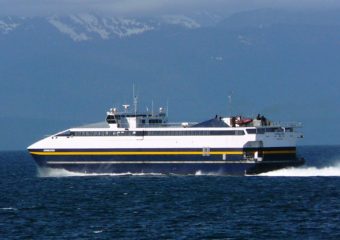
The fast ferry Fairweather sails Chatham Strait. (Photo by Ed Schoenfeld/CoastAlaska.)

looking at alternatives for Sitka, which gets five sailings a week. One option would add staff to the ferry LeConte, so it could run a longer schedule.

They’re also considering options for its two weekly Petersburg sailings, which have attracted less traffic.

The Fairweather will sail to Ketchikan’s Alaska Ship and Drydock under its own power. Neussl says it can operate on three engines.

“Obviously, we can’t be leaking oil all the way down there. If there’s oil in the system and it’s pressurized it’s going to leak. So basically we’ve got to vacate all the oil out of the system and not operate that No. 4 engine on the way down to Ketchikan to get it to the drydock,” he says.

He says about five quarts of oil leaked last week before the hole was discovered. It was cleaned up.

Neussl says the leak is not connected to ongoing engine problems that threaten to sideline the Fairweather and its sister ship, the Chenega.

Those problems are the subject of a lawsuit against the engine manufacturer and ship builder.

The fast ferries each carry up to 250 passengers and 36 vehicles.

A view from the lounge of the Fairweather on route from Juneau to Sitka.
Site notifications
Update notification options
Subscribe to notifications