Ed Schoenfeld, CoastAlaska

Sealaska Corp. expands Seattle-area seafood investments

Orca Bay is Sealaska Corp.'s latest Seattle-based seafood investment. It's merging with Odyssey Enterprises, another processor investment. (Courtesy Orca Bay Seafoods)
Sealaska Corp.’s latest Seattle-based seafood investment Orca Bay is merging with Odyssey Enterprises, another processor investment. (Image courtesy Orca Bay Seafoods)

Sealaska is increasing its investments in Seattle’s seafood-processing industry, as part of the Southeast Alaska regional Native corporation’s effort to boost revenues and increase dividends.

The first investment in the industry came in 2016.

Sealaska bought a minority interest in Independent Packers Corp., a Seattle processor employing about 180 people.

It later purchased a majority stake in Odyssey Enterprises, also based in Seattle and has about 200 workers.

Both do value-added processing, which means they turn seafood into fillets, soups, stews, breaded products and similar items.

The new addition is Orca Bay, based in Renton, about 10 miles southeast of Seattle, makes similar products and has about as many workers.

“The products they have, their customer base, their marketing strategies, their access to resources, all is very complimentary,” said Anthony Mallott, president and CEO of Sealaska, with nearly 23,000 mostly Tlingit or Haida shareholders.

He said Orca Bay is in the process of merging with Odyssey.

“The combination of the two offers not only good scale, but the opportunity to have an expanded customer base and give us a platform where we can continue to build our marketing expertise, try innovative new products and be the beginning of the seafood platform that we envisioned,” he said.

Cliff White, executive editor of the website SeafoodSource, said the acquisitions make Sealaska a medium-sized player in the industry. He said the latest purchase is a good move.

“Orca Bay is renowned for its marketing and its strong ability to connect with customers. It’s a smaller player, but it’s doing things the right way,” he said.

Mallott said it’s Sealaska’s last processing investment for now, but the corporation also plans to purchase Alaska seafood for the plants.

McDowell Group senior seafood analyst Andy Wink said too much of the catch heads overseas.

“To have another buyer out there in the U.S. that’s looking to grow their line of products using fish from Alaska is just another bump in demand,” he said. “Alaska produces something like 5 to 6 billion pounds in harvest volume. So it’s probably relatively minor, but it helps.”

Sealaska Plaza, headquarters of the Southeast regional Native corporation, in Juneau. (Photo by Ed Schoenfeld/CoastAlaska News)

Sealaska’s seafood buys are part of a five-year recovery plan after its construction company lost more than $25 million and other businesses more than doubled that amount in 2013.

With revenues, the loss added up to about $35 million.

Among other things, the plan called for development of businesses closer to Southeast Alaska and the Pacific Northwest, where many shareholders live.

Earlier investments included plastics factories as far away as Alabama and Guadalajara, Mexico.

Mallott said processing is one reason the corporation has been able to boost its businesses’ part of this month’s $11 million shareholder distribution.

“The earnings have improved across the board,” he said. “Natural resources, government services and the new seafood investments are all adding to the earnings that are culminating in this increased dividend.”

The dollar-per-share contribution isn’t a lot, but it’s the largest in the past few years. Earnings from Sealaska’s Marjorie Young Permanent Fund added another 86 cents per share.

But the largest amount comes from natural-resource earnings shared by all 12 regional Native corporations. The amount, $4.10 per share, is down.

“The distribution is driven by oil income from Arctic Slope Regional Corp. So the main driver is the lower oil price,” Mallott said.

Sealaska also pays shareholders a spring dividend. It’s driven, in part, by revenues from the Red Dog zinc mine. That‘s on property owned by the Kotzebue-based NANA Regional Corp.

Read more about the dividends’ breakdown.

Summer ferry schedule changes ships, not routes

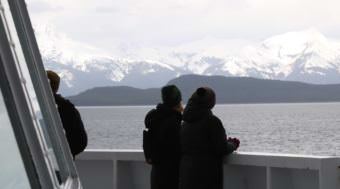
Passengers watch the scenery go by on the ferry Matanuska's forward deck during a May 3, 2017, sailing from Juneau to Haines. (Photo by Aaron Bolton/KSTK)
Passengers watch the scenery go by on the ferry Matanuska’s forward deck during a May 3, 2017, sailing from Juneau to Haines. Next May through September’s schedule just went out for public review. (Photo by Aaron Bolton/KSTK)

The Alaska Marine Highway System will operate without one of its mainline ferries next summer.

But it will be docked for major repairs, not sidelined or put up for sale. Those plans are part of a draft of next summer’s ferry schedule.

State ferry service shrunk in recent years as budgets got tighter because of declining oil revenues and opposition in the Legislature

But a draft of next summer’s schedule could escape that pattern.

“We feel pretty good. We’re about where we were last year,” General Manager Capt. John Falvey said.

He said Alaska ports from Ketchikan to Dutch Harbor, plus Prince Rupert, B.C., and Bellingham, Wash., will mostly see the same service as the past summer.

“There can be some shifting around of that, especially in the winter for the special events: The Gold Medal, the music festivals, the sports teams moving around. And we do our absolute best to cover all that,” he said. “We usually have those things all locked in or at least know what we need to accommodate.”

The state ferry Columbia will soon sail south for repairs to a damaged propeller. That will leave Sitka without marine highway service for two weeks. (Photo by Ed Schoenfeld/CoastAlaska News)
The state ferry Columbia has returned to service after almost a year docked for repairs. It is part of the summer 2018 ferry schedule. (Photo by Ed Schoenfeld/CoastAlaska News)

One change is the return of the ferry Columbia. It’s been out of service for close to a year. A propeller struck an unknown submerged object, probably a log, last fall. It resumed sailing Oct. 29.

Repairs took so long because replacement parts were no longer available, so they had to be built from scratch. The 500-passenger vessel is the largest in the marine highway’s fleet.

“That was paid by our insurance carrier,” he said. “That was in the range of about $3.5 million.”

But another ship will be out of service for the whole summer season. Falvey said the Matanuska, which can carry 450 passengers, will be tied up for some significant improvements.

“We’re completely rebuilding the engine room, right from the engines all the way out to the shafts and propellers and rudders and what not,” he said. “It’s a very major project and it will be gone for about 10 to 11 months.”

He said that work will cost about $32 million. It’s funded by the federal government, with a state match.

Ferry spokeswoman Aurah Landau said this year’s schedule had a similar twist.

“Last summer, the Malaspina was in its overhaul. And the Malaspina and the Matanuska have roughly the same carrying capacities,” she said. “We’re just switching one ship out for what was switched out last year.”

The summer schedule covers May through September 2018, based on a spending plan that’s been reviewed by the governor’s budget office.

But the Legislature makes the final decisions and some powerful lawmakers have pushed for large cuts in recent years.

Falvey said the ferry system hopes to protect the summer schedule, since it will have already taken reservations for some of those sailings.

A sign along Juneau's Glacier Highway points to the Auke Bay Ferry Terminal (Photo by Ed Schoenfeld/CoastAlaska News)
A sign along Juneau’s Glacier Highway points to the Auke Bay Ferry Terminal (Photo by Ed Schoenfeld/CoastAlaska News)

“We would hope that the magnitude wouldn’t be really severe,” he said. “If they weren’t really severe, we feel we could make those adjustments in the winter schedule.”

The marine highway faces other budget challenges this winter and spring.

A provision in an earlier spending plan takes a significant amount of money out of this year’s budget to fill a state health-care funding gap.

Falvey said he’s hoping lawmakers will vote to replace that money. The schedule will be drastically reduced if they don’t.

“If we were further into the season, it would most likely be a complete shutdown,” he said.

The ferry system is asking for feedback on next summer’s schedule. Written remarks are due by Nov. 10 via fax at 907-228-6874 or email at dot.amhs.comments@alaska.gov

A teleconference is planned for Nov. 16. Southeast schedules will be discussed starting at 10 a.m. Southwest and Southcentral schedules follow at 1 p.m. The toll-free number for both teleconferences is 1-515-604-9000, access code 279613.

The teleconference will be hosted at the Alaska Marine Highway Ketchikan office, 7559 North Tongass Highway.

Sealaska to pay $11 million in dividends

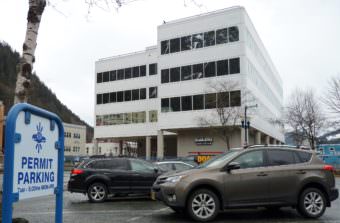
Sealaska's corporate headquarters are in this Juneau building. Nearly 23,000 shareholders will receive their fall dividends mid-November. (Photo by Ed Schoenfeld/CoastAlaska News
Sealaska’s corporate headquarters are in this Juneau building. Nearly 23,000 shareholders will receive their fall dividends mid-November. (Photo by Ed Schoenfeld/CoastAlaska News

Southeast Alaska’s regional Native corporation will distribute close to $11 million to its shareholders Nov. 17.

Juneau-headquartered Sealaska announced the distribution Oct. 27.

Payments will range from $596 to $186 for those with 100 shares. The amount depends on the class of shareholder and other factors.

Sealaska has 22,950 shareholders living in Alaska, the Pacific Northwest and elsewhere.

Operational income will make up $1 per share of the payments. That includes revenues from recently purchased fish processing plants, as well as timber and gravel operations, plus government contracting.

Officials said the amount demonstrates progress in developing its corporate businesses.

“We expect the operations dividend payment to nearly double due to continued growth in net income and cash flow. This will be the first increase in an operations dividend over the last five years,” board Chairman Joe Nelson said in a press release.

Sealaska’s Permanent Fund investment account makes up 86 cents per share.

The largest source, at $4.10 per share, is a pool of natural resource earnings from all 12 regional Native corporations.

Shareholders who are also members of an urban Native corporation, such as Juneau’s Goldbelt, will get the full dividend of $596 for those with 100 shares. That includes the resource pool earnings.

Those who are also members of village Native corporations, such as Kake Tribal, receive $133 for those with 100 shares. They do not include the resource pool earnings. Those go to the village corporation.

Recently enrolled shareholders’ dependents also receive the smaller payments.

Developers say Yakutat-area beach mine looks promising

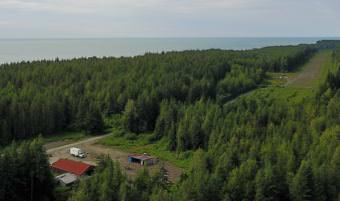
An old airstrip and work camp are being used in the effort to develop mineral deposits at Icy Cape. The Alaska Mental Health Trust Land Office owns the land and mineral rights and is overseeing exploration. (Photo courtesy The Alaska Mental Health Trust Land Office)
An old airstrip and work camp are being used in the effort to develop mineral deposits at Icy Cape. The Alaska Mental Health Trust Land Office owns the land and mineral rights and is overseeing exploration. (Photo courtesy Alaska Mental Health Trust Land Office)

Developers are optimistic about the potential for a beach-sand-mining operation in northern Southeast Alaska.

The Alaska Mental Health Trust Land Office claims good results from its second season of exploring Icy Cape, on the Gulf of Alaska between Yakutat and Cordova.

When mountains erode, they shed tiny particles of rock. They’re washed into streams to be deposited in lakes, deltas or the ocean.

In the Gulf of Alaska, strong waves toss them back on shore to help form beaches.

When those mountains contain veins of rare minerals, those sediments may have enough value to be worth mining.

That’s what’s happening at Icy Cape, where crews are drilling into the beach to see what – and how much — is there.

“There is gold, there’s zircon, there’s garnet, there’s epidote, there’s some platinum,” said Wyn Menefee, acting executive director of the land office of the Alaska Mental Health Trust Authority.

Its Icy Cape property includes about 25 miles of beach, plus forested uplands as wide as 2.5 miles. Those forests cover layers of sand and could be developed.

It’s an isolated area, about 75 miles west-northwest of Yakutat and nearly twice that distance east-southeast of Cordova.

“Right now, we’re in the exploration phase, which is determining what the resource is now, the lay of it … and we’re not at the point of identifying how we’re actually going to mine it,” he said.

About a year ago, the trust’s board allocated $2 million toward the project.

Officials said the new source of income could surpass all of its other efforts, bringing in hundreds of millions of dollars annually.

A work crew of about 16 spent last summer drilling cores from the sands, which stretch as far as 100 feet below the surface in some areas. Menefee said those samples are being analyzed.

The results have caught the attention of potential investors.

“We already have international companies that are interested in the project. They’ve already been visiting the site. They’ve already been trying to check out the resource and trying to see what quality it is,” he said. “This is a continual process.”

Land trust officials will discuss their plans for mining Icy Cape at meetings in two nearby communities.

The first is 6:30 p.m. Nov. 1 at Yakutat High School. The second is 6:30 p.m. Nov. 2 at the Cordova Center.

Gold and platinum’s value is obvious.

The other minerals have industrial uses as sand-sized particles.

The Trust Land Office manages its property to support mental health services for Alaskans.

It usually does that by leasing property or selling resources, such as timber, for others to harvest or extract.

But in this case, the agency is putting its own money into exploration and – possibly – development.

“We could potentially lease it out to an entity. We could lease it out to multiple entities. We could potentially go into a joint venture with entities,” he said. “There’s a lot of options that could be on the table.”

Menefee said further exploration is needed to determine whether there’s enough value to develop.

He expects that to take several more years.

The Alaska Mental Health Trust Land Office is developing its property at Icy Cape, which runs from the beach to the mountains. Logging will begin next year and and a mining projects is in the exploration phase. (Photo courtesy Alaska Mental Health Trust Land Office)
The Alaska Mental Health Trust Land Office is developing its property at Icy Cape, which runs from the beach to the mountains. Logging will begin next year and and a mining project is in the exploration phase. (Photo courtesy Alaska Mental Health Trust Land Office)

Menefee said it will be a placer-mining operation, which sifts through material near the surface, which would impact the environment less than mining into bedrock. It will also take advantage of existing roads, left over from earlier development.

But the potential project still raises concerns, especially about salmon habitat.

“Virtually every river and creek within the proposed area is listed on the anadromous streams catalog,” said Guy Archibald, staff scientist for the Southeast Alaska Conservation Council.

He worries, because a dozen streams and rivers flow through the land that could be mined. Like most nearby waterways, they’re short and their mouths are sometimes protected by sandbars or spits.

Archibald said they’re susceptible to the gulf’s frequent heavy winds and waves.

“I’m just concerned if they start removing these barrier sands, basically strip-mining them, that it’s going to expose the foot of these rivers to massive erosion during the winter storms and create a barrier to fish passage,” he said.

The Mental Health Trust Land Office plans to harvest more than minerals from the site.

It’s sold roughly 50 million board feet of timber to Sealaska Corp., Southeast’s regional Native corporation.

Menefee said he expects Sealaska to begin logging next year.

The property is within the boundaries of the Yakutat Borough. Officials there did not respond to requests for comment by deadline.

A somewhat similar proposal was made by an out-of-state company for mining beach sands in and near Yakutat about six years ago. That effort ended after initial mineral values could not be confirmed.

Editor’s note: KTOO’s building sits on land leased from the Alaska Mental Health Trust Authority. KTOO has also applied for and received occasional grants for special reporting projects from the authority.

Alaska Native tribes unite to oppose mega-mines

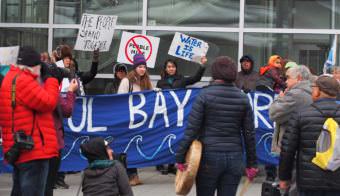
Groups rally against mine development near Dena'ina Convention Center during the Alaska Federation of Natives convention in Anchorage. Southeast and Bristol Bay tribal officials signed an agreement during the convention to combine fisheries-protection efforts. (Photo by Zach Hughes/Alaska Public Media)
Groups rally against mine and other development during the 2017 Alaska Federation of Natives convention in Anchorage. Southeast and Bristol Bay tribal officials signed an agreement during the convention to combine fisheries-protection efforts. (Photo by Zach Hughes/Alaska Public Media)

Tribal groups from opposite ends of the state have formed an alliance to fight mines they say threaten traditional fisheries.
Organizations representing about 30 Southeast Alaska and Bristol Bay tribal governments signed a memorandum of agreement Oct. 18 during the Alaska Federation of Natives convention in Anchorage.

The United Tribes of Bristol Bay opposes Southwest Alaska’s Pebble Mine project. The Southeast Alaska Indigenous Transboundary Commission is critical of mines and exploration projects in British Columbia watersheds that drain into state waters.

Southeast Alaska Indigenous Transboundary Commission Chairman Frederick Olsen Jr., left, and United Tribes of Bristol Bay President Robert Heyano hold canned salmon after signing an agreement Oct. 18. (Photo by  United Tribes of Bristol Bay)
Southeast Alaska Indigenous Transboundary Commission Chairman Frederick Olsen Jr., left, and United Tribes of Bristol Bay President Robert Heyano hold canned salmon after signing an agreement Oct. 18. (Photo by United Tribes of Bristol Bay)

“To combine with several tribes from the other part of the state should send a powerful message to everyone and especially the federal government that we want the federal government to uphold its fiduciary trust responsibility and its government-to-government relationship with its federally recognized tribes,” said Frederick Olsen Jr., who chairs the Southeast coalition.

The organizations agreed to back each other’s efforts to protect their regions’ fisheries, Olsen said.

United Tribes of Bristol Bay President Robert Heyano said what he calls mega-mines are threatening indigenous people.

“Our tribes are under siege, but the unification of our people is a powerful move to defeat these toxic projects,” he said in a news release.

Olsen said the two regional efforts have similar goals, but some differences.

“With our issue, the mines are in a different country. Maybe our fight’s a little more uphill,” he said. “It’s hard to say which one’s harder, of course. The grass is always browner on the other side of the fence in this issue.”

He said the coalition hopes to expand the alliance to tribal groups in other parts of the state.

Developers of mines in both areas say they’re safe and will not damage fish or wildlife habitat.

Correction: A previous version of this story referred to the Alaska Federal of Natives. The name of the organization is Alaska Federation of Natives. This story has been updated to reflect the change.

Talking Trash: Follow the garbage Southeast ships south

Household garbage from Sitka, Ketchikan and three other Southeast Alaska cities ends up in the Roosevelt Regional Landfill in Klickitat County, Washington. (Tom Banse/Northwest News Network)
Household garbage from Sitka, Ketchikan and three other Southeast Alaska cities ends up in the Roosevelt Regional Landfill in Klickitat County, Washington. (Photo by Tom Banse/Northwest News Network)

When you toss a candy wrapper in the trash, you’re sending it on a thousand-mile journey to a Lower 48 landfill. That’s the case if you live in one of five Southeast Alaska communities that send their garbage south via barge, truck and train.

We’ll take you on that trip, beginning in Sitka, as part of the CoastAlaska News series, Talking Trash.

Sitkan Megan Pasternak stands in her kitchen, holding a bag of garbage. So, what’s inside?

“Not much. There’s a couple used paper towels, I hate to admit,” she said. “And some stuff that could be composted because it’s vegetable stuff, but we don’t do that anymore because of the bears around here. And some plastics that I couldn’t recycle and a few odds and ends.”

And does she ever wonder what happens to it after it gets picked up by the trash truck?

“Not really, but I always like garbage day because it goes away from my house and just disappears,” she said, laughing.

Of course, it doesn’t. A garbage truck picks up her trash can, dumps the contents inside and hauls it to a solid-waste transfer station across town.

Jim Walters, with Waste Connections, operates a front-end loader to push trash aboard a container van, staged on the lower level of the Sitka Waste Transfer Station. (Robert Woolsey/KCAW)
Jim Walters with Waste Connections operates a front-end loader to push trash aboard a container van, staged on the lower level of the Sitka Waste Transfer Station. The containers are barged to Seattle. (Photo by Robert Woolsey/KCAW)

There, it and most other Sitka trash is unloaded, shoved into shipping containers and trucked back across town to a barge dock. There, it joins more containers from Sitka and other Southeast towns.

Sitka’s trash has taken that trip since the year 2000, when officials realized they were running out of space.

“The landfill was reaching a level to where it needed a new location. It was becoming a mountain,” said former Sitka City Administrator Hugh Bevan.

He said officials considered building a new dump. But more stringent environmental regulations would have made it extremely expensive.

New landfills have to virtually eliminate polluted runoff. And that’s hard to do in Southeast, where it rains up to 12 feet a year.

“And the idea of shipping waste to an off-island landfill rose to the top as being the most cost-effective over the long term,” Bevan said.

Trash from Southeast Alaska and the Pacific Northwest travel by train from Seattle to the Roosevelt Regional Landfill, near the Columbia River. (Tom Banse/Northwest News Network)
Trash from Southeast Alaska and the Pacific Northwest travel by train from Seattle to the Roosevelt Regional Landfill near the Columbia River. (Photo by Tom Banse/Northwest News Network)

Sitka now barges approximately 8,000 tons of garbage a year south. When added to trash from four other Southeast cities, it totals about 22,000 tons. Another 1,300 tons of regional recycling is shipped the same way.

The approximately 800-mile Alaska Marine Lines barge trip covers long stretches of open water and sometimes rough seas. It takes about 10 days.

After arriving at the barge dock, the containers are loaded onto trucks for a short ride to the Republic Services rail yard, just south of downtown Seattle. Once loaded onto rail cars, they head about 300 miles east to the Roosevelt Regional Landfill in southcentral Washington.

The final destination

That’s where the long journey of southeast Alaska’s trash comes to an end.

The landfill is in a wide bowl a few miles above the Columbia River. It’s bone dry and there’s not a neighbor in sight, which are two key reasons why it’s been so successful in getting contracts with cities near and far.

“It’s under the radar and that’s really the way we like it,” said Don Tibbetts, a Washington state-based manager for Republic Services, which owns the landfill.

“People like the garbage ferries to just take care of the garbage,” he said. “They don’t want to know where it goes. They just want to make sure it is being handled responsibly.”

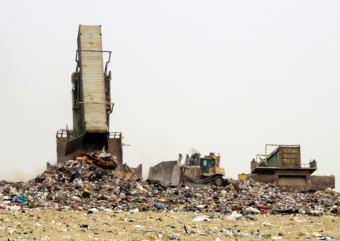
Don Tibbets looks over piles of garbage at the Roosevelt Regional Landfill, where he served as general manager. The landfill takes in about 22,000 tons of Southeast Alaska garbage each year (Photo by Tom Banse/Northwest News Network)
Republic Services’ Don Tibbets looks over piles of garbage at the Roosevelt Regional Landfill, where he served as general manager. The landfill takes in about 22,000 tons of Southeast Alaska garbage each year. (Photo by Tom Banse/Northwest News Network)

Tibbets said the regional landfill business took off when the U.S. Environmental Protection Agency cracked down on polluted runoff from garbage dumps. He said this landfill is “highly engineered” with liners and collection systems to capture and treat whatever harmful liquid does percolate through.

Southeast Alaska’s garbage is not alone. Much of Western Washington’s trash also heads here on trains often stretching more than a mile long.

“More than likely, about 10 percent of the containers you see on the train in front of you has Alaska waste on it,” Tibbets said.

One last truck ride shuttles the garbage containers a short distance uphill to the landfill, where the trash is finally tipped out, compacted and buried.

The decomposing garbage generates landfill gas, or methane. A network of pipes and wells collects that gas and sends it next door to a small power plant to be burned to make electricity. So in a small way, the banana peels and hamburger wrappers Alaskans throw away indirectly light homes in the small towns of southcentral Washington state.

Three other regional landfills are also located along the Columbia River.

Other options

Before Southeast communities started shipping garbage to the Lower 48, they considered a similar option — not so far away.

A group of cities called the Southeast Alaska Solid Waste Authority looked at a chunk of land in Thorne Bay, a former logging camp on Prince of Wales Island’s eastern shore.

City Administrator Wayne Benner heads up the authority’s board.

“That actually was a serious prospect,” he said. “When they first started out they were looking at a regional landfill facility. But when the study was done to look at it, it did not pencil out.”

So Petersburg, Wrangell and Klawock joined Sitka and Ketchikan by hiring Republic Services to haul its garbage south. Benner said Thorne Bay will be next.

It’s always possible that new technology and attitudes will change how the region’s garbage is handled. But ‘til then, Sitka’s Hugh Bevan thinks barging it south is the best solution.

“The thing to keep in mind with solid waste is that you’re responsible for it forever,” he said. “So if you build a landfill in your town, the responsibility for it flows to the next generation, along with all the capital costs associated with it.”

Not every Southeast community ships out its trash. Juneau, with about half of the region’s population, still uses a local landfill. So does Haines.

In both cases, garbage collection and disposal is done by a private company.

Most of Juneau's garbage ends up in the local landfill, operated by Waste Management. A municipal study estimates it will fill up in about 20 years. (Ed Schoenfeld/CoastAlaskaNews)
Most of Juneau’s garbage ends up in the local landfill, operated by Waste Management. A municipal study estimates it will fill up in about 20 years. (Photo by Ed Schoenfeld/CoastAlaskaNews)
Site notifications
Update notification options
Subscribe to notifications